Vehicle Leasing

A comprehensive guide to leasing vehicles and equipment in FS25_UsedPlus.
- Overview
- How to Lease
- Lease Terms
- Lower Monthly Payments
- Residual Value (Balloon Payment)
- Buyout Option
- Return Vehicle
- Damage Penalties
- Credit Impact
- Lease vs Finance
- Tips & Strategies
Leasing is a financing option where you pay to USE a vehicle for a set period, with the option to purchase it at the end of the lease term by paying a final "balloon payment" (the residual value).
Think of it like renting with an option to buy.
| Aspect | Leasing | Financing |
|---|---|---|
| Ownership | Lessor owns, you use | You own immediately |
| Monthly Payment | Lower | Higher |
| Down Payment | 0-20% | 0-50% |
| Final Payment | Residual value (balloon) | None |
| Can Sell? | No - leased until buyout | Yes - anytime |
| Best For | Short-term use, lower payments | Long-term ownership |
WARNING: Leased vehicles CANNOT be sold or traded in until you complete the buyout. The lessor owns the vehicle - you're just using it.
-
Open the Vehicle Shop
- Press the shop icon or visit a dealership
-
Select Your Vehicle
- Browse categories and choose equipment
-
Click "Lease" Button
- Opens the Unified Purchase Dialog
-
Configure Your Lease
- Down Payment: 0-20% (lower max than financing's 50%)
- Term: 1-5 years (custom lease terms)
- See monthly payment update in real-time
-
Review Total Cost
- Monthly payment × term + balloon payment = total cost
- Compare to Cash and Finance options
-
Confirm Lease
- Vehicle is added to your fleet
- Marked as "LEASED" in Finance Manager
- Monthly payments begin automatically
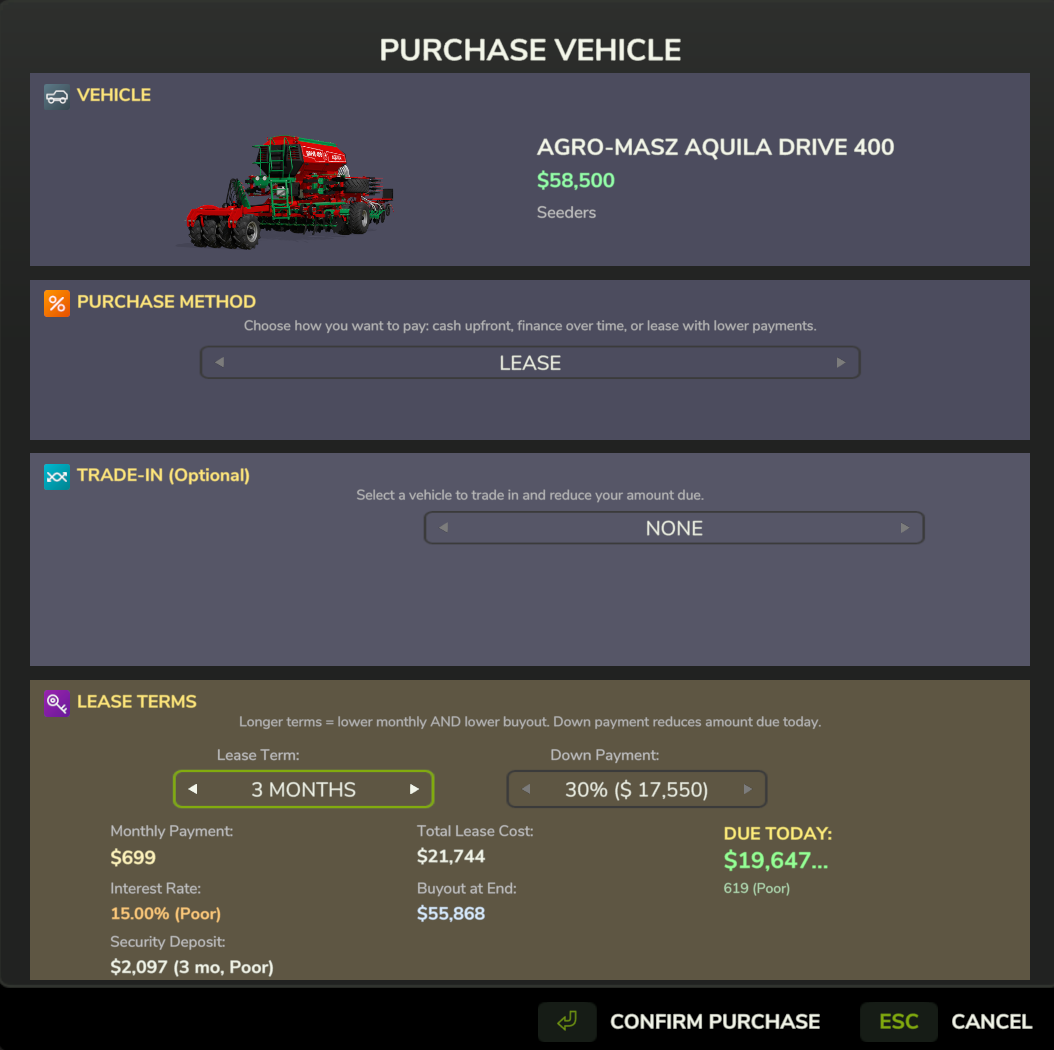
Lease configuration showing lower monthly payments with balloon payment at end of term
You can also view all active leases in the Finance Manager (press Esc → Finance Manager):
- Shows monthly payment, remaining term, balloon amount
- Make early payments
- Initiate early termination or buyout
 Lease Terms
UsedPlus offers flexible lease terms from 1 to 5 years.
| Term | Monthly Payment | Residual Value | Total Interest | Best For |
|---|---|---|---|---|
| 1 year | Highest | 65% of price | Lowest | Short-term projects |
| 2 years | High | 65% of price | Low | Seasonal use |
| 3 years | Moderate | 55% of price | Moderate | Medium-term needs |
| 4 years | Lower | 45% of price | Higher | Multi-year operations |
| 5 years | Lowest | 35% of price | Highest | Long-term use |
The residual value (balloon payment) decreases with longer lease terms:
1-2 years: 65% of original price
3 years:   55% of original price
4 years:   45% of original price
5 years:   35% of original price
Why it matters: Longer leases mean lower balloon payments at the end, making buyout more affordable.
Leasing payments are lower than financing because you're only paying for the depreciation during the lease period, not the full vehicle value.
Scenario: $100,000 Tractor, 10% down payment, 5% interest rate, 3-year term
Principal:         $90,000 (100k - 10k down)
Monthly Payment:   $2,699
Total Payments:    $97,164 (36 months)
Balloon Payment:   $0
───────────────────────────────────
TOTAL COST:        $107,164 (includes down payment)
YOU OWN IT:        After 3 years
Principal:         $90,000 (100k - 10k down)
Residual Value:    $55,000 (55% of 100k for 3-year lease)
Effective Loan:    $35,000 (90k - 55k)
Monthly Payment:   $1,051
Total Payments:    $37,836 (36 months)
Balloon Payment:   $55,000 (to buy at end)
───────────────────────────────────
TOTAL IF BUYOUT:   $102,836 (down + payments + balloon)
YOU OWN IT:        After 3 years + balloon payment
Result:
- Lease monthly payment: $1,051 (61% lower!)
- BUT: Must pay $55k balloon to own it
- Financing total cost: $107,164
- Leasing total cost: $102,836 (saves $4,328 if you buy)
Lower monthly payments come with a tradeoff:
- You don't own the vehicle until you pay the balloon
- You can't sell a leased vehicle
- Early termination has penalties
- Damage at lease end incurs fees
The residual value is the estimated value of the vehicle at the end of the lease term. This is the amount you must pay to purchase (buy out) the leased vehicle.
| Lease Term | Residual % | Example ($100k Tractor) |
|---|---|---|
| 1 year | 65% | $65,000 balloon |
| 2 years | 65% | $65,000 balloon |
| 3 years | 55% | $55,000 balloon |
| 4 years | 45% | $45,000 balloon |
| 5 years | 35% | $35,000 balloon |
At the end of your lease term, you have three options:
- Pay the balloon and own it - Pay residual value in full
- Return the vehicle - Walk away (minus damage fees)
- Extend/refinance - Not currently available (future feature)
Total Lease Cost = Down Payment + (Monthly × Term) + Balloon Payment

Example (3-year, $100k tractor, 10% down):
= $10,000 + ($1,051 × 36) + $55,000
= $10,000 + $37,836 + $55,000
= $102,836
Strategy 1: Pay balloon immediately
- Own the vehicle outright
- Total cost is down + payments + balloon
Strategy 2: Finance the balloon
- Take out a loan for the residual value
- Spreads balloon over additional years
- Converts lease into lease-to-own
Strategy 3: Return the vehicle
- Walk away at lease end
- Only paid down + monthly payments
- Good for equipment you only needed temporarily
At the end of your lease term, you can buy out the vehicle by paying the residual value (balloon payment).
-
Lease Term Ends
- You receive notification that lease is complete
- Vehicle remains in your fleet (grace period)
-
Decide: Buy or Return
- Buy: Pay balloon payment in Finance Manager
- Return: Initiate return (damage fees assessed)
-
After Buyout
- Vehicle ownership transfers to you
- No more monthly payments
- Can now sell or trade the vehicle
- Full ownership benefits
You can buy out a leased vehicle before the lease term ends:
Early Buyout Cost = Remaining Lease Balance + Residual Value + Early Term Fee

Early Term Fee = 10% of remaining lease balance
Scenario: 5-year lease on $100k tractor, 2 years remaining
Remaining Lease Balance:  $25,104 (24 months × $1,046)
Residual Value:           $35,000
Early Termination Fee:    $2,510 (10% of balance)
───────────────────────────────────────
TOTAL EARLY BUYOUT:       $62,614
Compare to:
- Finishing lease + balloon: $60,104 (cheaper by $2,510)
- Early buyout penalty = 10% fee
When to buy early:
- You need to sell the vehicle urgently
- You want to trade it in toward a new purchase
- You found a great deal on a replacement and need cash
You can return a leased vehicle before the term ends, but it comes with penalties.
- Open Finance Manager (press Esc → Finance Manager)
- Select Leased Vehicle
- Click "Terminate Lease"
-
Damage Assessment
- Inspector evaluates vehicle condition
- Damage penalties calculated
-
Pay Termination Fees
- Early termination fee (10% of remaining balance)
- Damage penalties (if applicable)
-
Vehicle is Removed
- Equipment disappears from your fleet
- Returned to lessor
| Fee Type | Amount | Example (3-year, $100k tractor, 1 year left) |
|---|---|---|
| Early Term Fee | 10% of remaining balance | $1,265 (10% × $12,648) |
| Damage Fee | Varies by condition | $0 - $15,000+ |
| TOTAL PENALTY | Both fees combined | $1,265 - $16,265+ |
Good Reasons:
- Equipment no longer needed (project completed)
- Better equipment available (tech upgrade)
- Consolidating fleet (downsizing)
- Cash flow crisis (reduce monthly obligations)
Bad Reasons:
- Minor inconvenience (penalty too high)
- Emotional decision (expensive mistake)
- Haven't checked damage fees first (surprise costs)
If you wait until the lease term expires, you can return the vehicle with no early termination fee - only damage penalties apply.
End-of-Lease Return Cost = Damage Penalties Only

Example:
Vehicle Damage:   15%
Damage Fee:       $3,750 (15% × 25% × $100k)
Early Term Fee:   $0 (lease completed)
───────────────────────────────
TOTAL COST:       $3,750
When returning a leased vehicle, the lessor inspects for damage and charges penalties based on condition.
Damage Fee = Vehicle Damage % × 25% × Original Price

Examples (on $100k tractor):
5% damage:    $1,250 fee
10% damage:   $2,500 fee
20% damage:   $5,000 fee
50% damage:   $12,500 fee
Chargeable Damage:
- Body damage from collisions
- Paint wear and scratches
- Component damage (engine, hydraulic, electrical)
- Tire damage beyond normal wear
Normal Wear (Not Charged):
- Reasonable operating hours for lease term
- Standard tire tread wear within limits
- Minor cosmetic wear from field use
Strategy 1: Maintain the vehicle
- Keep damage below 10% during lease
- Repair damage before lease end
- Costs less than damage fee
Strategy 2: Calculate repair vs. penalty
Scenario: 20% damage on $100k tractor

Option A - Pay damage fee:
$5,000 (20% × 25% × $100k)

Option B - Repair before return:
$5,000 (20% × 25% repair cost)

Result: Usually same cost, but repairing adds value if you're buying out!
Strategy 3: Buy instead of return If damage is high, buying out may be better than returning:
- Return: Pay damage fee + lose vehicle
- Buyout: Pay balloon + keep damaged vehicle (can repair later or sell as-is)
When initiating a return, you receive a detailed inspection report:
LEASE RETURN INSPECTION
─────────────────────────────────────
Vehicle:          John Deere 6R 150
Lease Term:       3 years (completed)
Operating Hours:  850 hours

CONDITION ASSESSMENT:
Body Damage:      18%
Paint Wear:       12%
Engine Health:    85%
Hydraulic Health: 78%
Electrical:       92%

DAMAGE FEES:
Body Damage:      $4,500 (18% × 25% × $100k)
Paint Wear:       $3,000 (12% × 25% × $100k)
Component Wear:   $0 (acceptable condition)
─────────────────────────────────────
TOTAL DUE:        $7,500

OPTIONS:
[Pay & Return]    [Buyout Instead ($55k)]
Lease payments are treated the same as finance payments for credit scoring purposes.
| Action | Credit Impact | Notes |
|---|---|---|
| On-Time Payment | +2 points | Each monthly payment made on time |
| Missed Payment | -45 points | Severe penalty per missed month |
| Early Buyout | +15 points | Treated as "loan paid off early" |
| Early Termination | 0 points | Neutral (not a default) |
| Lease Default | -175 points | 3+ missed payments = seizure |
Leasing is an excellent way to build credit:
Advantages:
- Lower payments = easier to pay on time
- Same credit boost as financing (+5/month)
- Early buyout gives big bonus (+50)
Example Credit Journey:
Starting Credit:    650 (Fair)
Lease Term:         3 years (36 months)
Payment History:    36 on-time payments
Credit Gain:        +180 points (36 × +5)
Early Buyout Bonus: +15 points
─────────────────────────────────────
Ending Credit:      880 (Excellent)
Leasing has the same credit requirements as financing:
| Credit Score | Max Lease Term | Interest Adjustment |
|---|---|---|
| 750+ (Excellent) | 5 years | -1.5% |
| 700-749 (Good) | 5 years | -0.5% |
| 650-699 (Fair) | 5 years | +0.5% |
| 600-649 (Poor) | 5 years | +1.5% |
| <600 (Very Poor) | 5 years | +3.0% |
Note: Unlike vehicle financing (which gates 11-15 year terms behind Good credit), leasing maxes at 5 years for everyone.
Lease if you:
- Need lower monthly payments
- Plan to upgrade equipment regularly
- Aren't sure you'll keep it long-term
- Want to "try before you buy"
- Have seasonal or project-based needs
Examples:
- Seasonal harvester - Lease for harvest season, return afterward
- Tech upgrade cycle - Lease new model every 3 years
- Cash flow management - Lower payments free up capital
- Testing equipment - Use during lease, buy if you love it
Finance if you:
- Want to own the vehicle outright
- Plan to use it for 10+ years
- Need to sell or trade it later
- Want simplest total cost
- Don't want balloon payment surprise
Examples:
- Workhorse tractor - Keep forever, finance over 10-15 years
- Fleet expansion - Own assets, build equity
- Resale value matters - Own to sell when needed
Scenario: $100,000 Tractor, 10% down, 5% interest, 3-year term
Down Payment:      $10,000
Monthly Payment:   $2,699
Total Payments:    $97,164 (36 months)
Balloon Payment:   $0
Final Ownership:   Immediate (after down payment)
Can Sell:          Yes, anytime
─────────────────────────────────────
TOTAL COST:        $107,164
YOU OWN IT:        After 3 years
Down Payment:      $10,000
Monthly Payment:   $1,051
Total Payments:    $37,836 (36 months)
Balloon Payment:   $55,000 (to buy)
Final Ownership:   After balloon paid
Can Sell:          No (until buyout)
─────────────────────────────────────
TOTAL COST:        $102,836 (if buyout)
YOU OWN IT:        After 3 years + $55k
Summary:
- Lease saves $61/month in payments (61% lower!)
- Lease saves $4,328 total if you buy at the end
- But: Can't sell until buyout, must pay balloon
┌─────────────────────────────────────┐
│ Do you KNOW you'll keep it 5+ years?│
└──────────┬──────────────────────────┘
           │
    YES ───┴─── NO
     │           │
     │           │
┌────▼─────┐   ┌▼─────────────┐
│ FINANCE  │   │ Balloon OK?  │
│          │   └┬─────────────┘
│ - Own it │    │
│ - Equity │  YES ─── NO
│ - Resale │   │       │
└──────────┘   │   ┌───▼─────┐
           ┌───▼───┤ FINANCE │
           │ LEASE ├─────────┘
           │       │
           │ - Low │
           │   pay │
           │ - Try │
           └───────┘
The Strategy: Lease equipment, use during lease term, return before it depreciates significantly.
How it works:
Year 1-3:   Lease new $100k tractor ($1,051/month)
Year 3:     Return tractor (minimal damage fees)
Year 3-6:   Lease next-gen model (newer tech)
Year 6:     Repeat cycle

Benefits:
- Always have latest equipment
- No long-term depreciation risk
- Predictable monthly costs
- Tax advantages (lease payments often deductible)
Best for: Large farms with regular equipment turnover needs
The Strategy: Lease used equipment, inspect hidden DNA quality during lease, buy only if it's a workhorse.
How it works:
1. Lease used equipment at lower price
2. During lease: Monitor reliability, check DNA hints
3. If workhorse DNA: Buy at lease end (keep forever)
4. If lemon DNA: Return at lease end (dodge bullet)

Example:
- Lease used $50k tractor (3-year term, $27.5k balloon)
- Use for 1 year, discover it's a lemon (constant repairs)
- Terminate lease early ($500 fee + $1,200 damage)
- Total loss: $13,300 (payments + fees)
- Avoided: $50k+ in long-term lemon ownership!
Best for: Risk-averse buyers who want to test before committing
The Strategy: Make balloon payment your "savings goal" during the lease term.
How it works:
Lease: $100k tractor, 5-year term
Monthly Payment: $1,046
Balloon Payment: $35,000

Savings Plan:
Set aside $585/month in savings (balloon ÷ 60 months)
At lease end: Use saved $35,100 to buy outright
Total monthly cost: $1,631 ($1,046 lease + $585 savings)

Compare to financing:
Finance payment: $1,887/month (5-year term)
Savings: $256/month vs financing
Benefits:
- Lower monthly obligation (flexibility)
- Build savings discipline
- Option to walk away if circumstances change
Best for: Disciplined savers who want flexibility
The Strategy: Lease specialized equipment for specific projects, return when done.
How it works:
Project: Clearing 50 acres of forest
Equipment Needed: $150k forestry mulcher
Project Duration: 6 months

Option A - Buy:
Purchase: $150,000
Use: 6 months (500 hours)
Resell: ~$120,000 (20% depreciation)
Net Cost: $30,000 + hassle

Option B - Lease (1-year term):
Down: $15,000 (10%)
Monthly: ~$3,800 × 6 = $22,800
Early Term: $2,280 (10% fee on remaining 6 months)
Damage Fee: $1,500 (minimal wear)
Net Cost: $41,580

Option C - Lease (2-year term):
Down: $15,000
Monthly: ~$2,100 × 6 = $12,600
Early Term: $1,890 (10% fee)
Damage Fee: $1,500
Net Cost: $30,990 (close to buying!)

Verdict: 2-year lease is best - similar cost to buying/selling but no resale hassle
Best for: One-time projects, specialized equipment
The Strategy: Use leases to rapidly build credit score through consistent payments.
How it works:
Starting Credit: 580 (Very Poor)
Strategy: Lease 3 smaller items with short terms

Lease 1: $20k trailer, 1-year term
  Monthly: $600
  Credit gain: +60 points (12 payments)

Lease 2: $30k implement, 2-year term
  Monthly: $800
  Credit gain: +120 points (24 payments)

Lease 3: $50k tractor, 3-year term
  Monthly: $1,200
  Credit gain: +180 points (36 payments)

After 3 years:
  Total Credit Gain: +360 points
  New Credit Score: 940 (capped at 850)
  Actual Score: 850 (Excellent)

Benefits:
- Unlocked 15-year financing terms
- -1.5% interest rate discount
- Access to premium equipment
Best for: New farms building credit from scratch
The Strategy: View the lease payment as paying for the OPTION to buy, not a commitment.
How it works:
Traditional Mindset:
"I'm paying $1,051/month toward owning this tractor"

Option Premium Mindset:
"I'm paying $1,051/month for:
  - Use of this equipment NOW
  - Right to buy for $55k later
  - Ability to walk away if better tech emerges
  - Flexibility if farm needs change"

Real Scenario:
Year 1-2: Use leased tractor
Year 2: New model released (20% more efficient)
Decision: Return leased tractor, lease new model
Result: Always have best equipment, minimal sunk cost
Best for: Tech enthusiasts, efficiency optimizers
The Strategy: Repair strategically before lease end to minimize penalties.
When to repair:
Damage Level: 15% ($3,750 penalty on $100k tractor)
Repair Cost: 15% × 25% × $100k = $3,750

Decision Matrix:

IF returning:
  Repair cost ≈ Penalty → Doesn't matter (choose cheaper)

IF buying out:
  ALWAYS repair before buyout
  Reason: Repair adds value you'll own

Example:
  Buyout price: $55,000
  Damage: 20% ($5,000 penalty)

  Option A - Buyout as-is:
    Pay: $55,000
    Own: Damaged tractor (worth $50k)
    Net: -$5,000 (overpaid)

  Option B - Repair then buyout:
    Repair: $5,000
    Buyout: $55,000
    Own: Good tractor (worth $55k)
    Net: $0 (fair deal)
Best for: Anyone planning to buy at lease end
The Strategy: Use leasing to match equipment costs to revenue cycles.
How it works:
Farming Revenue Pattern:
  Planting (Spring):    Heavy expenses, no revenue
  Growing (Summer):     Low expenses, no revenue
  Harvest (Fall):       High expenses, HIGH revenue
  Off-Season (Winter):  Minimal activity

Traditional Purchase Problem:
  Tractor purchase: $100k upfront (spring)
  Cash flow: NEGATIVE $100k when you can least afford it

Leasing Solution:
  Down payment: $10k (spring)
  Monthly: $1,051 spread over 12 months
  Cash flow: NEGATIVE $10k spring, then manageable monthly

Revenue Match:
  Harvest revenue: $200k (fall)
  Use surplus to:
    - Cover 6 months payments in advance
    - Save for next year's down payment
    - Build balloon payment fund
Best for: Farms with seasonal cash flow
The Strategy: Lease before committing to a major brand/model decision.
How it works:
Scenario: Choosing between Brand A and Brand B for $120k tractor

Option 1 - Buy Brand A:
  Risk: $120k commitment
  Problem: Might prefer Brand B after using it

Option 2 - Lease Brand A (1 year):
  Cost: ~$3,500/month × 12 = $42,000
  After 1 year:
    - LOVE IT? → Buy out for $78k (total $120k)
    - HATE IT? → Return, lease Brand B instead

  Trial cost: $42k to avoid $120k mistake
Best for: First-time buyers, brand switchers
The Strategy: Lease equipment, generate revenue, use profits to buy better equipment.
How it works:
Year 1:
  Lease: $50k used baler (low payment)
  Revenue: Custom baling for neighbors
  Profit: $15k/year

Year 2:
  Continue lease ($12k/year payments)
  Profit: $15k
  Net: +$3k

Year 3:
  Accumulated profit: $9k
  Lease end: $27.5k balloon
  Decision: Return baler, use $9k + loan for NEW $80k baler

Result:
  - Bootstrapped from $50k used to $80k new
  - Minimal personal capital invested
  - Revenue paid for upgrade
Best for: Custom work operators, contractors
When to Lease:
- Lower monthly payments needed
- Short-term or seasonal use
- Testing equipment before buying
- Want flexibility to upgrade
When to Finance:
- Long-term ownership (5+ years)
- Need to own/sell the asset
- Avoid balloon payment complexity
- Simplest total cost structure
Key Leasing Facts:
- Monthly payments 40-60% lower than financing
- Cannot sell until buyout completed
- Damage penalties on return
- Same credit impact as financing
- Balloon payment required to own
Critical Formula:
Total Lease Cost = Down + (Monthly × Term) + Balloon + Damage Fees

Example:
= $10k + ($1,051 × 36) + $55k + $1,500
= $104,336 total cost to own via lease
Last Updated: 2026-02-18 Version: 2.15.0
For more information, see: