Vehicle Financing

Transform how you acquire equipment on your farm
Vehicle Financing in UsedPlus replaces the vanilla "buy or lease" dichotomy with a realistic financing system that mirrors real-world farm equipment loans. Instead of paying full price upfront or being locked into a lease, you can finance any vehicle or implement with flexible terms ranging from 1 to 15 years.
- Overview
- How to Finance a Vehicle
- Loan Terms
- Down Payment
- Interest Rates
- Monthly Payments
- Early Payoff
- Ownership & Flexibility
- Credit Score Impact
- Finance vs Lease Comparison
- Tips & Strategies
Vehicle Financing allows you to purchase equipment by paying a down payment (0-50% of the price) and spreading the remaining cost over monthly installments. Unlike leasing, you own the vehicle immediately and can modify, sell, or trade it at any time.
- Preserve Cash Flow - Keep capital available for seeds, fertilizer, and operations
- Scale Faster - Acquire equipment sooner rather than waiting to save full price
- Build Credit - On-time payments improve your credit score, unlocking better terms in the future
- Flexibility - Pay extra when cash is good, or make minimum payments during tight months
| Aspect | Vanilla FS25 | UsedPlus Financing |
|---|---|---|
| Payment Options | Buy outright or lease | Buy, finance, or lease |
| Ownership | Immediate (buy) or deferred (lease) | Immediate ownership |
| Terms | Fixed lease duration | 1-15 year flexible terms |
| Credit Impact | None | Builds or damages credit score |
| Early Exit | Lease penalties | Payoff anytime, save interest |
| Sell Anytime | Yes (buy) or No (lease) | Yes - you own it |
-
Open the Shop and browse to any vehicle or implement
-
Click the vehicle to view details
-
Click "Finance" button (replaces vanilla "Buy" if override enabled, or separate button)
-
Unified Purchase Dialog opens with three tabs:
- Cash (pay full price)
- Finance (what we're here for!)
- Lease (balloon payment option)
-
Configure Your Finance Deal:
- Down Payment: Slider from 0% to 50%
- Loan Term: Dropdown from 1 to 15 years (credit-gated)
- Trade-In (optional): Apply old equipment value toward purchase
-
Review the Summary:
- Monthly payment amount
- Total interest paid over life of loan
- Total cost (principal + interest)
- Your credit score and interest rate
-
Click "Confirm" to complete the purchase
-
Vehicle is yours immediately - drive it off the lot!
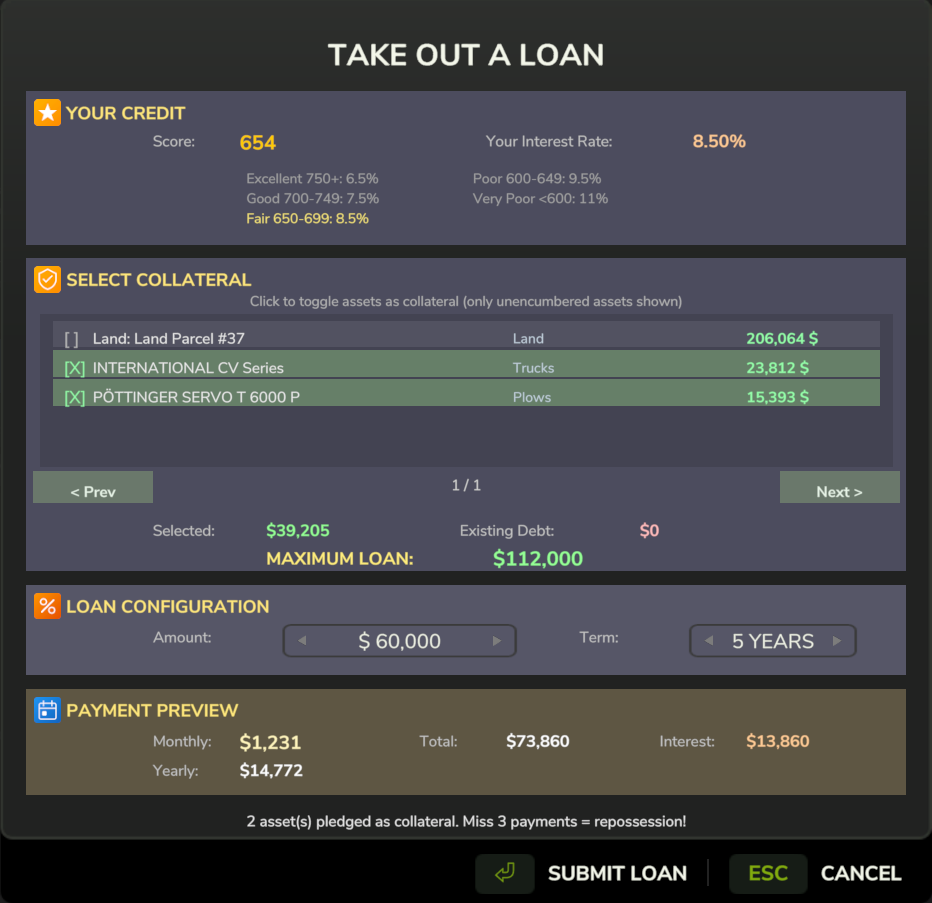
Finance tab showing loan configuration with down payment, term selection, and monthly payment calculation
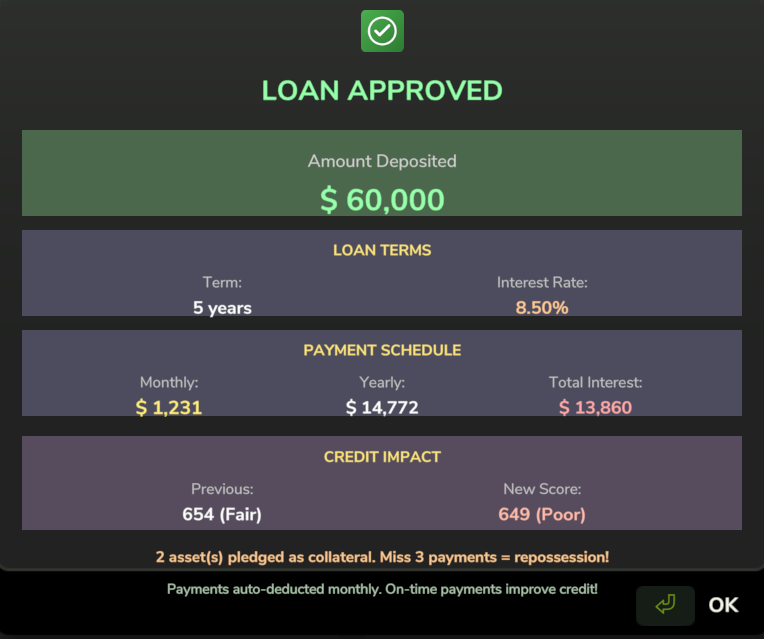
Loan approval confirmation with deal summary and next steps
- U - Open Used Search dialog (from shop)
- Esc → Finance Manager - Open Finance Manager (anywhere)
 Loan Terms
Vehicle financing offers terms from 1 year to 15 years, but longer terms are credit-gated to ensure you have the financial stability to handle extended debt.
| Term Range | Credit Requirement | Monthly Payment | Total Interest | Use Case |
|---|---|---|---|---|
| 1-5 years | Any credit score | High | Low | Short-term needs, good cash flow |
| 6-10 years | Fair (650+) | Moderate | Moderate | Balanced approach |
| 11-15 years | Good (700+) | Low | High | Maximize cash flow, long-term assets |
Your credit score doesn't just affect your interest rate - it also gates what financing options are available to you:
| Credit Rating | Score Range | Max Term | Min Down Payment | Interest Modifier |
|---|---|---|---|---|
| Excellent | 750-850 | 15 years | 0% (no down payment required!) | -1.5% |
| Good | 700-749 | 15 years | 5% | -0.5% |
| Fair | 650-699 | 10 years | 10% | +0.5% |
| Poor | 600-649 | 5 years | 20% | +1.5% |
| Very Poor | <600 | 5 years | 25% (must have skin in game) | +3.0% |
Key Insights:
- Term gating prevents over-leveraging: New farmers can't take on 15-year debt they can't afford
- Down payment minimums ensure you have capital investment: Banks want to see you have "skin in the game"
- Excellent credit unlocks 0% down: This is the "gold standard" - banks trust you completely
Important: Land financing can extend up to 20 years with Good credit (see Land Financing for details).
Example: $100,000 Tractor, 10% down ($90,000 financed), 8.5% APR (Fair credit)
| Term | Monthly Payment | Total Interest | Total Paid | Monthly Cash Flow Impact |
|---|---|---|---|---|
| 3 years | $2,843 | $12,348 | $112,348 | High impact, quick payoff |
| 5 years | $1,844 | $20,640 | $120,640 | Moderate impact |
| 10 years | $1,115 | $43,800 | $133,800 | Low impact, expensive |
| 15 years | $887 | $69,660 | $159,660 | Very low impact, very expensive |
Strategy Tip: Shorter terms save money but require higher monthly payments. Choose based on your farm's cash flow, not just what you qualify for.
You can finance up to 100% of the purchase price (0% down with Excellent credit) or reduce your loan with a down payment of up to 50%.
Important: Your minimum down payment is determined by your credit score:
- Excellent (750+): 0% minimum - can finance 100% if desired
- Good (700-749): 5% minimum
- Fair (650-699): 10% minimum
- Poor (600-649): 20% minimum
- Very Poor (<600): 25% minimum - must show commitment
Example: $100,000 Tractor, 5 year term, 8.5% APR (Fair credit, average down payment)
| Down Payment | Amount Financed | Monthly Payment | Total Interest | Total Cost |
|---|---|---|---|---|
| 0% ($0) | $100,000 | $2,052 | $23,120 | $123,120 |
| 10% ($10,000) | $90,000 | $1,847 | $20,820 | $120,820 |
| 25% ($25,000) | $75,000 | $1,539 | $17,340 | $117,340 |
| 50% ($50,000) | $50,000 | $1,026 | $11,560 | $111,560 |
| Situation | Recommended Down Payment | Reason |
|---|---|---|
| Starting Out | 0-10% | Preserve cash for operations |
| Stable Income | 20-30% | Balance cash flow and interest savings |
| Strong Cash Position | 40-50% | Minimize interest, build equity fast |
| Credit Building | 10-20% | Manageable debt-to-asset ratio |
Pro Tip: If you have excellent credit and low monthly obligations, financing at 0% down lets you invest that capital elsewhere (land, livestock, supplies) while paying minimal interest.
 Interest Rates
UsedPlus uses realistic interest rates that vary by loan type and credit score. Vehicle financing starts with a base rate that's higher than land loans (vehicles depreciate, land appreciates).
| Loan Type | Base Rate | Reason |
|---|---|---|
| Vehicle Financing | 8.0% | Depreciating asset, higher risk |
| Land Financing | 7.0% | Appreciating asset, lower risk |
| General Loans | 8.0% | Unsecured, same as vehicles |
Note: Base rates can be adjusted in mod settings. These are the default values.
Your credit score directly affects your interest rate through a modifier applied to the base rate:
| Credit Rating | Score Range | Interest Modifier | Effective Rate (Vehicle) |
|---|---|---|---|
| Excellent | 750-850 | -1.5% | 6.5% |
| Good | 700-749 | -0.5% | 7.5% |
| Fair | 650-699 | +0.5% | 8.5% |
| Poor | 600-649 | +1.5% | 9.5% |
| Very Poor | <600 | +3.0% | 11.0% |
Note: Additional adjustments apply based on term length (0% to +1.5%) and down payment (-1.0% to +1.0%), so your actual rate may vary from these base effective rates.
Example: $100,000 Tractor, 0% down, 10 year term (base rates, no term/down payment adjustments)
| Credit Score | Interest Rate | Monthly Payment | Total Interest | Difference vs Excellent |
|---|---|---|---|---|
| 800 (Excellent) | 6.5% | $1,136 | $36,320 | - |
| 720 (Good) | 7.5% | $1,187 | $42,440 | +$6,120 |
| 670 (Fair) | 8.5% | $1,239 | $48,680 | +$12,360 |
| 620 (Poor) | 9.5% | $1,292 | $55,040 | +$18,720 |
| 550 (Very Poor) | 11.0% | $1,379 | $65,480 | +$29,160 |
Key Insight: A Very Poor credit score costs you $29,160 more in interest over 10 years compared to Excellent credit. Building credit is worth real money!
Note: Actual rates may be slightly different due to term length and down payment adjustments. Use the in-game finance dialog for exact calculations.
UsedPlus uses amortized loan calculations, the same method used by real banks:
Formula:
M = P × [r(1 + r)^n] / [(1 + r)^n - 1]

Where:
M = Monthly payment
P = Principal (amount financed)
r = Monthly interest rate (annual rate ÷ 12)
n = Number of months
What This Means for You:
- Early payments are mostly interest, later payments are mostly principal
- Paying extra early in the loan saves the most interest
- Your monthly payment stays the same, but the split between interest and principal changes over time
Payments are automatically deducted from your farm account on the 1st in-game day of each month at approximately 6:00 AM.
Important: If you don't have sufficient funds, you'll miss the payment, which damages your credit score and starts the seizure countdown.
Every monthly payment is split between interest (what the bank charges you) and principal (what reduces your loan balance).
Example: $100,000 loan at 8.5% APR (Fair credit), 5 year term
| Month | Monthly Payment | Interest Paid | Principal Paid | Remaining Balance |
|---|---|---|---|---|
| 1 | $2,052 | $708 | $1,344 | $98,656 |
| 6 | $2,052 | $675 | $1,377 | $92,240 |
| 12 | $2,052 | $625 | $1,427 | $83,160 |
| 24 | $2,052 | $498 | $1,554 | $61,360 |
| 36 | $2,052 | $356 | $1,696 | $38,040 |
| 48 | $2,052 | $201 | $1,851 | $13,240 |
| 60 | $2,052 | $14 | $2,038 | $0 |
Notice: In month 1, only $1,344 goes toward your loan balance. By month 60, almost the entire payment ($2,038) reduces the balance. This is why paying extra early saves the most money.
You can view your full amortization schedule in the Finance Manager:
- Open Finance Manager (press Esc → Finance Manager)
- Click any finance deal
- Click "View Details"
- See month-by-month breakdown
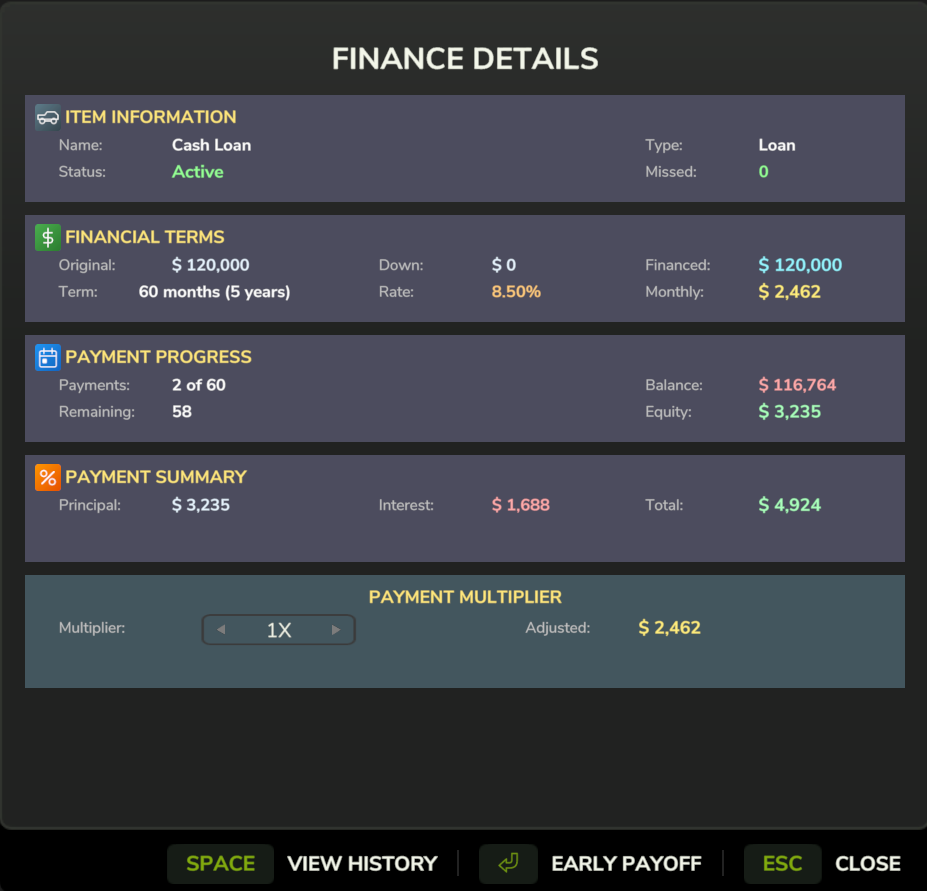
Detailed finance deal view showing loan terms, interest rate, and payment configuration options
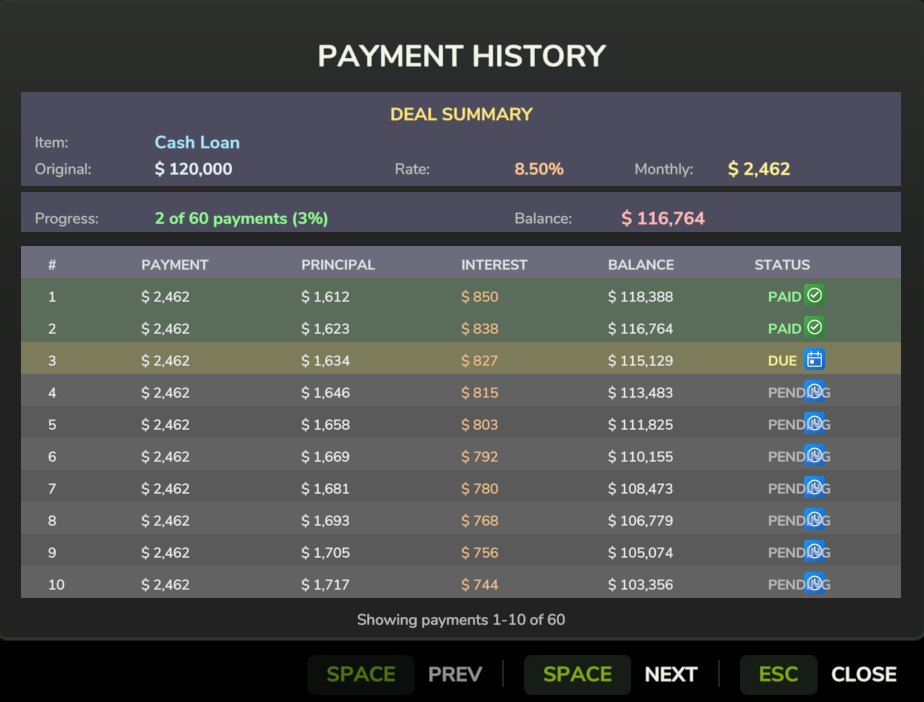
Complete amortization schedule showing monthly breakdown of principal vs interest payments
UsedPlus allows you to customize your payment amount for each loan independently. See Payment Configuration for full details.
Quick summary of options:
| Payment Type | Description | Credit Impact |
|---|---|---|
| Skip | No payment, balance grows (negative amortization) | -45 points |
| Minimum | Interest-only payment, balance unchanged | 0 points |
| Standard | Original amortized payment | +2 points |
| 1.5x Extra | 50% extra reduces principal faster | +2 points |
| 2x Extra | Double payment for aggressive payoff | +2 points |
| Custom | Set any amount ≥ minimum | Varies |
Unlike some real-world loans with prepayment penalties, UsedPlus financing has NO prepayment penalty. Paying off your loan early:
- Saves Interest - Stop paying interest immediately
- Improves Credit - +50 credit score bonus
- Frees Up Debt Capacity - Lower debt-to-asset ratio unlocks better terms
- Reduces Monthly Obligations - More cash flow flexibility
- Open Finance Manager (press Esc → Finance Manager)
- Click the finance deal you want to pay off
- Click "Pay Early" button
- Select "Pay Off Loan" option
- Confirm payment
Alternative: Make extra payments over time using the "2x Extra" or "Custom" payment options.
Scenario: $100,000 loan at 8.5% APR (Fair credit), 10 year term, paid off after 3 years
| If You Pay... | Total Interest Paid | Interest Saved | Credit Bonus |
|---|---|---|---|
| Full 10 years | $48,680 | - | +5 per payment |
| Payoff after 3 years | $14,760 | $33,920 saved | +50 bonus |
- Year 1-2: Finance a $50k implement at Fair credit (8.5% APR)
- Build Credit: Make on-time payments, score rises from 650 → 720
- Year 3: Take out a new loan at Good credit (7.5% APR) to pay off the old loan
- Result: Lower interest rate on remaining balance, +50 payoff bonus, improved cash flow
When you finance a vehicle, you own it immediately. This is fundamentally different from leasing:
| Aspect | Financed Vehicle | Leased Vehicle |
|---|---|---|
| Ownership | You own it | Dealership owns it |
| Sell Anytime | Yes | No (lease must end) |
| Trade-In | Yes | No |
| Modifications | Unlimited | None |
| Damage Penalties | None | Yes (at lease end) |
| Balloon Payment | None | Yes (residual value) |
- Sell It - Loan balance must be paid from sale proceeds, you keep the rest
- Trade It In - Trade-in value applied toward new purchase, loan paid off
- Modify It - Paint, tires, attachments - it's yours
- Repair It - Finance repairs if needed (see FAQ - Repairs)
- Let It Sit - No usage requirements, payments continue regardless
If you sell a vehicle that still has a finance balance:
- Sale proceeds pay off the loan balance first
- Remaining funds go to you
- If sale < balance: You must pay the difference (negative equity)
Example:
- Vehicle sells for $60,000
- Finance balance: $45,000
- You receive: $15,000 ($60k - $45k)
Negative Equity Example:
- Vehicle sells for $30,000
- Finance balance: $45,000
- You must pay: $15,000 from pocket ($45k - $30k)
Strategy Tip: Don't finance 100% of a rapidly depreciating vehicle unless you plan to keep it long-term. You can end up "underwater" (owing more than it's worth).
Every financial decision you make with vehicle financing impacts your credit score, which in turn affects your future financing options.
| Action | Credit Impact | Notes |
|---|---|---|
| On-Time Payment | +2 points | Each month you pay on time |
| Pay Off Loan Early | +50 points | One-time bonus |
| Extra Payment | +5 points | Same as standard payment |
| Action | Credit Impact | Notes |
|---|---|---|
| Skip Payment | -25 points | Balance grows (negative amortization) |
| Missed Payment | -25 points | Insufficient funds, not intentional skip |
| Asset Seized | -100 points | 3 missed payments triggers seizure |
Scenario: New farmer starts at 650 (Fair) credit
| Month | Action | Credit Change | New Score |
|---|---|---|---|
| 0 | Start | - | 650 |
| 1-12 | On-time payments (×12) | +60 | 710 |
| 12 | Pay off small loan early | +50 | 760 |
| 13-24 | On-time payments (×12) | +60 | 820 |
Result: After 2 years of responsible financing, farmer goes from Fair (650) to Excellent (820), unlocking:
- 15-year vehicle terms (vs 10-year max before)
- 20-year land terms (vs denied before)
- Interest rate drops from 5.0% to 3.0% (saves thousands!)
| Credit Rating | Score | Vehicle Term | Land Term | Interest Modifier | Loan Approval |
|---|---|---|---|---|---|
| Excellent | 750+ | 15 years | 20 years | -1.5% | Easy approval |
| Good | 700-749 | 15 years | 20 years | -0.5% | Approved |
| Fair | 650-699 | 10 years | 15 years | +0.5% | Approved |
| Poor | 600-649 | 5 years | 10 years | +1.5% | Conditional |
| Very Poor | <600 | 5 years | Denied | +3.0% | High denial risk |
Your debt-to-asset ratio is the primary factor in credit scoring (see Credit Scoring for full details). Vehicle financing affects this ratio:
Debt-to-Asset Ratio = Total Debt / Total Assets

Where:
Total Debt = All active loan balances (vehicles, land, cash loans)
Total Assets = Owned vehicles + owned land (at market value)
Strategy: Keep your ratio below 0.50 (50%) for Good credit, below 0.30 (30%) for Excellent credit.
| Factor | Finance | Lease |
|---|---|---|
| Ownership | Immediate | At lease end (after balloon) |
| Down Payment | 0-50% | 0-20% |
| Monthly Payment | Higher | Lower |
| Can Sell? | Yes | No |
| Can Trade-In? | Yes | No |
| Damage Penalties | No | Yes (at end) |
| Total Cost | Principal + Interest | Principal + Interest + Balloon |
| Credit Building | Yes | Yes |
| Early Exit | Anytime, no penalty | Termination fee |
| Best For | Long-term ownership | Short-term use, upgrade soon |
Scenario: $100,000 Tractor, 5 year term, 5% APR
- Down payment: $25,000
- Amount financed: $75,000
- Monthly payment: $1,416
- Total payments over 5 years: $84,960
- Total cost: $109,960 (down + payments)
- You own it free and clear
- Down payment: $10,000
- Residual value (balloon): $55,000 (55% of price)
- Amount financed: $35,000 ($100k - $10k down - $55k residual)
- Monthly payment: $662
- Total payments over 5 years: $39,720
- Balloon payment at end: $55,000
- Total cost: $104,720 (down + payments + balloon)
- You own it if you pay balloon
Difference: Lease costs $5,240 less over 5 years, but requires $55,000 cash at the end to keep the vehicle.
Choose Finance when:
- You plan to keep the equipment long-term (10+ years)
- You want immediate ownership and flexibility
- You have steady cash flow to handle higher monthly payments
- You want to build equity in the equipment
- You plan to sell or trade-in within the term
Choose Lease when:
- You plan to upgrade frequently (every 3-5 years)
- You want lower monthly payments to preserve cash flow
- You have lumpy income (harvest sales) and can pay balloon at end
- You want to test equipment before committing
- You expect equipment value to hold (residual value stays high)
- Year 1: Lease a $50k implement with $10k down, $400/month
- Year 3: Pay balloon ($27.5k), own outright
- Year 3: Lease a $100k tractor with $20k down, $800/month
- Year 6: Pay balloon ($55k), own outright
- Result: Own $150k in equipment, paid over 6 years, preserved cash flow early on
Goal: Start with small loans to build credit, then upgrade to larger equipment with better terms.
- Month 1: Finance a $20k implement at Fair credit (5% APR), 3 year term
- Months 1-36: Make on-time payments (+5 each month = +180 points)
- Month 36: Pay off early (+50 bonus) - Credit rises from 650 → 880 (capped at 850)
- Month 37: Finance a $150k tractor at Excellent credit (3% APR), 15 year term
- Result: Save $30k+ in interest over life of tractor loan
Key Insight: Don't rush into massive debt at poor credit terms. Build up first.
Goal: Use harvest proceeds to make large principal reductions annually.
- Finance equipment with standard monthly payments
- During growing season: Pay minimum or standard amount
- After harvest: Make custom payment of $20k-50k (harvest proceeds)
- Result: Drastically reduce interest paid, own equipment in 2-4 years instead of 10-15
Example:
- $100k loan at 8.5% APR (Fair credit), 10 year term
- Standard plan: $1,239/month, $48,680 total interest
- Harvest plan: $1,239/month + $30k/year harvest payment
- Result: Paid off in 3 years, only $14,760 interest - $33,920 saved
Goal: Acquire multiple pieces of equipment quickly with minimal upfront capital.
Situation: You have $50k cash. You need a $100k tractor, $50k harvester, and $30k planter.
Option A: Traditional (Buy Outright)
- Buy $50k harvester with cash
- Wait years to save for tractor and planter
- Result: Limited operation scale, slow growth
Option B: Finance Everything (0% down at Fair credit, 8.5% APR)
- Finance $100k tractor: $2,052/month (5 years)
- Finance $50k harvester: $1,026/month (5 years)
- Finance $30k planter: $616/month (5 years)
- Total monthly: $3,694
- Cash remaining: $50k (for seeds, fuel, operations)
- Result: Full operation from day one, high productivity
Risk: High monthly obligations. Ensure your farm revenue exceeds $4.5k/month to cover payments + operations.
Goal: Continuously upgrade equipment using trade-in value, building equity over time.
- Year 1: Finance $50k tractor (100% financing)
- Year 3: Tractor worth $40k, owe $25k - $15k equity
-
Year 3: Trade in for $80k tractor:
- Trade-in value: $25k (pays off old loan)
- Finance remaining: $55k ($80k - $25k)
- New monthly: Lower than before (financing less than original $50k)
- Year 6: Repeat with $120k tractor
- Result: Always have newer equipment, equity compounds
Key Insight: Equity builds fastest in the first half of the loan. Trade-in every 2-3 years to maximize this effect.
Goal: Balance cash flow by mixing short-term and long-term loans.
Scenario: You need $200k in equipment.
Option A: All Long-Term (10 years)
- Finance $200k at 10 years: $2,122/month
- Problem: High total interest ($54,640), slow equity build
Option B: All Short-Term (3 years)
- Finance $200k at 3 years: $6,048/month
- Problem: Crushing monthly payment
Option C: Mixed Portfolio (Fair credit, 8.5% APR base)
- Tractor ($100k): 10 year term, $1,239/month - Keep long-term
- Harvester ($60k): 5 year term, $1,231/month - Pay off mid-term
- Planter ($40k): 3 year term, $1,274/month - Pay off quickly
- Total Year 1-3: $3,744/month
- Total Year 4-5: $2,470/month (planter paid off)
- Total Year 6-10: $1,239/month (harvester paid off)
- Result: Manageable payments early, declining obligations over time
Key Insight: Finance depreciating assets (harvesters, specialty equipment) short-term. Finance workhorses (tractors) long-term.
Goal: Lower your interest rate by paying off old loans with new loans at better terms.
- Start: $100k loan at Fair credit (8.5% APR), 10 years remaining, $60k balance
- After 3 years: Credit rises to Good (7.5% APR)
- Refinance: Take new $60k loan at 7.5% APR, pay off old loan
-
Result:
- Old loan: $1,239/month for 7 more years = $104,076 total
- New loan: $1,193/month for 7 years = $100,212 total
- Savings: $3,864
- Bonus: +50 credit for early payoff
When to Refi: When your credit score improves by 50+ points.
| Mistake | Why It's Bad | Solution |
|---|---|---|
| 100% financing on depreciating assets | Can end up underwater (owe more than it's worth) | Put 10-20% down on harvesters and specialty equipment |
| Maxing out term length | Minimizes payment but maximizes interest | Choose shortest term you can comfortably afford |
| Ignoring credit impact | Miss payments tanks credit, costs thousands in future interest | Set aside payment buffer, prioritize on-time payments |
| Buying too much too soon | High debt-to-asset ratio denies future loans | Start small, build credit, scale up gradually |
| Not reviewing amortization | Don't realize how much goes to interest early on | Make extra payments in first 2-3 years to save most |
| Financing consumables | Seeds, fuel, etc. don't build equity | Use cash for consumables, finance only capital assets |
- Credit Scoring - Full credit system explanation
- Vehicle Leasing - Vehicle leasing with balloon payments
- Land Financing - Finance farmland purchases
- Payment Configuration - Customize payment amounts
- Early Payoff - Interest savings and credit bonuses
- Trade-In System - Trade old equipment toward new purchases
- Quick Start Guide - Getting started with the Finance Manager
Built with Claude and Samantha - AI-powered farming simulation