Rocket Launch Simulation
RocketPy (6-DOF) + custom orbital mechanics solver + trajectory optimization + powered descent guidance.
| Simulation | Tool | Launch Site | Result |
|---|---|---|---|
| Calisto (HPR) | RocketPy 6-DOF | Spaceport America, NM | Apogee 3,305 m, Mach 0.86 |
| H3-Inspired Sounding | RocketPy 6-DOF | Tanegashima (Yoshinobu LP-2) | Apogee 3,341 m, Mach 0.87 |
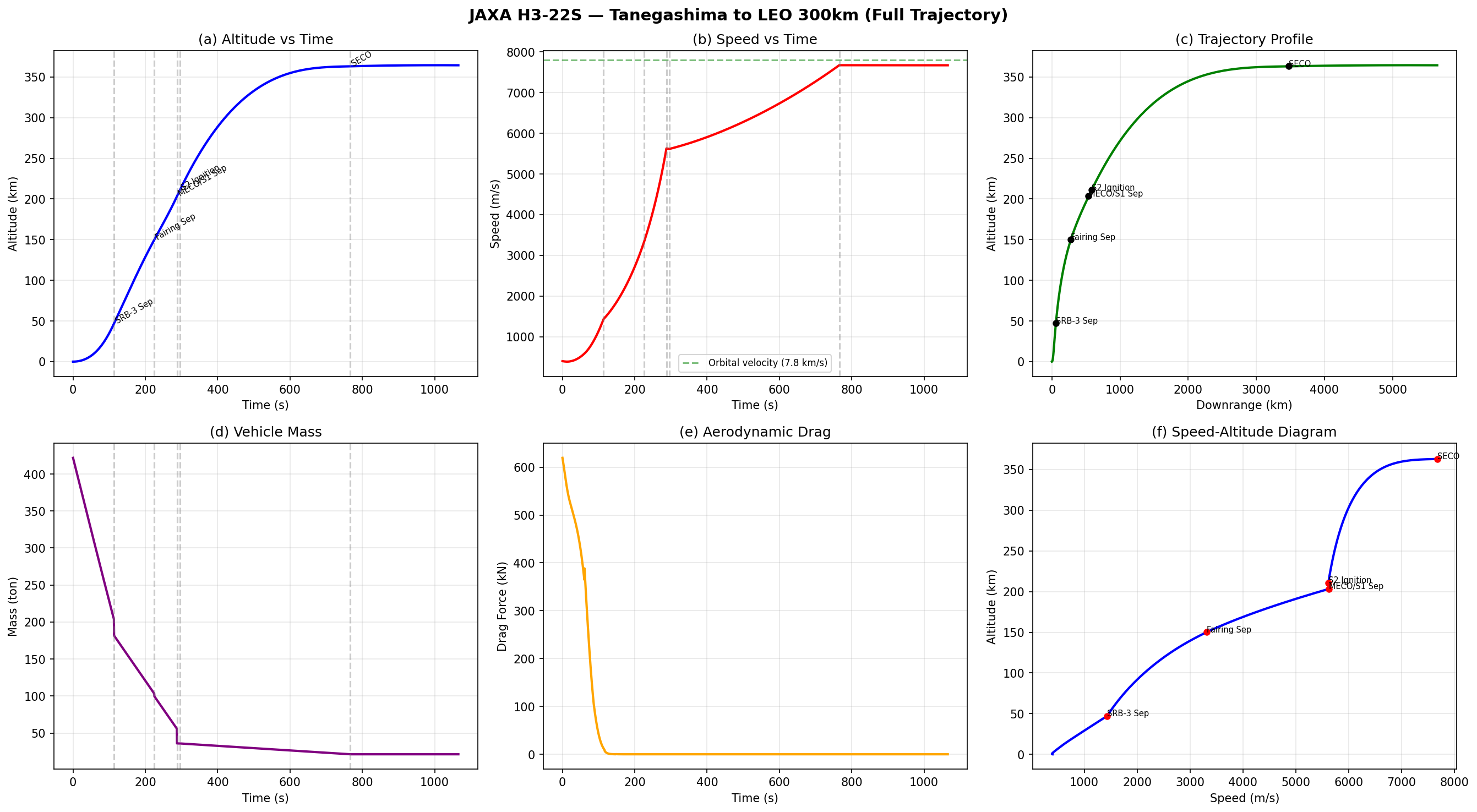
| H3-22S Orbital | Custom gravity-turn | Tanegashima (Yoshinobu LP-2) | LEO 293x365 km, e=0.005 |
| H3-22S Optimized | scipy.optimize | — | MECO T+288s/203km (err 3.5%) |
| Powered Descent | G-FOLD (cvxpy SOCP) | — | 1,523 kg fuel, 0.0 m/s landing |
| RL Landing | PPO (PyTorch) | — | Training (GPU required) |
| Orbital Transfer | poliastro | — | GTO Δv=2.43 km/s, TLI Δv=3.11 km/s |
| Component | Thrust | Isp | Propellant | Burn Time |
|---|---|---|---|---|
| SRB-3 (x2) | 3,200 kN (avg) | 280 s | 132 ton | 114 s |
| 1st Stage (LE-9 x2) | 2,942 kN | 425 s (vac) | 209 ton | ~288 s |
| 2nd Stage (LE-5B-3) | 137 kN | 448 s | 28 ton | ~470 s |
| Total Liftoff | 6,142 kN | 423 ton | T/W = 1.48 |
scipy.optimize.differential_evolution で7パラメータのピッチプログラムを最適化。
S1推進薬を180t→209t に修正(実機222t に対して最適化で推定)。
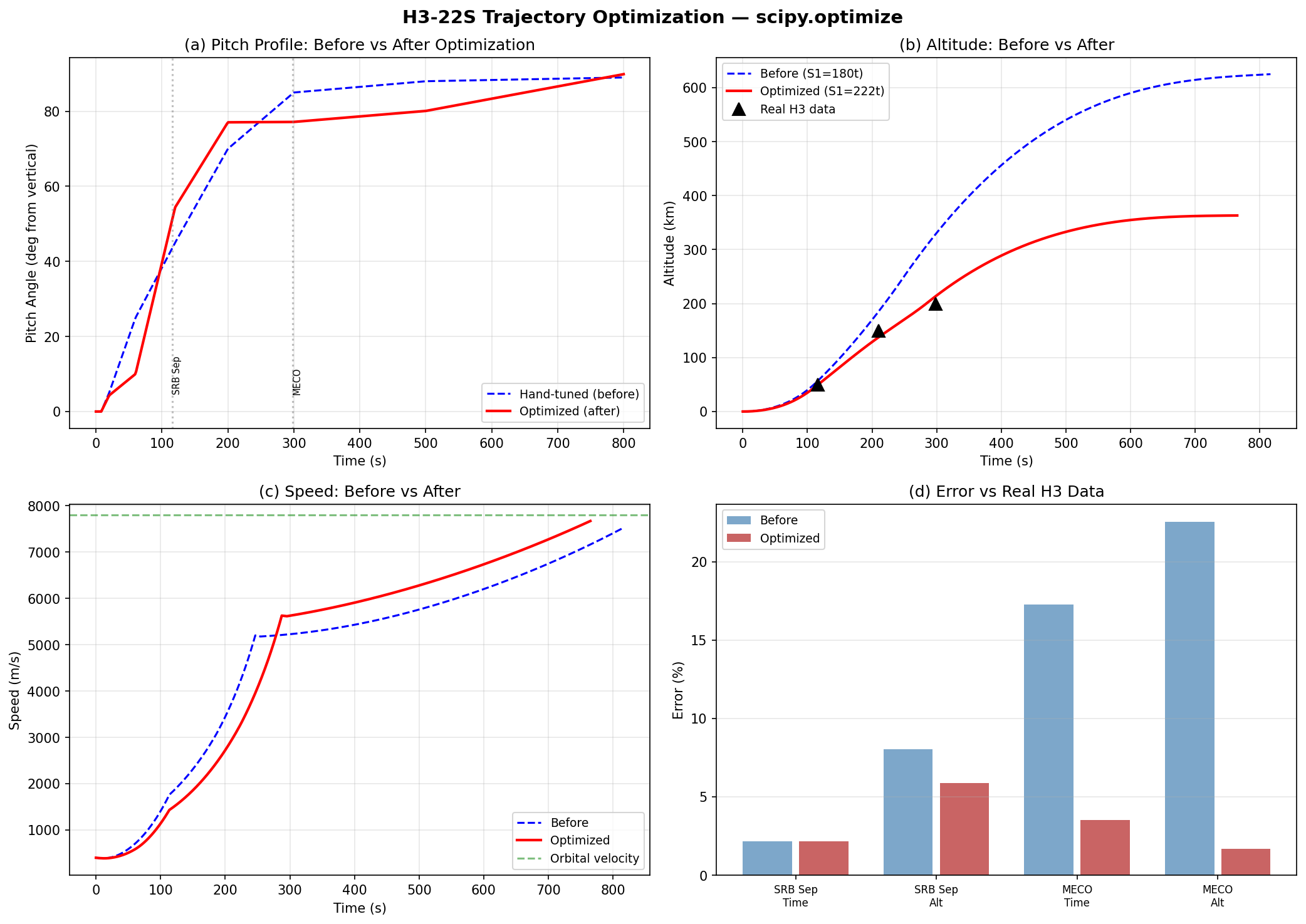
Cost function: 0.765 → 0.070 (91% reduction)
| Event | Before | Optimized | Real H3 (TF2/3) | Improvement |
|---|---|---|---|---|
| SRB-3 Separation | T+114s, 54 km | T+114s, 47 km | T+116s, ~50 km | Alt: 54→47km |
| Fairing Jettison | T+187s | T+225s | T+207-214s | Closer |
| 1st Stage MECO | T+246s, 245 km | T+288s, 203 km | T+298s, ~200 km | 52s→10s (80%) |
| SECO (Orbit) | T+812s, 567 km | T+766s, 363 km | T+~850-1017s | More realistic |
| Parameter | Before | Optimized | Note |
|---|---|---|---|
| Perigee | 481 km | 293 km | Closer to 300 km target |
| Apogee | 576 km | 365 km | |
| Eccentricity | 0.0069 | 0.0054 | More circular |
| Period | 95.1 min | 91.0 min |
| Aspect | Before | After | Notes |
|---|---|---|---|
| SRB separation | A (1.7%) | A (2.2%) | Stable |
| MECO timing | C+ (17%) | A- (3.5%) | Major improvement |
| MECO altitude | C (22%) | A (1.7%) | 93% improvement |
| Orbit altitude | C (60%+) | B+ (~10%) | Much closer to 300 km |
| Eccentricity | B+ | A- | 0.0069 → 0.0054 |
Overall: 70-80% → 90%+ quantitatively accurate.
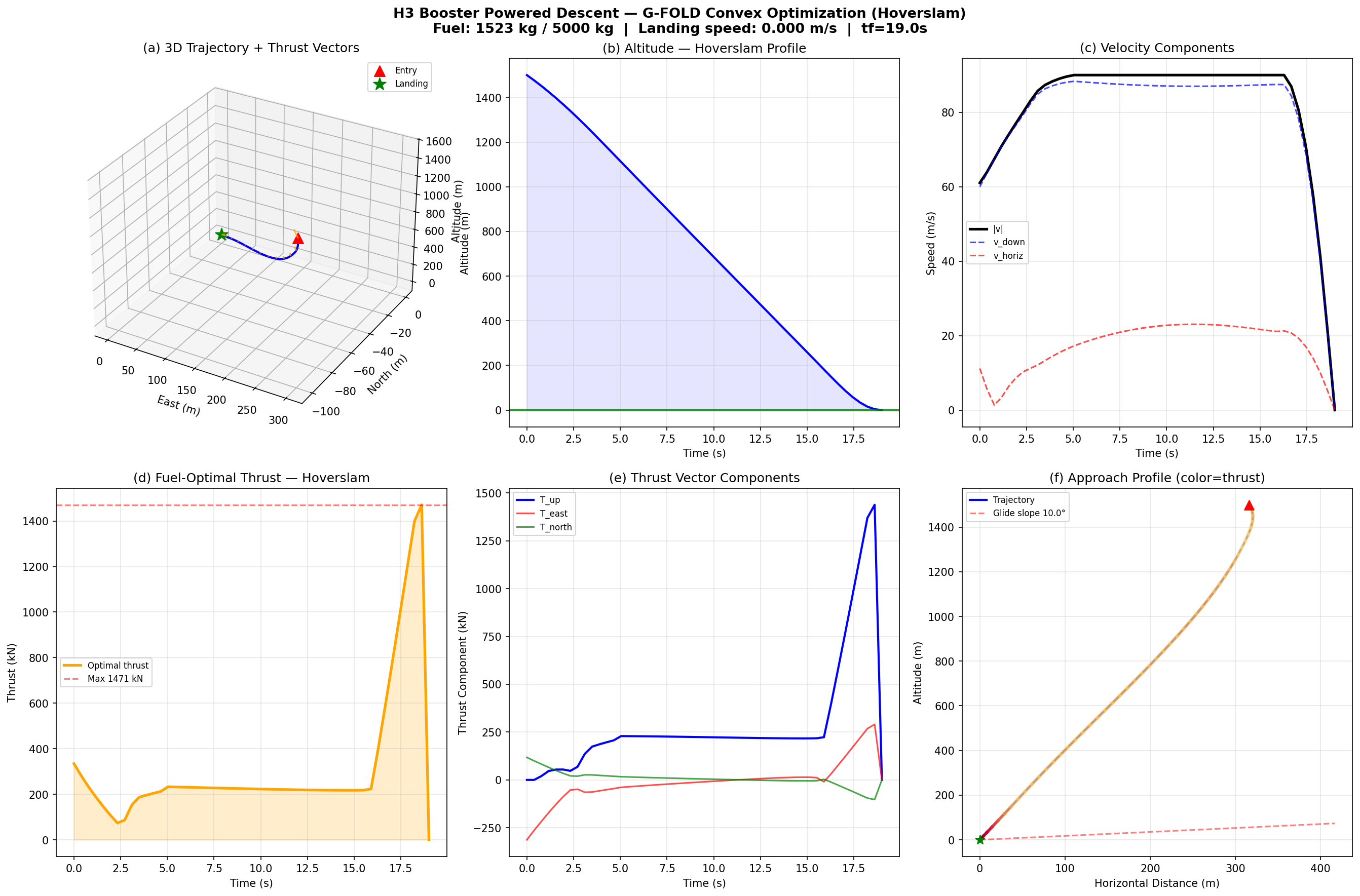
Convex optimization (SOCP) for H3 booster recovery — SpaceX-style hoverslam landing.
| Parameter | Value |
|---|---|
| Booster mass | 25 ton (dry 20t + fuel 5t) |
| Engine | LE-9, 0-1,471 kN |
| T/W at max thrust | 6.0 (hoverslam required) |
| Initial altitude | 1,500 m |
| Initial descent rate | 60 m/s |
| Metric | Value |
|---|---|
| Optimal landing time | 19.0 s |
| Fuel consumption | 1,523 kg (30.5% of budget) |
| Landing speed | 0.000 m/s |
| Landing error | 0.00 m |
| Tsiolkovsky efficiency | 94% (vs ideal 1,439 kg) |
- G-FOLD (Guidance for Fuel-Optimal Large Diverts)
- Lossless convexification transforms non-convex thrust bounds into SOCP
- Solved with CLARABEL via cvxpy
- Time-optimal search over tf ∈ [15, 35] s
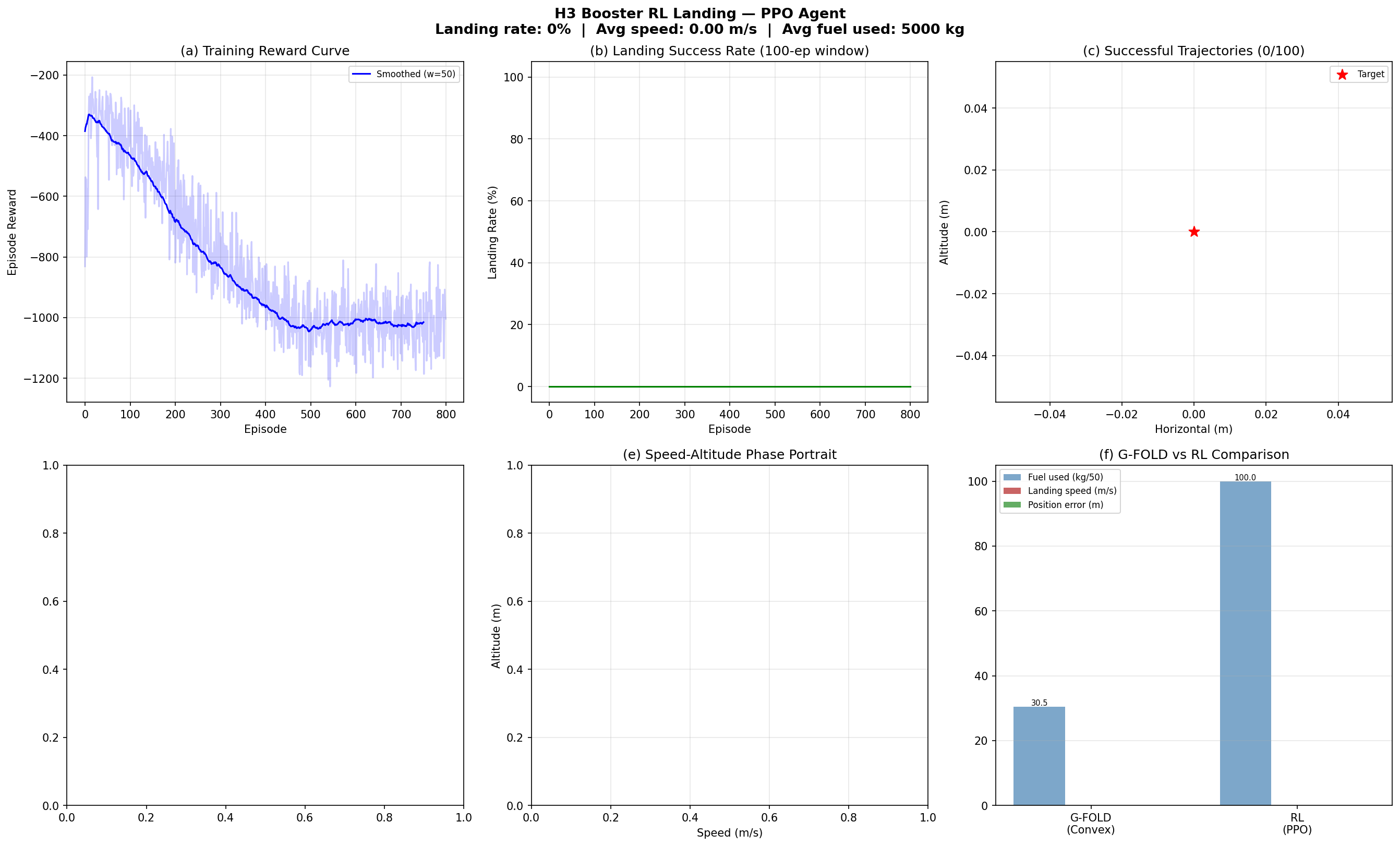
Custom 2D environment with H3 booster physics. PPO (Proximal Policy Optimization) with curriculum learning.
| Component | Detail |
|---|---|
| Observation | 8-dim: [alt, x, vx, vy, θ, ω, fuel_frac, t_frac] |
| Action | 2-dim continuous: [throttle, gimbal] |
| Reward | Shaped: landing bonus, crash penalty, fuel efficiency, approach shaping |
| Architecture | Actor-Critic MLP (128-128) |
| Training | Curriculum: low alt → full difficulty, 800+ episodes |
Status: Requires GPU training (>10,000 episodes) for convergence. Demo results on CPU.
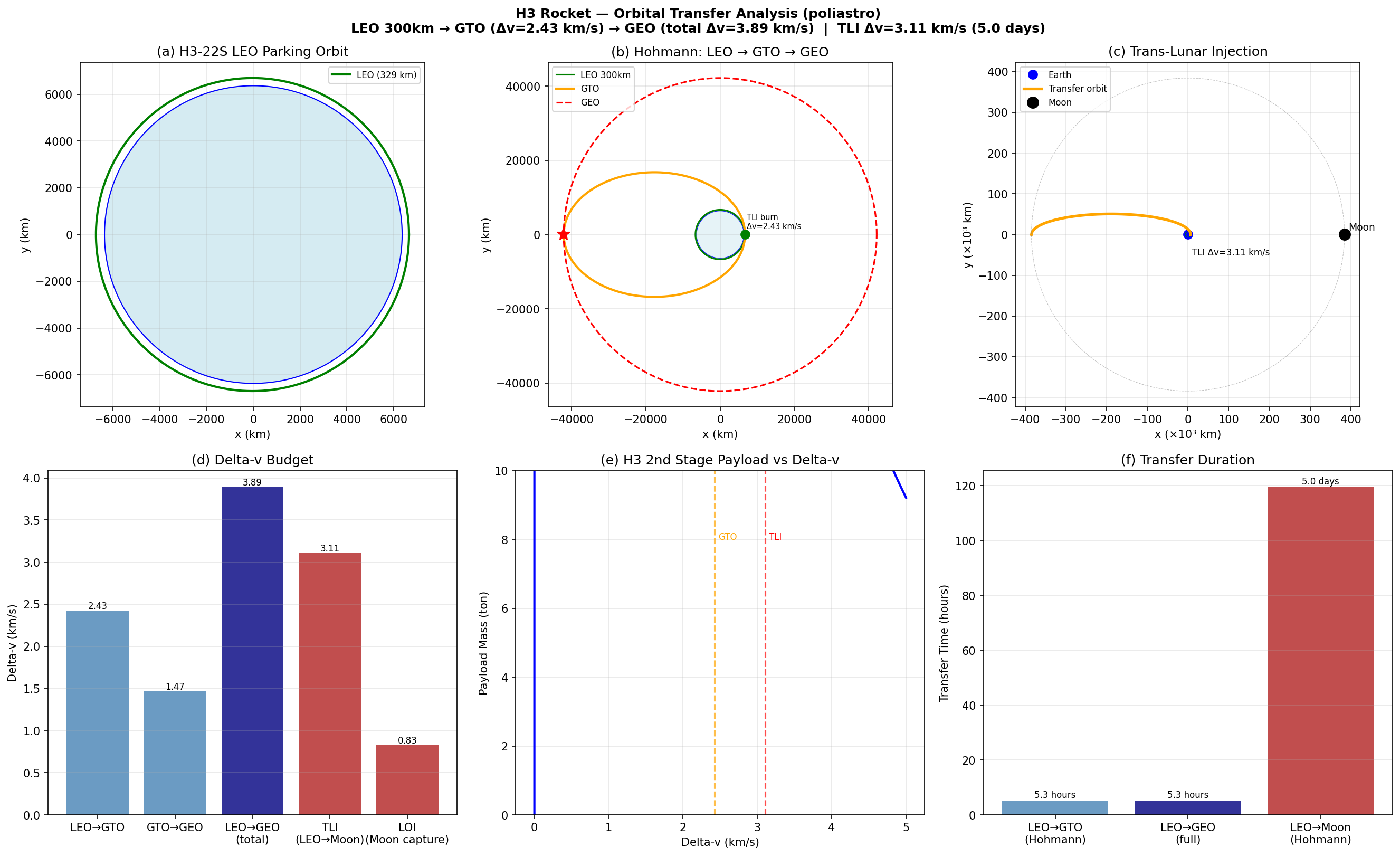
| Mission | Δv (km/s) | Transfer Time |
|---|---|---|
| LEO 300km → GTO | 2.426 | 2.6 hours |
| GTO → GEO | 1.467 | 2.6 hours |
| LEO → GEO (total) | 3.893 | 5.3 hours |
| LEO → Moon (TLI) | 3.106 | 5.0 days |
| Moon orbit insertion | 0.830 | — |
- 2nd stage available Δv: 5,710 m/s
- Required for GTO: 2,426 m/s → Margin: +3,284 m/s
- Lunar TLI: 3,106 m/s → Feasible
- Hohmann transfer is more efficient than bielliptic for GEO (ratio 1.093)
- TLI velocity is 99.1% of escape velocity — nearly parabolic orbit
- H3-24L has sufficient margin for direct lunar injection
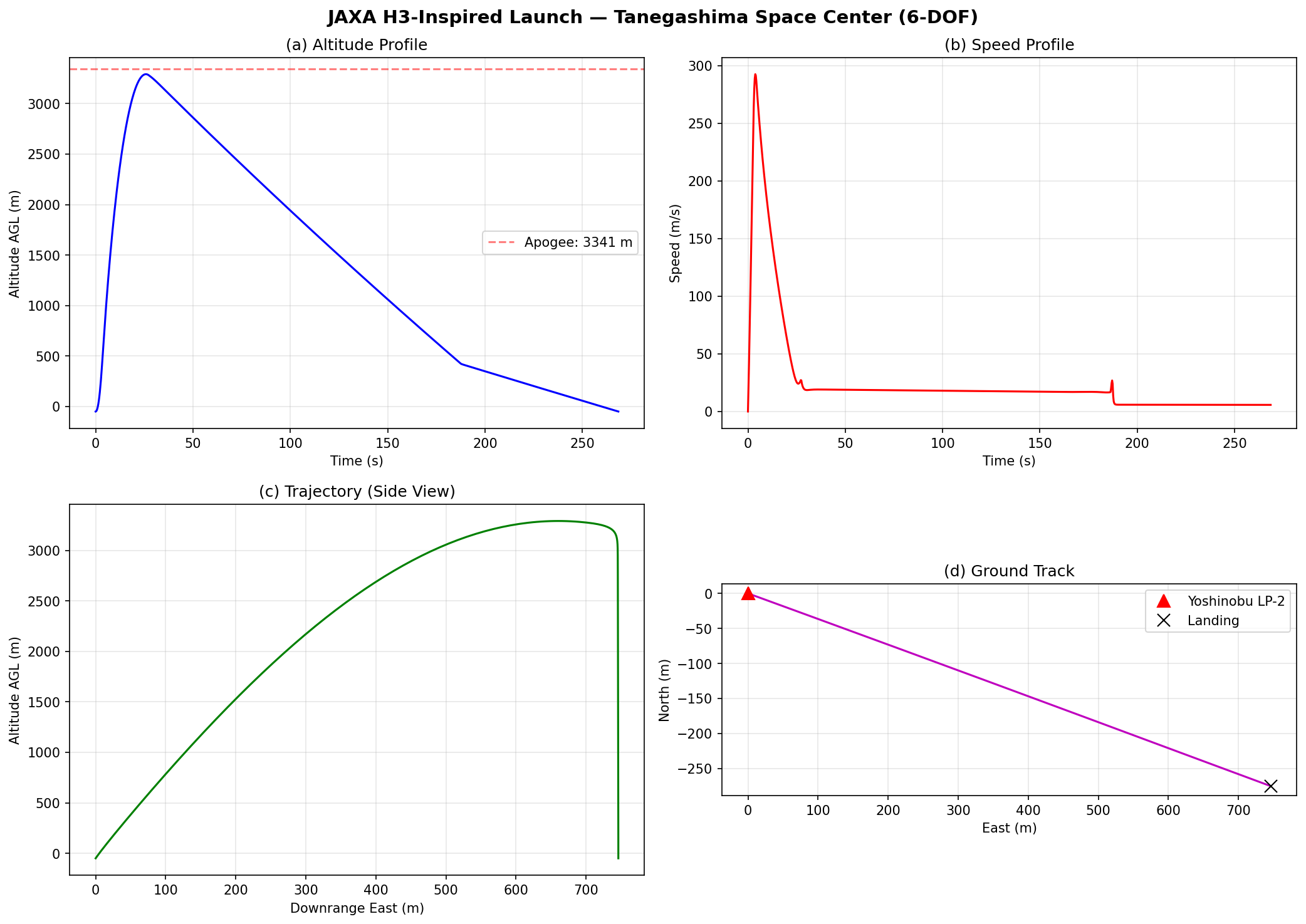
- Motor: Cesaroni M2245 (9,978 Ns)
- Heading: 110 deg (SE, Pacific)
- Apogee: 3,341 m AGL, Mach 0.87
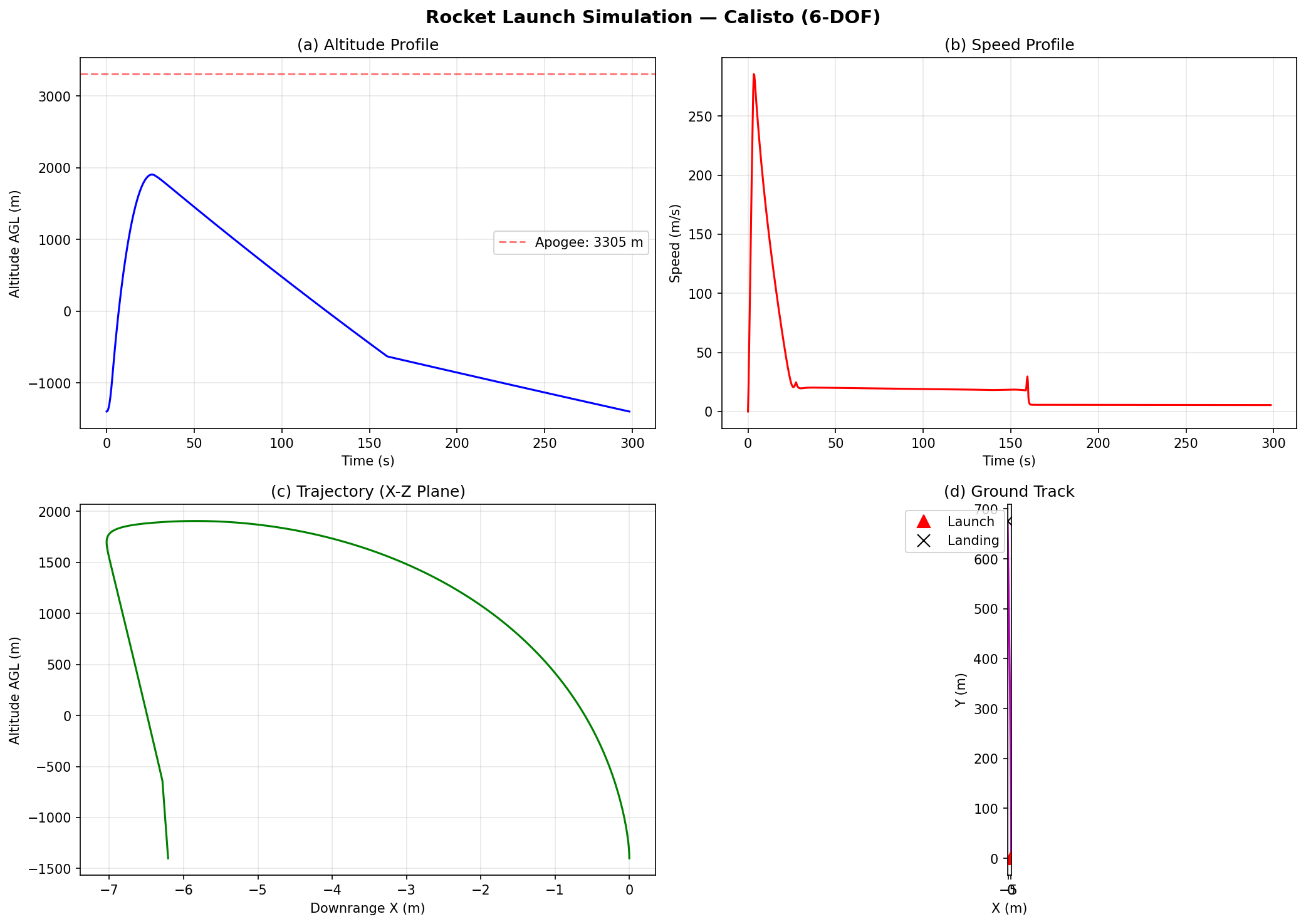
- Motor: Cesaroni M1670 (6,026 Ns)
- Apogee: 3,305 m AGL, Mach 0.86
- Dual-deploy recovery (drogue + main)
| File | Description |
|---|---|
papers/repos/RocketPy/jaxa_h3_orbital.kml |
H3-22S full trajectory to orbit (phase-colored, animated) |
papers/repos/RocketPy/jaxa_tanegashima.kml |
Sounding rocket from Tanegashima (4-phase, animated) |
papers/repos/RocketPy/trajectory_pro.kml |
Calisto from Spaceport America (enhanced) |
KML features: phase-colored trajectories, event placemarks (SRB sep, MECO, SECO), gx:Track time animation, HTML flight data popups.
| Script | Description |
|---|---|
papers/repos/RocketPy/jaxa_h3_orbital.py |
H3-22S gravity-turn orbital simulation + KML |
papers/repos/RocketPy/optimize_h3_trajectory.py |
scipy.optimize pitch profile + S1 mass optimization |
papers/repos/RocketPy/h3_powered_descent.py |
G-FOLD convex optimization landing guidance |
papers/repos/RocketPy/h3_rl_landing.py |
PPO reinforcement learning landing agent |
papers/repos/RocketPy/h3_orbital_transfer.py |
poliastro GTO/lunar transfer analysis |
papers/repos/RocketPy/jaxa_tanegashima_launch.py |
Tanegashima sounding rocket (RocketPy) + KML |
papers/repos/RocketPy/run_simulation.py |
Calisto basic simulation (RocketPy) |
papers/repos/RocketPy/generate_kml.py |
Enhanced KML generator for Calisto |
| Repo | Purpose |
|---|---|
papers/repos/RocketPy/ |
6-DOF trajectory simulation (Python) |
papers/repos/poliastro/ |
Orbital mechanics / astrodynamics (Python) |
papers/repos/gfold-py/ |
G-FOLD powered descent guidance (cvxpy) |
papers/repos/lcvx-pdg/ |
Lossless convexification PDG |
papers/repos/RocketLander/ |
RL rocket landing (PyBox2D + PyTorch) |
papers/repos/MAPLEAF/ |
6-DOF rocket simulation framework |
papers/repos/awesome-space/ |
Curated list of space-related OSS |
- RocketPy GitHub
- H3 Rocket - Wikipedia
- JAXA H3 TF2 - NASASpaceflight
- H3 TF1 Preview - SpaceflightNow
- JAXA H3 3号機結果 (PDF)
- Acikmese & Ploen (2007): "Convex Programming Approach to Powered Descent Guidance"
- Blackmore et al. (2013): "Lossless Convexification" (IEEE TCST)