A hybrid hardware/software project for Xilinx Zynq MPSoC demonstrating a pipelined Multiply-Accumulate (MAC) hardware accelerator. This project compares the execution paradigms and performance differences between AXI-Lite (MMIO) and AXI-Stream (Direct Memory Access) interfaces on an FPGA.
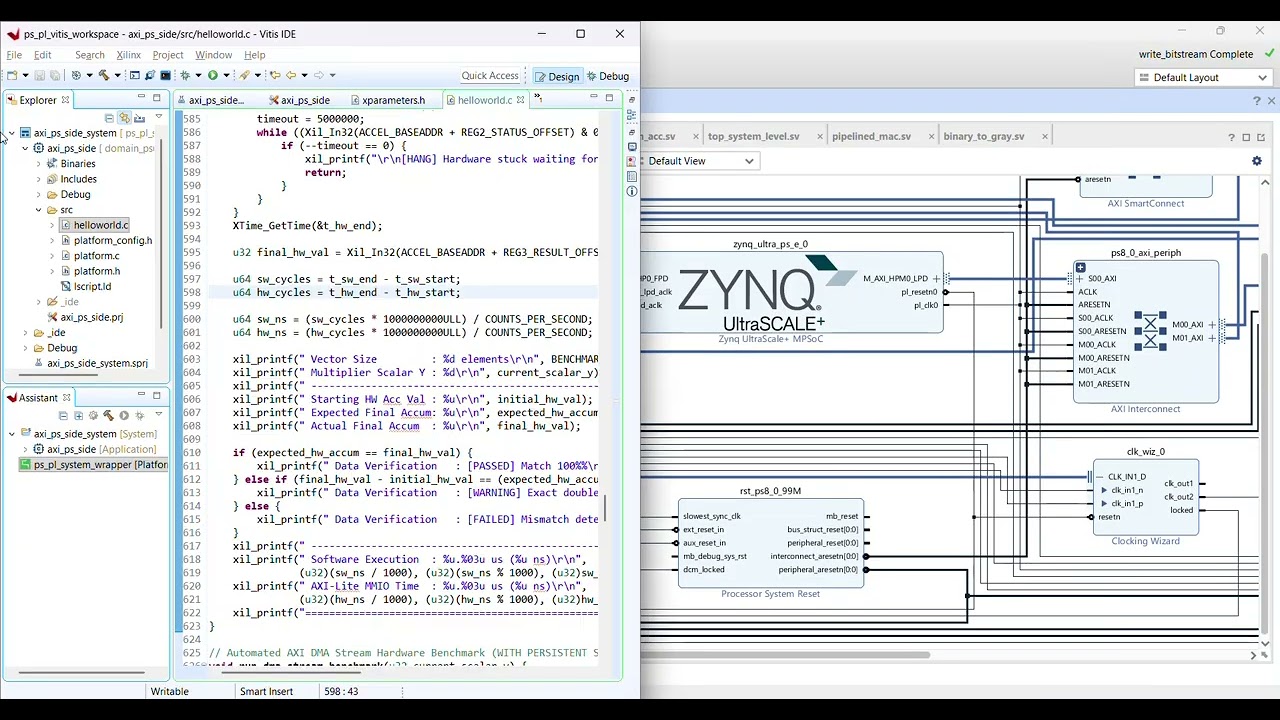
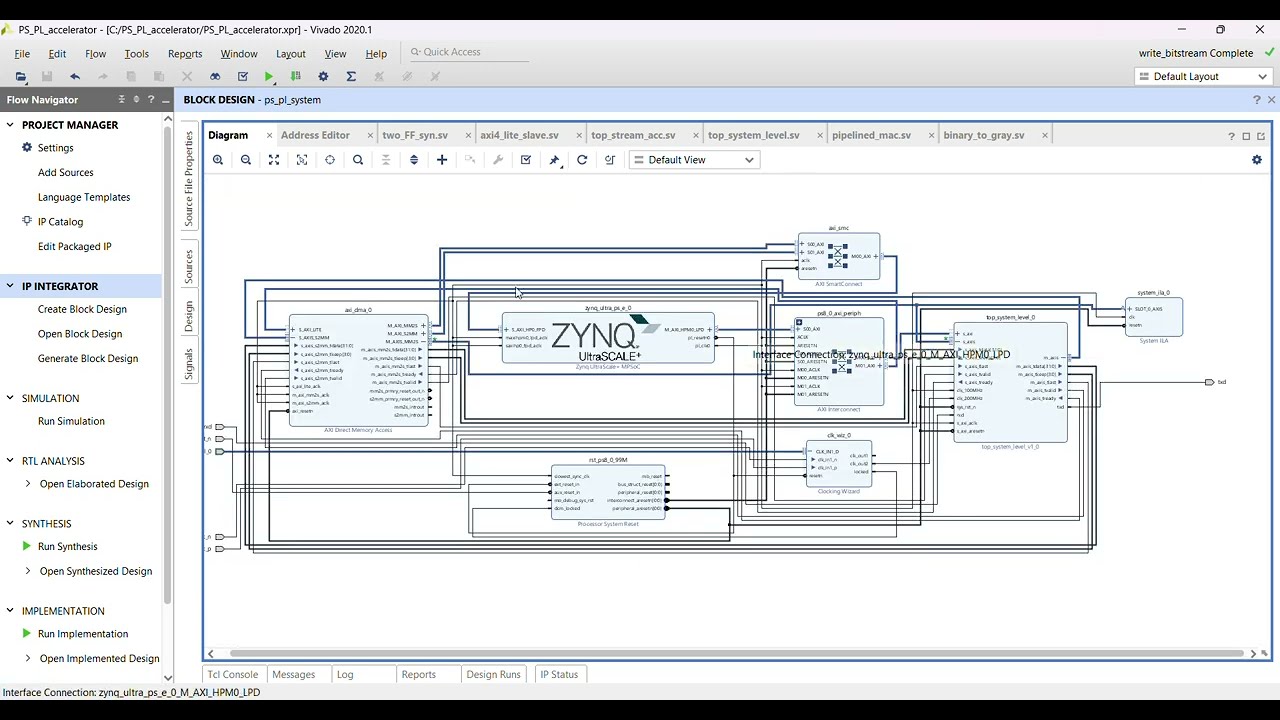
This repository contains both the SystemVerilog RTL for the Programmable Logic (PL) and the bare-metal C driver for the Processing System (PS).
The accelerator takes a 16-bit input array X, multiplies it by a configurable 16-bit scalar Y, and continuously accumulates the result into a 32-bit register. It provides an interactive UART console to dispatch calculations, change scalars on the fly, and benchmark communication overhead.
- Dual AXI Interfaces: Supports single-shot AXI-Lite polling and high-bandwidth AXI-Stream DMA bursts.
- Asynchronous Clocking: AXI-Lite bus runs at 100 MHz for control logic, while the AXI-Stream datapath runs at 200 MHz to maximize throughput.
- Bare-Metal C Driver: Fully standalone execution using
xaxidma,xil_cache, andxtime_lhardware timers. - Automated Data Verification: The ARM processor calculates expected results and verifies 100% of the stream data returned from the PL, properly handling 32-bit hardware rollover math.
top_stream_acc.sv: The top-level wrapper managing the AXI interfaces and Clock Domain Crossing (CDC).pipelined_mac: The core DSP logic. CalculatesResult = Result + (X * Y).
- AXI-Lite Memory Map:
0x00(REG0): Scalar Y Configuration0x04(REG1): Single Input Data X0x08(REG2): FSM Status (0=IDLE, 1=PROC, 2=DONE)0x0C(REG3): MMIO Accumulator Result
- AXI DMA Engine: Configured in simple transfer mode (Interrupts disabled, polling-based) for high-speed streaming between DDR memory and the PL.
To maximize pipelined throughput and avoid complex CDC edge cases on AXI-Stream tlast signals, the hardware accumulator does not reset between DMA transfers. It retains the total sum indefinitely.
Because the hardware runs continuously, the software C driver tracks the state of the hardware in memory using a persistent static u32 counter. When the 32-bit hardware register naturally overflows (rolls over past 4,294,967,295), the C driver mirrors this exact same overflow behavior using standard 32-bit unsigned integer math, ensuring the verification sequence never fails.
The AXI-Lite result register (REG3) is decoupled from the active AXI-Stream pipeline register to prevent timing violations across clock domains. During DMA streams, the MMIO FSM remains idle.
Once flashed to the Zynq MPSoC, connect via a serial terminal (115200 baud). The C application presents an interactive menu:
===================================================
    PS-PL AXI Hardware MAC Accelerator Interface
===================================================
 Current Scalar (Y) : 3
 Hardware Limit     : 16-Bit Input X (0 to 65,535)
 -------------------------------------------------
  [M] Calculate Single Integer Input (AXI-Lite)
  [V] Run AXI-Lite MMIO Loop Benchmark (N = 1024)
  [D] Run AXI DMA Stream Hardware Benchmark (N = 1024)
  [S] Change Scalar Multiplier (Y)
  [H] Reprint Menu
  [Q] Exit Application
===================================================
Unfortunately there are still issues that remain to be fixed. This includes:
- The PS side of the DMA expectations are not dynamically updated despite the DMA calculations are returning proper values.
- The AXI-Lite MMIO Loop is currently hanging and cannot return calculated values.
The board is an AXU5EV-P board.
