
An AI-powered platform that transforms a business requirement into a structured set of software engineering artifacts through a coordinated network of nine specialised AI agents operating under human governance.
Where the two preceding projects — the Vectorless and Hybrid RAG chatbots — answered questions about existing documents, this platform generates the documents themselves: requirements specifications, business analysis, architecture and database designs, UI/UX recommendations, and security and compliance assessments.
The design principle carried forward from both chatbots is the one that matters most here: keep every agent's output grounded in a shared, verifiable project context, and require explicit human sign-off before that output can influence the next stage.
Enterprise software delivery depends on a sequence of specialists — business analysts, architects, database designers, security reviewers — each producing documentation that must remain consistent with everyone else's.
Coordinating this manually introduces four recurring failures:
- Requirements are incomplete at initiation, yet every downstream stage depends on them.
- Architecture quality varies with individual experience rather than following a repeatable method.
- Artifacts produced by different disciplines at different times drift out of consistency.
- Knowledge transfer between teams is slow, and the reasoning behind a decision is often lost.
Large language models draft structured technical content competently, but are typically deployed as isolated assistants rather than coordinated engineering collaborators. The open question this project addresses: can a network of specialised agents automate that coordination while preserving the governance enterprise delivery requires?
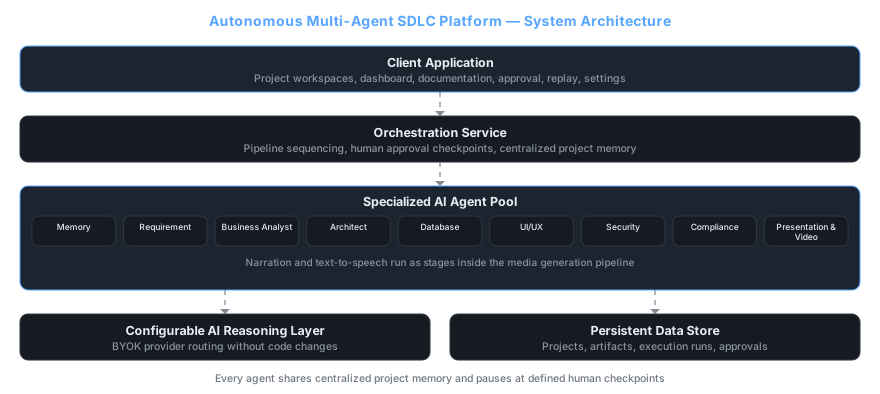
A client application over an orchestration service, a pool of specialised agents, a configurable reasoning layer, and a persistent store built around traceability.
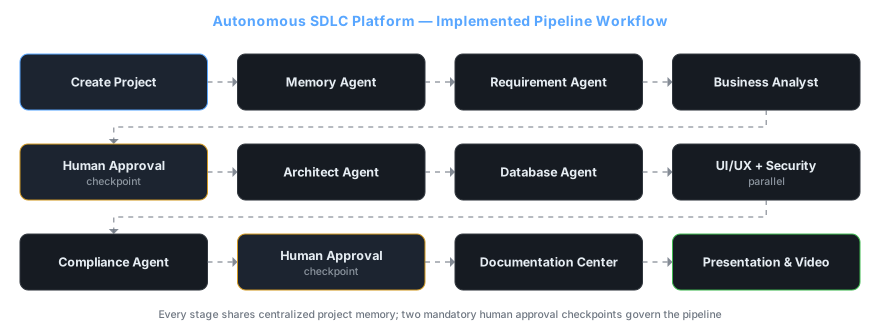
Agents execute in sequence, sharing centralized project memory. Two mandatory human approval checkpoints govern the pipeline.
| Agent | Responsibility |
|---|---|
| Memory | Establishes project-scoped context from uploaded documents and descriptions; every later agent reads from and writes to it, keeping cross-discipline outputs consistent |
| Requirement Analysis | Turns a business idea, RFP or uploaded document into a structured specification — functional and non-functional requirements, business rules, dependencies, validation rules, acceptance criteria, risks |
| Business Analyst | Produces BRD and SRS, user personas, user stories with acceptance criteria, epics, a MoSCoW-prioritised backlog, business process flows, risk assessment and success metrics |
| Solution Architect | Transforms approved requirements into high-level and component architecture, data-flow and sequence diagrams, technology recommendations, deployment architecture, and architecture decision records — recording why a structure was chosen |
| Database Design | Converts the approved architecture into an entity-relationship model, schema, indexing recommendations and scaling strategy |
| UI/UX Design | Screen inventory, user flows, wireframe recommendations, and a design system covering typography, spacing and accessibility |
| Security | Authentication and authorization design, RBAC, threat modelling and secure-coding guidance aligned to OWASP practice — runs in parallel with UI/UX |
| Compliance | Evaluates accumulated artifacts against ISO/IEC 27001, SOC 2 and GDPR-style data-protection expectations, producing gap analysis and remediation guidance |
| Presentation & Video | Turns the artifacts the pipeline has already produced into a consulting-style presentation deck and, optionally, a narrated demonstration video — story planning, slide rendering, narration script, text-to-speech, avatar and composition run as swappable stages of its media pipeline |
The pipeline pauses after business analysis, and again after compliance. At each, a reviewer may approve, reject, request regeneration, or adjust project context before anything downstream executes.
- Project Dashboard — live pipeline visualisation: per-stage status, aggregate metrics, running agents, pending approvals, chronological execution history.
- Documentation Center — every generated artifact in one searchable, exportable repository organised by category.
- Approval Center — extends the governance model beyond the two mandatory gates to any artifact, with a full audit trail of reviewer decisions.
- Temporal Replay Center — records every workflow event as an immutable, replayable timeline, so a reviewer can reconstruct exactly how an artifact was produced.
The reasoning layer is configurable rather than fixed to one vendor. Each project may supply its own credentials, addressing data-residency, cost-control and vendor-flexibility requirements.

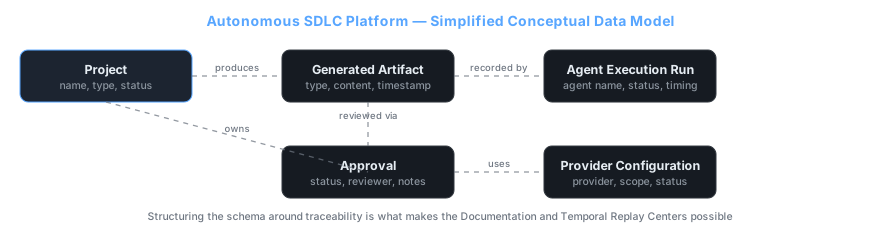
Traceability is designed into the schema: every artifact links to the agent execution run that produced it and the approval that reviewed it.
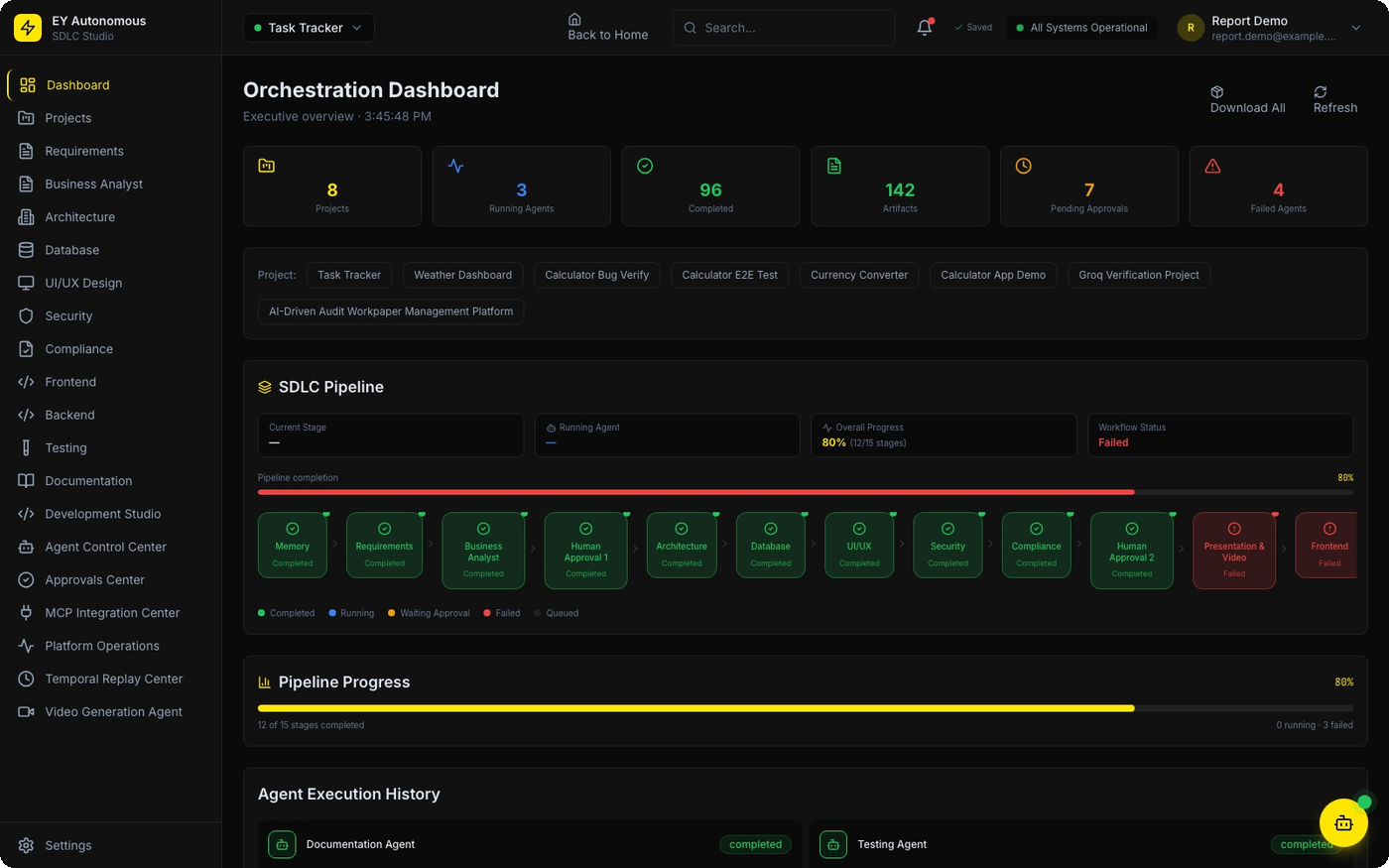
Orchestration Dashboard — pipeline stage status, running agents, artifacts, pending approvals, execution history
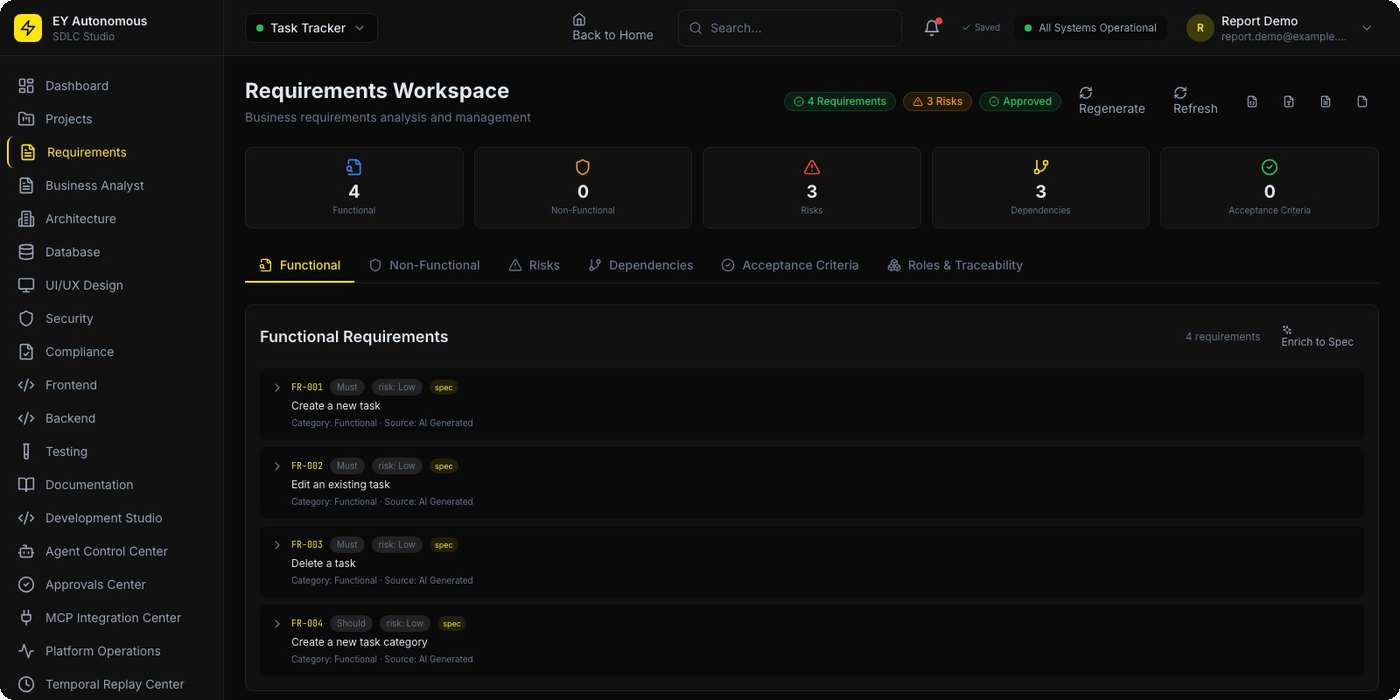
Requirements Workspace — functional and non-functional requirements, risks, dependencies, acceptance criteria, traceability
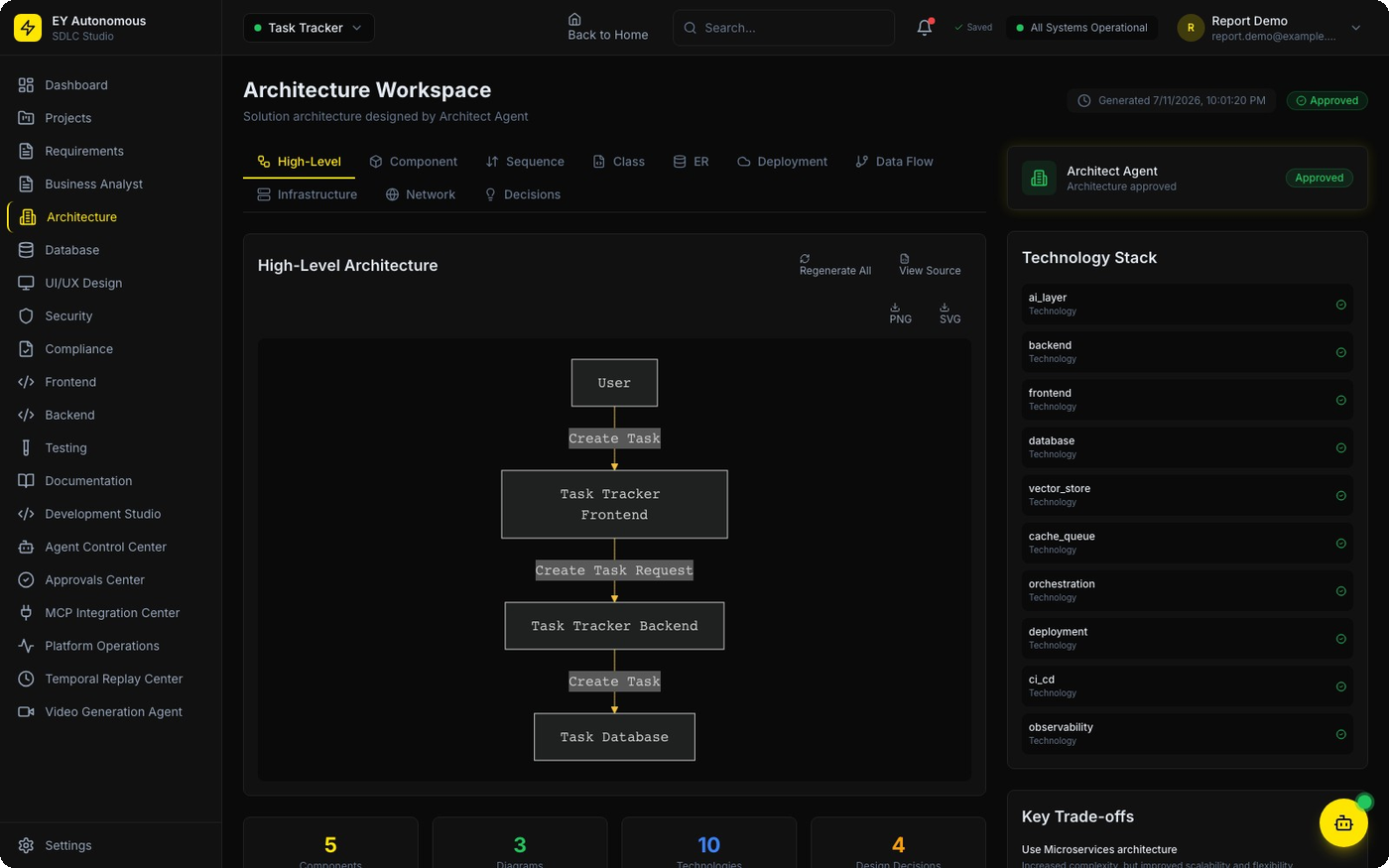
Architecture Workspace — generated high-level architecture with technology stack and recorded trade-offs
- Nine specialised agents executing in sequence over shared project memory.
- Two mandatory human approval checkpoints, with approve / reject / regenerate / adjust-context outcomes.
- Centralized project memory — agents read shared context rather than re-deriving requirements, which is what prevents cross-artifact drift.
- Parallel execution where disciplines are independent (UI/UX alongside Security).
- Full artifact traceability — every artifact links to its execution run and approval record.
- Temporal replay — reconstruct how any artifact was produced, retroactively.
- BYOK provider routing with graceful degradation to a locally hosted model.
- Media generation pipeline — the Presentation & Video agent's own pipeline, converting produced artifacts into a deck and, optionally, a narrated video.
Frontend — React · TypeScript · Tailwind CSS · shadcn/ui · Vite Backend — FastAPI · Python AI framework — LangGraph · Ollama · Azure OpenAI (configurable) Database — PostgreSQL DevOps — Docker · GitHub
Clone the repository:
git clone <repository-url>
cd Autonomous-SDLC-Platform
Install and run the frontend:
cd frontend
npm install
npm run dev
Install and run the backend:
pip install -r requirements.txt
cd backend
uvicorn fastapi_agents.main:app --reloadfrontend/ React + TypeScript client
backend/ FastAPI application
agents/ Specialised AI agent implementations
services/ Orchestration and project services
routes/ API route definitions
controllers/ Request handling
database/ Schema and persistence
docs/ Generated documentation
🚧 Active development. Current focus: agent integration, workflow automation, documentation generation, human approval system, AI orchestration.
The platform was originally scoped around an end-to-end SDLC covering every major engineering phase. Within the internship timeframe, implementation focused on the foundational stages that turn a business input into structured engineering deliverables — memory, requirements, business analysis, architecture, database, UI/UX, security and compliance — together with the enterprise governance modules and the presentation/video generation capability.
Autonomous frontend and backend code generation, testing, deployment and operational monitoring were deliberately deferred, with the architecture designed to accommodate their later integration.
- Frontend and backend code generation
- API generation
- Automated testing
- Expanded security review
- DevOps automation and CI/CD integration
- Deployment automation
- Monitoring and analytics
Developed during an AI engineering internship at Ernst & Young LLP (Technology Consulting, CNS — Technology Strategy & Transformation) as part of ongoing enterprise AI automation research. Per enterprise confidentiality, this repository contains no client data, prompt text or internal configuration values. Architecture and workflow diagrams are redrawn from my Project Semester Report.