


🐣 A tiny helper that lets a robot keep moving while its policy is still thinking.
This project runs chunked policy inference in a background thread while the main thread keeps sending robot commands at a steady control rate.
It is useful for policies such as IL, VLA or WAM, where one model forward pass predicts a whole chunk of future actions.
Below are the deployment results on real-world robotic manipulation tasks. The left example shows inference without Async Temporal Aggregation, while the right example shows inference with Async Temporal Aggregation.
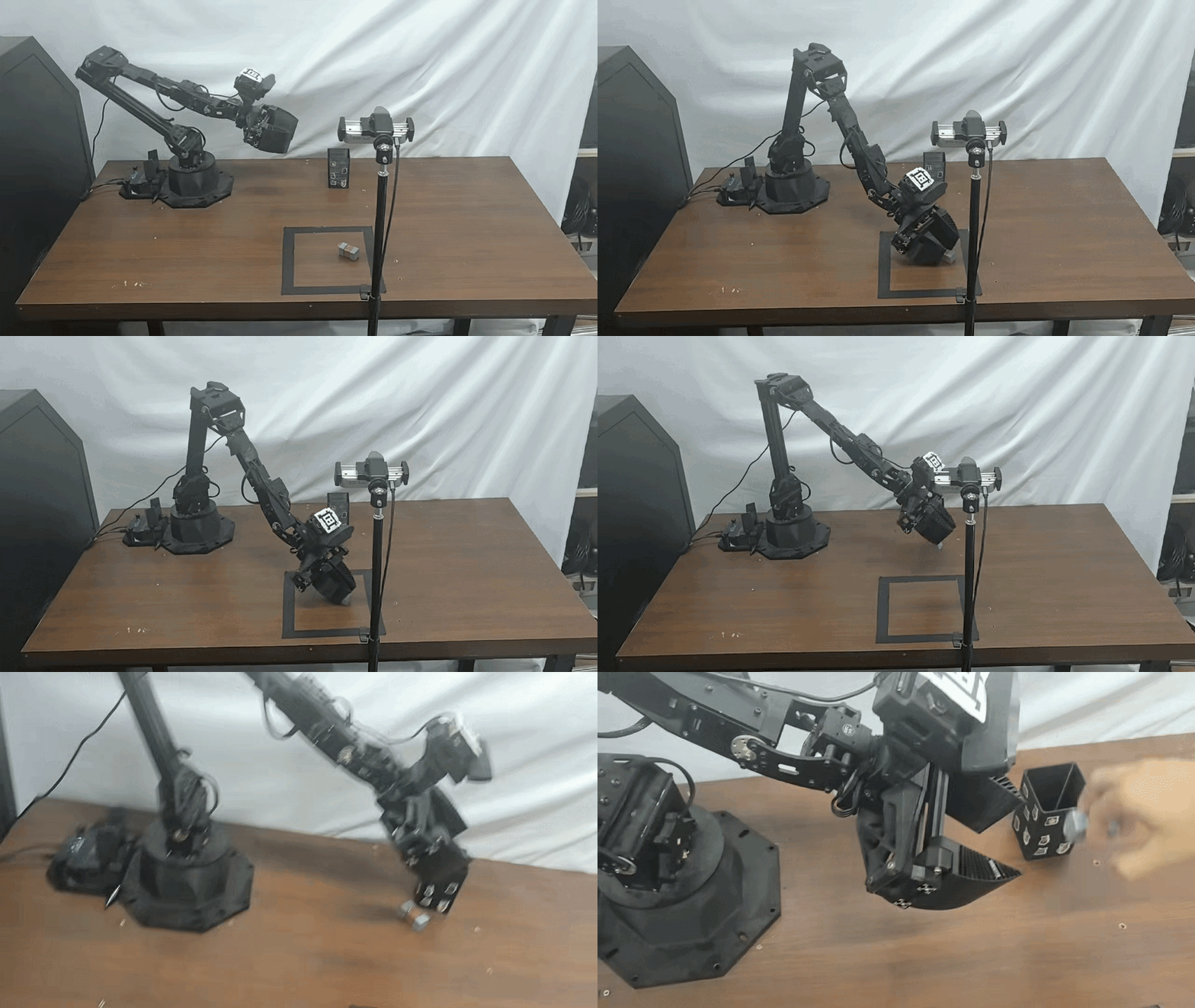
Without Async Temporal Aggregation |
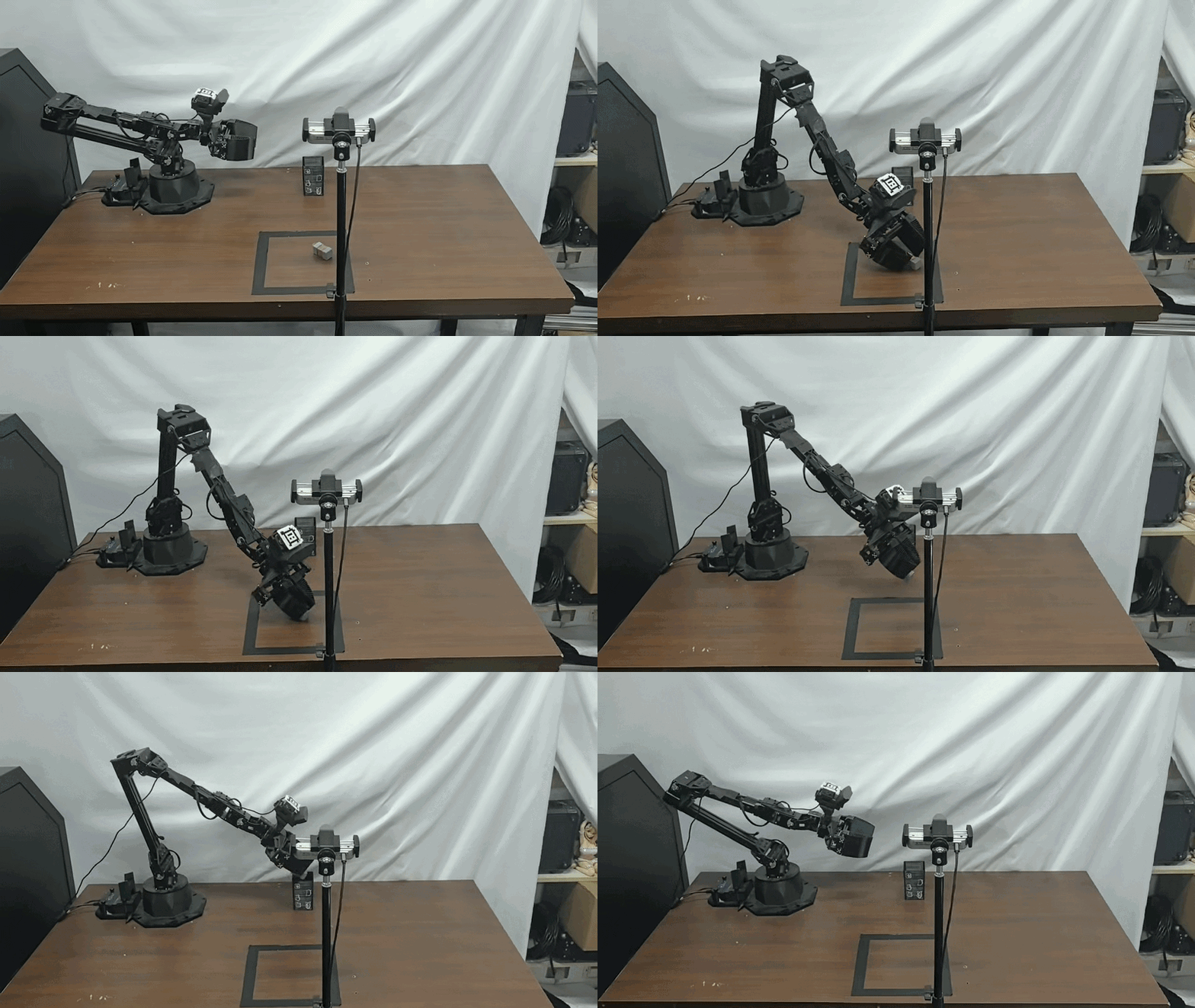
With Async Temporal Aggregation |
Imagine that your robot should receive a command every 20 ms:
50 Hz control loop = one command every 20 ms
But your policy needs 25 ms to produce a new action chunk.
With normal synchronous inference, the robot has to wait:
observe → wait for policy → command robot → observe → wait again...
That waiting can make motion slow or jerky.
This project separates the work:
🦾 Robot thread
observe → blend ready actions → command robot → sleep
   │
   └── sends the newest observation when the worker is free

🧠 Policy thread
preprocess → model inference → full action chunk → result queue
The robot thread does not wait for routine policy inference.
- 🧵 Runs policy inference on a background thread.
- 📸 Uses the newest observation instead of building a stale image queue.
- ⏱️ Remembers when each observation was captured.
- 🧩 Aligns overlapping action chunks to the current control step.
- 🫧 Blends matching actions with temporal aggregation.
- 🚨 Sends background exceptions back to the control thread.
- 🧰 Works with PyTorch, ONNX Runtime, TensorFlow, or custom inference code.
The core module only depends on NumPy.
git clone <your-github-repository-url>
cd async_temporal_agg

python -m venv .venv
source .venv/bin/activate
python -m pip install -r requirements.txtpython -m unittest -v test_async_temporal_agg.pyExpected result:
Ran 4 tests

OK
python demo.pyThe demo simulates:
- a
50 Hzrobot-control loop; - a
25 mspolicy forward pass; - chunks containing
100future actions.
Example output:
step=000 contributors=01 action[0]=0.0000
step=020 contributors=10 action[0]=0.0140
step=040 contributors=20 action[0]=0.0287
...
completed 200 control steps in 4.04s
A normal policy may predict one action:
[joint_1, joint_2, ..., gripper]
A chunked policy predicts many future actions in one forward pass:
chunk[0]   → action for the first future step
chunk[1]   → action for the second future step
...
chunk[99]  → action for the 100th future step
For a seven-dimensional robot action and a chunk size of 100:
chunk.shape == (100, 7)🌟 One chunk does not mean 100 separate model calls.
One model forward pass returns all 100 actions together.
Suppose an observation is captured at control step 20.
The background worker finishes its chunk at step 22. The controller should
not restart that delayed chunk from index zero. It uses:
offset = current_step - observation_step
action = chunk[offset]
In this example:
action = chunk[22 - 20]
action = chunk[2]
This small timestamp trick keeps delayed predictions on the correct timeline.
Several chunks can predict an action for the same current step:
chunk A:  A[current_step - A.query_step]
chunk B:  B[current_step - B.query_step]
chunk C:  C[current_step - C.query_step]
The project selects those matching actions and computes a weighted average:
action, history, contributors = aggregate_action_chunks(
    history,
    step=current_step,
    decay=0.01,
)
The result is usually smoother than switching from one chunk to the next.
This copied implementation preserves the ACT++ ordering:
weight[i] = exp(-decay * i)Chunks are ordered from earlier to later query steps, so earlier chunks receive more weight.
This is smooth, but a very long history can make stopping feel delayed. For faster stopping, consider:
- keeping only recent chunks;
- using freshness-based weights;
- giving newer chunks more weight.
First, write a function that receives one observation and returns one complete action chunk:
def infer_action_chunk(observation):
    # Run preprocessing and your model here.
    return chunk  # shape: [chunk_size, action_dim]
Generate the first chunk before robot motion:
first_observation = observe()
first_chunk = infer_action_chunk(first_observation)

history = [(0, first_chunk)]
last_action = first_chunk[0]
Start the worker:
from async_temporal_agg import LatestObservationWorker

worker = LatestObservationWorker(infer_action_chunk)
worker.start()
Then use it inside the control loop:
import time

from async_temporal_agg import aggregate_action_chunks

control_hz = 50
period = 1 / control_hz

try:
    for step in range(max_steps):
        tick_started = time.perf_counter()

        # Collect results that are already finished. This never waits.
        for result in worker.poll():
            history.append((result.step, result.value))

        # Submit only when the worker is idle.
        if step > 0:
            worker.submit(
                step,
                lambda: copy_latest_observation(),
            )

        # Pick and blend the actions that belong to this step.
        action, history, contributors = aggregate_action_chunks(
            history,
            step=step,
            decay=0.01,
        )

        # Choose a safe fallback for your robot.
        if action is None:
            action = last_action
        else:
            last_action = action

        command_robot_nonblocking(action)

        remaining = period - (time.perf_counter() - tick_started)
        time.sleep(max(0, remaining))
finally:
worker.close()Put GPU work inside the worker's inference function:
def infer_action_chunk(observation):
    with torch.inference_mode():
        qpos = preprocess_qpos(observation["qpos"]).to("cuda")
        images = preprocess_images(observation["images"]).to("cuda")

        chunk = policy(qpos, images)

        return (
            chunk.squeeze(0)
            .detach()
            .cpu()
            .numpy()
        )
The control thread only receives the completed CPU chunk. It does not call the policy directly after initialization.
async_temporal_agg/
├── async_temporal_agg.py       # Worker + aggregation logic
├── demo.py                     # Runnable simulated controller
├── test_async_temporal_agg.py  # Four unit tests
├── requirements.txt
├── .gitignore
└── README.md
worker = LatestObservationWorker(infer_fn)| Method | What it does |
|---|---|
start() |
Starts the background thread |
submit(step, factory) |
Submits an observation if the worker is idle |
poll() |
Returns finished results without waiting |
wait(timeout) |
Waits for one result, mainly for setup or tests |
close() |
Stops and joins the worker |
ready |
Tells whether a new request can be accepted |
Each completed result contains:
| Field | Meaning |
|---|---|
step |
Step at which the observation was captured |
value |
The predicted action chunk |
elapsed |
Inference time in seconds |
error |
Background exception, if one occurred |
error_traceback |
Full background traceback |
action, active_history, contributor_count = aggregate_action_chunks(
    action_history,
    step=current_step,
    decay=0.01,
)
It removes expired chunks, selects timestamp-aligned actions, and returns their weighted average.
Yes. One background model call still returns the complete chunk, such as
(100, 7).
No. While the robot executes the current aggregated action, the worker can already predict another full chunk from a newer observation.
No. It uses a Python threading.Thread, a request queue, a result queue, and a
small readiness event.
No. Model inference runs in the worker. Temporal aggregation stays in the control thread because it is tiny and must use the exact current control step.
The new request is skipped. The controller keeps using valid actions from existing chunks. Old camera frames do not pile up.
This project schedules inference. It is not a complete robot safety system.
Before using it on hardware, add:
- joint and workspace limits;
- velocity and acceleration limits;
- rejected-command handling;
- a maximum accepted chunk age;
- emergency-stop monitoring;
- a safe fallback for missing actions;
- reduced-speed testing.
⚠️ Please test with a simulator or an observation-only mode before enabling robot motion.
- Only one inference request runs at a time.
- Busy workers skip new requests instead of queueing them.
- An inference already running cannot be interrupted by
close(). - Temporal aggregation runs in the control thread by design.
- The default weighting order favors earlier chunks.
This standalone implementation was extracted from a real-robot ACT++ inference workflow. It is inspired by the temporal-aggregation idea used in ACT-style chunked robot policies.
Happy robot building! 🦾✨