
Reproducible single-cell integration with a documented decision trail. Integrate a multi-batch dataset with scVI/scANVI (or Harmony/Scanorama), inspect the result, decide which cells and clusters to drop, filter, and re-integrate — repeating until the data is clean. Every round records its seed, code commit, and input fingerprint, so the whole lineage is reproducible. Like a trail of cairns, each round leaves a marker you can retrace.
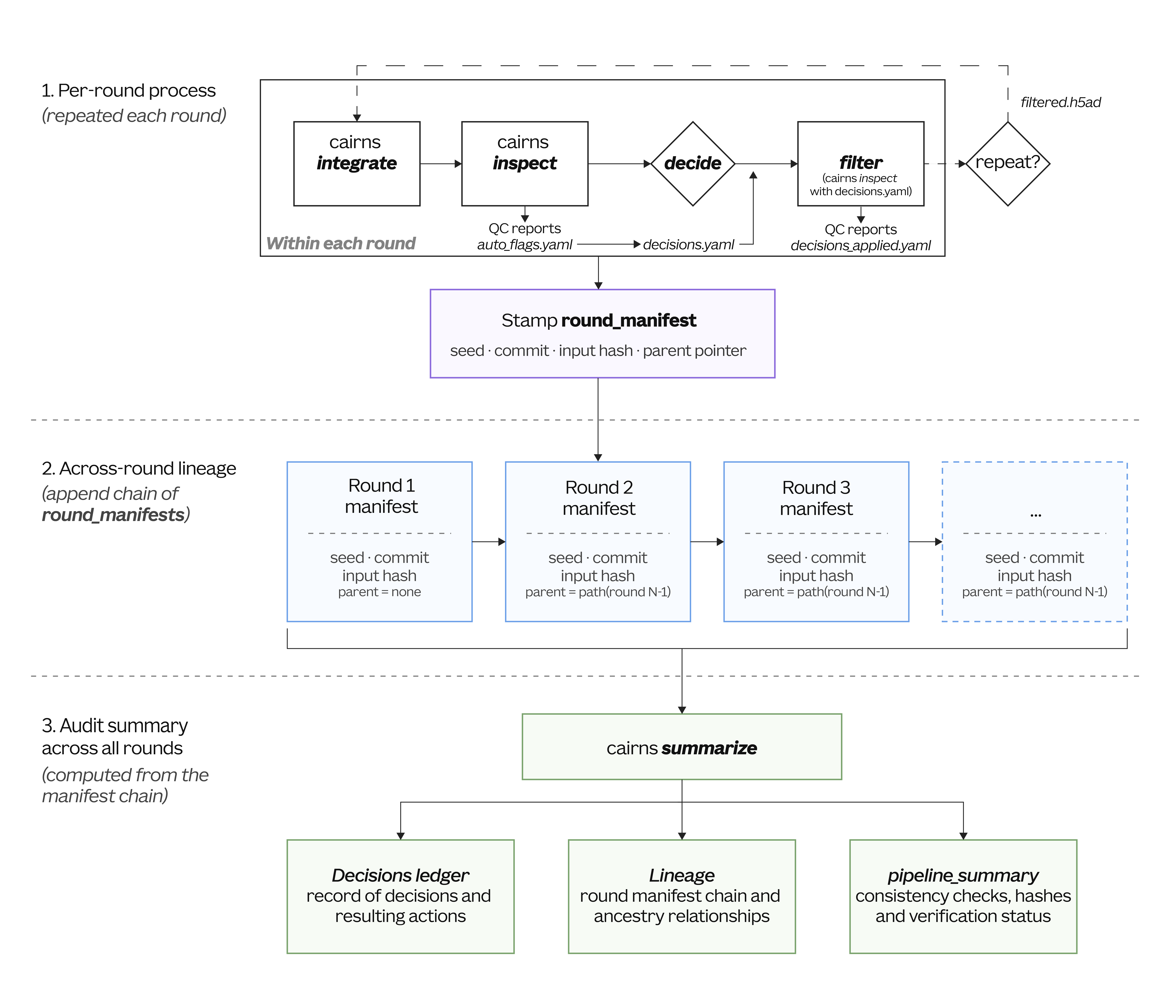
per round:     integrate → inspect → edit decisions → filter → re-integrate
                                   ↓  each round stamps a round_manifest
across rounds:   round 1 → round 2 → round 3 → …   (seed · commit · input hash · parent pointer)
                                   ↓
               cairns summarize → decisions ledger + lineage + integrity report
Who it's for: anyone doing quality-controlled single-cell integration who wants a reproducible, reviewable loop rather than an ad-hoc notebook. The defaults are tuned for mouse sympathetic-nervous-system data, but the engine is dataset-agnostic — see Adapting to your data.
| Guide | For |
|---|---|
| Getting started | Install, verify, and the input-data contract |
| Tutorial | A full runnable loop on synthetic data (no downloads) |
| Configuration reference | Every config field, and when to change it |
| Integration methods | Tune the scVI architecture, or swap in another method (Scanorama, etc.) |
Decisions (decisions.yaml) |
The filtering syntax |
| Interpreting outputs | Is my integration good? When do I stop? |
| Adapting to your data | Non-mouse / non-SNS datasets (and: should you fork?) |
| Troubleshooting | Common errors and fixes |
| Code Ocean | Running the capsule |
flowchart TD
    cfg["pipeline.yml<br/>(versioned config)"]:::cfg

    subgraph INT["cairns integrate"]
        direction TB
        qc["QC filter<br/>(skippable after round 1)"] --> hvg["HVG selection<br/>(batch-aware)"]
        hvg --> scvi["scVI training<br/>obsm['X_scVI']"]
        scvi -.->|annotation.enabled| scanvi["scANVI annotation<br/>obsm['X_scANVI']"]
        hvg -.->|harmony.enabled| harmony["Harmony<br/>obsm['X_pca_harmony']"]
        scvi --> emb["neighbors → UMAP → Leiden<br/>per embedding"]
        scanvi --> emb
        harmony --> emb
        emb --> bench["scIB benchmarking<br/>scVI vs Harmony vs PCA"]
    end

    INT --> integ["integrated.h5ad<br/>+ round_manifest.json<br/>+ scib_benchmark_results.csv"]:::art

    subgraph INS["cairns inspect"]
        direction TB
        rpt["cluster QC + markers<br/>+ diagnostic plots"] --> flags["auto_flags.yaml<br/>(suggested removals + reasons)"]
        flags --> html["inspection_report.html<br/>(+ Run Provenance footer)"]:::art
    end

    integ --> INS
    html --> review{"human review"}:::dec
    review --> dec["decisions.yaml<br/>(keep/remove + reasons)"]:::cfg

    dec --> filter["apply_decisions()"]
    filter --> filt["filtered.h5ad<br/>+ decisions_applied.yaml<br/>+ filtering_retention_summary.csv"]:::art
    filt -->|next round| INT

    cfg --> INT
    cfg --> INS

    classDef cfg fill:#e8f0fe,stroke:#4477AA;
    classDef art fill:#eef7ee,stroke:#449944;
    classDef dec fill:#fff3e0,stroke:#cc7a00;
The filtered output of each round feeds the next round's integration. A human reviews
the report and authors the decisions.yaml — that's the one non-automated gate.
scCairns installs as the sccairns package with a single cairns command:
| Module / command | Role |
|---|---|
sccairns.integrate — cairns integrate |
QC, HVG selection, scVI training, optional scANVI annotation, UMAP/Leiden, benchmarking → integrated.h5ad |
sccairns.inspect — cairns inspect |
Inspection report, cluster QC, auto-flags, and decisions-based filtering |
sccairns.summarize — cairns summarize |
Cross-round summary: table, decisions ledger, Mermaid lineage, integrity report |
sccairns.record_filter — cairns record-filter |
Record provenance for a filter applied outside scCairns (Seurat, Loupe, a notebook), from an .h5ad pair or cell-ID lists |
sccairns.contamination — cairns flag-contamination |
Marker-based per-cell contamination flagging (used by inspection) |
sccairns.config |
Shared config defaults, validation, and provenance helpers |
The package lives at
code/sccairns/(not the repo root) because Code Ocean reproducible runs ship only thecode/folder.pyproject.tomlmaps it back to the import namesccairnsfor local/PyPI installs, soimport sccairnsworks everywhere. Thecode/*.pyscripts are thin backward-compat shims (e.g.python code/integrate_scvi.py) so the Code Ocean capsule keeps working unchanged; new work should prefer thecairnsCLI.
Install (details in getting-started.md):
pip install scCairnsFor a reproducible environment with pinned dependencies (recommended for analysis):
mamba create -n sccairns -c conda-forge python=3.10 pip scikit-misc -y
mamba activate sccairns
python -m pip install -r requirements.txt   # pinned scientific stack
python -m pip install -e .                  # the sccairns package + `cairns` CLI
One full round, locally:
cp examples/pipeline_scvi.yml pipeline.yml      # then edit data.input_h5ad / output_dir

# 1. integrate
cairns integrate --config pipeline.yml

# 2. inspect (writes inspection_report.html + auto_flags.yaml)
cairns inspect --config pipeline.yml

# 3. review the report, rename auto_flags.yaml -> decisions.yaml, edit it, then filter:
cairns inspect --config pipeline.yml \
  --input rounds/round_01/integrated.h5ad \
  --decisions rounds/round_01/decisions.yaml \
  --output-dir rounds/round_02

# 4. re-integrate the filtered object for the next round
cairns integrate --config pipeline.yml \
  --input rounds/round_02/filtered.h5ad --output-dir rounds/round_02

# 5. summarize every round so far: table, decisions ledger, lineage, integrity checks
cairns summarize --rounds-dir rounds --verify
Step 5 writes to rounds/summary/ and is worth running even after a single round —
--verify is what catches a dirty working tree, seed or version drift between rounds,
and an input whose content no longer matches what the parent round produced. Add
--strict to exit non-zero on any finding, which is what you want inside a pipeline.
Prefer a guided, runnable version? Follow the tutorial — it generates a synthetic dataset and walks the whole loop with expected numbers.
Each round writes a cumulative record. Highlights:
| File | Description |
|---|---|
integrated.h5ad |
All genes; log-normalized .X; raw counts in the counts layer; embeddings, UMAPs, clusters |
inspection_report.html |
Self-contained report with a Run Provenance footer |
auto_flags.yaml |
Suggested removals — the starting point for your decisions.yaml |
filtered.h5ad |
The filtered object for the next round |
filtering_retention_summary.csv |
Pre/post counts by cluster, batch, and cluster × batch |
run_config_resolved.yml |
The fully merged config that actually ran |
round_manifest.json |
Seed, git commit, input fingerprint, parent-round pointer, package versions |
Reproducibility. reproducibility.seed (default 0) is applied via
scvi.settings.seed before any stochastic step, so scVI/scANVI training, the neighbor
graph, UMAP, and Leiden clustering are deterministic — which makes the Leiden
cluster IDs that decisions.yaml references stable across re-runs of the same
config. Set seed: null for an intentionally non-reproducible run. Every
round_manifest.json also identifies the pipeline that ran — its installed version,
plus the git revision and a dirty flag when running from a checkout — along with
a SHA-256 fingerprint of the input, and a parent_round pointer linking rounds into
an explicit lineage. Installed from a pinned release rather than a checkout, the version
is the identifier, so pin an exact tag in whatever builds your environment. command_args.json keeps an append-only history of every stage
invocation. Full field-by-field detail lives in the
configuration reference and
interpreting outputs.
If filtering happened in an external interactive tool, record the same provenance without re-running Cairns filtering:
cairns record-filter \
  --input-h5ad rounds/round_01/integrated.h5ad \
  --output-h5ad rounds/round_02/filtered.h5ad \
  --output-dir rounds/round_02 \
  --embedding-key X_scVI_Xlarge_geneXcell_cell_nb \
  --filter-used "Removed non-neuronal clusters from interactive review" \
  --notes "Manual lasso/cluster filtering in interactive mode"
Either side can be a list of cell IDs instead of an .h5ad (--input-cell-ids /
--output-cell-ids), so a tool that can't write AnnData — Seurat, Loupe — can hand back
just the barcodes it kept. --embedding-key is optional, for a filter applied at ingest
before any embedding exists. See
filtering outside scCairns.
After several rounds, combine every round_manifest.json into one view. Point at a
parent directory of round_* subdirectories:
cairns summarize --rounds-dir results/rounds --verify…or pass an explicit, ordered list of round directories (useful when rounds are
archived under arbitrary names — e.g. Code Ocean overwrites /results each run, so
rounds are copied out to durable storage):
cairns summarize \
  --rounds data/260603_cmg_round1 data/260605_cmg_round3 \
--output-dir results/summary --verify| Output | Contents |
|---|---|
pipeline_summary.md / .html |
Round table + Mermaid lineage + integrity findings |
rounds_table.csv |
One row per round (input + final cells, clusters, seed, commit, filtered-on variant, scIB scores) |
decisions_ledger.csv |
Every keep/remove action across all rounds |
lineage.mmd |
Raw Mermaid lineage diagram |
pipeline_summary.json |
Full merged record + verification verdicts |
With --rounds, the supplied order is taken as the lineage when run-time paths no
longer resolve; --verify still hashes each parent's integrated.h5ad as it sits on
disk and compares it to the child's recorded input fingerprint. --strict exits
non-zero when a check fails, so the summary can gate CI. In discovery mode
(--rounds-dir), rounds are ordered by their recorded parent_round lineage.
Local development uses a Python 3.10 conda/mamba environment and requirements.txt
(CPU-friendly scvi-tools==1.3.3). The Docker image pins the
same libraries with the CUDA extra for GPU/container parity. Run the checks with:
python -m compileall -q sccairns code tests
python -m pytest -q- V1 supports
integration.model_type: scvi; scANVI is an annotation stage on top of the single-model scVI path (not combinable with sweeps). - SNS marker defaults are part of the resolved config/template rather than implicit inspection logic, so they're visible and overridable.
See LICENSE (Allen Institute).