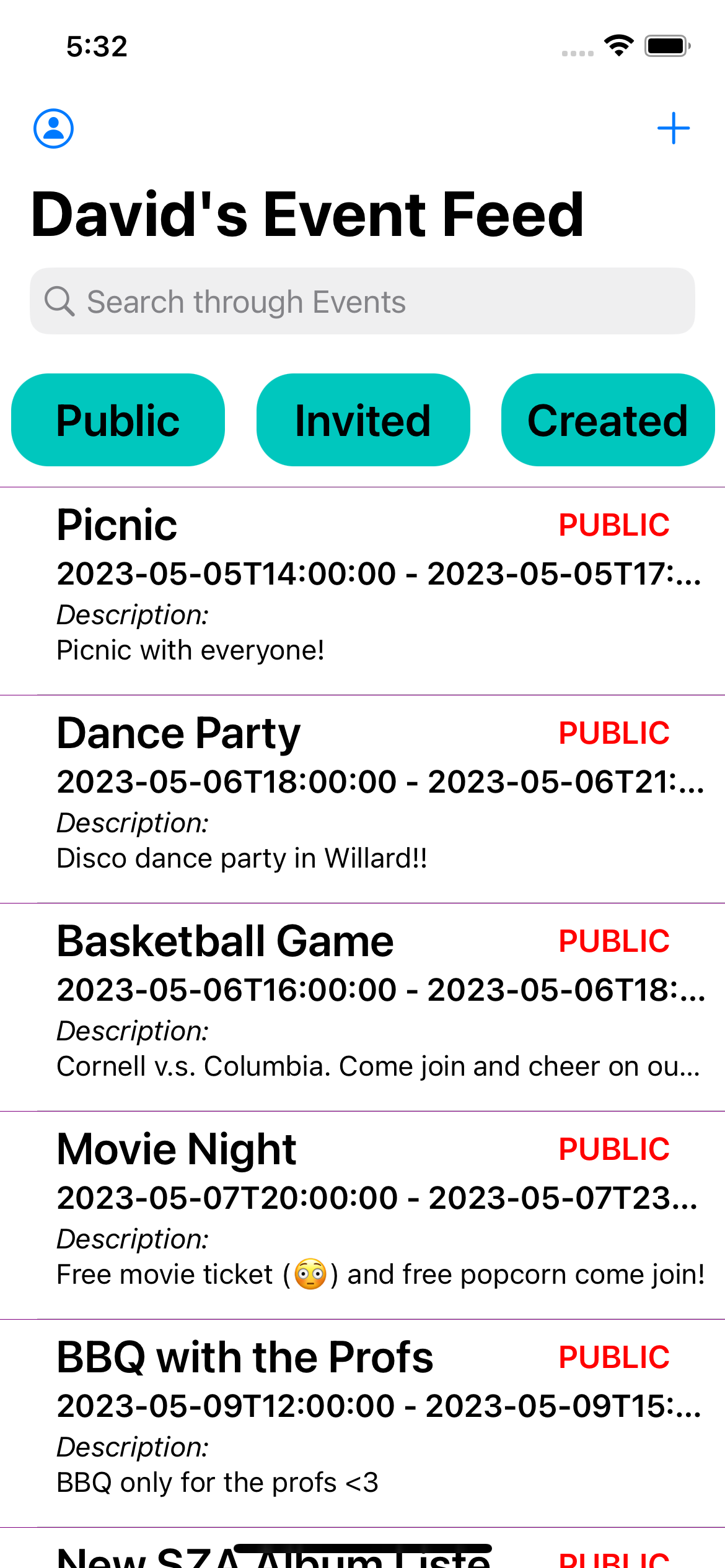
Want to invite any of your friends to an event? Simply create an event and invite them through Invited!

-
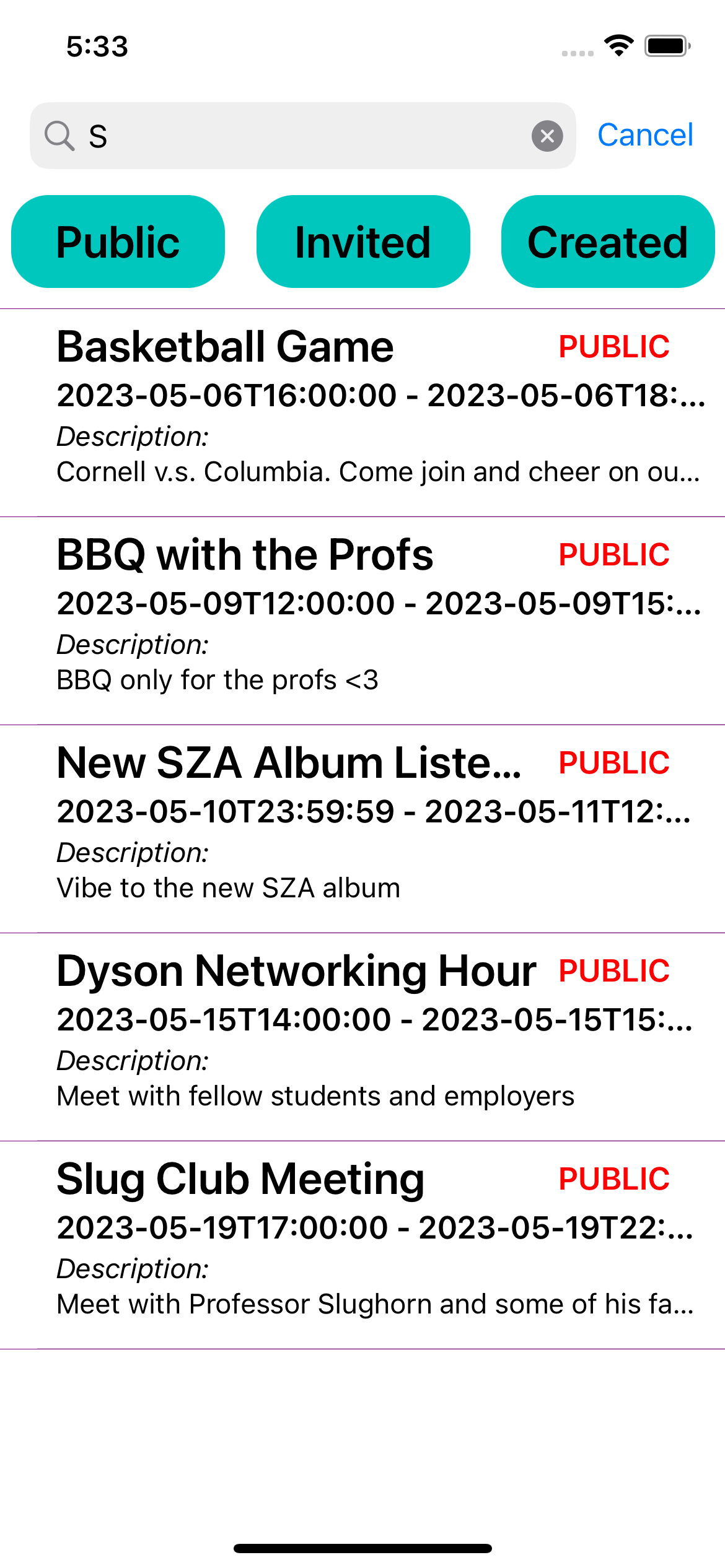
🔍 Search Events: Use the searchbar to go through public, invited, and created events!
-
👤 Create a Profile: Save your name and email!
-
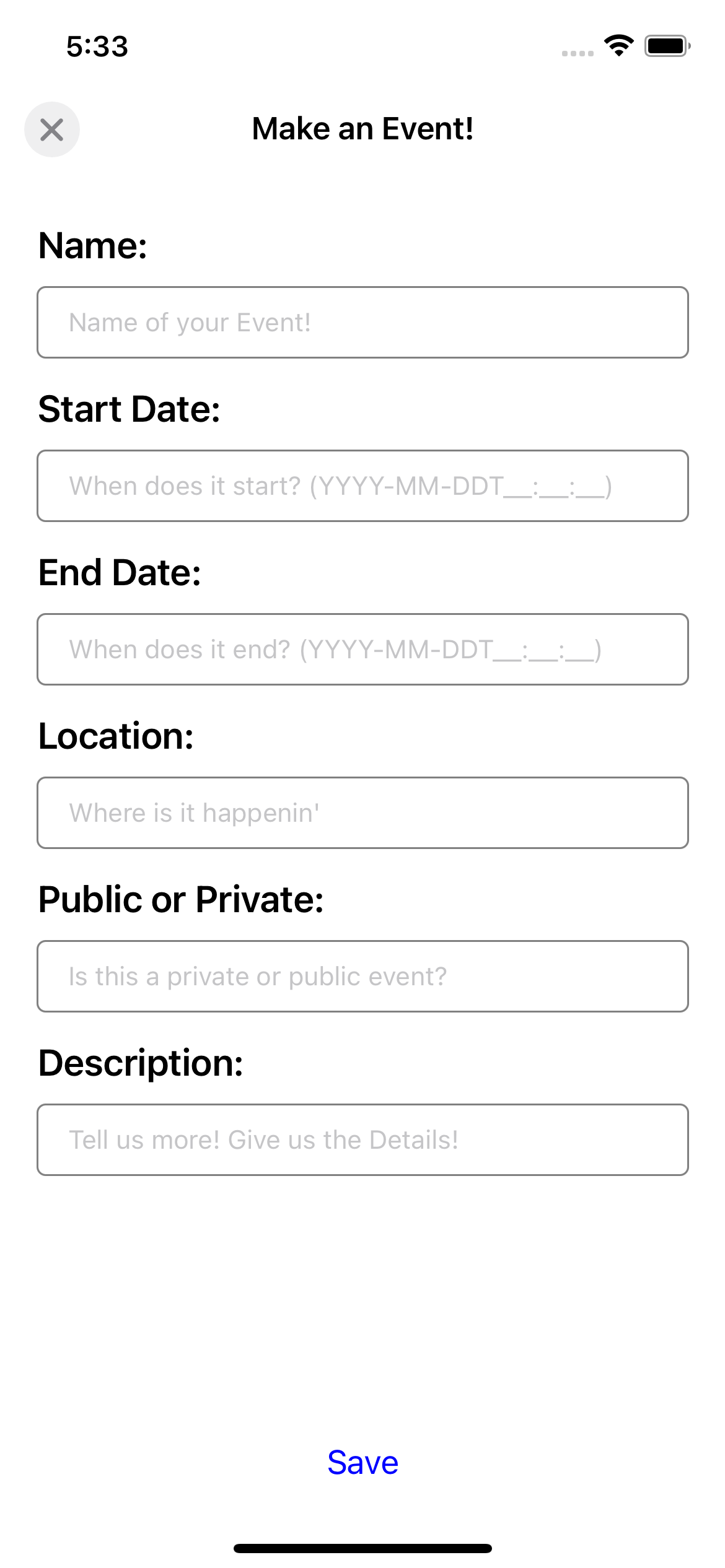
🎉👥 Make Events: Host events and share them!
-
🔄 Refresh: Swipe up to see new events added to your event feed!
- We added multiple ViewControllers alongside the main VC: ProfileViewController (PVC), EventDetailViewController (EDVC), EventMakerViewController (EMVC).
- The PVC shows a screen where the user can write their name and email, which gets saved within the app through UserDefaults. Though initially it used delegation to change the main VC's title to also show the User's name, we later changed to using persistence and UserDefaults. There's email validation on the frontend side as users cannot write out a random set of chars and pass it off as an email.
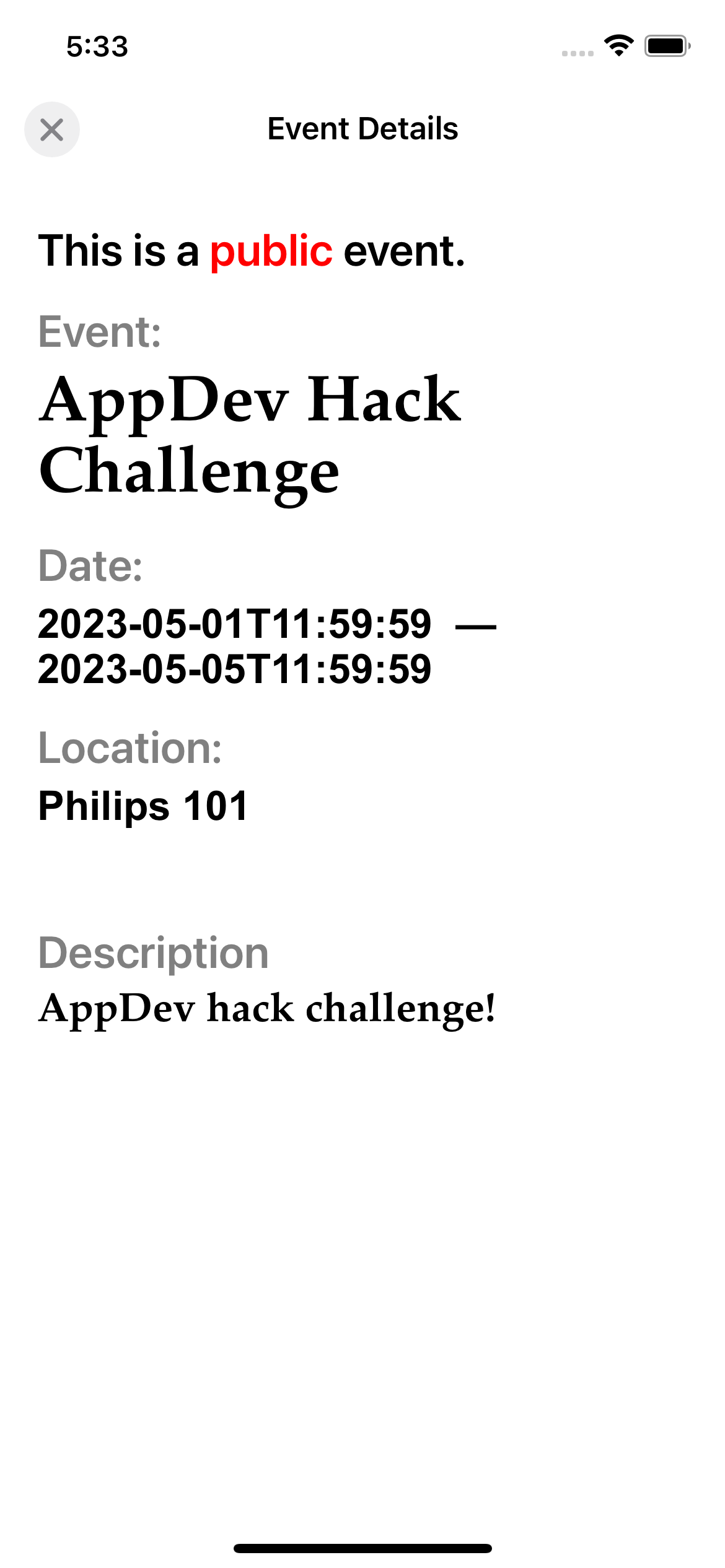
- The EDVC displays data from a
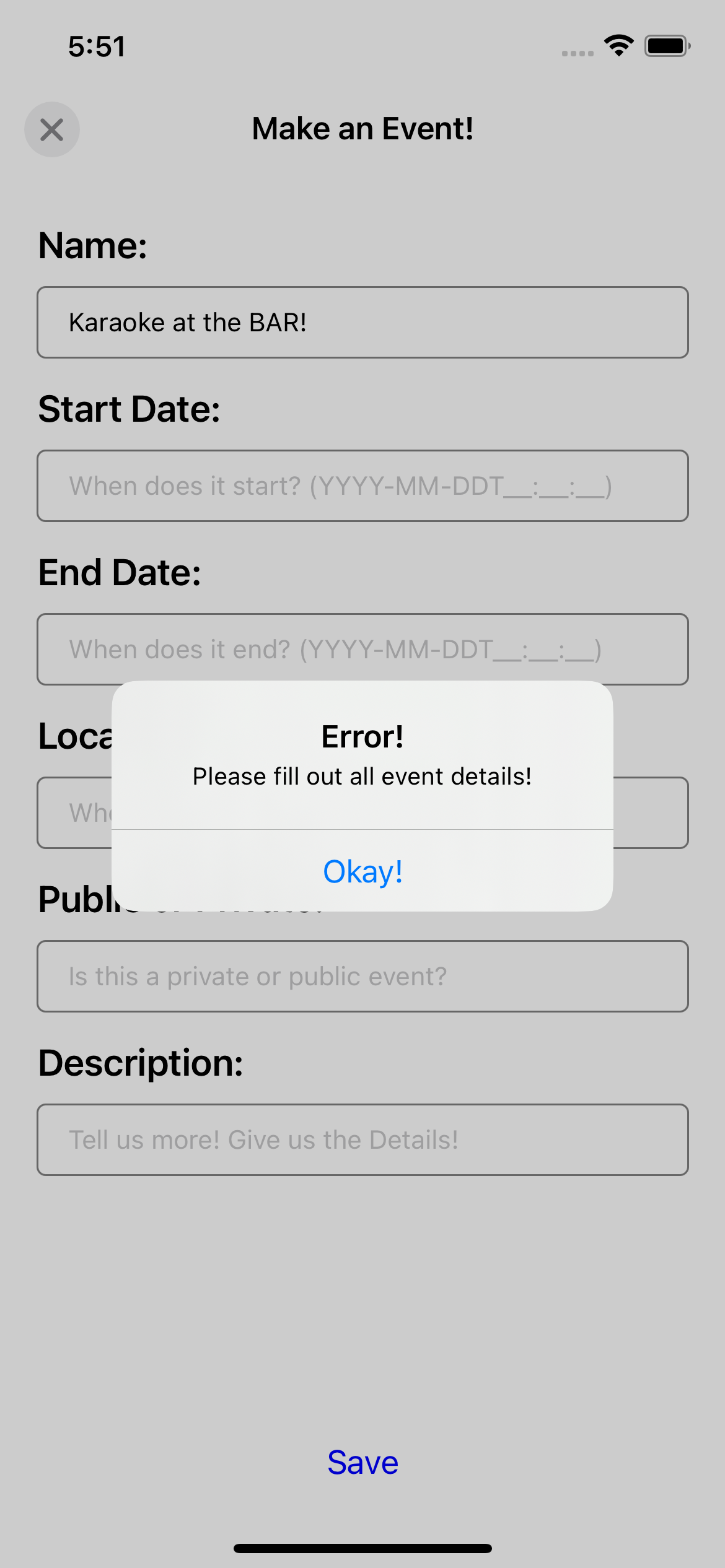
tableviewcellfrom the tableview in the main VC and the screen presents all the information about the event. The user can also exit out of any VC that is not the main VC. - The EMVC allows the user to create an event itself. Currently, we only support public events; users writing anything other than PUBLIC or PRIVATE will be shown an alert. Another alert is also shown in the EMVC if the start and end timing are written in an incorrect format.
- When making the event, it does a POST and once created, the EMVC is exited and the main VC is shown. The user can refresh the tableview and see the event they made.
- The main tableview itself uses GET to show all public events.
- In terms of filtering, we have public and created events implemented such that the public events filter, when selected, shows all public events and the created events filter, when selected, shows all the events the user created.
- We also have a
searchbarthat filters through the event names and can be used alongside the filters from thecollectionview. - Our
networkmanageris connected to the backend API, to reiterate again!
- Implemented schemas for serialization, deserialization, and validation through Marshmallow
- Three models (for now) through SQlAlchemy as an ORM tool: User, Event, and Asset
- Implemented many-to-many relationship between User and Event
- Users can either be a creator or a recipient of an event (which can be public or private)
- Users can create multiple events and be a recipient of many events, vice versa
- We implemented the role (creator/recipient) through an association object w.r.t. a UserEvent model
- One-to-One relationship between User and Asset (a user has a profile picture as an asset)
- Implemented many-to-many relationship between User and Event
- Routes and features implemented
- User authentication and authorization (through session token)
- User account registration, login, logout, session refresh
- User can perform CRUD operations on event, including adding/removing a recipient (a user) from an event
- Get all public events
- Get all user-created events
- Get all events invited to a logged-in user
- Edit user profile information
- Get user(s) public profile information
- Image retrieval (user profile pictures) through AWS
- Containerization and image creation through Docker