
HypeCheck reads a draft health press release next to the paper it reports, flags every sentence that claims more than the study found, has Claude rewrite it, and re-checks the rewrite before anything is published.
Every 1,000 honest press-release sentences: Claude Sonnet as the judge wrongly blocks 296 and costs $0.97. HypeCheck wrongly blocks 67 and costs $0.18 ($0 on your own GPU).
On 345 press releases that experts judged faithful to their paper, HypeCheck wrongly flagged 6.7%. Claude asked the same question flagged 29.6% (Sonnet 4.6) to 44.9% (Haiku 4.5). The gap holds against all three Claude models in a paired bootstrap (Sonnet: 22.9 points fewer false flags, 95% CI 17.8–27.9). On the full 563-pair benchmark it scores macro-F1 0.498 zero-shot (95% CI 0.452–0.541), level with the best published system (0.4735), which was trained on the task.
AWS's own Bedrock Guardrails grounding check ranks these exaggerations at chance (AUROC 0.50 vs
0.72), because the facts stay the same and only the claim grows. On real text, the gate flags 15% of
85 NIH releases and 1 in 9 Claude summaries of the same papers, and fixes 9 in 10 of those
summaries. All ten experiments were pre-registered, and python research/reproduce.py recomputes
every number offline.
| Live demo | https://d174bz5yly61n4.cloudfront.net (click New here? 30-second tour) |
| HypeWatch | https://d174bz5yly61n4.cloudfront.net/hypewatch: 85 real NIH releases checked against their papers, updated daily |
| Developers | https://d174bz5yly61n4.cloudfront.net/developers: free API key in one click, REST API, MCP connector, bring your own data or AWS |
| Decision pattern | decision_pattern/: a claim-fidelity gate, #guardrails |
| Notebook | notebooks/reproduce.ipynb: every headline number recomputed offline, with charts (open in Colab) |
| Article | ARTICLE.md |
| Article | Builder Center |
| Video | https://youtu.be/FYuR9-ymPR4 (2:44, 4K) — generated reproducibly by video/make_video.py |
| Tags | #strands-decider-2b #guardrails |


| Criterion | The claim | The evidence | Where |
|---|---|---|---|
| Creativity | Hype is stopped at its source, and the gate explains every verdict with a claim ladder | The hero replay; a live check; HypeWatch on real NIH releases; the AI-summaries run | Live demo · HypeWatch |
| Effective use of Decider + Bedrock | One typed question, compared in code; a threshold with a kept promise; Claude rewrites and Decider re-checks; all four intervention actions; a hashed receipt per verdict | decision_pattern/, research/results/calibration/summary.json, research/results/significance/summary.json |
Pattern README · Developers |
| Beats the alternatives | Fewer false alarms than three Claude models, Bedrock Guardrails and a keyword rule, with CIs | research/results/baseline-*/, guardrails/, keyword-baseline/ |
Results table · docs/false-alarms.svg |
| Honesty | Ten pre-registered experiments with every miss reported; every error listed by direction; the threshold sweep | research/PREREGISTRATION-*.md, research/results/misses/MISSES.md, docs/sweep.svg |
Misses · Sweep |
| Communication | Plain-language site with ⓘ on every number, a 30-second tour, this README, the article, the video | — | ARTICLE.md · VIDEO.md |
| Originality | The only entry on health news and AI summaries of science | — | COMPETITION notes |
| Reproducibility | 22 headline numbers recompute offline in 10 s; every result file is fingerprinted | research/reproduce.py, research/results/MANIFEST.json |
Notebook |
Decider gets one typed question, asked of the paper's conclusion and then of every sentence in the draft:
How strong is the relationship this statement claims?
no_relationship<correlational<conditional_causal<direct_causal
The overclaim score is P(sentence level > paper level). A Strands InterventionHandler runs it
in before_tool_call on publish_release. Each sentence then lands in one of three zones, and
both thresholds are conformal, fitted on held-out expert-labelled data:
| Zone | Rule | What happens |
|---|---|---|
| BLOCK | score > 0.50 (α = 0.10) | Guide: Claude rewrites those sentences, then the rewrite is re-checked |
| REVIEW | 0.40 < score ≤ 0.50 (α = 0.20) | Low confidence. Doesn't block; listed for an editor in the publish record |
| OK | score ≤ 0.40 | Passes |
| still blocked after 3 rewrites | Confirm: a person decides |
Decider only classifies; plain code decides; Claude cannot argue with a number. In one recorded AgentCore run, Claude's first rewrite still overclaimed (0.56). The gate caught it and the third round was clean.
- The exaggeration starts upstream. Most exaggeration in health news starts in the press release, not the newsroom (Sumner et al., BMJ 2014, 462 releases). A third of releases turned correlation into causation. When the release exaggerated, 81% of the news did too.
- Fixing the release works. A randomised trial in 9 press offices showed that aligning releases with the evidence made headlines more accurate with no loss of coverage (Adams et al., BMC Medicine 2019).
- Nobody has automated it. The only free human pre-publication review service closed in 2018, and no tool checks a draft against its own paper.

The threshold is not a knife edge. Every cut-off from 0.46 to 1.0 keeps false flags on non-exaggerating pairs at or below 10%; ours (0.50) sits inside that band and catches 38.5% of exaggerations, against a best of 41% anywhere in it (python research/sweep.py). Every miss is listed by direction in research/results/misses/MISSES.md: 75 exaggerations let through (of which 7 were in the review zone, so an editor saw them) and 23 faithful releases blocked, each with the sentence, the paper and both readings of the ladder.
All test data is published expert coding that we did not write. Every experiment was pre-registered before it ran (research/), ten in all, and every missed prediction is reported.
| Measurement | Decider 2B (zero-shot) | Claude on Bedrock, same question |
|---|---|---|
| Faithful releases wrongly flagged (the negative control) | 6.7% (CI 4.1–9.4%) | Haiku 4.5 44.9% · Sonnet 4.6 29.6% · Opus 4.6 40.0% |
| Exaggeration macro-F1, 563 pairs (Wright & Augenstein 2021) | 0.498 (CI 0.452–0.541; published best 0.4735, trained: a statistical tie) | Haiku 0.358 · Sonnet 0.401 · Opus 0.460 |
| Exaggerates-vs-not AUROC | 0.716 | Haiku 0.570 · Sonnet 0.580 · Opus 0.663 |
| No-model baseline: flag any sentence with a causal verb (the site's own cue-word lists) | AUROC 0.716 vs 0.528; gap 0.19 (95% CI 0.12–0.25) | The rule flags 26.4% of faithful releases vs our 6.7% (pre-registration) |
| AWS-native baseline: Bedrock Guardrails contextual grounding, same pairs, same conformal fit | AUROC 0.716 vs 0.503; gap 0.21 (95% CI 0.14–0.29). Recall 38.5% vs 13.9% | Guardrails flags 13.3% of faithful releases (pre-registration) |
| Conformal promise (≤10% false flags) vs measured, 441 unseen non-overclaim pairs | 7.7% (95% CI 5.6–10.6%) | — |
| Recall at that strict threshold | 39% (CI 30–47%) | Haiku at ~10% false flags: 18% |
| Advice inflation, 116 real UK releases (InSciOut), AUROC | 0.84 | — |
| Causal strength, 3,061 PubMed sentences (Yu 2019), direct-vs-correlational AUROC | 0.894 | — |
| Latency per decision | 160 ms (laptop RTX 4070) · ~0.9 s (EC2 CPU) | Haiku ~2.0 s · Sonnet ~0.9 s · Opus ~5.3 s |
| Cost per sentence checked | $0.00018 (c7i CPU at full use) · $0 on owned hardware | Haiku $0.00051 · Sonnet $0.00097 · Opus $0.0056 |
Cost basis:
- Claude: tokens actually used across 563 checks × Bedrock list price (Haiku 4.5 $1/$5, Sonnet 4.6 $3/$15, Opus 4.6 $5/$25 per million tokens in/out).
- Decider: c7i.4xlarge on-demand at $0.714/h × 0.9 s per decision.
Measured limits:
- 39% recall at the strict threshold: it is a safety net, not a full reviewer. The other published 2B checkpoints don't fix it: on the train split, hobson-v21 ranked 0.720 and an ensemble 0.724, against 0.712 for ours, below our pre-registered +0.03 bar (pre-registration).
- The animal-to-human hint is weak: AUROC 0.61 on 45 releases, so it never blocks.
- 563 pairs give wide intervals.
- The demo server runs Decider on CPU, because a GPU quota request was still pending.
What this does not show:
- No press officer has used it. The rules come from published research (Sumner 2014, Adams 2019), not from user testing.
- HypeWatch and the AI-summary run have no human labels. Their rates are Decider's flags. On the labelled benchmark, about 58% of blocks at the strict threshold are real overclaims, so some HypeWatch flags will be wrong. That is why each sits next to the paper's own words.
- It judges one thing: how strong a causal claim is. It does not check numbers, doses, sample sizes or invented facts. That is a job for a grounding check, and Bedrock Guardrails' grounding check does not catch inflated strength.
- English health research only. Every dataset is English-language biomedicine.
- Claude's rewrites can change meaning. Decider re-checks how strong each rewrite's claim is, not whether it is faithful in every other respect. A person should read what is published.
- One run each. Every experiment ran once; the intervals are bootstrap intervals over items, not over repeated runs.
Reproduce every number, offline: python research/reproduce.py recomputes the 22 headline numbers in this README from the saved per-item outputs. It checks each file against its fingerprint first. It needs no Decider, AWS or network, costs nothing, and takes about 10 seconds.
Benchmarks are curated, so we also pointed HypeCheck at text nobody chose for us: every NIH news release from February 2023 to October 2026 that cites its paper by DOI. These releases are public domain. That is 85 releases and 615 sentences. Each headline, subtitle and opening sentence was checked against the paper's abstract, and Claude suggested a rewrite for every blocked sentence.
| Pre-registered measure | Result |
|---|---|
| Releases with a sentence the gate would block, strict public rule | 15.3% (13 of 85; predicted 3–20%) |
| Same under the benchmark rule (conclusion only) | 43.5% (predicted 20–50%) |
| Headlines vs body, mean overclaim score | 0.20 vs 0.19, no meaningful gap |
| Claude's suggested rewrites that pass Decider's check | 66.7% (missed the 85% prediction, so they are shown as suggestions) |
The public rule only flags a sentence that claims more than the conclusion and more than the
strongest claim anywhere in the abstract. That avoids flagging an animal result reported earlier
in the abstract, and since it can only remove flags, the calibrated false-flag bound still holds.
A systemd timer on EC2 checks new releases every morning (hypecheck/hypewatch.py).
Peters & Chin-Yee (2025, R. Soc. Open Sci. 12:241776) found that AI summaries of research were
4.85× as likely as expert-written ones to generalise beyond the paper (95% CI 3.06–7.70). We asked
Claude Sonnet 4.6 and Haiku 4.5 to summarise the same 85 papers, then scored the summaries under
the same public rule (pre-registration,
research/ai_summary_eval.py).
| Pre-registered measure | Sonnet 4.6 | Haiku 4.5 |
|---|---|---|
| Summaries with a sentence the gate blocks (predicted 5–25% for Sonnet) | 11.8% (10 of 85) | 10.6% (9 of 85) |
| Flagged summaries fixed by the gate (predicted ≥ 85%) | 90% | 89% |
| Per-sentence block rate (NIH releases on the same papers: 2.9%) | 4.3% | 3.9% (predicted higher than Sonnet: missed) |
Example: the paper says medication for opioid use disorder in jail "was associated with" lower overdose and death risks. Both summaries said expanding it "can save lives". These are Decider's flags, without human labels.
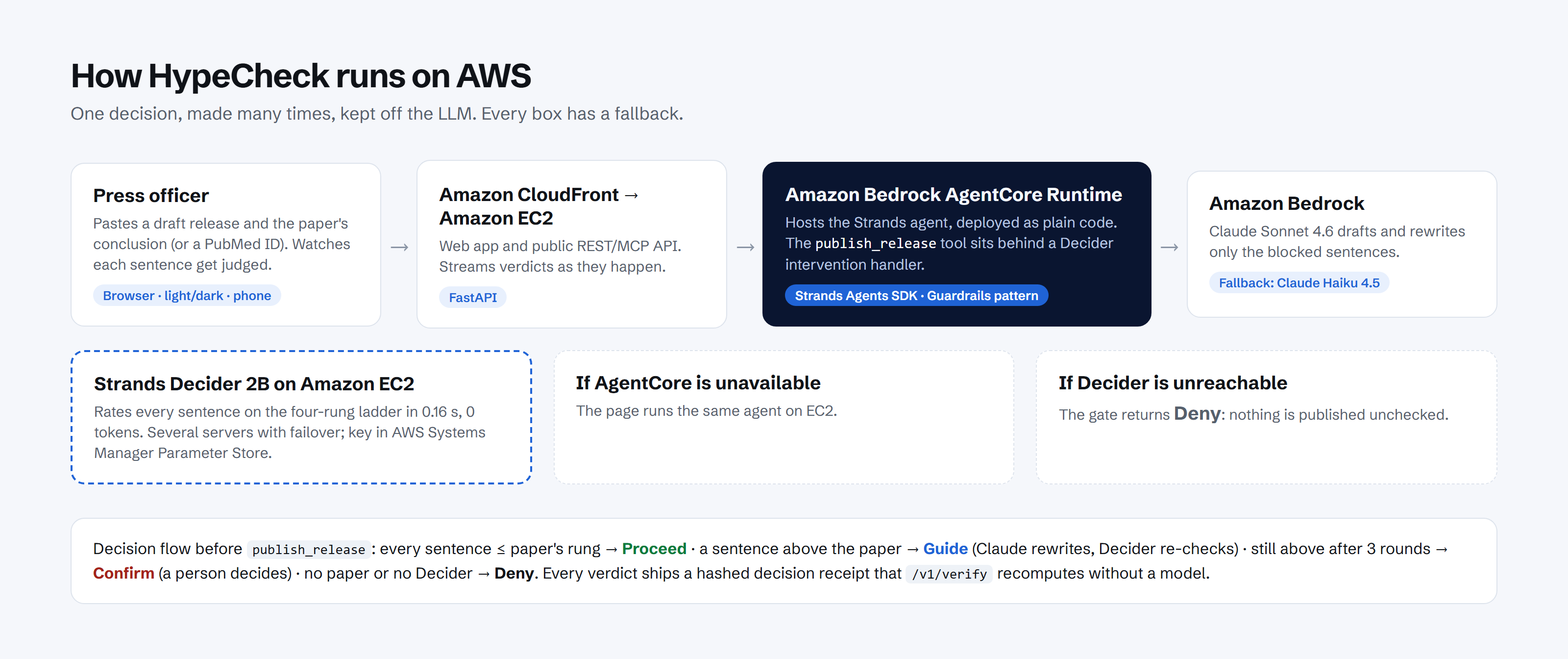

- Amazon Bedrock AgentCore Runtime hosts the Strands agent (
agentcore_app.py).- Direct code deploy, no container:
deploy/agentcore_deploy.py. - Streams every event.
- Direct code deploy, no container:
- Amazon Bedrock serves Claude Sonnet 4.6, which drives the agent and writes the rewrites.
- Amazon EC2 (Elastic IP) runs Strands Decider 2B and the web app, which queues runs and streams sentence-by-sentence progress.
- Amazon CloudFront gives HTTPS.
- AWS Systems Manager Parameter Store holds the key that guards the Decider endpoint AgentCore calls.
- Fallback: if AgentCore fails, the web app runs the identical agent in-process.
decision_pattern/README.md covers the typed question and option
set, the wiring, the actions, and how to calibrate on your own data. In short:
from decision_pattern import Decider, ClaimFidelityGate, load_threshold

gate = ClaimFidelityGate(Decider(), source=lambda: paper_conclusion,
                         tool_name="publish_release", text_arg="text",
                         threshold=load_threshold("calibration.json", "0.1"),
                         review_threshold=load_threshold("calibration.json", "0.2"))
agent = Agent(model="us.anthropic.claude-sonnet-4-6", tools=[publish_release], interventions=[gate])
examples/leaflet_gate.py runs the identical gate on a patient-leaflet writer: it caught "less
likely to develop dementia" stated as fact. pytest -q runs the offline tests (fake decider, no
Bedrock).
| Way in | What you get |
|---|---|
| REST API | POST /v1/check (free, 300 a day per key): every sentence's claim strength, overclaim probability and zone. POST /v1/rewrite (20 a day): Claude fixes the blocked sentences, and Decider verifies each fix. Keys are issued instantly at /developers, with no signup; only a SHA-256 hash is stored. OpenAPI reference at /docs |
| MCP connector | https://d174bz5yly61n4.cloudfront.net/mcp exposes check_claims and suggest_rewrites to any MCP client: Strands, Claude Desktop (via mcp-remote), Kiro, Cursor. A Strands agent on Bedrock has been verified using it to block "Statins prevent dementia" (0.73) |
| Bring your own data | A form on /developers (paste or upload a CSV, or load a sample from a non-health domain) or POST /v1/calibrate with 10–60 of your labelled pairs returns a split-conformal threshold with a stated false-flag rate for your domain |
| Decision receipt | Every verdict carries hashed, code-written facts (checkpoint, every rung probability, scores, thresholds, zone, policy). POST /v1/verify or the verify_decision_receipt MCP tool recomputes them with no model, and names any sentence that doesn't match |
| Python package | pip install "git+https://github.com/usv240/hypecheck" installs the reusable decision_pattern gate on its own |
| Bring your own AWS | deploy/hypecheck-stack.yaml deploys the whole stack into your account: one EC2 instance, a least-privilege Bedrock role, access through SSM, no SSH. Test-launched end to end |
Claude rewrites spend real Bedrock money, so they also have a shared ceiling of $2 per day. Checks never call a language model.
Upstream: strands-decider#103 proposes docs for comparing two texts, with our numbers.
Backups, and failing closed:
- The agent's host: the agent runs on AgentCore Runtime, and the page falls back to the same agent on EC2 if AgentCore fails.
- Claude: Sonnet 4.6 falls back to Haiku 4.5 if it is throttled or unavailable. This was tested by forcing a model the account cannot use.
- Decider: the client takes several servers and fails over between them.
- Failing closed: if no Decider answers, or there is no source to check against, the gate
returns
Denyand nothing is published unchecked.
pip install strands-decider
strands-decider serve StrandsAgents/strands-decider-2B-qwen3.5-v1-2610 --port 8099

pip install -r requirements.txt            # AWS credentials with Bedrock access
python -m hypecheck.agent --draft examples/referral_release.txt \
    --conclusion "Use of the urgent referral pathway could be efficacious."
uvicorn hypecheck.web:app --port 8080      # the demo UI
To deploy:
deploy/ec2-bootstrap.shbuilds the EC2 box. It uses the GPU if there is one, CPU otherwise.deploy/agentcore_deploy.pycreates the AgentCore runtime.deploy/update-ec2.shrolls out new code.
| Path | What |
|---|---|
decision_pattern/ |
The reusable gate: questions, scoring, intervention, conformal calibration, client |
hypecheck/ |
The agent (agent.py), web app (web.py, static/), AgentCore client |
agentcore_app.py |
AgentCore Runtime entrypoint |
research/ |
Pre-registrations, evaluation scripts, per-item results |
deploy/ |
EC2 bootstrap and update, AgentCore deploy |
AUDIT.md, DESIGN.md |
Self-audit against the rules; UI design principles |
Apache-2.0. Benchmark data is not redistributed; each dataset keeps its own licence
(see research/README.md).