

Sift massive security datasets.



An offline, evidence-safe workbench for investigating multi-gigabyte CSV security data — without loading it into RAM, uploading it anywhere, or modifying the source. Written in Rust; command-line tool and desktop application for Linux, macOS and Windows.
Status: pre-release, under active development. Interfaces and the manifest format may still change before 1.0.
- Evidence-safe -- The source is opened read-only and never rewritten. Its SHA-256 is computed on open; every derived artefact is tied to it.
- Bounded memory -- The source never has to be held in RAM as a whole: a sparse, quote-aware record index (a few KiB per GiB) plus fixed read buffers is what navigation needs, so the index pass runs in the same ~35 MiB at 1 GiB and at 10 GiB. Match sets and lookup tables grow with the matches and the tables, not with the file (measured operations and conditions in bench/README.md).
- Strictly offline -- No telemetry, no update checks, no DNS. Enrichment (GeoIP / ASN, domain classification, lookups) uses only local datasets the analyst imports, each identified by hash.
- Reproducible -- Every filter, time range, enrichment and redaction is
recorded in a provenance manifest next to the export;
gridsift verifychecks it later.
| Interface | Binary | Description |
|---|---|---|
| Desktop | gridsift-desktop |
The interactive investigation: instant rows, search and pivot with a visible selection lineage, value counts, dashboard and timeline, enrichment, export with redaction. |
| CLI | gridsift |
Index, search, count, timeline, profile, export, verify; --json on every command for scripting and batch use. |
Both binaries come from the one gridsift package; the desktop application
is what cargo run starts.
Rust 1.88 or newer. From crates.io, one package installs both binaries:
cargo install gridsift --locked # gridsift-desktop and gridsift
Or build from source:
git clone https://github.com/uky007/GridSift.git
cd GridSift
cargo build --release
./target/release/gridsift --help
./target/release/gridsift-desktop
See docs/installation.md for Linux build
dependencies, the dist profile and where the index cache lives.
The examples use a synthetic proxy log made by the tool itself (the demo
profile only uses hosts under the IANA-reserved example.com / .net / .org and TEST-NET addresses, so
nothing in it is a real host or incident), in a scratch directory that
the repository ignores:
export PATH="$PWD/target/release:$PATH"
mkdir -p demo && cd demo
gridsift gen  --profile demo --size 200M -o proxy.csv   # synthetic proxy log, seed 1
gridsift info proxy.csv                                  # dialect + first rows, no scan
gridsift index proxy.csv                                 # sparse index + SHA-256, one pass
gridsift search proxy.csv '/c2/beacon' -c path -n 5      # literal, one column, all cores
gridsift search proxy.csv -r 'deny,"curl/[0-9.]+"'       # regex
gridsift freq proxy.csv -c dst_port -s '/c2/beacon'      # top values over the matches
gridsift timeline proxy.csv -c timestamp -b 1h           # records per hour
gridsift profile proxy.csv                               # ipv4, domain, sha256, timestamp, …
gridsift export proxy.csv -o beacon.csv -s '/c2/beacon' -c path --domain host
gridsift verify beacon.csv                               # re-hash output and source against the manifest
gridsift-desktop proxy.csv                               # or drag & drop onto the window
gridsift-desktop proxy.csv --search '/c2/beacon' --dashboard
Redaction with a key (--redact user=hmac --hmac-key-file KEY) is shown
in docs/usage.md; keep the key outside the repository
(*.key is ignored) and never in the manifest, which records only its
fingerprint.
See docs/usage.md for every option, jq recipes and the
desktop walkthrough.
- Instant open -- rows on screen in milliseconds; the index and the SHA-256 are built in one background pass (~1 s per GiB warm).
- Quote-aware sparse index -- checkpoints carry parser state, so multi-line quoted fields are records, any record is one bounded read away, and scans run on all cores over disjoint ranges.
- Search -- literal, regex or exact field value, per column, case-insensitive, inverted; 2–13 GiB/s on a 10-core laptop with a warm cache; results are a compressed bitmap of records.
- Selection lineage -- a search within a search within a time range: each step is a chip with its count, revertable without rescanning, and exactly what the manifest records.
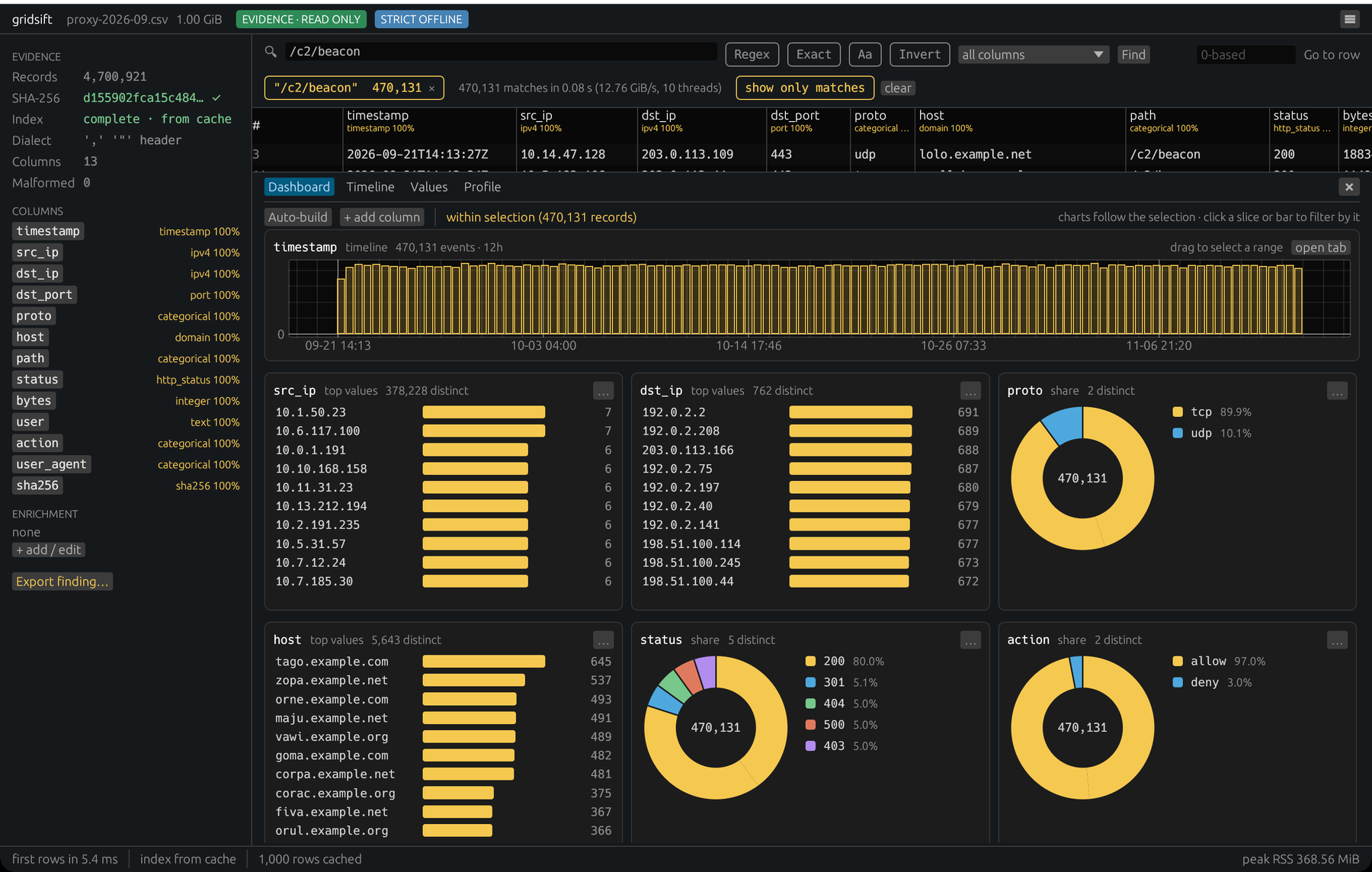
- Dashboard -- charts picked from what the columns hold: a timeline for the timestamp column, pies for protocol / action / status, top-value bars for hosts, addresses and ports. They follow the current selection, and a click on a slice or bar of a source column is the next selection step; derived enrichment columns are counted only.
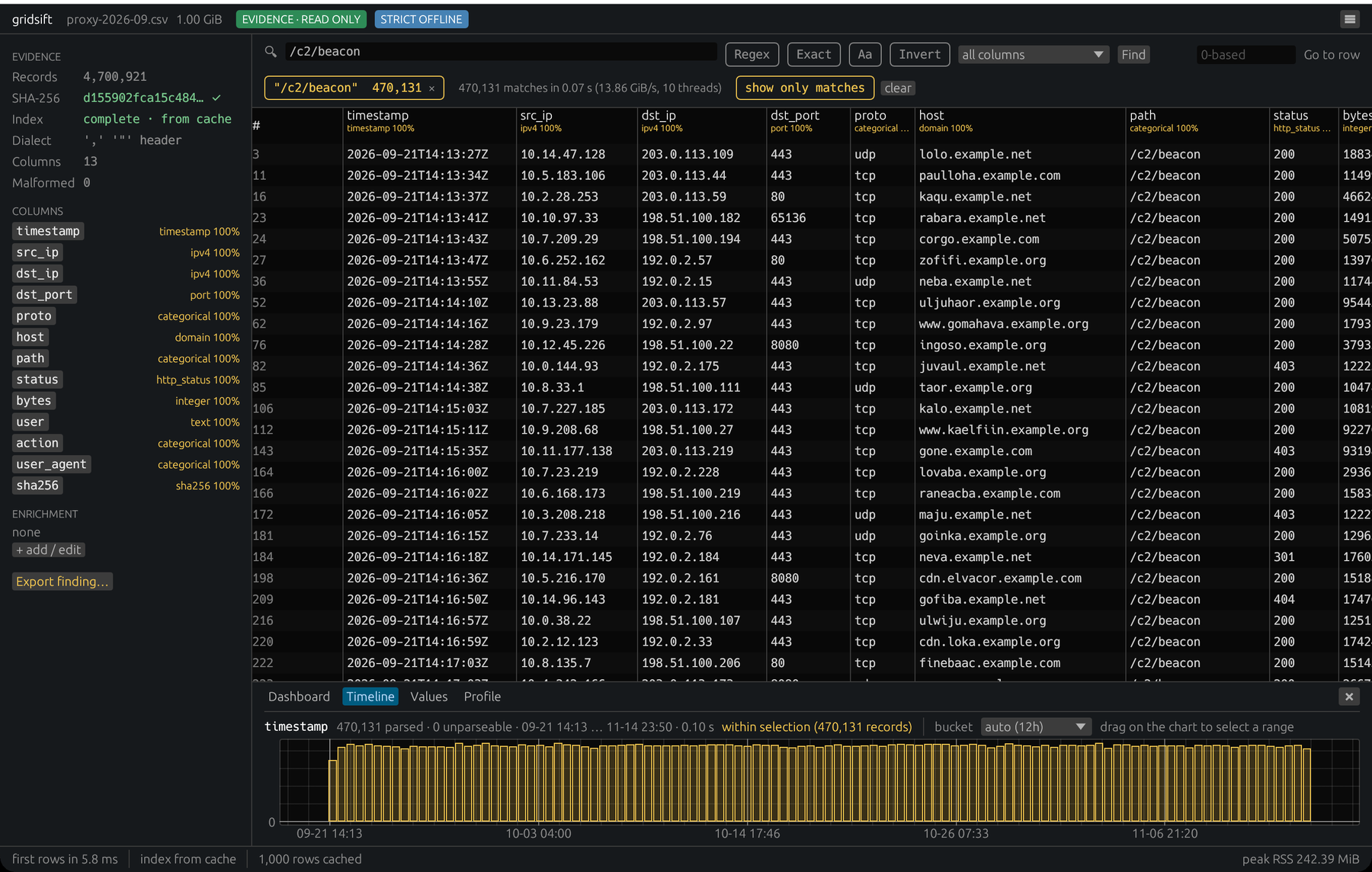
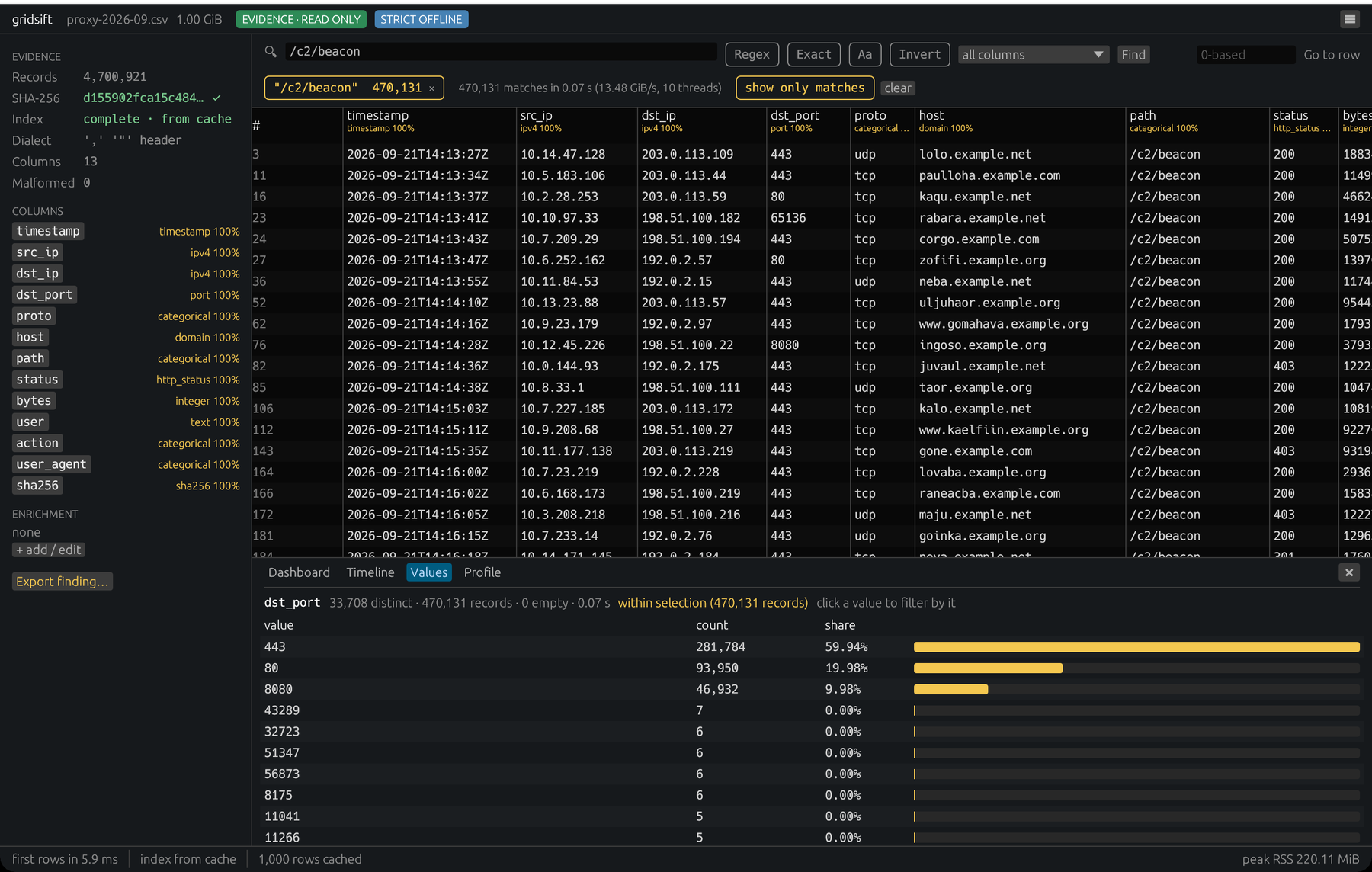
- Value counts and timeline -- top-N per column (exact, then lossy with a stated bound), records per time bucket with drag-to-select ranges.
- Semantic typing -- columns labelled ipv4, domain, sha256, timestamp, port, … with confidence; annotations only, values are never converted.
- Offline enrichment -- GeoIP / ASN from an imported MMDB, registrable domain from the bundled Public Suffix List, joins against local CSVs; derived columns in the grid, in counts and in exports.
- Edits as an overlay -- change cells and mark rows in the grid; saved as named versions with the case, never into the source; an export can apply them and its manifest lists every change.
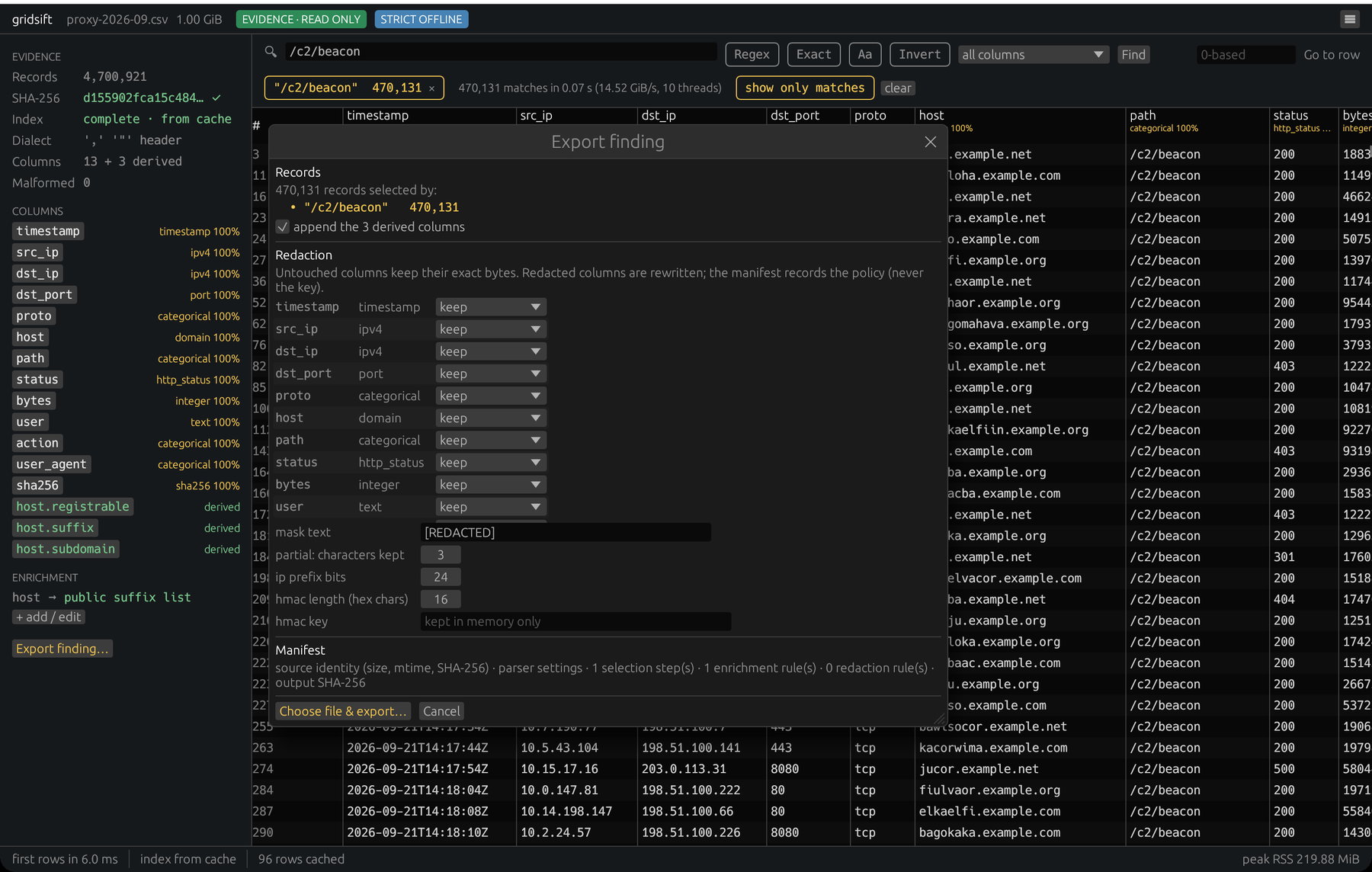
- Export with redaction -- exact source bytes per record, or drop / mask / partial / ip-prefix / HMAC-pseudonymised columns; the policy (never the key) goes into the manifest.
- Provenance manifest -- source identity, parser settings, every
operation, output digest; written before the output it describes and
checked by
gridsift verify(docs/manifest.md). - Evidence protection by construction -- every path the tool writes (output, manifest, index sidecar, their temporaries) is checked against the source first; a source that changes on disk after it was opened is detected and blocks exports.
- Honest numbers -- elapsed time, throughput and peak RSS on every command; approximate results say so.
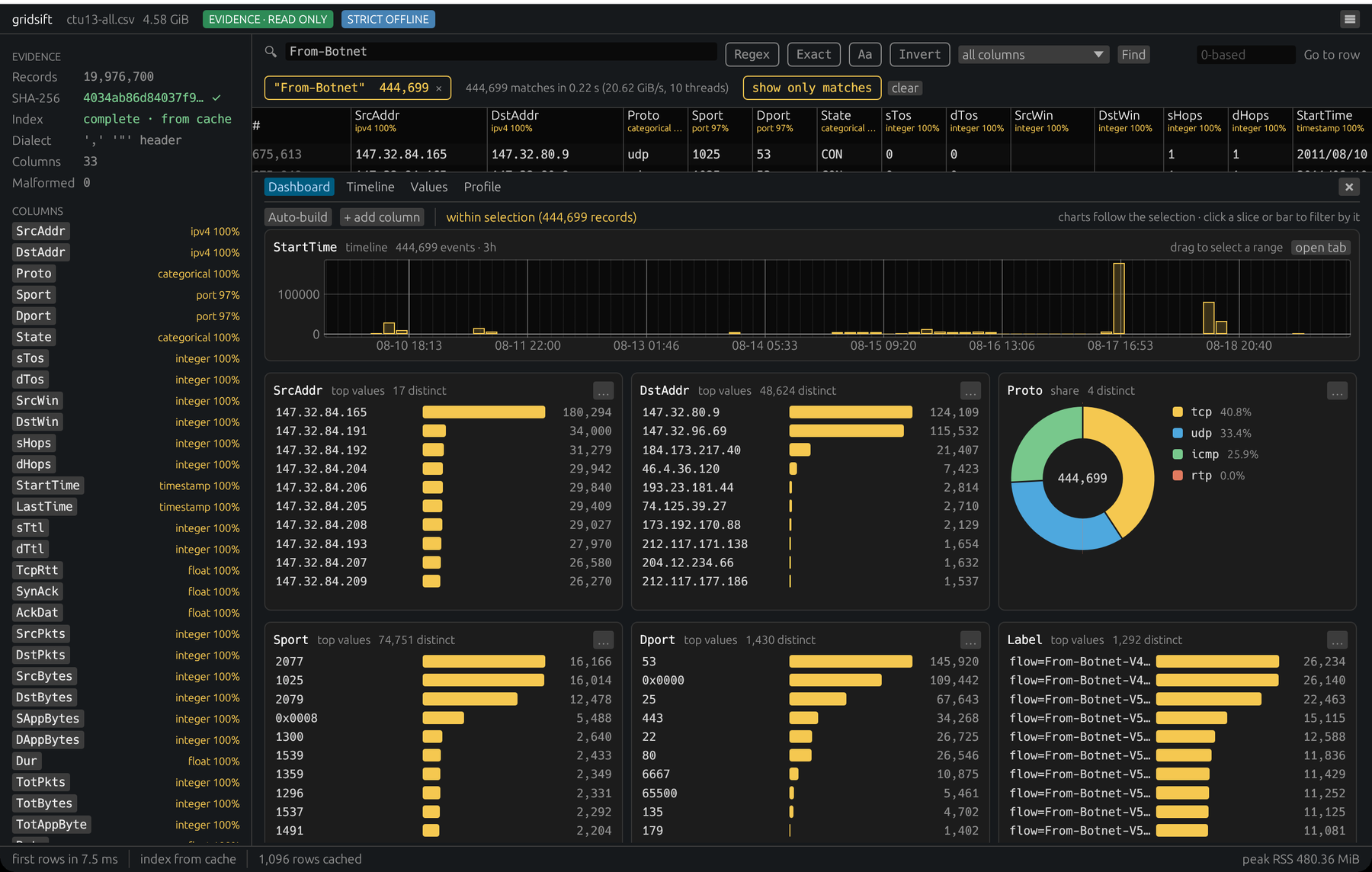
The first four screenshots show synthetic data from gridsift gen: the
hosts, addresses, users and /c2/beacon paths are generated, and no real
incident, host or indicator appears in them. The last one shows public
research data that stays under its own licence.
Twenty million labelled flows from the CTU-13 dataset (Stratosphere
Laboratory, Czech Technical University in Prague; CC BY 2.0,
García et al. 2014), with the From-Botnet flows selected and the charts
following the selection. The addresses are the dataset's own, and the data
in this image stays under the dataset's licence, not the project's (see
NOTICE). The investigation with its known answers is in
docs/demo.md.
| Code | Meaning |
|---|---|
| 0 | Success |
| 1 | Error while running (input not found or unreadable, refused write, index or scan failure) — for verify, a digest mismatch or a required source that is missing |
| 2 | Command-line usage error (unknown option, missing argument), reported by the argument parser |
- Why gridsift exists — the problem, who it is for, how it is used
- Description & feature list
- Installation
- Usage & examples
- Demo on real traffic (CTU-13), with known answers
- The provenance manifest
- Survey of existing tools
- Roadmap
- Desktop UI design
- Benchmarks
Dual-licensed under either of
- Apache License, Version 2.0 (LICENSE-APACHE)
- MIT license (LICENSE-MIT)
at your option. Third-party licences, and the licence of the dataset shown in the CTU-13 screenshot, are listed in NOTICE.