Agents Crew is a dependency-free TypeScript control plane for durable multi-agent work across Codex, Claude Code, OpenCode, and Antigravity. The normal interface is one prompt: Agents Crew bootstraps its runtime state, creates the smallest useful task graph, coordinates capable agents, enforces policy, recovers durable work, and verifies completion. Registered AI agents can also coordinate directly through task leases, durable mailboxes, and optional A2A delivery without routing every interaction through the engine.
Only the manager host needs the plugin files. Workers can be native host agents, installed CLI tools, read-only API models, or peer agents participating through the agent mesh.
From a connected Codex, Claude Code, OpenCode, or Antigravity host, the normal workflow is:
@agents-crew fix OAuth reconnect and add tests
The equivalent CLI entry point is:
agents-crew orchestrate --host opencode --goal "fix OAuth reconnect and add tests"No explicit crew init, crew name, or manual manager loop is required. If .agents-crew/config.toml is missing, orchestration creates the minimum starter configuration automatically and records durable run state under .agents-crew/ inside the current repository. That directory is coordination state, not another copy of the source tree. Equivalent active requests resume by normalized request hash instead of creating duplicate runs.
Low-level lifecycle, manager, and agent commands remain supported for integrations, debugging, and explicit manual control.
For requirements, installation instructions, first setup, development guidelines, and release procedures, see GUIDELINE.md.
agents-crew orchestrate --host <host> --goal "..." [--plan-only]
crew init [--force] [--non-interactive]
crew ui [--port 4815] [--no-open]
crew start <template-id> --goal "..." [--expectation "..."] [--acceptance "..."] [--constraint "..."]
crew run <goal...>
crew plan <goal...>
crew status [run-id | --run run-id]
crew resume [run-id | --run run-id]
crew pause [run-id | --run run-id]
crew approve <approval-id> [--run run-id]
crew reject <approval-id> [--run run-id]
crew cancel [run-id | --run run-id]
crew doctor
crew config validate|show
crew template list|show|validate|delete
crew plugin list|install|doctor|uninstall
crew worker probe
crew worker run <worker-id> <task.json>
crew manager start --goal "..." --host <host>
crew manager step --run <run-id>
crew manager submit --run <run-id> --action <action-id> --result <result.json>
crew agent capabilities
crew agent register <agent-id> --provider <provider> --roles <csv> --capabilities <csv> [--a2a-url <url>] [--a2a-tenant <tenant>]
crew agent list
crew agent heartbeat <agent-id>
crew agent claim <run-id> <task-id> <agent-id> [--lease-seconds 300]
crew agent release <run-id> <task-id> <agent-id>
crew agent send <run-id> <from-agent> <to-agent> --body "..." [--kind message|request|response|review|blocker] [--task <task-id>]
crew agent inbox <run-id> <agent-id>
Add --json anywhere for machine-readable output. JSON output never contains ANSI styling. Human output uses structured headings, indentation, status symbols, and ANSI color only when stdout/stderr is an interactive TTY; NO_COLOR disables color. Add --workspace <path> anywhere to target another repository.
An AI agent can discover the coordination protocol without starting or initializing the engine:
crew agent capabilities --jsonAgents register a stable identity and capabilities, then can discover peers, claim/release tasks using leases, exchange messages, and inspect their inbox. Claims are accepted only while the run is working, and the registered agent must match the task role and include every capability requested by that task. These operations do not call the engine progression loop.
Messages are journaled to the durable local mailbox before optional direct delivery is attempted. When a recipient registers an A2A endpoint, direct A2A additionally requires the sender's registered network capability and the run snapshot's permissions.network = "allow"; ask and deny stay mailbox-only. Eligible direct delivery uses A2A 1.0 JSON-RPC SendMessage, and a registered interface tenant is echoed on the request. A delivery receipt overlays the durable mailbox record after the direct attempt, so a slow or failed network cannot delay creation of the local audit record. If direct delivery is unavailable or fails, mailbox delivery remains functional. A2A authorization values can be supplied by the TypeScript API as environment-variable references; secret values are never stored in registration files.
Force-releasing a lease is intentionally unavailable through the ordinary peer CLI. Trusted TypeScript callers can use AgentMesh.releaseTask(..., true) for recovery tooling.
This makes the engine a coordination kernel rather than a mandatory communication relay. The existing manager protocol remains authoritative for planning, guarded execution, approvals, verification, retries, and completion.
Integrations and debugging tools can use the explicit durable protocol directly:
crew manager start --goal "Implement the requested change" --host claude-code --json
crew manager step --run <run-id> --json
crew manager submit --run <run-id> --action <action-id> --result result.json --json
The manager must only execute actions returned by the runtime:
plan— define acceptance criteria and bounded tasksreview— recover or revise failed/interrupted workdispatch_native— execute one host-native role with an exact capability enveloperequest_approval— wait for a user decisionterminal— display final state
Action IDs are one-time, capability-bounded, and expire after 24 hours. Peer messages and task leases do not require a manager action, but they cannot bypass these lifecycle/policy decisions. The generated @agents-crew host command hides this protocol during normal one-prompt use.
.agents-crew/
├── config.toml
├── roles/
├── templates/
├── plugin-manifests/
├── agents/<agent-id>.json
├── active/<run-id>/
│   ├── run.json
│   ├── orchestration.json
│   ├── crew.snapshot.toml
│   ├── goal-<run-id>.md
│   ├── status.md
│   ├── status.json
│   ├── events.jsonl
│   ├── intent.json
│   ├── actions/
│   ├── agents/claims/<task-id>.json
│   ├── communication/<agent-id>.jsonl
│   ├── communication/.delivery/<message-id>.json
│   ├── artifacts/
│   ├── context/
│   └── tasks/
├── history/<run-id>/
└── worktrees/<run-id>/<task-id>/
Each run snapshots its resolved configuration. Resuming a run does not silently adopt later workspace or template edits. orchestration.json contains only high-level request/recovery metadata; it does not store model chain-of-thought.
One-prompt orchestration automatically writes a starter .agents-crew/config.toml only when no configuration exists. Use crew init explicitly when you want the complete role files and setup workflow. Existing configuration is never overwritten by automatic bootstrap.
Example CLI workers:
[[workers]]
id = "opencode-implementer"
kind = "cli"
enabled = true
adapter = "opencode"
model = "configured-by-user"
roles = ["implementer", "tester"]
capabilities = ["read", "write", "shell"]
priority = 80
args = []
env_allowlist = []
requires_network = true
requires_credentials = true

[workers.headers]
Built-in adapters provide default invocations for codex, claude-code, opencode, and antigravity. Set command and args for custom CLIs. Supported placeholders are {model}, {prompt}, {workspace}, and {output}.
API workers are intentionally read-only:
[[workers]]
id = "read-only-reviewer"
kind = "api"
enabled = true
provider = "openai"
model = "configured-by-user"
api_key_env = "OPENAI_API_KEY"
roles = ["researcher", "reviewer"]
capabilities = ["read", "network"]
priority = 50
args = []
env_allowlist = []
requires_network = true
requires_credentials = true

[workers.headers]
Credential values are read from environment variables and never printed by doctor output.
Each guarded operation is configured as allow, ask, or deny:
[permissions]
local_read = "allow"
local_edit = "allow"
test_commands = "allow"
network = "ask"
destructive_commands = "ask"
credentialed_actions = "ask"
commit = "ask"
push = "ask"
deploy = "ask"
The runtime checks the task envelope before dispatch, validates reported capabilities, rejects writable API workers, validates changed-file scope, serializes writers in current-workspace mode, and requires criterion-linked evidence before completion.
Set:
[run]
workspace_mode = "isolated"
Write tasks receive .agents-crew/worktrees/<run>/<task>/. Independent writers can execute in parallel. Their binary Git diffs are applied back to the main workspace and the temporary worktrees are cleaned after successful integration. Failed worktrees can be retained for inspection.
Configure commands as arrays, avoiding shell interpolation:
[verification]
commands = [["npm", "test"], ["npm", "run", "build"]]
require_independent_review = true
allow_same_agent_review = false
Worker results must follow schemas/worker-result.schema.json and include capabilities used, tests, changed files, and evidence linked to acceptance criteria.
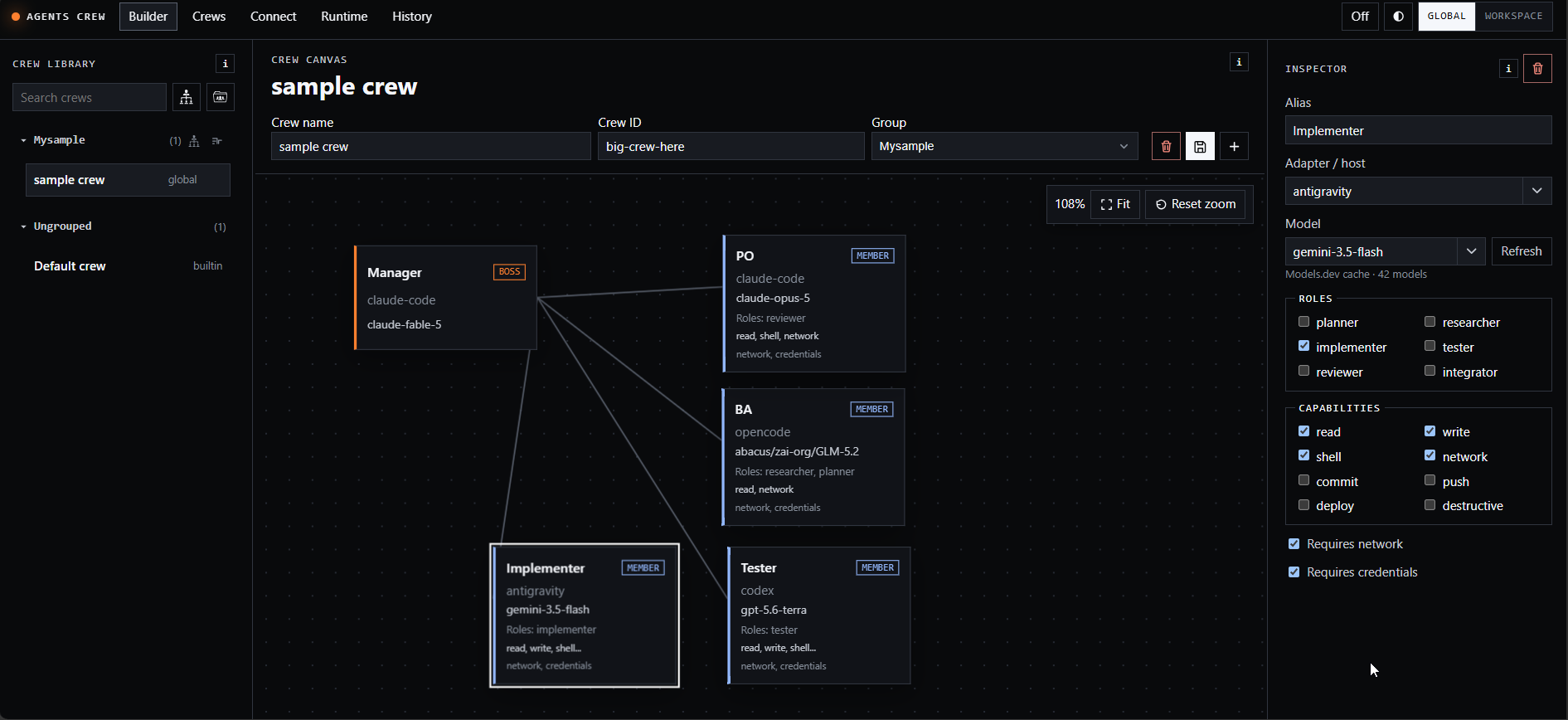
crew uiThe UI binds only to 127.0.0.1, serves bundled local assets, and requires a random per-launch API token embedded in the opened local URL. It has five views:
- Builder — compose a crew on a grab-to-pan, wheel-to-zoom graph with Fit and Reset controls. Edit hosts, models, roles, capabilities, network access, and credential requirements.
- Crews — browse built-in, global, and workspace crew definitions in a data table and open them in Builder.
- Connect — install, check, repair, or disconnect Agents Crew wiring in the current user's global host scope for Codex, Claude Code, OpenCode, and Antigravity. Ownership manifests prevent Connect or Repair from seizing unrelated files.
- Runtime — inspect and control active durable runs plus Agents-Crew-managed worker subprocesses. Process controls provide safe Pause/Resume scheduling and managed Restart/Stop; Runtime never lists arbitrary operating-system processes.
- History — inspect completed, cancelled, failed, and otherwise archived runs without active-run controls.
Host/model fields use a searchable custom combobox with centered SVG controls. Model choices are loaded for the selected adapter from the Models.dev catalog and limited to active models with text input and text output. OpenCode can use catalog models from every provider; Codex, Claude Code, and Antigravity receive their supported provider sets. Fresh cache remains usable for six hours, while stale or unavailable catalogs expose no selectable model IDs.
The header provides explicit dark and light modes. Every section has contextual help, and all buttons and text fields use square corners. Template saves are scoped to global or workspace storage. Request bodies are capped at 1 MiB. The UI has no CDN, remote fonts, analytics, frontend framework, or external browser dependency.
See guidelines, installation, configuration, manager protocol, security, local UI, troubleshooting, and releasing.