

We explore agentic security, local and distributed AI, resilient systems, and unusual computing architectures through small, inspectable experiments.
Build a chapel, not a cathedral—and no preaching.
We optimize for the rate at which ideas become evidence.
Failure is a result.
| Program | Question |
|---|---|
| Agentic Security & Trust | How can autonomous systems remain observable, bounded and attack-resistant? |
| AI & Computing Systems | How can intelligence become cheaper, local and distributed? |
| Resilient & Space Systems | How can computation survive faults, energy scarcity and extreme duration? |
| Frontier Experiments | Which unusual ideas deserve the smallest decisive test? |
| Project | Research focus | Current status |
|---|---|---|
| Loopscope | Observability for agent workflows | Flagship; daily personal use reported by the owner |
| Nightshift | Bounded overnight portfolio work with reviewable branches | Research Engine flagship; net human time savings under evaluation |
| OSCAL Skills Guardrails | Static + semantic admission and integrity checks for agent skills | Reference implementation; hardening questions remain |
| TSLIT-DSPy DGX | Controlled model-integrity probes | Experimental evidence; negative findings and withdrawn work documented |
| Wiki vs RAG | Retrieval quality, token and latency tradeoffs | Recorded four-arm study on one corpus |
Research Atlas and evidence dossiers →
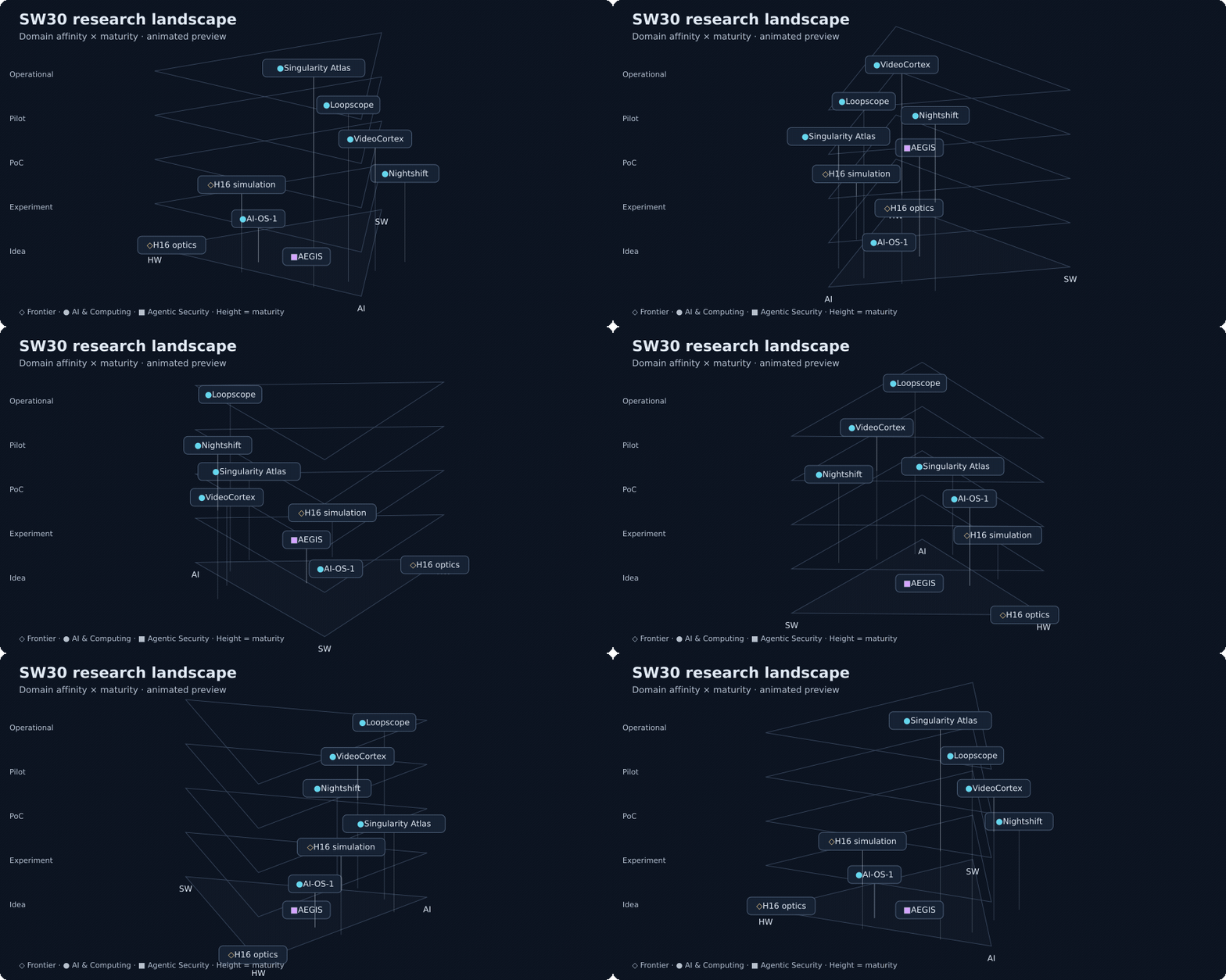
Animated preview (slow orbit). Full interactive version →
Explore the broader portfolio, including Singularity Atlas, VideoCortex, design studies and the RPC-H16 frontier experiment. Height means maturity, not importance; each project links to evidence and its next milestone. Physical optics and space qualification remain unproven.
Explore Porter Five Forces and weekly effort →
Ten source-grounded assessments, a holistic portfolio review, and an adjustable planning example. Current focus: Loopscope, Nightshift and Skills Guardrails, with bounded Atlas maintenance and a small frontier allocation. Ratings are analyst judgments, not measured market scores.
How humans and agents work together — cadence, decisions, and the local stack.
| Page | What it covers |
|---|---|
| About / How we work → | Research loop, weekly cadence, human judgment vs agent momentum |
| My tech stack → | Machines, models, languages, memory, observe/assess, deliver/decide |
The SW30 Research Engine is a cross-cutting layer: local models, deterministic tools, simulations and recorded experiments, with selective frontier-model review. It supports all four programs.
Hypothesis → experiment → evidence → finding → kill / modify / reproduce / promote.
Research method and template · Full repository catalog and wiki · Published writing
- Author: AI Agents in Cybersecurity — companion code.
- Named key contributor: The Human-Agent Orchestrator and Agentic Artificial Intelligence.
- Published articles · Agentic Intelligence newsletter · The FS Intelligence Hub.
Built by Nic Cravino · AI/ML Engineering · Cybersecurity · Enterprise Automation
Profile reviewed: 2026-09-06. Evidence dates and limitations are recorded in the linked dossiers.