A JSON viewer that survives large files.
Open multi-gigabyte JSON and NDJSON in your browser. No freezing, no upload, no server.
➜ Install from the Chrome Web Store





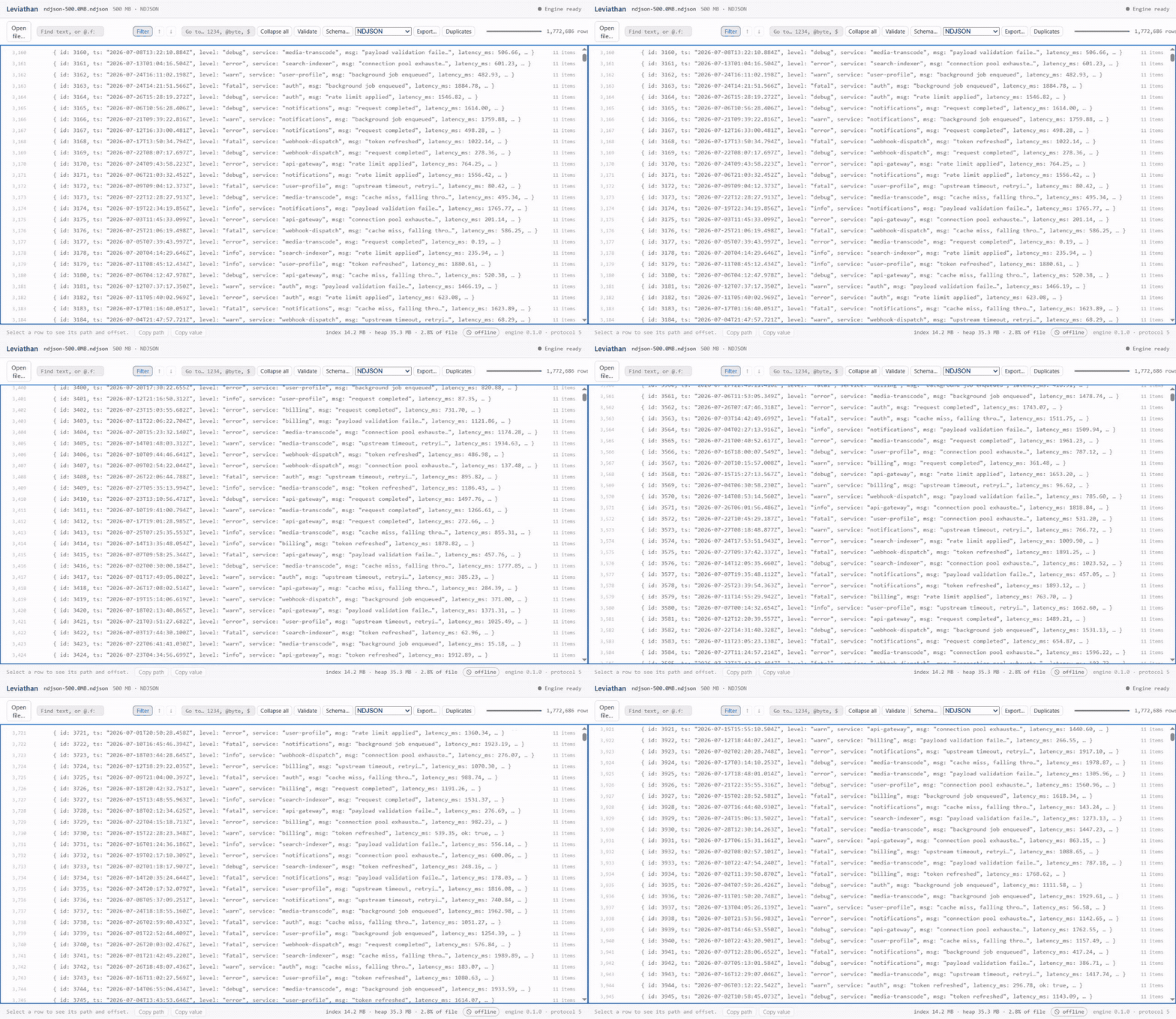
A real 500 MB NDJSON file — 1,772,686 records — scrolling unedited. The
status bar is live throughout: index 14.2 MB · heap 35.3 MB · 2.8 % of file.
Recorded by scripts/demo.mjs, which drives the extension
over the DevTools Protocol so the take is reproducible rather than
hand-staged · full-quality MP4
Note
Status: v0.1.0 is live on the Chrome Web Store — reviewed and approved
11 August 2026, with a permissions list Chrome itself renders as empty. An
8 GB NDJSON file indexes in 17.8 s inside 539 MB, and paints fifty
rows from record 28,239,470 in 2.5 ms
(how big is "large"?). On the 500 MB benchmark
fixture: first rows in 141 ms, a median 16.6 ms frame with zero long
tasks, @.level == "error" over 1.77 M records in 8.7 s, 24.8 M keys
checked for duplicates in 6.5 s, and the whole file written back out in
7.7 s — all in 22 MB. One criterion is not met: 0.7 % of frames exceed
32 ms (details) — published rather than buried, as it was before
the listing went live. Still to publish: the crates.io and npm packages, and
the Edge listing. See the roadmap.
Every JSON viewer in your browser does the same thing:
JSON.parse(await file.text()) // ← the tab is now gonefile.text() holds the whole file as a UTF-16 string (2× its size), and
JSON.parse builds an object graph typically 3–10× its size again. A 500 MB
file asks for several gigabytes on the main thread.
flowchart LR
    subgraph N["❌ Every other viewer"]
        direction TB
        F1["500 MB file"] --> T1["file.text()<br/><b>1 GB</b> UTF-16 string"]
        T1 --> P1["JSON.parse()<br/><b>~2.5 GB</b> object graph"]
        P1 --> X1["💀 tab freezes, then dies"]
    end

    subgraph L["✅ Leviathan"]
        direction TB
        F2["500 MB file"] --> S2["stream it in a Worker<br/>never held whole"]
        S2 --> I2["byte-offset index<br/><b>14 MB</b>, 8 B per node"]
        I2 --> R2["🚀 paint 40 visible rows<br/>re-lex 4 KB each"]
    end

    N ~~~ L
Leviathan never parses the file into a value — it indexes it. The index stores only where things start. Key names, values and spans are re-derived by re-lexing a few kilobytes at the moment a row is painted: microseconds each, against hundreds of megabytes to store them.
| Feature | Lands in | |
|---|---|---|
| 📂 | Load — drag-and-drop, file picker, folder, paste. JSON and NDJSON auto-detected | M2 |
| 🧭 | Navigate — go to a row, a byte offset, or a path pasted back from Copy path | M2 |
| 🌲 | View — virtualized tree, breadcrumb, full keyboard navigation, dark mode | M2 |
| 🔍 | Find — literal search streamed over the whole file, not just what's on screen | M2 |
| ✅ | Validate — byte/line/column-accurate errors, jump to the break, JSON Schema | M3 |
| 🧭 | Filter — @.status == "error" && @.latency_ms > 1000, evaluated against the index, results streamed |
M4 |
| 🧬 | Dedup — duplicate keys and elements, reported with both locations | M5 |
| 📤 | Export — JSON, NDJSON, CSV, or the current filter result — streamed to disk, byte-faithful | M6 |
Everything rides one engine. Nothing needs a server, an account, or a network.
It survives broken files, too. A truncated dump, one bad escape at 90 % depth, a log rotation mid-record: every stage degrades instead of aborting — partial index, markers in the tree, exports that write what they can. "It won't open" is the failure mode of the tools this replaces.
Large JSON is a specialist problem. These are the people who hit it.
| Persona | The moment they reach for it | What carries the load |
|---|---|---|
| 👩💻 Priya — Backend / API | A 300 MB API dump with one malformed record among 200,000 | Tree + find + JSONPath, without dropping to jq |
| 🛠️ Rahul — Data / ETL | 500 MB–2 GB NDJSON out of Kafka or BigQuery, before a load job | NDJSON auto-detection, validation, dedup — his whole range is measured, with 4× of headroom above it |
| 🔬 Sofia — QA / Test | A pile of captured responses and one JSON Schema | "Does it conform, and exactly where does it break" |
| 🚨 Marcus — Platform / SRE | Mid-incident, inside a depth-20 Terraform or k8s state file | Fast deep navigation and subtree export |
| 🧩 Aisha — Integration dev | An unfamiliar third-party payload, learning its shape from a sample | Shape inference — v1.5, not v1 |
The bar: a tool that saves an engineer 40 minutes during an incident earns
permanent toolbar space. Narrow and deep, not broad — see
USER_PERSONAS.md.
flowchart TB
    subgraph MAIN["🖥️  Main thread — renders, never parses"]
        direction LR
        UI["<b>Viewer UI</b><br/>virtual tree · find bar<br/>breadcrumb · export"]
        CLIENT["<b>Engine client</b><br/>typed RPC · one batch per frame"]
        UI <--> CLIENT
    end

    subgraph WORKER["⚙️  Web Worker — owns the file handle"]
        HOST["<b>Worker host</b><br/>typed dispatch · progress · cancel"]
        BLOB[("<b>File / Blob</b><br/>never read whole")]
    end

    subgraph CORE["🦀  leviathan-core — Rust → WASM, zero dependencies"]
        direction TB
        LEX["<b>Streaming lexer</b><br/>resumable across chunk boundaries"]
        IDX["<b>Node index</b><br/>8 B/node · two-tier · lazy"]
        OPS["<b>Find</b> · <b>Query</b> · <b>Validate</b> · <b>Dedup</b> · <b>Export</b><br/>all run against the index"]
        LEX --> IDX --> OPS
    end

    CLIENT -->|"postMessage · transferable"| HOST
    HOST -->|"feed(&[u8])"| LEX
    OPS -->|"ByteRange::read(start, len)"| BLOB
    BLOB -.->|"4–64 KB slices"| OPS
    IDX -.->|"packed rows, one buffer per screen"| CLIENT

    classDef thread fill:#0d1117,stroke:#4a9eff,stroke-width:2px,color:#e6edf3
    classDef rust fill:#0d1117,stroke:#ce832f,stroke-width:2px,color:#e6edf3
    class MAIN,WORKER thread
    class CORE rust
What actually happens when you drop a 500 MB file
sequenceDiagram
    autonumber
    participant You
    participant UI as Main thread
    participant W as Worker
    participant Core as Rust core

    You->>UI: drop file
    UI->>W: postMessage(handle) — bytes never copied
    W->>Core: sniff 64 KB
    Core-->>UI: "ndjson, 500 MB" (instant)
    loop every 4 MB, yielding between batches
        Core->>W: read(offset, 1 MB)
        W-->>Core: bytes via FileReaderSync
        Core-->>UI: progress · rows so far · cancellable
    end
    Note over UI: tree is browsable long before indexing ends
    You->>UI: scroll to row 1,595,372
    UI->>W: rows(1595372, 50)
    W->>Core: materialize slice
    Core->>W: one packed buffer, 40 B/row
    W-->>UI: transferred, not copied
    UI-->>You: 50 painted rows — 68 µs
Three rules hold it together, each enforced by something that fails rather than by convention:
| Rule | Enforced by |
|---|---|
| Parsing never happens on the main thread | The Worker compiles with lib: WebWorker — the UI has no parser to call |
| The core stays portable and publishable | check-layering.sh fails CI on any wasm/IO dependency |
| The bundle stays small | build.mjs fails the build above 150 KB gz |
Measured to 8 GB. Not extrapolated — the numbers below come from running the
shipped .wasm against generated fixtures of each size, and the row that fails
is in the table too.
| File | Records | Index | Peak WASM memory | Indexed in | 50 rows from the far end |
|---|---|---|---|---|---|
| 500 MB | 1.8 M | 14.2 MB · 2.8 % | 22 MB | 1.1 s | 68 µs |
| 2 GB | 7.1 M | 56.6 MB · 2.8 % | 136 MB | 4.4 s | 2.1 ms |
| 8 GB | 28.2 M | 226 MB · 2.8 % | 539 MB | 17.8 s | 2.5 ms |
First rows paint ~23 ms into the first batch at every size — you are browsing while the rest indexes. Filtering all 28 M records of the 8 GB file takes 160 s at 50 MB/s, and the longest single step is 171 ms, so the UI never stops answering.
Where it actually stops, and why it is about shape rather than size
The index is 8 bytes per node whatever that node is. A log record is ~280 bytes and costs 8 to index — 2.8 %. A bare number is ~10 bytes and costs the same 8 — 81 %. So cost tracks how many values a file holds, not how many bytes.
| Shape | File | Index | Peak WASM | Result |
|---|---|---|---|---|
| Records (NDJSON) | 8 GB | 226 MB | 539 MB | ✅ complete |
| Flat array of numbers | 1 GB | 800 MB | 2.15 GB | ✅ complete, near the limit |
| Flat array of numbers | 2.5 GB | 1.07 GB | 2.15 GB |
WebAssembly is 32-bit: 4 GiB of address space, and the table is not the only thing in it. The last row is the ceiling, and it is handled rather than hit — indexing stops, says index too large, and the 134 million records it did find stay fully browsable: painting fifty rows from record 134,217,668 still takes 1.6 ms.
The viewer also warns before you wait: once 2 % of the file is indexed it projects the total from measured bytes-per-node, and says so if the projection will not fit.
This is ADR-004's known trade, measured at its boundary rather than argued about. Two mitigations are identified there; neither is built, because no one has yet asked this tool to open a two-gigabyte array of bare integers.
500 MB NDJSON fixture, 8 × x86_64, bench-native profile. Reproducible with
leviathan bench. Nothing here is an estimate; — means not yet built.
| Metric | Target | Naive JSON.parse |
Leviathan |
|---|---|---|---|
| Tier-1 index build | — | ✗ crashes | 0.35 s warm · 1.07 s cold |
| Index size | < 40 MB | n/a | 14.2 MB — 2.8 % of the file ✅ |
| Peak memory, indexed | < 400 MB | ✗ crashes | 22 MB ✅ |
| 50 rows from the middle | < 20 ms | ✗ crashes | 68 µs warm · 132 µs cold ✅ |
| Same, 5 M-element array | < 20 ms | ✗ crashes | 65–119 µs ✅ |
| Whole-file find | — | ✗ crashes | 466 ms (1.1 GB/s) ✅ |
| JSON Schema, 50 MB / 177,906 records (WASM) | < 5 s | ✗ crashes | 2.78 s ✅ |
| Filter, 500 MB / 1.77 M records (WASM) | — | ✗ crashes | 8.7 s (55–57 MB/s, ~200 k records/s) |
| Longest filter step | < 500 ms | ✗ crashes | 52 ms ✅ |
| Duplicate keys, 500 MB / 24.8 M keys | — | ✗ crashes | 6.5 s (77 MB/s) |
| Element dedup, marginal cost | < 20 % | ✗ crashes | +1.5 % ✅ |
| Element dedup, marginal memory | < 64 MB | ✗ crashes | +34.6 MB ✅ |
| Export 500 MB to NDJSON | — | ✗ crashes | 7.7 s (65 MB/s) |
| Export peak memory, over index | < 64 MB | ✗ crashes | +0 MB ✅ (22.1 vs 22.2 MB) |
| Lex throughput | ≥ 200 MB/s | — | 248–327 MB/s ✅ |
| Parse + validate | — | ✗ crashes | 216 MB/s |
| First rows painted (browser) | < 2 s | ✗ never | 124–143 ms ✅ |
| Long tasks > 50 ms while scrolling | 0 | ✗ constant | 0 ✅ |
| Frame time, scrolling 100 k rows | — | ✗ never | median 16.6 ms, p95 16.9 ms |
| Longest frame | < 32 ms | ✗ never | 35.5 ms ❌ — 2 frames of 2,500 |
| 500 MB fully indexed (browser) | < 10 s | ✗ crashes | 3.6–6.8 s ✅ (74–140 MB/s) |
One criterion is missed, and it is published rather than buried. Scrolling 100 000 rows: 2 500 frames, median 16.6 ms and p95 16.9 ms — 95 % of frames at 60 fps, zero long tasks — but 2 frames reach 35.5 ms against a 32 ms bar.
A second was revised, on evidence. It read "≥ 100 MB/s in WASM" and measured 74–140, so it straddled its own line. The same
.wasmindexes the same file at 470–542 MB/s in Node, where a read is areadSyncinto a reused buffer rather than ablob.slice()plus a freshArrayBuffer— so the criterion was measuring the browser's file API, not the engine. Cutting 479 reads to 120 changed nothing, which says the cost is per byte, not per call; that change was reverted rather than kept. The criterion is now stated as what a user actually experiences — a 500 MB file indexed in under 10 s (C54).A third was revised, for a different reason. M4's criterion read "first results in < 500 ms". Across five filters, four returned in 10–21 ms and one took 6.1 s — because its single matching record sits 330 MB into the file, and 330 MB ÷ 57 MB/s is 5.7 s of arithmetic that no engine change touches. A criterion the same code passes or fails depending on where a match happens to be cannot distinguish a good implementation from a bad one, so it is now stated over what the code controls: no single step over 500 ms, meaning results stream and nothing blocks (C62).
The filter got 2.5× faster by deleting reads, not by parsing better. The first version read each record's own byte range — 1.77 million reads of ~280 bytes — and ran at 23 MB/s. Reading 1 MB windows and reusing one matcher across records took it to 57 MB/s. Notably, the same change to the indexer bought nothing (C54): there the cost scaled with bytes, here with calls, and the two look identical from the source (C60, C61).
The duplicate check got 30× faster before it was published, twice for the same reason. It first read a fresh 256 KB window and then consumed only the ~165 bytes up to the first newline — 78 GB of reading for a 50 MB file, at 1.7 MB/s. Consuming every record in the window took it to 2.7 s; hashing tokens in place instead of copying each into a
Vectook it to 0.99 s. That is the same mistake as the filter's (C60), in a second place, and no test could see either: every answer was already correct (C66).Opening a file is six times cheaper than parsing it. NDJSON indexing scans for newlines and never parses — exact, not heuristic, because JSON forbids raw control characters in strings. It runs at 1.4 GB/s against a 1.2 GB/s newline-counting ceiling, while full parse-and-validate manages 216 MB/s.
One caveat published rather than buried: 8 bytes per node is 2.8 % of a record-shaped file and ~80 % of a flat array of small scalars. That shape misses the criterion, two mitigations are identified, neither is built — ADR-004.
Correctness, not just speed:
| JSONTestSuite (RFC 8259) | 95/95 must-accept · 185/188 must-reject — 3 documented deviations |
| JSONPath CTS (RFC 9535) | 133/133 in scope · 93/93 invalid selectors refused — support table below |
| Export round trip (requirement 11) | 7/7 fixtures token-exact and idempotent — leviathan roundtrip |
| Fuzzing | 1,969,106,501 cases in 30 min — 0 panics, 0 chunk-size disagreements |
| Determinism | The same fixture always yields 108,133,846 tokens and 1,772,686 records, at every chunk size |
The fuzzer checks chunk invariance, not just crashes: a resumable lexer's real failure is giving different answers depending on where the boundary falls.
Type a condition into the find box and it filters records instead of searching
text — @ or $ at the start is what tells the two apart, so there is no mode
to toggle:
@.status == "error" && @.latency_ms > 1000
@.meta.region == "ap-south-1" || !@.ok
@.tags[0] == "auth"
@.user.email != null
This is a subset of RFC 9535, and the size of the subset is a number rather
than an adjective. Run leviathan cts against the official compliance
suite —
703 cases, pinned in CI:
| Cases | ||
|---|---|---|
| In scope — a root filter within the expression subset | 133 | all pass ✅ |
| Correctly rejected — RFC 9535 says invalid, Leviathan refuses | 93 | all refused ✅ |
Out of scope — path expressions ($.a.b[0]) |
214 | |
Out of scope — slices ([1:3]) |
91 | |
Out of scope — function extensions (length(), match(), …) |
73 | |
| Out of scope — expression forms not implemented | 65 | |
Out of scope — descendants (..) |
23 | |
Out of scope — wildcards (*) |
11 |
Two properties are worth more than the pass count:
- An invalid selector is never accepted. All 93 are refused. Leviathan rejects a superset of what the RFC rejects — that is what a subset means — and this is the direction that matters, because accepting an invalid query means answering a question nobody asked.
- Nothing unsupported is silently reinterpreted. Every one of the 477
out-of-scope cases produces an error naming the construct.
$..a == 1is refused with "descendant segments (..) are not supported by this subset", not quietly evaluated as something else.
The suite earned its keep immediately: it found six real bugs on the first
run, including @.a != null wrongly excluding records with no a at all —
RFC 9535 §2.3.5.2 makes an absent member Nothing, and Nothing is not equal to
null. The engine had it backwards, and so did the test asserting it, with a
comment citing the RFC for the opposite of what it says.
Leviathan on the Chrome Web Store — one click, 113 KiB, and the permissions list Chrome shows you on the install prompt is empty. Works in Chrome and any Chromium browser that consumes the Chrome listing — Brave, Opera, Vivaldi. Edge and Firefox are on the roadmap.
Open it from the toolbar, then drop a file on it.
You do not have to take the privacy claims on faith — the store
build comes from this tree, and pnpm build reproduces it.
Prerequisites: Rust, wasm-pack, Node 22+, pnpm 10+.
git clone https://github.com/shadkhan/leviathan
cd leviathan
pnpm install
pnpm build        # WASM package, then the extension
Load it in Chrome: chrome://extensions → Developer mode → Load unpacked
→ packages/extension/dist. pnpm dev rebuilds on change.
Testing
pnpm check runs everything. Individually:
| Command | Proves |
|---|---|
cargo test --workspace |
280 tests: lexer, grammar, index, rows, expansion, conformance |
cargo test -p leviathan-core --test conformance |
RFC 8259 accept/reject, every case at three chunk sizes |
leviathan conformance [DIR] |
The full JSONTestSuite corpus; non-zero exit on any undocumented disagreement |
leviathan fuzz --seconds N |
Panics and chunk-boundary disagreements; reproducible from its seed |
bash scripts/check-layering.sh |
The core has no wasm/IO dependency and still builds for wasm32 |
pnpm typecheck |
Both TS projects — UI (lib: DOM) and Worker (lib: WebWorker) |
pnpm build |
Bundles, and enforces the 150 KB gz budget (currently 14.8 KB, 10 %) |
Not cargo-fuzz: it needs libFuzzer and nightly and does not support
x86_64-pc-windows-msvc, so rather than make an exit criterion
platform-conditional, the fuzzer uses the same seeded xorshift the fixtures do.
Still to land: criterion benches and Playwright end-to-end tests.
leviathan-core is sans-IO — it never opens a file, never awaits, and does
not know what a Blob is. Bytes are pulled through a trait you implement. It has
zero dependencies, which is why the same crate runs unchanged in a Worker, a
CLI, and (v2) an MCP server.
| Package | Registry | What it is |
|---|---|---|
leviathan-core |
crates.io — not yet published | The engine. Pure Rust, no dependencies |
@shadkhan/leviathan-core |
npm — not yet published | The same engine, as WASM + TypeScript types |
leviathan-cli |
crates.io — not yet published | Native harness: benchmarks, fixtures, conformance, fuzzing |
The extension ships first because it is the thing with users; the registries
follow. Build them from this tree in the meantime — see
docs/RELEASE.md.
| Milestone | Status | |
|---|---|---|
| M0 | Skeleton, WASM boundary, typed protocol, CI | ✅ |
| M1 | Streaming lexer + node index ← the make-or-break phase | ✅ measured, conformant, fuzzed |
| M2 | Virtual tree, navigation, find + filter, trust indicators | ✅ scope complete · measured, with 1 published miss |
| M3 | Validation: byte-accurate errors, jump-to-position, JSON Schema | ✅ measured — 50 MB schema-checked in 2.78 s |
| M4 | Query: JSONPath filters over the index | ✅ measured · 133/133 in-scope CTS cases, 93/93 invalid refused |
| M5 | Dedup: duplicate keys and elements | ✅ measured — 24.8 M keys checked in 6.5 s |
| M6 | Export: JSON / NDJSON / CSV, streamed | ✅ measured — 500 MB out in 7.7 s, round trip token-exact |
| M7 | Publish: crates.io + npm + Chrome Web Store | 🔷 Chrome Web Store live — approved 11 Aug 2026 · crates.io, npm and Edge still to go |
v1 stops there. Not in v1: cloud sync, accounts, telemetry, JSON-LD/SEO checking, an AI-agent surface, or editing.
Your data never leaves your machine, and you needn't take that on faith:
- The manifest requests zero permissions and zero host permissions. A Chrome extension cannot make a cross-origin request without one, and Chrome enforces that — not us.
- No analytics, no telemetry, no accounts, no storage.
- One network request, ever: the Worker loads the bundled
leviathan_wasm_bg.wasmfromchrome-extension://at startup, before your file is touched. Open DevTools' Network tab and you will see it, and nothing after it.
Unzip the extension and check — PRIVACY.md says how, in about a
minute.
This repository is written to be read — the reasoning is checked in, not implied.
| Document | What it holds |
|---|---|
USER_PERSONAS.md |
Who hits the wall, and when |
SPEC.md |
The phased build plan, with exit criteria per milestone |
DEEP_REASONING.md |
Every core concept, dated — what it rules out, how it was validated |
docs/adr/ |
One architectural decision each, with the rejected alternatives and what it cost |
USER_MANUAL.md |
Installing, using, testing |
CHANGELOG.md |
What shipped, and the known limitations of it |
PRIVACY.md |
The policy, and how to verify it yourself |
docs/RELEASE.md |
The publishing runbook, and what is irreversible |
docs/store-listing.md |
Store copy, reviewed here rather than typed into a form |
docs/launch/ |
Announcement copy per channel, and the order to use it in |
Copyright © 2026 Shadab Khan. Dual-licensed under MIT or Apache-2.0, at your option — the Rust convention: MIT is short and permissive, Apache-2.0 adds the explicit patent grant some organisations require before adopting a dependency. Offering both means neither is a reason to say no.
Contributions are dual-licensed the same way unless you state otherwise.