
Multi-GPU prefill acceleration for llama.cpp.
This repository contains a file overlay for llama.cpp and helper scripts for running llama-server benchmarks.
TurboPrefill is the first public Proof-of-Concept implementation of Intra-Prompt Pipeline Scheduling for Multi-GPU Prefill.
Further development of the project adds support for multi-user mode, Vision Language Models (VLM), and Multi-Token Prediction (MTP) models. And has been validated on modern high-performance GPUs. How to launch the latest version. here.
For a detailed architectural discussion, see: RFC: Intra-Prompt Pipeline Scheduling for Multi-GPU Prefill
| Configuration | Model | Pipeline Parallel (tok/s) | TurboPrefill (tok/s) | Speedup |
|---|---|---|---|---|
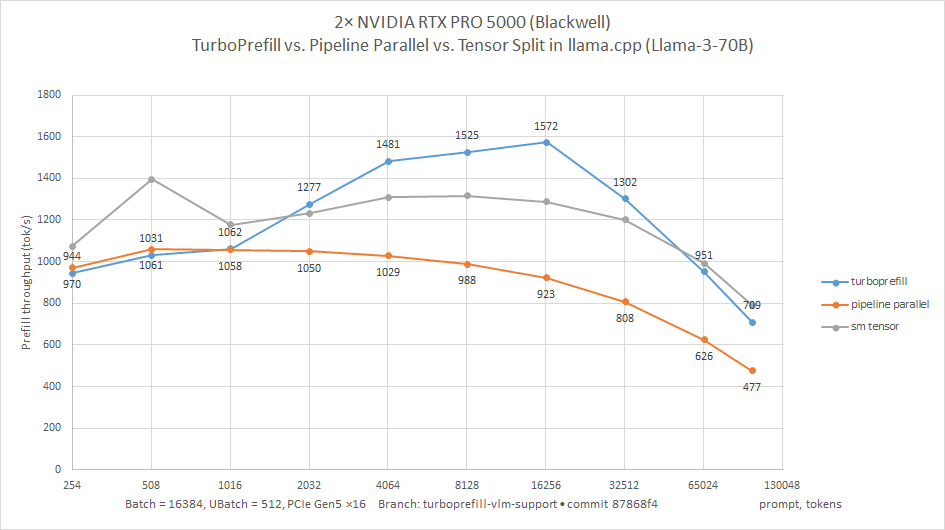
| 2× RTX PRO 5000 | Llama-3-70B | 923 | 1572 | 1.7× |
| 2× GTX 1080 Ti | GPT-OSS-20B | 836 | 1302 | 1.6× |
| 4× GTX 1080 Ti | GPT-OSS-20B | 778 | 1320 | 1.7× |
| 4× RTX 3090 | GPT-OSS-120B | 1477 | 2758 | 1.9× |
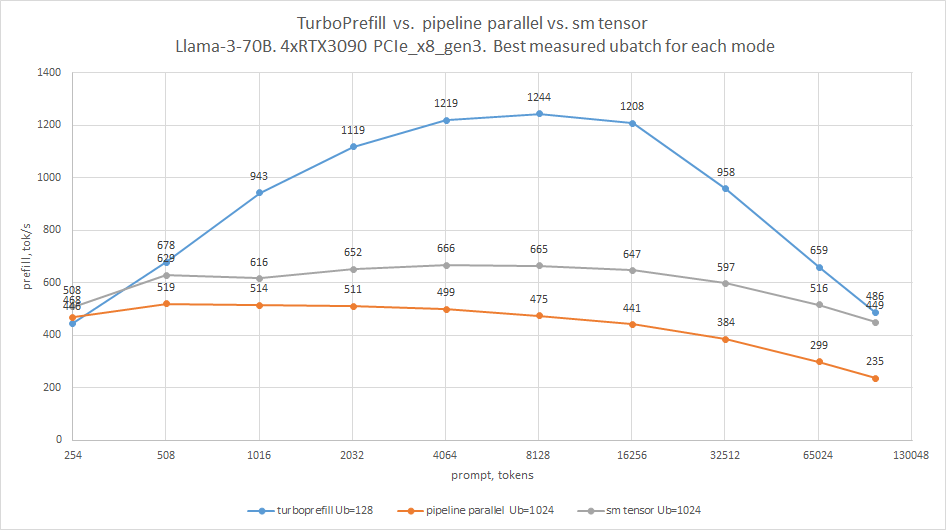
| 4× RTX 3090 | Llama-3-70B | 400 | 1208 | 3.0× |
| 4× RTX 5060 | Qwen2.5-VL-72B | 303 | 604 | 1.9× |
| 4× RTX 5070 Ti | Llama-3-70B | 301 | 919 | 3.0× |
| 4× RTX 5070 Ti | Qwen3.6-27B-MPT | 735 | 1611 | 2.1× |
| 5× RTX 5060 Ti | GPT-OSS-120B | 1993 | 3886 | 1.9× |
| 8× RTX 5060 Ti | GPT-OSS-120B | 1963 | 4380 | 2.2× |
| 10× P104-100 (Pascal) | GPT-OSS-120B | 77 | 345 | 4.5× |
| 12× P104-100 (Pascal) | Llama-3-70B | 37 | 199 | 5.3× |
| Configuration | Model | Tensor Split (tok/s) | TurboPrefill (tok/s) | Speedup |
|---|---|---|---|---|
| 2× RTX PRO 5000 | Llama-3-70B | 1287 | 1572 | 1.22× |
| 4× RTX 5070 Ti | Llama-3-70B | 417 | 919 | 2.2× |
| 4× RTX 5070 Ti | Qwen3.6-27B-MPT | 794 | 1611 | 2.0× |
| 4× RTX 3090 | Llama-3-70B | 647 | 1208 | 1.87× |
| 12× P104-100 (Pascal) | Llama-3-70B | 1.18* | 199 | 168× |
- split_mode=tensor became bandwidth-limited on PCIe Gen1 ×1 due to its significantly higher inter-GPU bandwidth requirements, while TurboPrefill operated on the much less bandwidth-demanding split_mode=layer.
TurboPrefill operates on top of split_mode=layer (-sm layer), which is significantly less demanding on inter-GPU communication bandwidth than split_mode=tensor (-sm tensor). The theoretical difference in the required communication bandwidth is up to 320×. In bandwidth-limited configurations, TurboPrefill achieved up to 168× practical speedup over -sm tensor.
Thus, the proposed approach enables faster computation in cases where the computational performance of current and future GPUs exceeds the capabilities of the communication link between them, including PCIe, NVLink, Infinity Fabric, network interconnects, and any other interconnect technologies.

| Prompt Tokens | Baseline (8x GPU) tok/s | TurboPrefill tok/s | Speedup Gain |
|---|---|---|---|
| 255 | 1038 | 1043 | 1.00x |
| 504 | 1609 | 1613 | 1.00x |
| 1017 | 1762 | 1765 | 1.00x |
| 2044 | 2021 | 2022 | 1.00x |
| 4076 | 2046 | 3180 | 1.55x |
| 6142 | 2122 | 3668 | 1.73x |
| 8164 | 2076 | 4111 | 1.98x |
| 12280 | 2035 | 4421 | 2.17x |
| 16373 | 1963 | 4380 | 2.23x |
| 24560 | 1853 | 3684 | 1.99x |
| 32761 | 1776 | 3359 | 1.89x |
For more than 20 years, I worked on the design, construction, and optimization of custom industrial production lines and control systems.
While experimenting with running local AI models using llama.cpp on multi-GPU systems in layer-split mode, I noticed a well-known characteristic of long-context prefill execution.
In layer-split mode, the model is distributed across multiple GPUs by layers. Under the standard execution path, each ubatch passes sequentially through all model layers. As a result, some GPUs remain idle while waiting for the previous ubatch to complete processing through the remaining layers.
While analyzing the scheduler's behavior, I began asking a simple question: does prefill really require waiting for the previous ubatch to traverse the entire model before the next ubatch can begin?
For decode, such a dependency does exist. However, during prefill, the next ubatch can start processing on a layer immediately after the previous ubatch has finished on that layer, without waiting for it to complete the entire model.
To test this idea, I created an experimental execution path that later became TurboPrefill.
The core idea is not to modify the model, mathematical computations, or attention algorithms. TurboPrefill changes only the scheduling strategy used to process a series of ubatches inside the scheduler.
If GPUs are viewed as stations on a production line, the standard approach sends one workpiece through every station before starting the next one. As a result, parts of the equipment periodically sit idle while waiting for previous stages to finish.
TurboPrefill is intended to keep multiple ubatches active within the pipeline simultaneously. This allows each GPU to begin processing the next ubatch as soon as its own work is complete, without waiting for the previous ubatch to finish across the entire GPU chain.
In simplified form:
Standard scheduler:
step    1234567890123
GPU(1)  #000#000#0000
GPU(2)  0#000#000#000
GPU(3)  00#000#000#00
GPU(4)  000#000#000#0
TurboPrefill:
step    1234567
GPU(1)  ###0000
GPU(2)  0###000
GPU(3)  00###00
GPU(4)  000###0
TurboPrefill does not modify model weights, computations, or inference results. Only the execution order of prefill workloads inside the scheduler is changed.
As a result, idle time between processing stages can be reduced and higher prefill performance can be achieved on long contexts while preserving identical model outputs.
TurboPrefill is not intended to be a universal accelerator for all llama.cpp workloads.
It is specifically designed for long single-request prefill workloads running in multi-GPU layer-split mode, where underutilization of available hardware is most visible.
The idea behind TurboPrefill did not come from modifying the mathematical side of the model. It came from viewing multi-GPU inference as a production pipeline, where the primary focus is hardware utilization, reducing idle time, and improving overall system throughput.
TurboPrefill was not designed as a universal acceleration path for every llama.cpp workload.
Instead, it focuses on a specific scenario where the potential benefit is highest: long-context prefill of a single request running on multiple GPUs in layer-split mode.
TurboPrefill can be used in multi-user servers; the scheduling logic operates on individual requests, rather than users.
The reason is simple. TurboPrefill relies on the ability to observe and schedule a series of consecutive ubatches that belong to the same request. This allows multiple ubatches to be active within the pipeline at the same time and reduces idle periods between neighboring processing stages.
Many other workloads do not provide the same opportunity.
For example:
- Decode workloads have stronger dependencies between consecutive tokens.
- Single-GPU execution does not suffer from inter-GPU pipeline bubbles.
- Embedding workloads follow a different execution pattern.
- Multi-sequence batches introduce additional scheduling constraints.
- Non-layer-split configurations do not expose the same pipeline structure.
For this reason, TurboPrefill does not attempt to replace the standard llama.cpp scheduler.
Instead, a dispatcher in llama-context.cpp evaluates each workload and decides whether it matches the conditions required for TurboPrefill. Workloads that do not match these conditions continue to use the standard execution path.
This behavior is intentional.
The goal of TurboPrefill is not to accelerate every possible workload. The goal is to improve utilization and throughput in a specific execution pattern where unused pipeline capacity is most visible.
| Workload | Reason |
|---|---|
| Decode | Strong dependencies between consecutive tokens |
| Single GPU | No inter-GPU pipeline to optimize |
| Embeddings | Different execution pattern |
| Multi-sequence batch | Additional scheduling complexity |
| Non-layer-split mode | No layer pipeline between GPUs |
| Short prefill | Insufficient number of ubatches to benefit from scheduling |
TurboPrefill focuses on workloads where pipeline underutilization is most visible and where scheduling multiple ubatches can improve overall throughput.
The standard llama-bench pp* benchmark does not represent a pure long-context prefill workload.
A token output is requested at the end of each benchmark prompt, which causes the request to follow the standard execution path instead of the TurboPrefill path.
For this reason, dedicated benchmark scripts are used in this repository to measure TurboPrefill performance on long-context prefill workloads.
The standard llama.cpp scheduler processes each ubatch independently.
A ubatch enters the pipeline, passes through all model layers, and only then the next ubatch begins its full journey through the pipeline.
In layer-split mode this creates a familiar pipeline behavior: some GPUs are busy while others are waiting for work to arrive from previous stages.
TurboPrefill introduces an alternative execution path for eligible long-context prefill workloads. The execution consists of two phases:
Instead of immediately executing each eligible ubatch through the entire pipeline, TurboPrefill temporarily stores information about a sequence of consecutive ubatches belonging to the same request. This creates a batch of work that can later be scheduled as a whole.
After the capture phase is complete, the stored ubatches are replayed through the multi-GPU pipeline. Instead of processing one ubatch completely before starting the next one, TurboPrefill plans execution so that multiple ubatches can be active at different pipeline stages at the same time.
Conceptually:
Standard:

ubatch1 -> all layers
ubatch2 -> all layers
ubatch3 -> all layers
TurboPrefill:
wave1: ubatch1
wave2: ubatch2 + ubatch1
wave3: ubatch3 + ubatch2 + ubatch1
...
This allows more GPUs to remain active simultaneously and reduces idle periods between neighboring pipeline stages.
The model, weights, attention algorithms, and numerical results remain unchanged. Only the execution schedule is different.
Request
   |
   v
Prefill Phase
   |
   v
UBatch Classification
   |
   +--------------------------+
   |                          |
   v                          v
Standard Path         Intra-Prompt Pipeline
                      Scheduling
                               |
                               v
                       UBatch Accumulation
                               |
                               v
                       Capture / Replay
                               |
                               v
                      Layer-Split GPU Pipeline
                               |
                               v
                      ggml-backend-sched
One of the main goals of TurboPrefill is to improve utilization of multi-GPU layer-split pipelines during long-context prefill workloads.
The expected behavior is that the benefit grows as the prompt becomes longer. Longer prompts generate more ubatches, providing more opportunities to keep multiple stages of the pipeline active simultaneously.
To evaluate this effect, GPT-OSS-120B was tested across multiple context lengths using the same hardware and execution settings.
The results show that TurboPrefill provides limited benefit on shorter prompts and increasing benefit as context length grows.
This behavior is consistent with the original design goal of reducing pipeline idle time during long-context prefill workloads.
The largest improvement observed in these tests was approximately 2.23× compared to the standard execution path.
TurboPrefill is designed for multi-GPU layer-split execution, therefore it is important to evaluate how its behavior changes as the number of GPUs changes.
The tests below compare the same GPT-OSS-120B model running on 5 and 8 RTX 5060 Ti 16GB GPUs using identical execution settings.
The results show two effects:
- Increasing the number of GPUs improves absolute prefill throughput.
- TurboPrefill continues to provide substantial acceleration on both configurations.
5× and 8× NVIDIA RTX5060 (Blackwell) gpt-oss-120b

This suggests that TurboPrefill is not tied to a specific GPU count. The scheduling approach remains effective across different multi-GPU layer-split configurations.
2× NVIDIA RTX PRO 5000 (Blackwell) Llama3-70b
4× RTX3090 gpt-oss-120b

4× RTX3090 Llama3-70b
2× GTX1080 gpt-oss-20b

TurboPrefill has been tested on multiple NVIDIA GPU generations and hardware configurations.
Architecture Hardware
Pascal NVIDIA P104-100
Project: gpt-oss-120b-p104-pascal
Ampere NVIDIA RTX 3090
Blackwell NVIDIA RTX 5060 Ti 16GB
Blackwell RTX PRO 5000
The goal of these tests was not to optimize for a specific GPU architecture, but to verify that the scheduling approach remains effective across different generations of hardware.
TurboPrefill is based on pipeline utilization and execution scheduling principles rather than architecture-specific GPU optimizations. The same execution model was successfully validated on three different NVIDIA generations spanning several years of hardware evolution.
The observed improvements therefore appear to be related to scheduler behavior and pipeline utilization rather than to features unique to a particular GPU family.
This suggests that the approach should remain relevant for future GPU generations as long as multi-GPU layer-split execution continues to rely on similar pipeline and scheduling concepts.
TurboPrefill targets prefill workloads only. The decode execution path remains unchanged. Testing on multiple models and hardware configurations showed that decode throughput did not meaningfully depend on whether TurboPrefill was enabled or disabled. The measured improvements therefore come from changes in prefill scheduling rather than from modifications to decode execution.
Clone the validated TurboPrefill PoC implementation:
mkdir -p /workspace/projects
cd /workspace/projects

git clone -b turboprefill-rfc-poc \
https://github.com/sergey-automation/llama.cpp.git
cd llama.cpp
Clone the TurboPrefill repository (benchmark scripts, context files and documentation):
cd /workspace

git clone https://github.com/sergey-automation/TurboPrefill.gitcd /workspace/projects/llama.cpp
cmake -B build \
-DGGML_CUDA=ON \
-DGGML_CUDA_FA=ON \
-DGGML_CUDA_GRAPHS=ON \
-DCMAKE_BUILD_TYPE=Release
cmake --build build -j4 --target llama-serverBenchmark scripts require requests:
pip install requestsCreate model directory:
mkdir -p /workspace/models
cd /workspace/models
GPT-OSS 20B:
hf download unsloth/gpt-oss-20b-GGUF \
  gpt-oss-20b-Q4_K_M.gguf \
  --local-dir /workspace/models
or
wget -c --content-disposition "https://huggingface.co/unsloth/gpt-oss-20b-GGUF/resolve/main/gpt-oss-20b-Q4_K_M.gguf"GPT-OSS 120B:
hf download unsloth/gpt-oss-120b-GGUF \
  Q4_K_M/gpt-oss-120b-Q4_K_M-00001-of-00002.gguf \
  Q4_K_M/gpt-oss-120b-Q4_K_M-00002-of-00002.gguf \
  --local-dir /workspace/models
or
mkdir -p /workspace/models/Q4_K_M
cd /workspace/models

wget -c --content-disposition "https://huggingface.co/unsloth/gpt-oss-120b-GGUF/resolve/main/Q4_K_M/gpt-oss-120b-Q4_K_M-00001-of-00002.gguf" -P /workspace/models/Q4_K_M

wget -c --content-disposition "https://huggingface.co/unsloth/gpt-oss-120b-GGUF/resolve/main/Q4_K_M/gpt-oss-120b-Q4_K_M-00002-of-00002.gguf" -P /workspace/models/Q4_K_M
Check files:
ls -lh /workspace/models
ls -lh /workspace/models/Q4_K_M
Benchmark scripts are designed to be copied into the llama.cpp checkout and executed from there.
Benchmark files must be copied into the llama.cpp root directory. Benchmark scripts must be executed from the llama.cpp root directory. Copy GPT-OSS 20B scripts:
cp -r /workspace/TurboPrefill/benchmarks/gpt20b/* /workspace/projects/llama.cpp/Copy GPT-OSS 120B scripts:
cp -r /workspace/TurboPrefill/benchmarks/gpt120b/* /workspace/projects/llama.cpp/Copy context files:
cp -r /workspace/TurboPrefill/benchmarks/contexts_gpt_tokenizer \
/workspace/projects/llama.cpp/Before running the benchmarks, review and adjust the settings in:
- server_config_20b.sh
- server_config_gpt120b.sh
Verify and adjust the model paths, context directory, output directory, GPU configuration, tensor split, context size, batch size (B), micro-batch size (UB), and split mode as needed.
- TurboPrefill must be run with -sm layer. All requirements for pipeline parallelism must also be met, since TurboPrefill is an extension built on top of the existing pipeline parallelism implementation.
- The batch size should be significantly larger than the micro-batch size, typically by 4–64×; for example, B=4096 and UB=128.
- The context length should be at least 4× larger than the micro-batch size (UB); otherwise, there is insufficient work for TurboPrefill to optimize.
- Do not run the standard llama-bench benchmark. Base your performance evaluation on the server statistics. Use either the provided TurboPrefill benchmark scripts or your own benchmarking script.
- TurboPrefill typically achieves the best performance with a smaller micro-batch size (UB) than standard -sm layer. For example, a configuration that peaks at B=8192, UB=1024 in the baseline may perform best at B=8192, UB=128 with TurboPrefill, while also reserving less memory for compute buffers.
GPT-OSS 20B baseline:
cd /workspace/projects/llama.cpp
TURBOPREFILL=0 python3 bench_server_gpt20b.py
GPT-OSS 20B with TurboPrefill:
cd /workspace/projects/llama.cpp
TURBOPREFILL=1 python3 bench_server_gpt20b.py
GPT-OSS 120B baseline:
cd /workspace/projects/llama.cpp
TURBOPREFILL=0 python3 bench_server_gpt120b.py
GPT-OSS 120B with TurboPrefill:
cd /workspace/projects/llama.cpp
TURBOPREFILL=1 python3 bench_server_gpt120b.pyGPT-OSS 20B:
cd /workspace/projects/llama.cpp
TURBOPREFILL=1 bash run_server_gpt20b.sh
GPT-OSS 120B:
cd /workspace/projects/llama.cpp
TURBOPREFILL=1 bash run_server_gpt120b.sh
On VAST, use SSH tunnel from your local Windows CMD:
ssh -L 8081:127.0.0.1:8081 -p YOUR_SSH_PORT root@YOUR_SSH_HOSTExample:
ssh -L 8081:127.0.0.1:8081 -p 26865 root@ssh4.vast.aiOpen in browser:
http://127.0.0.1:8081Do not expose llama-server directly to the public internet without access control.
If you edit .sh files from Windows, save them with Unix line endings: LF, not CRLF.
If you see this error: $'\r': command not found
fix the files:
cd /workspace/projects/llama.cpp

sed -i 's/\r$//' *.shTurboPrefill is controlled at runtime.
Enable:
TURBOPREFILL=1 ./build/bin/llama-server ...Disable:
unset TURBOPREFILL
./build/bin/llama-server ...
Disabled values are: unset, 0, false, off.
VAST Template: NVIDIA CUDA Container disk: 200 GB OS: Ubuntu 24.04.4 LTS GPU: 8x RTX 5060 Ti 16GB Driver: 580.159.03 CUDA: 13.0 nvcc: 13.0.88 gcc: 13.3.0 cmake: 3.28.3 git: 2.43.0 P2P: not supported NVLink: not present
[RFC][PoC] Intra-Prompt Pipeline Scheduling for Multi-GPU Prefill ggml-org/llama.cpp#24219
Initial Proof-of-Concept implementation: https://github.com/sergey-automation/TurboPrefill
Continued development and new functionality: https://github.com/sergey-automation/TurboPrefill-VLM-Validation
Reference implementation branch: https://github.com/sergey-automation/llama.cpp/tree/turboprefill-vlm-support
Special thanks to Andrii Trykhlieb for technical assistance, testing support, benchmark validation, and countless discussions during the development of TurboPrefill. LinkedIn: https://de.linkedin.com/in/andrii-trykhlieb-826848323
MIT. See LICENSE.