
Samsar is a generative video and media automation platform for turning prompts, product images, structured content, and creative ideas into finished videos and reusable studio assets.
It brings together one-shot text-to-video, image-list-to-video, image editing, audio generation, semantic search, recommendations, assistant workflows, multi-provider model routing, and detailed post-production controls across one integrated Studio and API surface.
Production app · Production API docs · Demo channel · Setup wizard


Features · Quick start · Workflows · Documentation · API · Operations
- One-shot Studio text-to-video up to 3 minutes for documentary, infotainment, ed-tech, film summary, custom themes, and original ideas.
- One-shot image-list-to-video that turns product images into polished ad videos with optional narrator avatar, outro, and CTA.
- One-click scene re-rolls after render to fix small imperfections without rebuilding the full project.
- Full Studio workspace for detailed, granular post-processing.
- Sandboxed local logging, with logs and traces kept on your machine.
- Multi-provider model routing so each operation can use the best available provider and model.
- Built-in search and recommendations for creating a generative video library and Studio knowledge base.
- Git.
Note
Node.js, npm, and Yarn are not host prerequisites for a standalone installation. The setup wizard and its JavaScript tooling run inside Docker.
If you cloned this repository directly, stay at the repository root and continue to step 2.
Using this repository as a deployable wrapper around sibling source projects?
This parent-workspace workflow additionally requires rsync, Node.js, and npm:
cd samsar
npm run sync
The sync script excludes common secret and generated paths when copying projects into this monorepo. Skip this workflow in a standalone clone.
How the launcher handles Docker on each platform
The direct setup launcher checks Docker before continuing:
| Platform | Bootstrap behavior |
|---|---|
| Linux | Installs Docker CE, Buildx, and the Compose plugin from Docker's official package repository, enables the service, and configures user access. |
| macOS | Uses an existing Docker Desktop installation, or installs it automatically through Homebrew when Homebrew is available. |
| Windows | setup.ps1 installs Docker Desktop with winget when needed and runs the launcher through Docker Desktop's WSL 2 integration. |
Set SAMSAR_SETUP_INSTALL_DOCKER=0 to disable automatic Docker installation.
On macOS without Homebrew, install Docker Desktop for Mac.
On Windows without winget, install Docker Desktop for Windows and enable WSL 2 integration.
Linux, macOS, or WSL:
./setup.shWindows PowerShell:
.\setup.ps1Windows Command Prompt:
setup.cmdnpm run setup-wizard remains available as a developer convenience, but is not required for installation.
The launcher installs or starts Docker when supported, builds and starts the containerized setup wizard, waits for it to respond, prints the available setup URLs, and tries to open http://localhost:8089 in the default browser. It prints a public-IP setup URL only when TCP 8089 responds on that public address. Set SAMSAR_SETUP_OPEN_BROWSER=0 to skip browser auto-open.
Complete the browser flow to write deployment config, render runtime env and model availability, build and start the selected Docker Compose profiles, publish the local media gateway when required, verify the processor API and Studio client, and prepare local login.
| Service | URL |
|---|---|
| Studio | http://localhost:3000 |
| Processor API | http://localhost:3002 |
| Local media through Processor API | http://localhost:3002/assets_v2/... |
| MinIO console | http://localhost:9001 |
| Grafana logs | http://localhost:4000 |
Stop the stack:
npm run docker:downWhat the five setup wizard steps configure
| Step | What it configures | Runtime effect |
|---|---|---|
| Providers | Inference routing, OpenAI, Google Cloud, Kimi K3, Alibaba Cloud, FAL, ElevenLabs, RunwayML, Samsar | Controls which models/actions appear in runtime/config/available-models.json. |
| Services | Processor, setup wizard, image generator, assistant query processor, audio generator, AI video layer generator, video renderer, frames processor, express video listener, and logger | Determines which Docker service families are enabled for the local runtime. |
| Mail and Data | Local or remote MongoDB, local MinIO or external S3-compatible storage, SMTP/SES/disabled mail | Writes database, storage, CDN, media, and mail settings. |
| Domain | Optional nginx reverse proxy for a public domain/subdomain, public IP, or private IP, with optional IP detection, port opening, and Let's Encrypt SSL for validated domains | Enables public or intranet access URLs for Studio and the processor API. |
| Admin | Organization and initial admin/login setup | Prepares Docker setup login and local access details. |
Use manual runtime config when you want direct control over credentials, provider selection, storage URLs, database settings, or mail settings.
Explore every setup step, validation, generated file, and lifecycle stage →
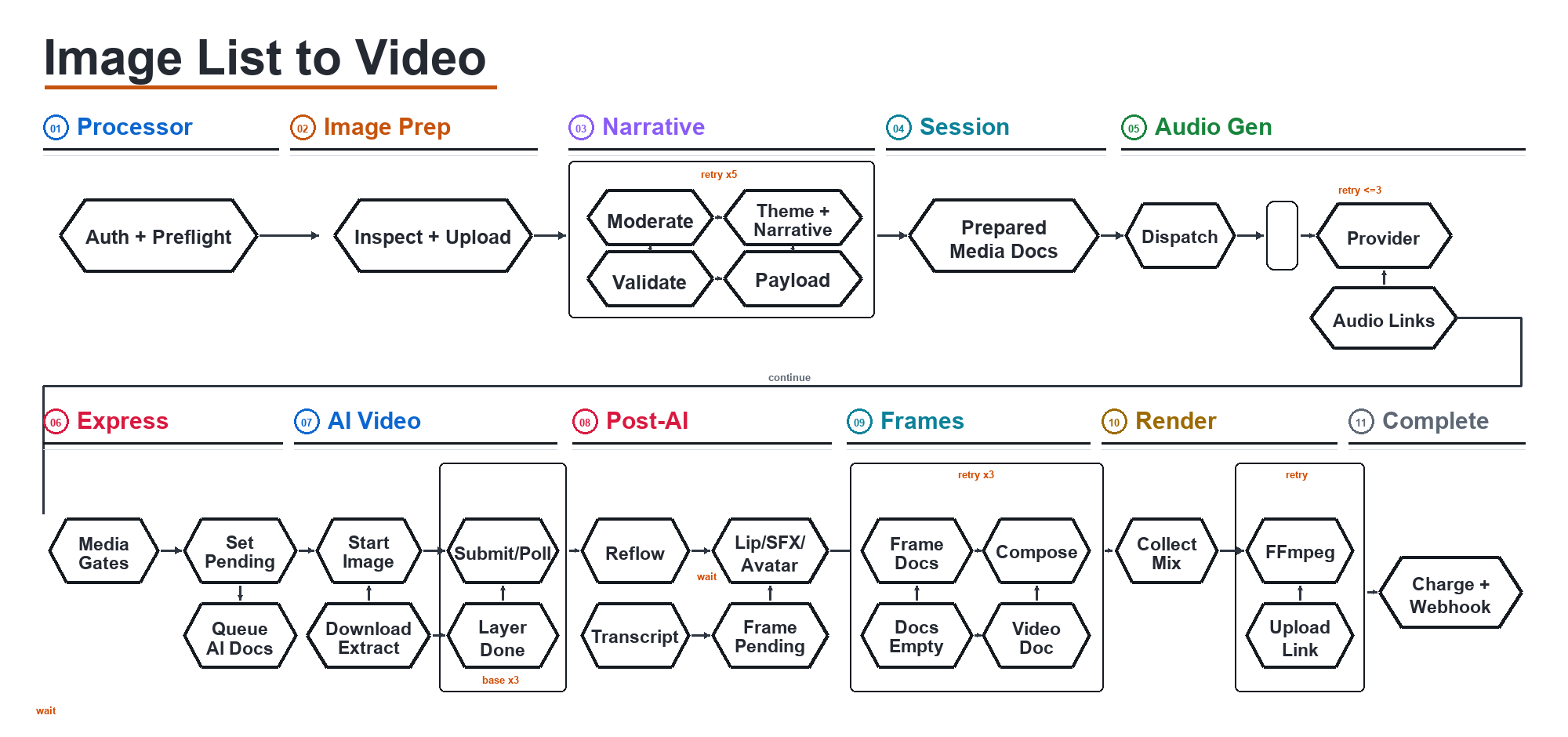
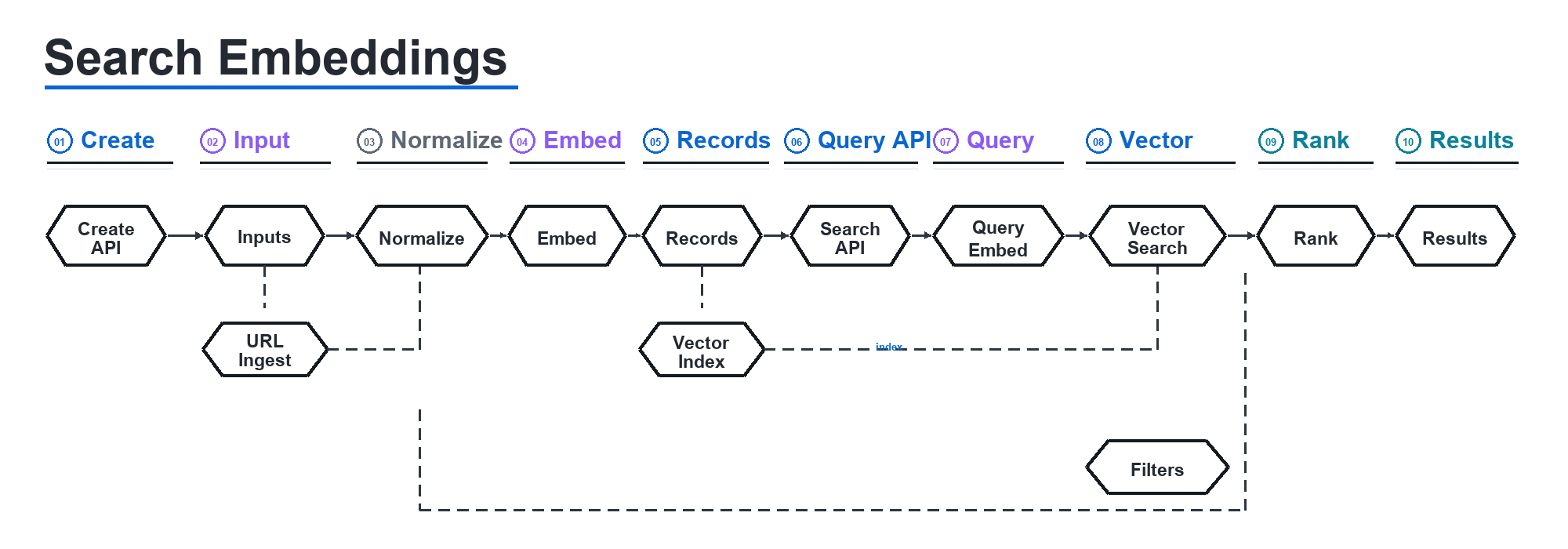
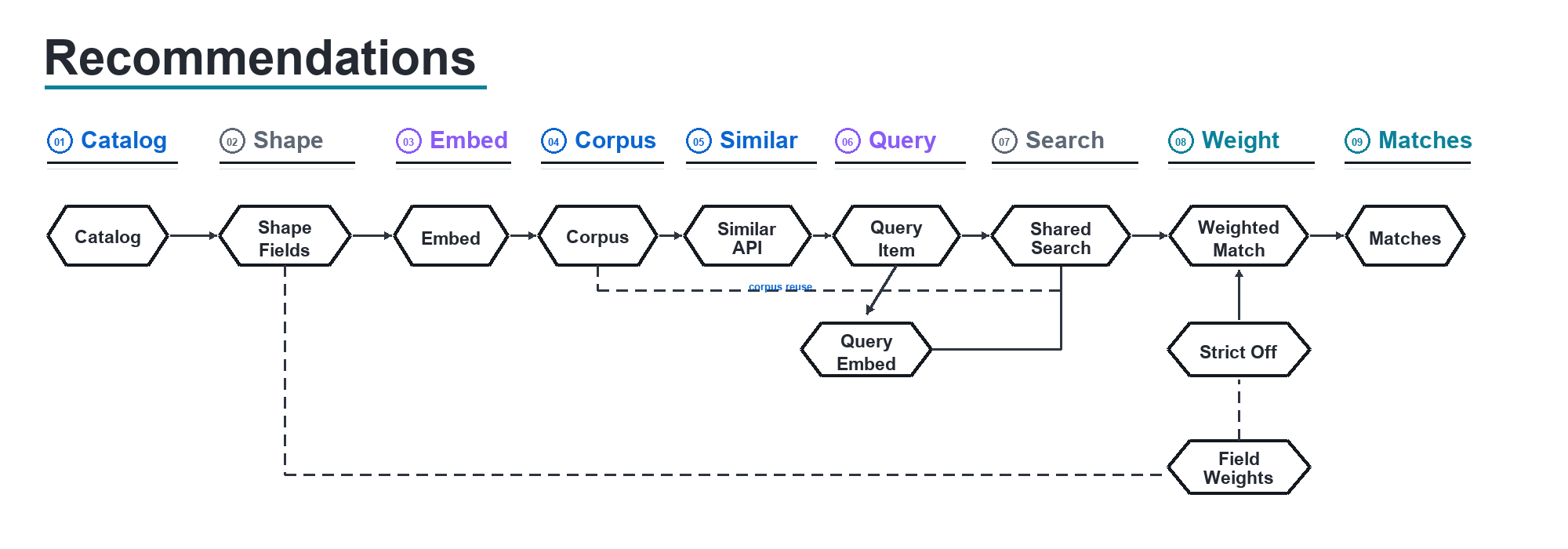
The diagrams below show the primary generation and discovery pipelines. Open any workflow to explore it, then select the diagram for its detailed documentation.
Text to Video
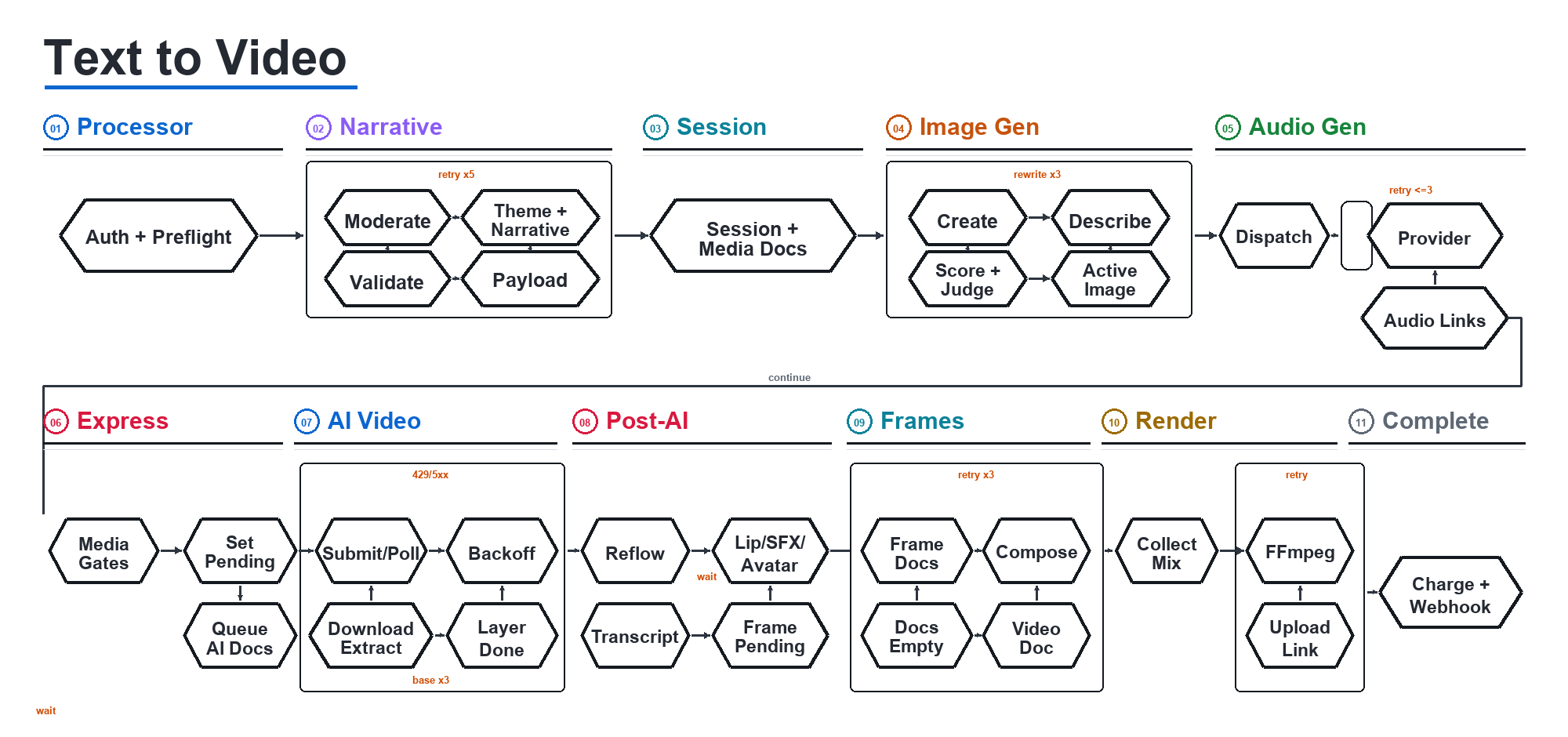
Image List to Video
Search Embeddings
Recommendations
| Page | Use it for |
|---|---|
| Architecture | Docker service topology, request flow, runtime config, storage, logging, and deployment modes. |
| Providers and Models | Provider credentials, supported model families, fallback behavior, and generated model availability. |
| Setup Wizard | UI-driven setup steps, validation, generated files, and Docker setup lifecycle. |
| Search | Embedding-backed indexing, semantic search, filters, and status endpoints. |
| Recommendations | Similarity and recommendation workflows built on embedding templates. |
| Text Enhance | Copy enhancement endpoint, inputs, billing headers, and inference routing. |
| Image Edit | Image enhancement, branding removal, text-to-image, image set expansion, title generation, and status polling. |
| Image List to Video | Image-list-to-video and ad-style CTA video generation from image URLs plus metadata. |
| Text to Video | One-shot prompt-to-video generation, model selection, duration limits, and status flow. |
| Area | Directory | Purpose |
|---|---|---|
| Studio app | apps/samsar-client |
Samsar Studio and VidGenie frontend. Runs on port 3000 in Docker. |
| Setup wizard | apps/setup-wizard |
Browser setup flow for providers, services, data, mail, and admin configuration. Runs on port 8089 when started. |
| Processor API | services/processor |
Public API, Studio API, auth, billing, session orchestration, search/recommendation APIs, and status endpoints. Runs on port 3002. |
| Generation workers | services/generator, services/ai-video-layer-generator, services/video-generator, services/audio-generator, services/frames-processor |
Image generation/editing, AI video layers, final rendering, speech/music/sound effects, frame processing, and media processing. |
| Workflow workers | services/express-video-listener, services/assistant-query-processor, services/task-processor |
Express video state machine, assistant queries, and scheduled/background tasks. |
| Runtime config | runtime/config, runtime/secrets |
Generated deployment config, model availability, env files, and local secrets. Not committed. |
| Deployment | deploy/compose |
Docker Compose stack and local deployment configuration. |
| Docs | docs, pages |
Runtime notes, brand assets, and deeper Markdown documentation linked from this README. |
View the Docker deployment architecture

Provider availability is explicit. npm run config:render reads runtime/config/samsar.config.json and the optional runtime/secrets/provider.credentials.json, writes runtime/secrets/root.env, and generates runtime/config/available-models.json from enabled providers. The video API then filters supported model responses through that generated availability file.
| Provider | Enables | Models and families from the setup logic |
|---|---|---|
| Samsar API key | Universal fallback for configured Docker deployments | All configured Docker model families in the setup logic, including gpt-5.6-sol, gemini-3.1-pro, KIMIK3, QWEN3.7, chat, assistant, image, image edit, video, audio, lip sync, sound effects, and NanoBanana families. |
| OpenAI | Chat, assistant, image, image edit, audio, moderation, search, recommendations | gpt-5.6-sol, GPTIMAGE2, GPTIMAGE2EDIT, OPENAI_TTS. |
| Google Cloud | Gemini, image, image edit, video, audio, moderation | gemini-3.1-pro, VEO3.1I2V, VEO3.1I2VFAST, LYRIA3, GOOGLE_TTS, NANOBANANA2, NANOBANANA2EDIT, NANOBANANAPRO, NANOBANANAPROEDIT. |
| Kimi K3 | Native inference, assistants, strict structured output, and vision | KIMIK3, backed by the exact provider model kimi-k3 with high reasoning. Native Kimi is preferred, followed by the Samsar fallback when configured. |
| Alibaba Cloud | Native Qwen inference in Docker, plus Alibaba media models | Public model key QWEN3.7 is available through the native adapter only when CURRENT_ENV=docker; Alibaba media-model routing is independent of the hosted Qwen inference rule. |
| FAL | Image, image edit, video, audio, lip sync, sound effects | SEEDREAM (Seedream 5 Pro), NANOBANANA2, NANOBANANA2EDIT, NANOBANANAPRO, NANOBANANAPROEDIT, VEO via FAL, COSMOS3SUPERI2V, SEEDANCEI2V, Kling image-to-video, HAPPYHORSEI2V (Happy Horse 1.1 I2V), ElevenLabs/PlayAI/CassetteAI/AudioCraft via FAL, MMAUDIOV2, MIRELOAI, and lip sync model families. |
| ElevenLabs | Speech and music | ELEVENLABS, ELEVENLABS_MUSIC. |
| RunwayML | Video generation and image-to-video | RUNWAYML. |
Provider precedence and deployment-specific routing are documented in Providers and Models.
The built-in adapters normalize model selection, text and vision payloads, structured output, timeouts, retries, and provider authorization across the processor and inference workers. They remain separate from configuration.custom_adapters, which are user-supplied media-operation endpoints. Transient external-inference requests retry up to three times after the initial attempt, with exponential backoff and provider Retry-After support.
OpenRouter optionally routes supported GPT, Gemini, and Qwen text/vision workflows. Kimi K3 uses native kimi-k3 with high reasoning first and the Samsar fallback when configured. Validated Alibaba credentials stay in runtime/secrets/provider.credentials.json and render only into the backend Docker environment.
Adapter implementation details
The same adapter contract is used by processor, generator, audio-generator, ai-video-layer-generator, express-video-listener, and assistant-query-processor. This keeps provider selection consistent across chat, assistant, prompt generation, vision analysis, and express-video stages.
Configure OPENROUTER_API_KEY through the setup wizard or runtime/secrets/provider.credentials.json for supported GPT, Gemini, and Qwen text/vision workflows.
Kimi K3 uses https://api.moonshot.ai/v1 and the exact model kimi-k3 for both inference and vision. The adapters request high reasoning, translate developer messages to Kimi-compatible system messages, preserve the chat/JSON contracts, and enforce strict JSON schemas for structured output. Public image inputs are prepared as inline data and video inputs use Kimi file references where supported.
Configure provider credentials
All API provider keys are optional. Add only the credentials needed for the generative features you want to enable. Provider keys can provide direct or routed inference while still using the Samsar media generation pipeline inside your environment. Google Cloud uses a service account JSON key, not a standard API key.
Keep credentials private: Do not commit
runtime/or copy keys into browser/client-side code.
| Provider | Runtime config | Credential source and setup note |
|---|---|---|
| Samsar | providers.samsar.apiKey → SAMSAR_API_KEY |
Register or log in, add credits in Billing, then create an API key and paste it into Samsar universal fallback. |
| OpenAI | providers.openai.apiKey → OPENAI_API_KEY |
Choose the correct project in OpenAI API keys, create a secret key, and copy it when shown. |
| Google Cloud | providers.googleCloud.projectId, providers.googleCloud.credentialsJsonB64 |
Create a JSON key for a minimally permitted service account, leave Principals with access blank, then paste the JSON or encode it with base64 < service-account.json | tr -d '\n'. |
| Kimi K3 | providers.kimi.apiKey → KIMI_K3_API_KEY |
Create a key in the Kimi platform. The browser session copy redacts it; the generated backend env shares it with every inference worker. |
| Alibaba Cloud | runtime/secrets/provider.credentials.json → ALIBABA_API_KEY, ALIBABA_API_HOST |
Create a key in the Model Studio console. Optionally provide a workspace API host or full /compatible-mode/v1 URL; leave it blank for the international endpoint. |
| FAL | providers.fal.apiKey → FAL_API_KEY |
Create a key in the fal dashboard. FAL SDK examples may call the same credential FAL_KEY. |
All routes below are served by the processor API at http://localhost:3002 in local Docker. Auth accepts a Samsar API key, auth token, or app key where supported by the route.
The Studio one-shot flow exposes durations up to 3 minutes; the text-to-video API accepts requests from 10 to 240 seconds.
| Workflow | Main endpoints | Notes |
|---|---|---|
| Health | GET /v1/chat/health, GET /v1/image/health, GET /v1/video/health, GET /v2/health |
Per-route health checks for local verification. |
| Supported video models | GET /v1/video/supported_models |
Returns text-to-video and image-list-to-video model lists filtered by deployment availability. |
| Text enhance | POST /v1/chat/enhance |
Enhances copy from message, optional metadata, language, and maxwords. |
| Search indexing | POST /v1/chat/create_embedding, POST /v1/chat/create_embedding_from_url, POST /v1/chat/generate_embeddings_from_plain_text |
Creates reusable embedding templates from records, URLs, or plain text. |
| Search query | POST /v1/chat/search_against_embeddings |
Searches a template with search_term, filters, and optional reranking. |
| Recommendations | POST /v1/chat/similar_to_embeddings |
Returns similar records from a template using text or structured search JSON. |
| Assistant workflows | POST /v1/assistant/*, POST /v2/assistant/* aliases |
Runs assistant queries through the processor and configured inference provider. |
| Image edit/generation | POST /v1/image/text_to_image, POST /v1/image/enhance, POST /v1/image/remove_branding, POST /v1/image/add_image_set |
Queues image sessions and returns request IDs for polling. |
| Image status | GET /v1/image/status?request_id=..., GET /v1/image/list |
Polls and lists image API sessions. |
| Text-to-video | POST /v1/video/text_to_video, POST /v2/text_to_video |
Requires prompt, image model, video model, and duration from 10 to 240 seconds. |
| Image-list-to-video | POST /v1/video/image_list_to_video, POST /v2/image_list_to_video |
Uses image URLs, prompt/metadata, selected models, aspect ratio, and optional CTA/outro/footer/narrator settings. |
| Video status | GET /v2/status, GET /v2/status_detailed, GET /v1/external_users/status |
Status endpoints support request IDs/session IDs and detailed external request reporting. |
Manual Docker setup
Use this path only when you do not want the browser setup wizard to write runtime config for you.
Create a local runtime config:
mkdir -p runtime/config runtime/secrets
cp -n samsar.config.example.json runtime/config/samsar.config.json
Edit runtime/config/samsar.config.json for provider enablement, non-secret provider settings, storage, database, and public URLs. Provider credentials can be kept in runtime/secrets/provider.credentials.json. The checked-in example is safe for local Docker defaults: local MongoDB, local MinIO-compatible storage, local media gateway, and no external provider enabled.
Render env files:
npm run config:renderInstall Docker-visible fonts and prepare the optional local logger stack:
npm run docker:setup-assetsStart the complete local Docker stack:
npm run docker:upDocker Compose profiles, volumes, and maintenance
Validate the rendered Compose configuration:
npm run docker:confignpm run docker:up renders runtime/secrets/root.env and runtime/config/available-models.json, then starts the local default profiles. The setup wizard adds the reverse-proxy profile only when nginx access is enabled.
| Profile | Services |
|---|---|
core |
client, processor |
workers |
generator, audio-generator, frames-processor, video-generator, ai-video-layer-generator, express-video-listener, assistant-query-processor, task-processor |
local-mongo |
mongo |
minio |
minio |
local-media |
media-gateway, media-tunnel-controller |
logger |
loki, promtail, grafana |
reverse-proxy |
Optional reverse-proxy nginx service when enabled by the setup wizard. |
Run npm run docker:setup-assets whenever fonts or logger config need to be refreshed. It installs subtitle/render fonts into runtime/fonts, copies them into running Samsar service containers, and recreates Promtail/Grafana only when services.logger is enabled.
Persistent Docker state is stored in mongo-data, minio-data, media-assets, media-assets-v2, persistent-data, loki-data, promtail-data, and grafana-data.
Inspect logs:
docker compose -f deploy/compose/docker-compose.yml logs -f processor clientRebuild and replace only the frontend container:
docker compose -f deploy/compose/docker-compose.yml --profile core build client
docker compose -f deploy/compose/docker-compose.yml --profile core up -d --force-recreate --no-deps client
When making changes during an active generation session, prefer restarting only the affected client or API container.
Active jobs: Avoid restarting generation workers while a video, audio, or sound-effect job is active unless you have confirmed the worker is stuck or the job can safely resume.
Local media URLs and remote-provider access
In local Docker, completed render URLs are expected to look like:
http://localhost:3002/assets_v2/video/output/<session-id>/<file>.mp4
That browser URL is served by the configured processor API from the mounted media volume. It is not an S3 or CloudFront URL unless external media publishing is enabled in runtime config.
When a remote provider must fetch local-only media, the local-media profile starts a Compose-managed Cloudflared controller. It starts a quick tunnel when runtime config enables a remote media consumer, validates the exact media-gateway health marker, atomically publishes localMediaTunnel.publicUrl, and replaces the tunnel when health checks fail or a worker writes the shared refresh marker. It does not mount the Docker socket or depend on the setup-wizard process.
For a manual runtime, start or recreate only the local-media services:
docker compose --env-file runtime/secrets/root.env \
  -f deploy/compose/docker-compose.yml \
  --profile local-media up -d --build \
  media-gateway media-tunnel-controller
Inspect its lifecycle and current URL:
docker compose --env-file runtime/secrets/root.env \
  -f deploy/compose/docker-compose.yml \
  --profile local-media logs -f media-tunnel-controller
Provider workers reload and validate the published URL before each public adapter request. Browser previews continue to use the configured processor or reverse-proxy URL.
The legacy scripts/start-local-media-tunnel.sh command remains a compatibility wrapper that starts and waits for the same Compose services instead of creating a second tunnel container.
Runtime configuration and generated files
The main config file is runtime/config/samsar.config.json. Its local Docker defaults are:
database.provider:local-mongostorage.provider:s3-compatiblestorage.staticCdnUrl:http://localhost:3002/storage.externalMediaPublishEnabled:falsepublicUrls.clientApp:http://localhost:3000publicUrls.processorApi:http://localhost:3002publicUrls.media:http://localhost:3002reverseProxy.enabled:false
Enable only the providers you intend to use, then rerender:
npm run config:renderFor a manual Alibaba Cloud setup, enable the provider in runtime/config/samsar.config.json and save this as runtime/secrets/provider.credentials.json:
{
  "version": 1,
  "alibabaCloud": {
    "apiKey": "<alibaba-model-studio-api-key>",
    "apiHost": "https://workspace-id.ap-southeast-1.maas.aliyuncs.com/compatible-mode/v1"
  }
}
Protect it with chmod 600 runtime/secrets/provider.credentials.json before rendering. The setup wizard performs these steps automatically after validating the credentials.
Generated files:
runtime/secrets/root.env: env consumed by Docker services.runtime/secrets/provider.credentials.json: setup-wizard-managed provider keys and validated endpoints. Keep it private and mode0600.runtime/config/available-models.json: model/action availability derived from enabled providers.runtime/config/model-adapter-preferences.json: standalone-admin adapter order overrides saved from Settings → Model Adapters. Config rendering preserves this file.
See Architecture for storage and deployment defaults and Providers and Models for credential, availability, and fallback behavior.
Warning
Public reverse-proxy and domain access are disabled by default, but Docker publishes the Studio and processor ports on the host. Use host firewall rules or localhost-only Docker port bindings when the stack must not be reachable from other networks.
The setup wizard can optionally enable nginx for a public domain/subdomain, public IP, or private IP. For public domain access, add A records for the Studio and processor domains pointing to the machine IP in your DNS provider. For public/private IP access, the wizard can detect IP candidates and uses one machine IP: Studio at http://<ip> and the processor/media base at http://<ip>/api. For production deployment, non-SSL access needs port 80; Let's Encrypt SSL setup uses ports 80 and 443, then closes port 80 if Samsar opened it. The wizard can try to manage these host firewall rules automatically on supported Linux hosts.
Set a strong setup/admin password first and restrict access with HTTPS, firewall rules, and authentication.
For custom enterprise deployments behind a VPS, private network, or managed ingress, contact hello@samsar.one.
Run the fast, dependency-free test suite:
npm testValidate the generated runtime files and full Docker Compose deployment configuration:
npm run test:deploymentGitHub Actions runs both checks for pull requests into main and pushes to main.
Caution
Do not commit runtime credentials, generated assets, local uploads, dependency folders, or build output.
A local Docker page fails on first navigation
If a local Docker page fails only on first navigation with a dynamic import error, the browser is usually holding an old frontend build while the container serves a newer build. Refresh the tab. The Docker client server also returns a reload module for missing hashed JS chunks so stale tabs can recover automatically.
Local downloads open in a new tab
Confirm the processor API can serve the mounted asset:
curl -I http://localhost:3002/assets_v2/video/output/<session-id>/<file>.mp4Remote generation providers cannot fetch local media
Open Local media URLs and remote-provider access, then inspect the Compose-managed tunnel lifecycle and current URL. Provider workers validate the exact asset and wait for a refreshed tunnel before dispatching.
Grafana runs on a remote Docker host
Set GRAFANA_ROOT_URL and optionally GRAFANA_DOMAIN, GRAFANA_PORT, or LOKI_PORT before starting Compose.