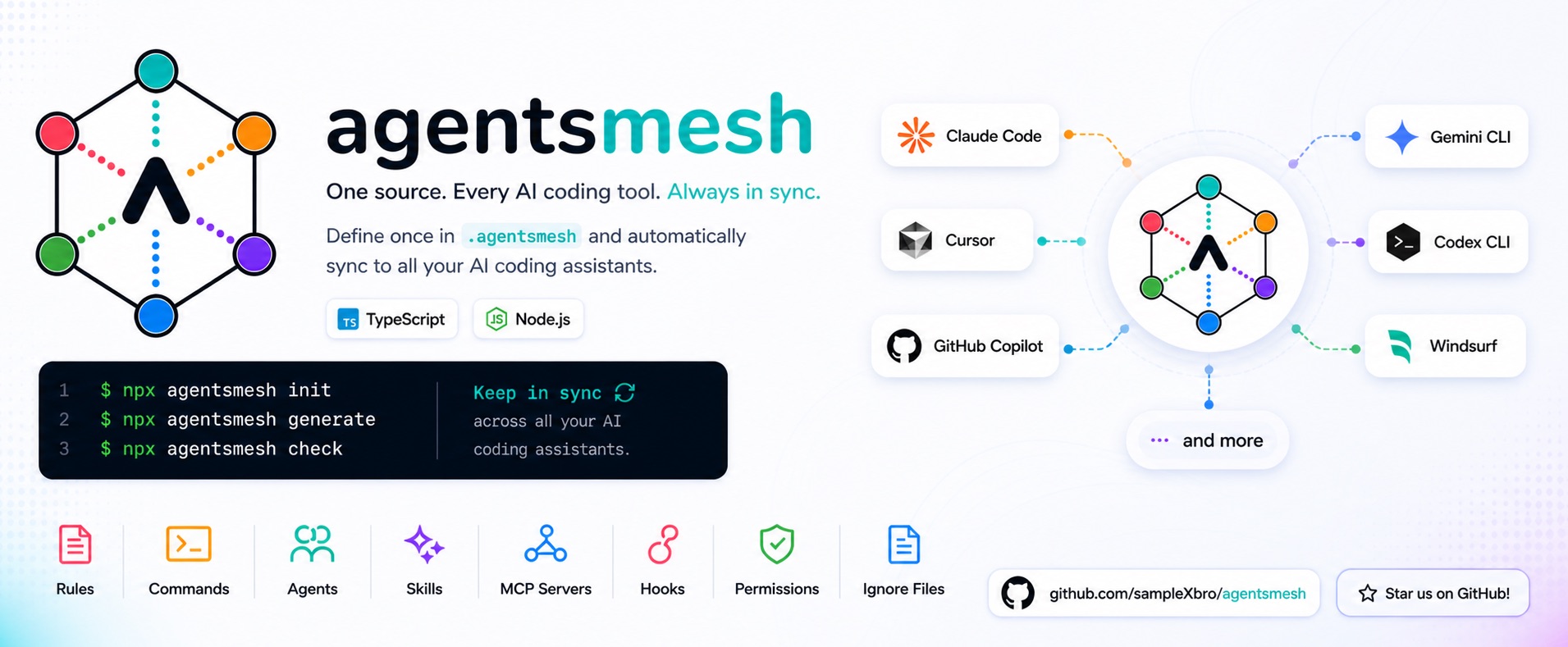







Every AI coding assistant has its own configuration format — CLAUDE.md, AGENTS.md, .cursor/rules/*.mdc, .github/copilot-instructions.md, and more. Keeping the same rules, prompts, MCP servers, hooks, and permissions in sync across all of them by hand is tedious, and they drift apart fast.
AgentsMesh fixes this. It is an open-source CLI and TypeScript library: write your rules, commands, agents, skills, MCP servers, hooks, ignore files, and permissions once in .agentsmesh/, run agentsmesh generate, and every tool gets its native config. agentsmesh import pulls existing tool configs back into the one source, and agentsmesh check catches drift in CI.
And your agents learn from your repo. With lessons, an agent saves a short rule every time something goes wrong — a failing test, a code review comment, a wrong assumption — and recalls it automatically before it touches the same files again. One shared memory, read and written by every AI tool you use.
Full documentation: samplexbro.github.io/agentsmesh
Pick whichever matches your environment — every install method ships the same CLI (agentsmesh and the amsh alias) and the same TypeScript library.
brew tap samplexbro/agentsmesh
brew install agentsmeshcurl -fsSL https://github.com/sampleXbro/agentsmesh/releases/latest/download/install.sh | shOr download a binary directly from GitHub Releases.
npm install -g agentsmesh          # global
# or as a dev dependency, pinned per repo:
npm install -D agentsmesh          # npm
pnpm add -D agentsmesh             # pnpm
yarn add -D agentsmesh             # yarn
# or run once without installing:
npx agentsmesh --help
The Node-based install also exposes the typed programmatic API for scripts and CI tooling.
Before — fragmented assistant-native config in one repo:
CLAUDE.md
AGENTS.md
.cursor/rules/*.mdc
.github/copilot-instructions.md
.gemini/settings.json
.windsurf/rules/*.md
.codex/config.toml
.kiro/steering/*.md
After — one canonical source, generated everywhere:
.agentsmesh/
  rules/
    _root.md
  commands/
  agents/
  skills/
  mcp.json
  hooks.yaml
  permissions.yaml
  ignore
  lessons/
    lessons.json
agentsmesh generateThe native files above are still emitted — AgentsMesh writes them for you from .agentsmesh/. Edit canonical sources, regenerate, and every tool stays in sync.
Works on Linux, macOS, and Windows. Install via Homebrew, a standalone binary, or any Node.js package manager, then:
agentsmesh init       # scaffold .agentsmesh/ + agentsmesh.yaml
agentsmesh generate   # produce native configs for every enabled tool
agentsmesh check # CI-friendly drift gate against .agentsmesh/.lockinit— createsagentsmesh.yaml,agentsmesh.local.yaml, and the canonical.agentsmesh/directory.generate— writesCLAUDE.md,AGENTS.md,.cursor/,.github/copilot-instructions.md, etc. from canonical sources.check— exits non-zero if generated files have drifted from.agentsmesh/.lock. Drop into CI.
Want your agents to learn from this repo too? Add the optional lessons memory:
agentsmesh init --lessons # adds a shared memory: recall before edits, capture after failuresSee Teach your agents: lessons just below for how it works.
If you installed via npm install -D agentsmesh (also pnpm add -D / yarn add -D), prefix each command with npx. The CLI ships as both agentsmesh and the shorter alias amsh.
Lessons give your AI coding agents a memory of past mistakes. An agent reads that memory before it touches anything, and writes to it after something goes wrong — so the same mistake doesn't happen twice, in any tool.
The memory is one git-tracked file: .agentsmesh/lessons/lessons.json. Every agent — Claude Code, Cursor, Codex CLI, Copilot, and the rest — reads and writes the same file through two commands:
- Recall — before editing a file or running a state-changing command, the agent asks
agentsmesh lessons query --file <path> --cmd <command>, gets back the rules that match, and follows them. - Capture — right after a failure (a red test, a lint error, a review comment, a wrong assumption), the agent saves the rule with
agentsmesh lessons add "<rule>" --topic <id> --trigger-file <glob>.
A 30-second example:
# 1. One-time setup
agentsmesh init --lessons && agentsmesh generate

# 2. You hit a bug: a Windows path broke because of a backslash.
#    Capture the lesson so it never bites again:
agentsmesh lessons add "Normalize CLI display paths to forward slashes" \
  --topic windows-paths \
  --new-topic --topic-summary "Cross-platform path handling" \
  --trigger-file "src/cli/**/*.ts"

# 3. Later, before editing a CLI file, the agent recalls it automatically:
agentsmesh lessons query --file src/cli/foo.ts
#   -> Normalize CLI display paths to forward slashes
Works in every tool. init --lessons wires the loop once. A small always-on rule lands in .agentsmesh/rules/_root.md — rules are native in every target, so every agent gets the recall/capture habit — and the full operating manual ships as a lessons skill on tools that support skills. Agents without shell access use the matching MCP tools (lessons_query / lessons_add).
Team-shared and reviewable. The graph is a normal git-tracked file: a lesson your agent learns today helps every teammate's agent tomorrow, and every change shows up in code review like any other diff.
Trust model. lessons.json is checked into the repo, so its rules are project content — trusted at the same level as the code and CLAUDE.md. Review a lesson graph from a cloned third-party repo as you would any other code you run. As a guardrail, recall truncates any single rule to 2000 characters before injecting it and capture rejects longer rules, so a malformed rule cannot flood the agent's context.
Upgrading from the legacy store? Run agentsmesh lessons import-md once to migrate index.yaml + topics/*.md + journal.md into the graph; the CLI deletes the legacy files after a successful migration.
Full walkthrough: Teach your AI agents with lessons · every subcommand and flag: agentsmesh lessons CLI reference.
If your repo already has .cursor/, .claude/, .github/copilot-instructions.md, or other native files, you don't have to delete them. The recommended flow imports them into .agentsmesh/ first, lets you preview the projection, and only then trusts generate.
agentsmesh import --from cursor   # or claude-code, copilot, codex-cli, gemini-cli, windsurf, amp, zed, warp, ...
agentsmesh diff                   # patch-style preview of what generate would change
agentsmesh generate               # write native configs (back) from canonical
agentsmesh check                  # add to CI to detect drift
What this gets you:
importreads existing tool configs and writes equivalent canonical files into.agentsmesh/— round-trip metadata is preserved so re-import doesn't lose information.diffshows the unified patch every output file would receive, so you can review before any write.checkreads.agentsmesh/.lockand fails the build if the canonical sources and the generated files disagree.
import --from accepts any built-in target ID listed in the Supported Tools matrix. Plugin targets are valid too.
A quick sample of the canonical → native projection:
agentsmesh init
find .agentsmesh -maxdepth 2 -type f      # see the canonical scaffold
agentsmesh generate
agentsmesh diff                       # preview future changes
agentsmesh check                      # CI-style drift gate
On macOS/Linux you can also run tree .agentsmesh if you have tree installed.
AgentsMesh generates native config for every major AI coding assistant — plus plugin targets you can ship as standalone npm packages. Each tool's native vs. embedded support per feature is tracked in the supported tools matrix. The full matrix table is also embedded further down this README.
- CLI agents: Aider, Amp, Claude Code, Codex CLI, Crush, Deep Agents CLI, Gemini CLI, Goose, OpenCode, Pi Agent, Qwen Code, Rovo Dev, Warp.
- IDE integrations: Amazon Q Developer, Antigravity, Augment Code, Cline, Continue, GitHub Copilot, Cursor, Junie, Kilo Code, Kiro, Roo Code, Trae, Windsurf, Zed.
- Cloud agent platforms: Factory Droid, Jules, Replit Agent.
- Bidirectional sync —
importreads existing tool configs into.agentsmesh/;generateprojects them back out. Round-trips are loss-free, so adopting AgentsMesh in an existing repo never throws away data. - Agents that learn — the optional lessons memory recalls past-mistake rules before each edit and captures new ones after each failure, shared across every tool and every teammate.
- Automatic link rebasing — references like
.agentsmesh/skills/foo/SKILL.mdare rewritten to target-relative paths in every generated artifact, so cross-file links stay valid from.claude/,.cursor/,.github/,.codex/, and the rest. - Managed embedding with round-trip metadata — when a target has no native slot for a feature (e.g. commands in Codex CLI, agents in Cline), AgentsMesh embeds it with frontmatter that survives the next
import. No silent data loss; the full feature-by-feature breakdown lives in the supported tools matrix. - Team-safe collaboration —
agentsmesh checkis a CI drift gate against.agentsmesh/.lock,agentsmesh diffpreviews changes,agentsmesh mergerebuilds the lock after three-way Git conflicts, andlock_features+ per-featurestrategyprevent accidental overrides. - Global mode —
~/.agentsmesh/syncs personal AI config to~/.claude/,~/.cursor/,~/.codex/,~/.windsurf/, and other user-level folders. Every CLI command accepts--global. - Extensible — community packs (
agentsmesh install ...), remoteextends, runtime plugins (agentsmesh plugin add), schema-validated config files, and a typed programmatic API for scripts, IDE extensions, and CI. - Self-serve MCP server —
agentsmesh mcpexposes canonical configuration as an MCP tool so AI agents can introspect rules, commands, agents, and skills, and triggergenerate— all within the conversation. Seeded automatically byagentsmesh init.
AGENTS.md is great as a shared, human-readable instruction file. AgentsMesh uses AGENTS.md natively where the target supports it (Codex CLI, Cursor, Copilot, Junie, Windsurf, …) and treats it as a first-class output, not a competitor.
The reason AGENTS.md alone is not enough: most AI coding assistants expose configuration surfaces beyond a single instruction markdown file, and those surfaces don't all overlap.
- Cursor has
.cursor/rules/*.mdc(with frontmatter scopes),.cursorignore, MCP config, and hooks. - Claude Code has
CLAUDE.md,.claude/agents/,.claude/skills/,.claude/commands/,.claude/settings.json, hooks, and permissions. - GitHub Copilot has
.github/copilot-instructions.md,.github/instructions/*.instructions.md, agents, prompts, and (partial) hooks. - Gemini CLI has
GEMINI.md,.gemini/settings.json(MCP + hooks),.gemini/commands/*.toml, and agents. - Codex CLI has
AGENTS.mdplus.codex/config.toml,.codex/agents/*.toml, and.codex/rules/. - Windsurf, Continue, Cline, Kiro, Junie, Roo Code, Antigravity, Amp, Zed, Warp each have their own native rules, workflows, MCP servers, skills, and ignore files.
AgentsMesh canonicalizes all of these — rules, commands, agents, skills, MCP servers, hooks, ignore patterns, permissions — so you don't pick one tool's surface as the lowest common denominator. When a tool has no native slot for a feature, AgentsMesh embeds it with round-trip metadata instead of dropping it.
.agentsmesh/ is the canonical source of truth. Generated tool files are artifacts. The directory contains:
rules/_root.md— the root rule every target projects (typically becomesCLAUDE.md,AGENTS.md,.cursor/rules/_root.mdc, etc.).rules/*.md— additional scoped rules.commands/*.md— reusable slash-style prompts/commands.agents/*.md— agent definitions (where the target supports them).skills/<name>/SKILL.md(+ supporting files) — composable skills.mcp.json— MCP server definitions.hooks.yaml— pre/post tool hooks.permissions.yaml— allow/deny rules where the target supports them.ignore— paths the assistant should not read or modify.lessons/— optional recall/capture memory: a single JSON graph (lessons.json) of lessons + topics + triggers. Agents talk to it viaagentsmesh lessons query/agentsmesh lessons addrather than hand-editing files.
Configuration:
agentsmesh.yaml— selects which targets and features are enabled.agentsmesh.local.yaml— per-developer overrides (gitignored by default)..agentsmesh/.lock— drift-detection lock file consumed byagentsmesh check.
Detailed contracts: Canonical Config · Generation pipeline.
agentsmesh init [--global | --lessons] [--yes]    # --lessons is project-mode only (rejected with --global)
agentsmesh generate [--global] [--targets <csv>] [--check] [--dry-run] [--force] [--refresh-cache]
agentsmesh import --from <target> [--global]
agentsmesh convert --from <target> --to <target> [--global] [--dry-run]
agentsmesh diff [--global] [--targets <csv>]
agentsmesh lint [--global] [--targets <csv>]
agentsmesh watch [--global] [--targets <csv>]
agentsmesh check [--global]
agentsmesh merge [--global]
agentsmesh matrix [--global] [--targets <csv>] [--verbose]
agentsmesh install <source> [--sync] [--path <dir>] [--target <id>] [--as <kind>] [--name <id>] [--extends] [--all] [--dry-run] [--global] [--force]
                            [--accept-hooks|--accept-permissions|--accept-mcp|--accept-elevated]
agentsmesh uninstall <name>[,<name>...] [--all] [--keep-pack] [--keep-generated] [--dry-run] [--global] [--force]
agentsmesh installs list [--global]
agentsmesh refresh [<name>[,<name>...]] [--dry-run] [--force] [--json] [--global]
agentsmesh plugin add|list|remove|info [--version <v>] [--id <id>]
agentsmesh target scaffold <id> [--name <displayName>] [--force]
agentsmesh lessons query [--file <p>] [--cmd <c>] [--keyword <k>] [--format plain|md|json] [--top <n>] [--max-tokens <n>] [--all] [--session <id>] [--no-dedup] [--ids]
agentsmesh lessons add "<rule>" --topic <id> --trigger-file <glob> [--trigger-cmd <regex>] [--trigger-kw <text>] [--evidence <ref>] [--rationale <text>] [--new-topic --topic-summary "<one line>"]
agentsmesh lessons topics | show <topic|id> | deprecate <id> | merge <loser> <keeper> | untrigger <lesson> <trigger> | strip-markers | journal | validate | stats | prune [--apply] | import-md
agentsmesh --help prints the same surface; agentsmesh <cmd> --help is also supported.
Lessons recall (query) is relevance-ranked and lean by default (top 10 results, ~400-token budget); capture (add) requires at least one trigger that can actually fire and rejects rules over 2000 characters. Every flag, warning, and maintenance subcommand is documented in the agentsmesh lessons CLI reference.
Per-project recall tuning lives in .agentsmesh/lessons/config.json, written by init --lessons with every field at its default: { "recallLimit": 10, "recallMaxTokens": 400, "autoPrune": false }. Lower the caps to keep recall lean on a large graph; set "autoPrune": true to garbage-collect dead triggers and orphan topics automatically after each capture (safe and fully git-reversible). --top/--max-tokens/--all override the caps per call.
All commands support --json for CI pipelines and scripting:
agentsmesh lint --json
# {"success":true,"command":"lint","data":{"diagnostics":[],"summary":{"errors":0,"warnings":0}}}

agentsmesh generate --check --json
# {"success":false,"command":"generate","error":"Command 'generate' failed","data":{"scope":"project","mode":"check","files":[...],...}}
Every command emits a single JSON envelope to stdout: { success, command, data?, error? }. Human output is fully suppressed. Exit codes are preserved. --json is not supported with watch.
.agentsmesh/ at the project level is for teams. ~/.agentsmesh/ at the home level is for personal setup across every repo you touch:
agentsmesh init --global
agentsmesh import --global --from claude-code
agentsmesh generate --global   # writes ~/.claude/CLAUDE.md, ~/.cursor/, ~/.codex/, ~/.windsurf/, etc.
Every built-in target with a global layout supports global mode. Every CLI command (diff, lint, watch, check, merge, matrix) accepts --global. Global mode paths per tool →
Ship new target support as a standalone npm package — no fork, no core PR:
agentsmesh plugin add agentsmesh-target-my-tool
agentsmesh generate            # plugin targets run alongside built-ins
agentsmesh generate --global   # global mode works for plugins too
Plugins have full parity with built-in targets: project + global layouts, feature conversions, scoped settings, per-feature lint hooks, and hook post-processing. By default a failed plugin import logs a warning and is skipped; set strict: true on the plugin entry or run AGENTSMESH_STRICT_PLUGINS=1 agentsmesh generate to fail the build instead — useful in CI where a missing target is a real regression. Build a plugin →
agentsmesh check— CI gate that exits 1 if generated files drifted from the lock.agentsmesh diff— preview what the nextgeneratewould change.agentsmesh lint— validate canonical config against target-specific constraints; also surfaces cross-target warnings (silent-drop-guard,hook-script-references,rule-scope-inversion) for content a target would silently drop or mishandle. Lint reference →agentsmesh watch— regenerate target files on save during local editing.agentsmesh merge— recover from three-way.lockconflicts aftergit merge.- Collaboration config —
lock_featuresandstrategyprevent accidental overrides.
Install shared skills, rules, agents, and commands from any git repo:
agentsmesh install github:org/shared-config@v1.0.0
agentsmesh install --path rules --as rules github:team/standards
agentsmesh install github:team/prompts --path workflows --as commands --extends
agentsmesh install --sync       # restore all packs after clone
Packs live in .agentsmesh/packs/, track in installs.yaml, and merge into canonical config on every generate. install --extends records a linked extends: entry instead of materializing a pack; when paired with --as, the forced kind is persisted as extends[].as so flat markdown directories continue to load as commands, agents, rules, or skills during later generate runs. Anthropic-style skill packs (root skills/, agents/, references/, .claude/commands/, …) are auto-detected by a multi-signal classifier and imported as a bulk set in a single command — no --as needed. The discriminator is strict enough that legacy tool-native and canonical-agentsmesh repos still take their original code paths (verified by 5 backcompat fixtures).
List and remove installed packs:
agentsmesh installs list                       # NAME / SOURCE / FEATURES / INSTALLED table
agentsmesh uninstall <name>                    # rm pack dir, drop installs.yaml/extends entry, clean generated outputs
agentsmesh uninstall --all                     # sweep every install in this scope
agentsmesh uninstall <name> --keep-pack        # only drop yaml entries; leave .agentsmesh/packs/<name>/ on disk
agentsmesh uninstall <name> --keep-generated   # skip the final generate; emit a warning about stale target files
agentsmesh uninstall <name> --dry-run          # preview; no writes
Each install writes .agentsmesh-install-manifest.json next to the pack with per-file sha256 hashes; uninstall compares current contents against that manifest and prompts before deleting locally-modified files. --force accepts the documented defaults (bulk = accept all, broken-link = leave-with-warnings, modified = delete-anyway). .agentsmesh/.install.lock serialises install/uninstall so concurrent runs on the same project fail fast rather than racing on disk.
agentsmesh refresh re-fetches every installed pack from its recorded source/ref
and re-applies it. Branch pins (@main) advance to the current tip; tag pins
re-resolve in case the tag moved; SHA pins stay put (re-fetch with the same content).
agentsmesh refresh                    # refresh every installed pack
agentsmesh refresh my-pack,other-pack # refresh just these
agentsmesh refresh --dry-run          # preview without writing
agentsmesh refresh --force            # skip the drift prompt
Each pack is refreshed atomically — a failure or interruption leaves the
affected pack at its pre-refresh state. Local edits to pack files trigger
a consolidated consent prompt (5-minute timeout) unless --force is set.
refresh does NOT switch refs. To move a pack to a different ref, just install with the new ref — install silently overwrites an existing pack of the same name:
agentsmesh install github:org/repo@v2.0.0refresh vs install --sync. --sync replays missing installs from
installs.yaml (e.g. after a fresh clone). refresh updates existing
installs against their declared sources. They are orthogonal.
agentsmesh init writes a .gitignore that follows the recommended convention. The defaults are deliberate:
| Path | In git? | Why |
|---|---|---|
.agentsmesh/ (canonical) |
commit | The source of truth — must be in git. |
.agentsmesh/.lock |
commit | Drift detection contract. agentsmesh check compares against this. |
.agentsmesh/packs/ |
gitignore | Materialized from installs.yaml. Same model as node_modules — agentsmesh install --sync reproduces them deterministically post-clone. |
agentsmesh.local.yaml |
gitignore | Per-developer overrides. |
.agentsmesh/.lock.tmp |
gitignore | Transient. |
.agentsmeshcache |
gitignore | Remote-extends cache. |
.agentsmesh/lessons/recall-log.jsonl |
gitignore | Opt-in recall telemetry (AGENTSMESH_LESSONS_TELEMETRY=1) — a runtime artifact, not the canonical graph. Added by init --lessons. |
Generated tool folders (.claude/, .cursor/, .github/, .gemini/, CLAUDE.md, AGENTS.md, etc.) |
commit | AI tools read these at runtime. Committing means a fresh clone has working AI configs without a build step. agentsmesh check in CI catches drift between canonical and generated. |
Why generated configs stay committed: the same reason package-lock.json does. They're deterministic build output that downstream consumers (in this case, the AI tool itself) read directly. Gitignoring them breaks fresh-clone UX and makes agentsmesh check meaningless. PR reviewers also benefit from seeing the projected diff in the format Claude/Cursor/Copilot will actually consume.
If your team has a strong reason to gitignore generated configs (e.g., monorepo size concerns, regenerate-on-checkout hooks), add the target-specific entries manually — but expect to wire agentsmesh generate into your post-checkout flow.
Every config file ships with a generated JSON Schema, so VS Code, JetBrains, and other editors give you autocomplete and validation out of the box:
| Config file | JSON Schema |
|---|---|
agentsmesh.yaml / .local.yaml |
node_modules/agentsmesh/schemas/agentsmesh.json |
.agentsmesh/hooks.yaml |
schemas/hooks.json |
.agentsmesh/permissions.yaml |
schemas/permissions.json |
.agentsmesh/mcp.json |
schemas/mcp.json |
.agentsmesh/packs/*/pack.json |
schemas/pack.json |
agentsmesh init writes the appropriate # yaml-language-server: $schema=... directive (or $schema field for JSON) into each canonical file, so editors pick up validation immediately.
| Variable | Default | Description |
|---|---|---|
AGENTSMESH_GITHUB_TOKEN |
— | GitHub personal access token for private repo installs and extends. |
AGENTSMESH_CACHE |
~/.agentsmesh/cache |
Override the remote-extends / tarball cache directory (the gitignored .agentsmeshcache in the project is a symlink to it). Must be an absolute path. |
AGENTSMESH_MAX_TARBALL_MB |
500 |
Maximum GitHub tarball size in MiB the install command will accept. Allowed range: 1–4096. Increase this when installing from large monorepos. |
AGENTSMESH_STRICT_PLUGINS |
0 |
When set to 1, a failed plugin descriptor import fails the build instead of warning-and-skip. Useful in CI where a missing plugin target is a regression. |
AGENTSMESH_ALLOW_LOCAL_GIT |
0 |
When set to 1, enables git+file:// sources in extends and install. Disabled by default because on shared hosts a world-writable repo could be planted by another user and combined with elevated-artifact emission for local privilege escalation. |
AgentsMesh is also importable as a typed ESM library, so you can drive every CLI capability — generate, import, lint, diff, check — from scripts, IDE extensions, MCP servers, or CI without spawning the CLI. Public entrypoints: agentsmesh (full surface), agentsmesh/engine, agentsmesh/canonical, agentsmesh/targets.
loadProjectContext() mirrors what the CLI does on startup: resolves config, applies local overrides, loads plugins, materializes extends and installed packs, and reads the canonical directory. The result is a single context value you can pass to generate, lint, or diff — the same surface the CLI uses.
import {
  loadProjectContext,
  generate,
  lint,
  diff,
  check,
  importFrom,
  registerTargetDescriptor,
  type GenerateResult,
  type LintResult,
  type LockSyncReport,
  type TargetDescriptor,
} from 'agentsmesh';

// CLI-parity generate pattern: config, plugins, extends, packs, then generation.
const project = await loadProjectContext(process.cwd());
const results: GenerateResult[] = await generate(project);

// Lint — pure, returns structured diagnostics + hasErrors.
const lintResult: LintResult = await lint(project);

// Diff — runs generate internally, returns unified diffs + summary.
const { diffs, summary } = await diff(project);

// Check — lock-file vs current canonical drift report.
const drift: LockSyncReport = await check({
  config: project.config,
  configDir: project.configDir,
  canonicalDir: project.canonicalDir,
});

// Import a built-in or registered plugin target back into canonical form.
await importFrom('claude-code', { root: process.cwd() });

// Register a custom target descriptor at runtime (same shape plugins ship).
const myDescriptor: TargetDescriptor = /* ... */;
registerTargetDescriptor(myDescriptor);
Subpath imports are available when you want narrower bundles:
import { generate, lint, diff, check, loadProjectContext } from 'agentsmesh/engine';
import { loadCanonical, loadCanonicalFiles } from 'agentsmesh/canonical';
import { getAllDescriptors } from 'agentsmesh/targets';
Every public symbol resolves to a real .d.ts under strict TypeScript. Full reference in the programmatic API docs — entrypoint table, every function signature, the typed error taxonomy, and the canonical/target type lists. ESM-only; requires Node.js 20+.
| Feature | Aider | Amazon Q Developer | Amp | Antigravity | Augment Code | Claude Code | Cline | Codex CLI | Continue | GitHub Copilot | Crush | Cursor | Deep Agents CLI | Factory Droid | Gemini CLI | Goose | Jules | Junie | Kilo Code | Kiro | OpenCode | Pi Agent | Qwen Code | Replit Agent | Roo Code | Rovo Dev | Trae | Warp | Windsurf | Zed |
|---|---|---|---|---|---|---|---|---|---|---|---|---|---|---|---|---|---|---|---|---|---|---|---|---|---|---|---|---|---|---|
| Rules | Native | Native | Native | Native | Native | Native | Native | Native | Native | Native | Native | Native | Native | Native | Native | Native | Native | Native | Native | Native | Native | Native | Native | Native | Native | Native | Native | Native | Native | Native |
| Additional Rules | Embedded | — | Embedded | Native | Native | Native | Native | Native | Native | Native | Embedded | Embedded | Embedded | Embedded | Embedded | Embedded | Embedded | Native | Native | Native | Native | Embedded | Native | Embedded | Native | Embedded | Native | Embedded | Native | Embedded |
| Commands | — | — | — | Partial (workflows) | Native | Native | Native (workflows) | Embedded | Embedded | Native | — | Native | — | — | Native | — | — | Native | Native | — | Native | — | Native | — | Native | — | — | — | Native (workflows) | — |
| Agents | — | — | — | — | — | Native | Embedded | Native | — | Native | — | Native | — | Native | Native | — | — | Native | Native | Native | Native | — | Native | — | Partial | — | — | — | Embedded | — |
| Skills | Native | — | Native | Native | Native | Native | Native | Native | Embedded | Native | Native | Native | Native | Native | Native | Native | — | Native | Native | Native | Native | Native | Native | Native | Native | Native | Native | Native | Native | — |
| MCP Servers | — | Native | Native | — | Native | Native | Native | Native | Native | — | Native | Native | Native | Native | Native | — | — | Native | Native | Native | Native | — | Native | — | Native | Native | Native | Native | Partial | Native |
| Hooks | — | — | — | — | Native | Native | Native | — | — | Partial | Native | Native | — | — | Partial | — | — | — | — | Native | — | — | — | — | — | — | — | — | Native | — |
| Ignore | Native | — | — | — | Native | Native | Native | — | — | — | Native | Native | — | — | Native (settings-embedded) | Native | — | Native | Native | Native | — | — | Native | — | Native | — | Native | — | Native | — |
| Permissions | — | — | — | — | — | Native | — | — | — | — | Partial | Partial | — | — | Partial | — | — | — | — | — | — | — | — | — | — | — | — | — | — | — |
| Feature | Aider | Amazon Q Developer | Amp | Antigravity | Augment Code | Claude Code | Cline | Codex CLI | Continue | GitHub Copilot | Crush | Cursor | Deep Agents CLI | Factory Droid | Gemini CLI | Goose | Jules | Junie | Kilo Code | Kiro | OpenCode | Pi Agent | Qwen Code | Replit Agent | Roo Code | Rovo Dev | Trae | Warp | Windsurf | Zed |
|---|---|---|---|---|---|---|---|---|---|---|---|---|---|---|---|---|---|---|---|---|---|---|---|---|---|---|---|---|---|---|
| Rules | Native | Native | Native | Native | Native | Native | Native | Native | Native | Native | Native | Native | Native | Native | Native | Native | — | Native | Native | Native | Native | Native | Native | — | Native | Native | Native | — | Native | — |
| Additional Rules | Embedded | — | Embedded | Embedded | Native | Native | Native | Embedded | Native | Native | Embedded | Embedded | Embedded | Embedded | Embedded | Embedded | — | Embedded | Native | Native | Native | Embedded | Embedded | — | Native | Embedded | Native | — | Partial | — |
| Commands | — | — | — | Partial (workflows) | Native | Native | Native (workflows) | Embedded | Native | Native | — | Native | — | — | Native | — | — | Native | Native | — | Native | — | Native | — | Native | — | — | — | Native (workflows) | — |
| Agents | — | — | — | — | — | Native | Embedded | Native | — | Native | — | Native | — | Native | Native | — | — | Native | Native | Native | Native | — | Native | — | Partial | — | — | — | Embedded | — |
| Skills | Native | — | Native | Native | Native | Native | Native | Native | Native | Native | Native | Native | Native | Native | Native | Native | — | Native | Native | Native | Native | Native | Native | — | Native | Native | Native | Native | Native | — |
| MCP Servers | — | Native | Native | Native | Native | Native | Native | Native | Native | — | Native | Native | Native | Native | Native | — | — | Native | Native | Native | Native | — | Native | — | Native | Native | Native | — | Partial | Native |
| Hooks | — | — | — | — | — | Native | Native | — | — | — | Native | Native | — | — | Partial | — | — | — | — | — | — | — | — | — | — | — | — | — | Native | — |
| Ignore | Native | — | — | — | — | Native | Native | — | — | — | — | Native | — | — | — | Native | — | — | Native | Native | — | — | — | — | Native | — | — | — | Native | — |
| Permissions | — | — | — | — | — | Native | — | — | — | — | — | — | — | — | — | — | — | — | — | — | — | — | — | — | — | — | — | — | — | — |
See the full feature matrix docs for native vs. embedded support details and per-tool global paths.
- Getting Started — installation, quick start
- Canonical Config — rules, commands, agents, skills, MCP, hooks, ignore, permissions
- CLI Reference —
init,generate,import,convert,install,uninstall,installs,refresh,diff,lint,watch,check,merge,matrix,plugin,target - Configuration —
agentsmesh.yaml, local overrides, extends, collaboration, conversions - Guides — adopting in existing projects · teaching agents with lessons · multi-tool teams · sharing config · CI drift detection · community packs · building plugins
- Reference — supported tools matrix · generation pipeline · managed embedding
Contributions welcome. Keep changes small, test them, and prefer editing canonical .agentsmesh/ sources over generated files.
pnpm install
pnpm build
pnpm test
pnpm lint
pnpm typecheck