




Practical workforce planning in Python: queue staffing, shift scheduling, rostering, and breaks.
pyworkforce helps teams turn variable demand into staffing decisions with a friendly, scikit-learn-like API. It combines Erlang queueing models and OR-Tools constraint programming so workforce analysts, data scientists, operations researchers, and Python developers can move from forecast volumes to workable staffing plans without building every solver from scratch.
It is useful for contact centers and call centers, but the same patterns apply to healthcare staffing, retail operations, logistics, support teams, service desks, and field operations.
Docs: pyworkforce.rodrigo-arenas.com
Package: PyPI
Examples: examples/
- More practical than spreadsheets: reusable models, scenario sweeps, tested calculations, and outputs that fit naturally into pandas workflows.
- Faster than custom scripts: common workforce planning steps are packaged
behind consistent constructors,
solve()methods, validation, and clear result dictionaries. - Lighter than enterprise WFM tools: use it inside notebooks, pipelines, internal apps, simulations, or decision-support workflows without adopting a full platform.
- Built on proven methods: Erlang C, Erlang A, and Erlang B for queue staffing; OR-Tools CP-SAT for scheduling, rostering, and break placement.
- Designed for adoption: small examples, copy-paste tutorials, and APIs that feel familiar to Python users.
pip install pyworkforcepyworkforce supports Python 3.12, 3.13, and 3.14.
Forecast demand -> Queue staffing -> Multi-skill staffing -> Shift scheduling -> Rostering -> Break scheduling
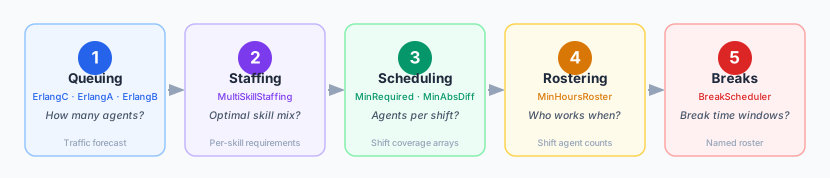
| Step | Module | Typical question |
|---|---|---|
| Queue staffing | pyworkforce.queuing |
How many agents or channels do we need for a service target? |
| Multi-skill staffing | pyworkforce.staffing |
What skill-profile mix covers all queues at minimum cost? |
| Shift scheduling | pyworkforce.scheduling |
How many people should work each shift? |
| Rostering | pyworkforce.rostering |
Which named people work on which days and shifts? |
| Break scheduling | pyworkforce.breaks |
When can breaks happen without dropping below coverage? |
from pyworkforce.queuing import ErlangC

erlang = ErlangC(
    transactions=100,  # calls in the interval
    aht=3,             # average handle time, minutes
    asa=20 / 60,       # answer-time target, minutes
    interval=30,       # interval length, minutes
    shrinkage=0.30,
)

print(erlang.required_positions(service_level=0.80, max_occupancy=0.85))
{'raw_positions': 14,
'positions': 20,
'service_level': 0.8883500191794669,
'occupancy': 0.7142857142857143,
'waiting_probability': 0.1741319335950498}
raw_positions is productive staffing. positions adds shrinkage for breaks,
training, meetings, and other unavailable time.
from pyworkforce.queuing import MultiErlangC
from pyworkforce.utils import results_to_dataframe

param_grid = {
    "transactions": [80, 100, 120],
    "aht": [3],
    "asa": [20 / 60],
    "interval": [30],
    "shrinkage": [0.20, 0.30],
}

multi = MultiErlangC(param_grid=param_grid, n_jobs=-1)
results = multi.required_positions({"service_level": [0.80], "max_occupancy": [0.85]})
df = results_to_dataframe(results, multi.required_positions_params)
print(df[["transactions", "shrinkage", "positions", "service_level"]])
Use this pattern to compare service levels, shrinkage assumptions, average handle time, patience, or arrival forecasts.
from pyworkforce.shifts import shift_coverage_from_hours

shifts_coverage = shift_coverage_from_hours(
    {
        "Morning": (6, 14),
        "Afternoon": (14, 22),
        "Night": (22, 6),  # wraps past midnight
    },
    num_periods=24,
)
The result feeds the scheduling solvers directly, avoiding hand-written 0/1 coverage arrays.
| Capability | Use it when | Start here |
|---|---|---|
| Erlang C staffing | Callers wait and abandonment is ignored or negligible | Erlang C guide |
| Erlang A staffing | Callers may abandon before being answered | Erlang A guide |
| Erlang B channel sizing | Blocked calls are lost because there is no queue | Erlang B guide |
| Multi-skill staffing | Agents can cover different skill combinations | Staffing guide |
| Shift scheduling | You need shift counts from hourly demand | Scheduling guide |
| Employee rostering | You need named assignments with rules and preferences | Rostering guide |
| Break scheduling | You need meal/rest breaks while maintaining coverage | Break guide |
pyworkforce is beta-stage open source software. The core models are tested and usable for real planning experiments, but workforce policies vary by operation, country, and labor agreement. Validate assumptions, units, and constraints against your own environment before using results operationally.
Contributions are welcome: examples, documentation, validation improvements, benchmarks, visualization helpers, additional workforce constraints, and bug reports all help. See CONTRIBUTING.md for local setup, tests, docs, and roadmap ideas.
pyworkforce is released under the MIT License.