Data science project using data from a Brazilian e-commerce company called Olist. SQL, Python, Exploratory analysis skills and Machine Learning were used to accomplish this project. Additionally, MLflow was used for experiment tracking and model registry, while FastAPI was employed to deploy the model as a REST API, enabling real-time predictions.
For a better view of the project, please enter the google colab link present in the notebooks

The present dataset has different data sources, each table specifying a topic of e-commerce sales. The tables are separated into:
- Costumers
- Geolocation
- Orders
- Order items
- Payments
- Order reviews
- Products
- Sellers
- Product category name
The data is divided in multiple datasets for better understanding and organization.
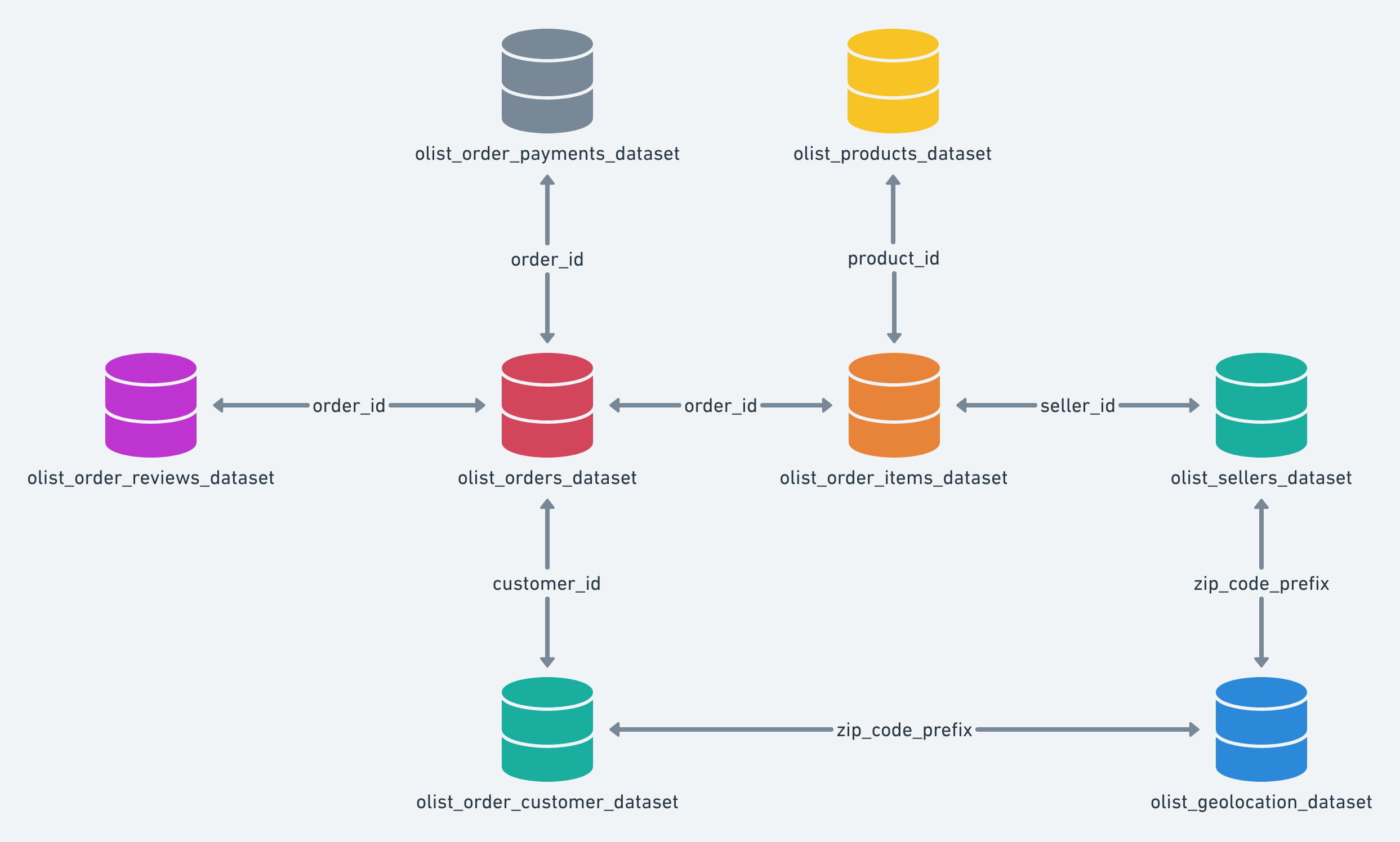
In the present project I performed Exploratory Data Analysis on each of the tables to better understand the influence by category on Olist's business. Later, using SQL language, I created a Big table with the union between all the tables and performed a new exploratory analysis with confrontations between the most diverse features of the dataset. After creating the unified table and conducting the Exploratory Data Analysis, I performed feature engineering, data manipulation and transformation on the existing variables to create new relevant features to the problem at hand.
Next, I defined the target variable representing the evaluation score and applied classification models. I used Pipelines of Random Forest and XGBoost, popular algorithms for classification problems in machine learning, to predict and classify the data based on the available features.
These additional steps of feature engineering and applying classification models allow for exploring patterns in the data, building a predictive model, and making decisions based on the obtained insights.
Note that the process of exploratory analysis, feature engineering, and applying machine learning models can be iterative, involving testing, adjusting, and continuous evaluation of the results.
To manage the entire machine learning lifecycle, I integrated MLflow into the project. With MLflow I was able to:
- Track experiments and log metrics for different runs.
- Save and version trained models.
- Register the best-performing model and promote it to the "Staging" stage of the MLflow Model Registry.
- Transition the best model to "Production" once validated.
For deployment, I used FastAPI to expose the production model via a REST API, allowing external applications to make inference requests. This ensures the project is not only a data science study but also demonstrates the complete workflow of experiment tracking, model management, and real-time inference.