

WorldFlow3D: Flowing Through 3D Distributions for Unbounded World Generation (ECCV 2026).
Amogh Joshi, Julian Ost, Felix Heide
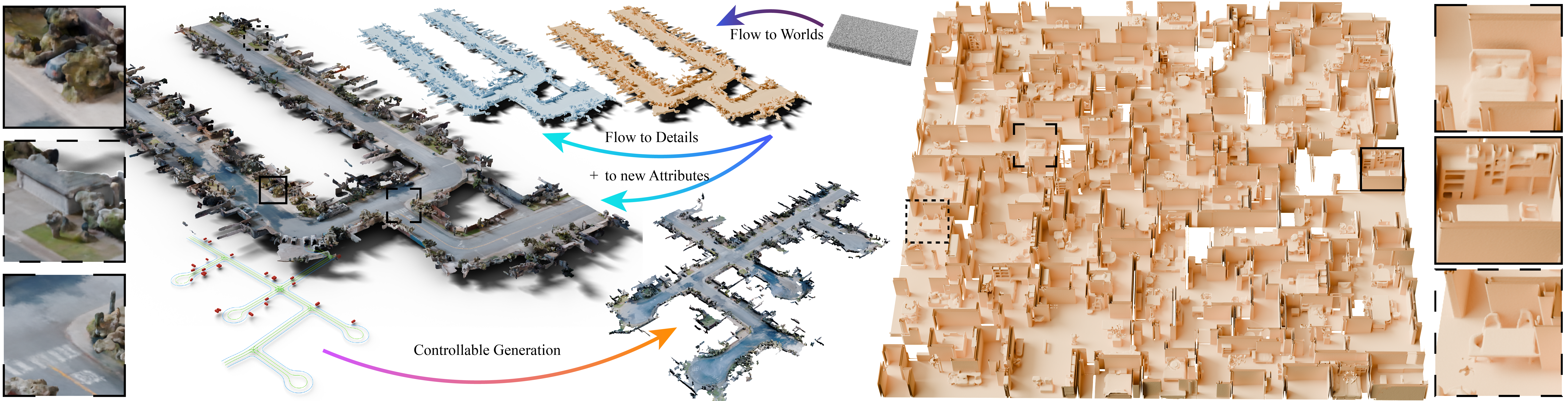
Diffusers-native inference for WorldFlow3D — hierarchical, map/layout-conditioned 3D scene generation via chunked flow matching. A self-contained inference package: pretrained cascades load straight from the Hugging Face Hub with nothing but PyTorch and diffusers.
Code is Apache-2.0. Released models are trained on datasets with their own terms. In particular the Waymo models are non-commercial (Waymo Open Dataset License) — see Licensing,
WAYMO_NOTICE.md, andTHIRD_PARTY_LICENSES.md.
✅ Inference code (worldflow3d package)
✅ Front3D (indoor) checkpoints
✅ Waymo (WOD) checkpoints
✅ PyPI package (pip install worldflow3d)
⬜ Map processing (raw scenes → conditioning maps) — mid July 2026
⬜ Training code — mid July 2026
⬜ Additional indoor layouts — end of July 2026
pip install worldflow3d            # core (torch, diffusers, trimesh, scikit-image, ...)
pip install "worldflow3d[layout]"  # + h5py, for loading Front3D/ScanNet++ .h5 layouts
PyTorch is expected to be installed for your CUDA/CPU platform. Requires
torch>=2.2 and diffusers>=0.29; tested on torch 2.2 / diffusers 0.29.2,
torch 2.5 / diffusers 0.38, and torch 2.12 / diffusers 0.38 (CUDA 13, aarch64)
(NumPy 1.x and 2.x both work).
Running on aarch64 / DGX Spark (GB10)
On an aarch64 host with a Blackwell GB10 (CUDA 13), the standard PyPI/conda torch
wheels don't target the platform — install torch from the CUDA-13 (cu130) index
first, then the package:
pip install torch torchvision --index-url https://download.pytorch.org/whl/cu130
pip install "worldflow3d[examples]"   # + tyro, for the CLI example scripts
pip install accelerate                # optional: quiets the model-load warning
Only the NVIDIA driver is needed — no separate CUDA toolkit — since the cu130
wheel ships its own CUDA runtime. For the fast path on GB10, add --simultaneous --compile to the CLI (Python: simultaneous=True, compile=True on from_hub /
from_converted).
Reference timings on GB10 (Waymo coarse→refine, cfg_scale=1.5, 30+30 steps,
smaller_map=True, fraction=0.12, segment 1172406780360799916, 1 coarse + 49
refine chunks): simultaneous=True + compile=True ~21 min,
simultaneous=False + compile=True ~50 min, simultaneous=False +
compile=False ~2h20m
GB10 is memory-bandwidth-bound here (~244 GB/s unified, vs ~768 GB/s on an A6000 and ~3.35 TB/s on an H100), so treat these as platform reference numbers, not a general benchmark — discrete GPUs are substantially faster.
Each cascade stage is a subfolder of a Hub repo (<dataset>-coarse, plus
<dataset>-refine / -color). The Waymo and Front3D cascades live in separate
repos (Waymo is non-commercial — see Licensing). Load with from_hub:
import torch
from worldflow3d import WorldFlow3DPipeline
from worldflow3d.pipeline.datatypes import LayoutContext
from worldflow3d.conditioning.waymo import load_waymo_map_json
from worldflow3d.recon import save_mesh

# Waymo coarse -> refine cascade, straight from the Hub (non-commercial).
pipe = WorldFlow3DPipeline.from_hub(
    "pci-lab/worldflow3d-waymo", stage="waymo-coarse", refinement_stages=["waymo-refine"],
    device="cuda",
)

# A shipped sample map -- self-contained: no coord transform or data root needed.
map_json = load_waymo_map_json("1172406780360799916", map_dir="examples/sample_maps")
ctx = LayoutContext("waymo", "1172406780360799916", map_json)

result = pipe(layout_context=ctx, cfg_scale=1.5, sampling_steps=30,
              refine=True, refine_sampling_steps=30, use_uniform_chunking=True,
              simultaneous=True, smaller_map=True, fraction=0.12)

save_mesh(result.voxels.cpu(), result.voxel_size, "scene.ply")
CLI (--repo/--stage for the Hub, or --model-dir for local dirs):
python -m worldflow3d.scripts.generate_streets \
    --repo pci-lab/worldflow3d-waymo --stage waymo-coarse --refine-stage waymo-refine \
    --segment 1172406780360799916 --map-dir examples/sample_maps \
    --cfg-scale 1.5 --coarse-steps 30 --refine-steps 30 \
    --smaller-map --fraction 0.12 --use-uniform-chunking --simultaneous \
    --output outputs/segment-1172406780360799916.ply
The sample maps used above ship in the repository under
examples/sample_maps/(they are not bundled in the PyPI wheel). Point--map-dir/map_dir=at any directory of map JSONs.
For a colored scene, use the color refinement stage. The color model is
tag-conditioned (location / time_of_day / weather) — pass tags for a
coherent result; without them the color channels are unconditioned and the mesh
shows color/surface artifacts. save_mesh also writes a colored <name>_color.ply.
python -m worldflow3d.scripts.generate_streets \
    --repo pci-lab/worldflow3d-waymo --stage waymo-coarse --refine-stage waymo-color \
    --segment 1172406780360799916 --map-dir examples/sample_maps \
    --cfg-scale 1.5 --coarse-steps 30 --refine-steps 30 \
    --smaller-map --fraction 0.12 --use-uniform-chunking --simultaneous \
    --coarse-tag location=location_sf \
    --refine-tag time_of_day=Dawn/Dusk --refine-tag weather=sunny \
    --output outputs/segment-1172406780360799916_color.ply
From Python, pass tags= / refine_tags= to the pipeline, e.g.
refinement_stages=["waymo-color"] with
tags={"location": "location_sf"}, refine_tags={"time_of_day": "Dawn/Dusk", "weather": "sunny"}.
Valid values: location ∈ {location_sf, location_phx, location_other};
time_of_day ∈ {Dawn/Dusk, Day, Night}; weather ∈ {sunny, rain}.
Indoor (Front3D), layout-conditioned coarse → color refinement:
python -m worldflow3d.scripts.generate_indoor \
    --repo pci-lab/worldflow3d --stage front3d-coarse --refine-stage front3d-color \
--scene-id <uuid> --data-root front3d_scenes --refine --output outputs/scene.plyEach stage is a self-contained diffusers layout in its own subfolder. The model
code is supplied by this package, so the subfolders carry only weights +
config (no duplicated .py). The Waymo and Front3D cascades are in separate
repos because they carry different licenses:
pci-lab/worldflow3d-waymo/   (NON-COMMERCIAL — Waymo Open Dataset License)
├── waymo-coarse/     model_index.json  unet/{config.json, *.safetensors}  scheduler/
├── waymo-refine/     "    (source-flow refinement, geometry only)
└── waymo-color/      "    (source-flow refinement, geometry + color, unet in=4)

pci-lab/worldflow3d/         (Front3D — 3D-FRONT terms)
├── front3d-coarse/   "
└── front3d-color/    "    (source-flow + color, unet in=4)
waymo-refine and waymo-color are alternative refinement stages for the same
coarse output — pick one. waymo-color also predicts per-voxel color, so save_mesh
writes an extra colored <name>_color.ply sidecar. Each unet/ folder is a distinct
trained model (different weights and configs), not a copy.
| Source | Call | Needs |
|---|---|---|
| Hub (cascade) | WorldFlow3DPipeline.from_hub(repo, stage, refinement_stages=[...]) |
pip install worldflow3d |
| Local dirs | WorldFlow3DPipeline.from_converted(coarse_dir, [refine_dir, ...]) |
converted dirs on disk |
| Bare diffusers | DiffusionPipeline.from_pretrained(repo, trust_remote_code=True) |
a model at the repo root only |
Why no
subfolder=one-liner?diffusers.DiffusionPipeline.from_pretraineddoes not applysubfolderat the pipeline level — it readsmodel_index.jsononly from the repo root (true even on the latest diffusers). So the subfolder/cascade layout is loaded viafrom_hub(this package). The bare-diffuserstrust_remote_codeone-liner works only for a model published at a repo root.
| Component | Class | Notes |
|---|---|---|
| Model | WorldFlow3DUNet(ModelMixin, ConfigMixin) |
wraps the 3D UNet; save_pretrained/from_pretrained (safetensors) |
| Scheduler | WorldFlow3DFlowScheduler(SchedulerMixin, ConfigMixin) |
velocity-prediction Euler flow matching |
| Pipeline | WorldFlow3DPipeline(DiffusionPipeline) |
custom __call__: chunking, CFG, source-flow + standard reconstruction, coarse→refine cascade, sequential + simultaneous |
Default models are direct-diffusion (voxel-space; no VAE). A VAE-decode path is wired but optional. Classifier-free guidance, the model-time scaling, and the inpainting blend live in the pipeline; the scheduler does only the per-step Euler update.
WorldFlow3D ships under multiple licenses depending on the artifact:
| Artifact | License |
|---|---|
Code (worldflow3d package) |
Apache-2.0 (LICENSE) |
Waymo models (waymo-coarse, waymo-refine) + sample maps |
Waymo Dataset License — non-commercial (WAYMO_NOTICE.md, https://waymo.com/open/terms) |
Front3D models (front3d-coarse, front3d-color) |
3D-FRONT terms (non-commercial) |
| Scenes / meshes / datasets generated with the Waymo models | "Distributed WOD Models" — also non-commercial |
The Apache-2.0 license covers the code only; it does not grant rights to the
Waymo- or Front3D-derived weights. Using the Waymo models or sample maps means
agreeing to the Waymo Open Dataset terms (non-commercial), providing the required
attribution, and passing the notice on to downstream recipients. See
WAYMO_NOTICE.md and THIRD_PARTY_LICENSES.md.
- Waymo (map-conditioned) coarse→refine cascade — sequential and simultaneous (feather-averaged) generation.
- Front3D (layout-conditioned) coarse→refine cascade including source-flow + color (unet in=4, with a color mesh sidecar).
- Hub loading via
from_hub(subfolder cascade) on both supported stacks (torch 2.2 / diffusers 0.29 and torch 2.5 / diffusers 0.38; NumPy 1.x and 2.x).
If you use WorldFlow3D in your research, please cite:
@inproceedings{joshi2026worldflow3d,
  title     = {WorldFlow3D: Flowing Through 3D Distributions for Unbounded World Generation},
  author    = {Joshi, Amogh and Ost, Julian and Heide, Felix},
  booktitle = {European Conference on Computer Vision (ECCV)},
  year      = {2026},
}