


Architecture should compile
git clone git@github.com:martinkrakowski/hexagen-monaco.git
cd hexagen-monaco
corepack enable && yarn install
yarn build
npx hexagen --help
The full CLI reference is in CLI Reference.
Generated projects opt into 44 production-ready templates — typed LLM adapters, auth providers, rate limiting, observability, background jobs, Docker/CI, the Adobe Firefly / Creative Cloud family, and more — composable and applied at any time:
npx hexagen templates list             # browse available templates
npx hexagen templates info <id>        # inspect questions, outputs, dependencies
npx hexagen add llm-adapter docker     # install one or more (dependencies auto-resolved)
npx hexagen validate-templates         # health-check installed templates
Full catalog and behavior (composable / idempotent / non-destructive / dependency-aware): Generator Add-On Templates.
For architectural planning and remediation plans, see the dedicated documentation:
The .architecture/ directory remains the single source of truth for machine-enforced contracts and primary ADRs.
Architectural decay is rarely visible until the cost of correcting it becomes systemic. In enterprise systems — and now in codebases increasingly authored by autonomous agents — bounded contexts merge silently through shared utilities, business logic leaks into adapters, and dependency edges form across layers that were never meant to touch. The damage is done before anyone files an alert.
Linting rules and review etiquette are not enough. When the actors mutating the system include both humans and LLM-driven agents, the architecture itself must be the contract that everyone — human or otherwise — is forced to honor.
Hexagen-Monaco treats architecture as a first-class, executable artifact. A single manifest.yaml encodes the system topology — planes, bounded contexts, ports, adapters, and layer rules — as deterministic data. The same manifest drives the visual canvas, the linter, and the tool surface AI agents are restricted to. Architectural decisions stop being documents that drift from reality and become rules the build enforces against every contributor, human or agentic.
Every mutation in the system, whether issued by a human in the visual control plane, an operator in the terminal control plane, or an LLM through the MCP server, flows through the same closed loop:
Manifest  ──►  Linter (hexagen-lint)  ──►  HITL Surface (Web / TUI)
   ▲                                              │
   │                                              ▼
Transaction  ◄──────────  Agent / Operator (via MCP server)
The manifest is the source of truth. The linter compiles invariants into a verdict. Humans review violations in either control plane. Agents propose remediations through the MCP server's tool surface. Changes proposed through the web control plane are captured as transactions and merge only after explicit approval. The MCP server's mutation tools currently write to the manifest directly — gated by deterministic structural and referential validation (split-manifest protection, dependency-cycle refusal, port/context referential checks) rather than by human approval; routing those writes through the same transaction-approval path is planned follow-up work.
Two operator surfaces participate in the governance loop: a visual control plane in the browser and a terminal control plane on the engineer's workstation. Both consume the same manifest state the linter compiles against and the MCP server reads from — the operator's view is the system's view. Operators inspect the same architectural state the system enforces.
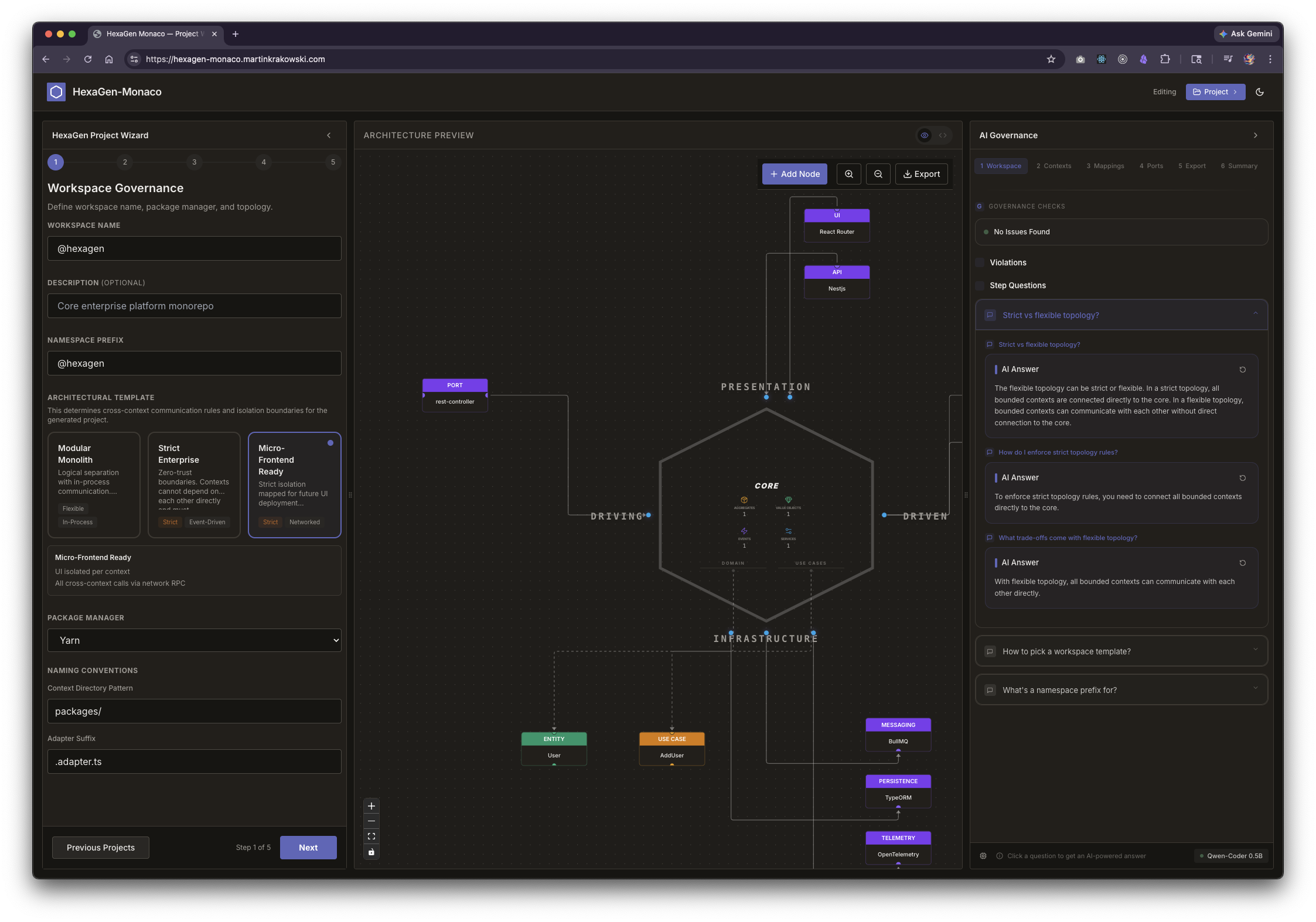
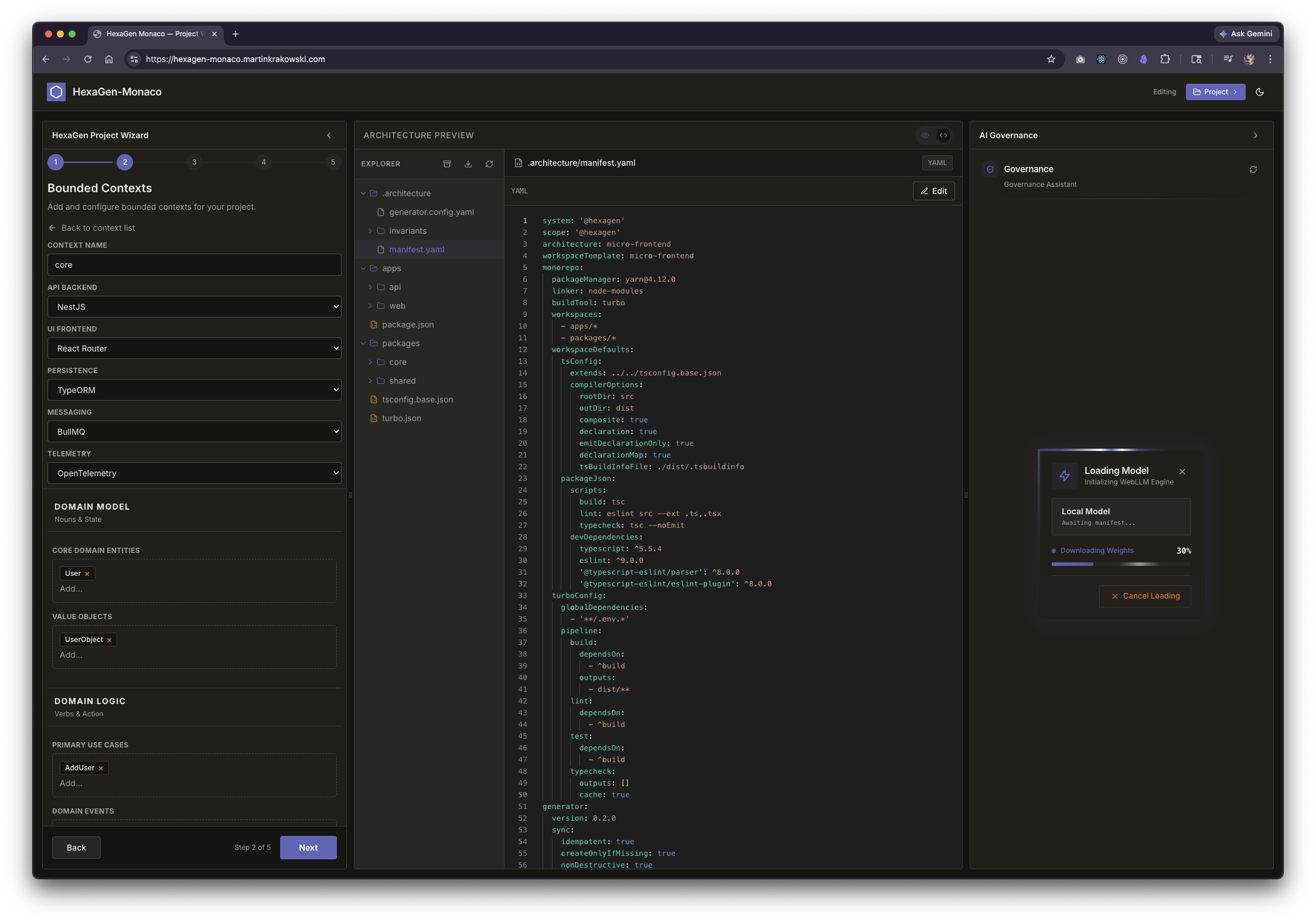
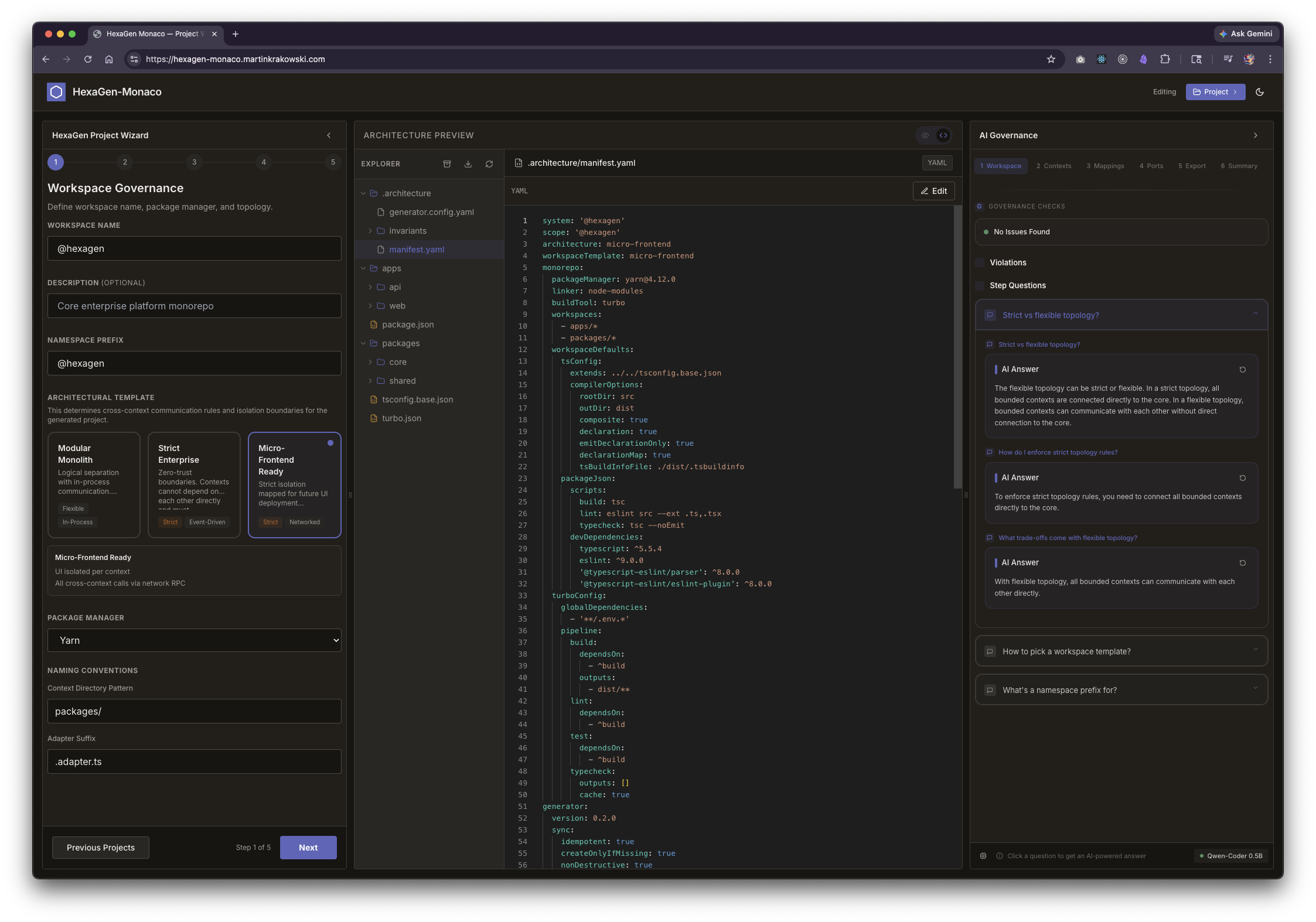
The Next.js application is the visual control plane. It surfaces the manifest's bounded contexts, ports, adapters, and dependency edges as a governance surface where human operators inspect invariants, review agent-proposed mutations, and accept or reject transactions before they reach main. The canvas is a window onto governance state, not a separate model of it.
The terminal control plane (apps/tui) built with Ink is the local operator surface for engineers reviewing governance state without leaving the terminal. Three panes expose live state: bounded-context navigation, the active invariant set, and a boundary-violation inspector. Filesystem watching on the manifest keeps the operator's view synchronized with what the linter and MCP server observe — there is no stale local cache to diverge.
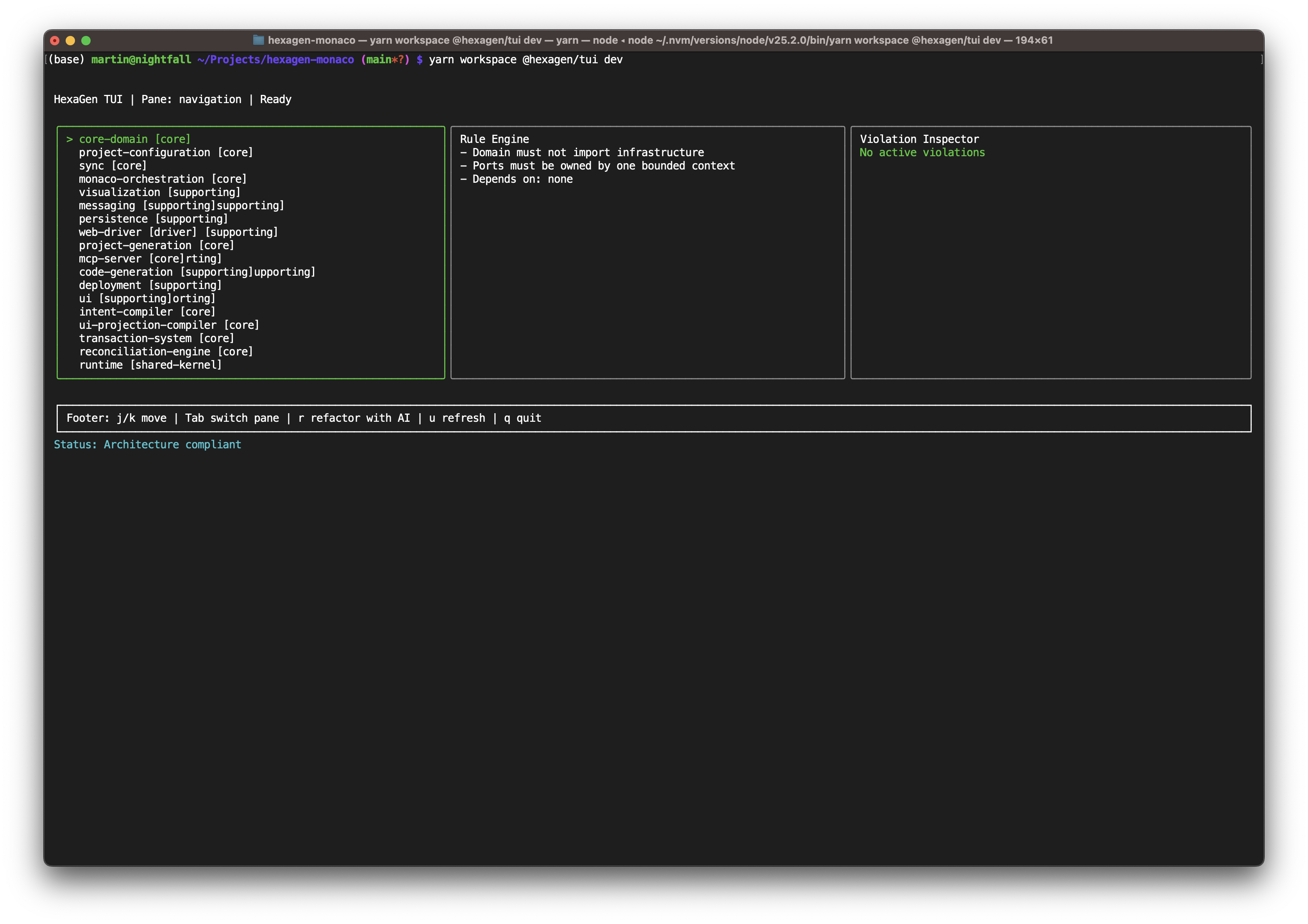
When the linter detects a boundary violation, pressing r sends the violation context to an LLM, which selects a remediation from an allow-listed set of MCP tools (audit, add-dependency, create-port, create-adapter, scaffold-module); the TUI then executes the selected tool through a local MCP client immediately — pressing r is the operator's sign-off, and the structural/referential write gates described in The Governance Loop above are what stand between the agent's suggestion and the manifest. A review-before-apply step is planned follow-up work. Key bindings: j/k to navigate, Tab to switch panes, r to request an agent remediation, u to refresh, q to quit.
yarn workspace @hexagen/tui dev       # development
yarn workspace @hexagen/tui start # builtA generated project can be downloaded as a ZIP or published directly to a new GitHub repository. From the wizard's summary step an operator can create the repo and commit the scaffold, and from the Monaco editor push subsequent edits straight back to it — no leaving the app.
- Authentication. GitHub OAuth via NextAuth (
GitHubProvider, scoperead:user user:email repo). The access token is read server-side from the session JWT and never reaches the browser — the client only ever sees commit URLs and status. A revoked or expired token is surfaced as a distinctreauth_requiredresponse so the operator is prompted to re-authenticate rather than shown a generic failure. - Publish —
POST /api/export/github. Creates the repository under the authenticated user or an organization (/user/reposvs/orgs/{owner}/repos), then writes the generated tree through the Git Data API — blobs → tree → commit → fast-forward ref — onto the repository's actual default branch. The new repo's identity ({ owner, repo, branch, htmlUrl, … }) is persisted on the saved project (SavedProject.githubLink, client-side IndexedDB) so the project remembers where it was published and reconnects on reload. - Editor push —
POST /api/push/github. Commits the editor's current file set to the connected repository as an incremental, base-on-HEAD commit and returns the commit URL. The wizard and editor surfaces report progress and the resulting repository link.
The GitHub plumbing lives in the infrastructure plane: a shared GitHubGitDataClient backs both the GitHubExporterAdapter (publish) and the GitHubRepositoryWriterAdapter behind a RepositoryWriterPort (editor push), all in @hexagen/external-integration and wired at the composition root. project-generation stays decoupled from the GitHub implementation — it depends only on @hexagen/shared and @hexagen/sync.
AI in Hexagen-Monaco is not a first-class domain actor. It is governed infrastructure modeled behind explicit ports, with quality controls and an escalation strategy that treat LLM output the same way the build treats any other untrusted input.
LLM ports (three, all in the probabilistic plane). Every inference call is routed through one of:
LLMProviderPort— generic request/response abstraction inagentic-interaction.CloudLLMProviderPort— OpenAI-compatible cloud inference withpreferredCloudModel, BYOK key handling, and cancellation signals.LocalLLMProviderPort— browser-side WebGPU inference via WebLLM (MLC AI) in thelocal-llmplane, with IndexedDB model caching for offline operation.
No domain code references a provider by name. Switching providers, swapping in a local WebGPU model, or routing through a future inference backend is an adapter concern — not an architectural one.
Outbound port quality controls. The agentic-interaction context applies deterministic validation to every LLM-proposed port before it is allowed into the manifest pipeline. Implemented in packages/agentic-interaction/src/domain/services/port-quality-validator.ts:
| Rule | Check |
|---|---|
| R16 | Port description is trivial or the justification is a degenerate restatement of the port name. |
| R17 | The port's forAggregate reference does not match any known aggregate root. |
| R18 | Port name leaks infrastructure or platform metadata (Vercel, FlyIO, AWS, GCP, *Client, *Adapter, *Host, *Platform …). |
Retry with model escalation. Stage-3 structured config generation uses STAGE3_ESCALATION_CONFIG (3 default retries, then up to 3 escalated retries on a stronger model). The escalation model is opt-in: it ships as escalationModel: undefined and is injected at the wiring layer from the LLM_ESCALATION_MODEL env var — hardcoding a model name (e.g. gpt-4o) would 404 on non-OpenAI providers (NVIDIA, vLLM, Ollama, Anthropic). When unset, the escalated retries are skipped. The generic DEFAULT_ESCALATION_CONFIG provides the same 3 + 3 pattern for use cases that need to fall back to a stronger model on persistent failure. Both live in packages/agentic-interaction/src/application/use-cases/staged-generation/retry-with-escalation.ts.
Confidence-gated type review. ClassifyContextTypeUseCase emits a confidence score on every inferred context type; results below the threshold are flagged needsTypeReview and surfaced to the human reviewer, never auto-applied.
MCP server (stdio). The mcp-server context exposes the entire governance surface to MCP-compatible clients — Claude Code, Copilot, the TUI's own client — over stdio transport:
- 7 read resources: manifest, dependency graph, linter report, decisions, invariants, linter config, workspace context.
- 19 tools: audit boundaries, diff manifest, scaffold module, create / remove port / context / adapter, add dependency, generate topology / adapters / manifest pipeline, accept / reject / get / list transaction, log agent remediation, initialize feature worktree, submit architectural spec.
Mutation tools write to the manifest directly, behind deterministic fail-closed write gates (split-manifest protection, dependency-cycle refusal, port/context referential checks — see The Governance Loop above). The transaction accept/reject tools operate on proposals from the web control plane's transaction flow; routing the MCP mutation tools through that same approval path is planned follow-up work.
Hexagen-Monaco is a modular monolith. Thirty-four bounded contexts live across five planes; the manifest at .architecture/manifest.yaml is the single source of truth.
| Plane | Context | Responsibility |
|---|---|---|
| Core | project-configuration | Governance core; manifest parsing and topology validation |
| Core | wizard-orchestration | Deterministic UI engine; Intent → Use Case → Projection |
| Core | monaco-orchestration | Semantic patching via ts-morph, confidence-gated mutations |
| Core | project-generation | Hexagonal boilerplate generation from manifest specs |
| Core | governance | Decisions, invariants, and architectural policy state |
| Core | ai-pipeline | Staged generation pipeline orchestration |
| Core | transaction-system | Speculative state machine, backpressure, semantic caching (frozen) |
| Core | intent-compiler | Compiles user intent into structured use-case input |
| Core | layout-engine | Deterministic layout for visualization projections |
| Core | ui-projection-compiler | Compiles projection specs into renderable UI trees |
| Core | prompt-compiler | Compiles prompts; ACL between domain and LLM ports |
| Core | manifest-generation | Manifest synthesis from architectural specs |
| Core | llm-driver | Domain-side driver for LLM-backed use cases |
| Core | report-governance | Governance reporting and remediation audit trail |
| Core | byok | Bring-your-own-key secret handling for cloud LLMs |
| Core | architectural-enforcement | Architectural enforcement tooling (ESLint plugin + arch-linter boundaries) |
| Core | code-generation | Code-generation tooling (folded into sync + project-generation) |
| Probabilistic | agentic-interaction | Outbound LLM ports, R16-R18 quality controls, retry + escalation |
| Probabilistic | mcp-server | Stdio MCP server; 7 governance reads, 19 tools (mutations behind deterministic write gates) |
| Probabilistic | local-llm | WebGPU/WebLLM inference, IndexedDB model + chat persistence |
| Probabilistic | reconciliation-engine | Reconciles agent proposals against current manifest state |
| Projection | web-driver | Next.js application shell; HITL canvas host |
| Projection | ui | Shared React components for projection planes |
| Projection | visualization | Architecture graph rendering (React Flow) |
| Projection | model-settings | Model configuration and provider selection UI |
| Infrastructure | sync | Manifest-to-workspace synchronization engine |
| Infrastructure | template-engine | Add-on template system — manifest-driven scaffolds, dependency resolution, idempotent emission |
| Infrastructure | persistence | Storage adapters (Drizzle, IndexedDB) |
| Infrastructure | messaging | Cross-context event delivery |
| Infrastructure | external-integration | Outbound adapters to external APIs |
| Infrastructure | deployment | Build and release artifacts |
| Infrastructure | runtime | Process and worker lifecycle |
| Shared-Kernel | core-domain | Cross-plane domain primitives |
| Shared-Kernel | shared | Type-only utilities permitted in any plane |
Three runtime surfaces expose the governance planes: apps/web (Next.js visual control plane), apps/tui (Ink terminal control plane), apps/api-gateway (HTTP surface for the canvas).
Four independent enforcement layers prevent unauthorized mutations from reaching main:
- TypeScript project references isolate package compilation graphs at the file-system level.
- ESLint boundaries reject unauthorized cross-package imports during local development.
- Turborepo pipeline enforces build-graph isolation and caches per-package outputs.
hexagen-lintvalidates the manifest against.architecture/invariants/linter-config.yaml— per-context subpath conventions, per-package import allow-lists, and a global whitelist.
hexagen-lint discovers the project root in this order: --root <path> argument, then HEXAGEN_ROOT env var, then a walk-up for .architecture/manifest.yaml, then a walk-up for a package.json containing a workspaces field.
The manifest is versioned and diffable. Three tracking surfaces support change review:
- Module splits show how bounded contexts decompose as the system grows.
- Port contract diffs surface drift in interface signatures before downstream adapters break.
- Manifest diffs (
hexagen arch diff) compare the working tree againstgit HEADor any specified revision — the same diff feeds the MCPDiffManifestToolUseCasefor agentic review.
Beyond scaffolding the architecture, HexaGen ships 44 opt-in add-on templates — production-ready infrastructure slices a generated project can apply at any time. Each template is self-contained: it declares its own questions, dependencies, output files, required env vars, and post-install checklist, then emits typed, hexagonal-architecture-aligned code into the project.
npx hexagen templates list             # list available templates (✅ marks installed)
npx hexagen templates info <id>        # inspect a template's questions, outputs, deps
npx hexagen add <id> [<id> ...]        # install one or more (dependencies auto-resolved)
npx hexagen add <id> --force           # re-apply an installed template
npx hexagen validate-templates         # verify installed templates are healthy
Templates are:
- Composable — any subset applies together; conflicts (e.g. competing auth providers) are declared and enforced at install time.
- Dependency-aware — install order is topologically sorted; missing dependencies and cycles are caught before any file is written.
- Non-destructive — a user-modified generated file is never overwritten; a
.hexagen-update.<ext>conflict copy is written alongside it. - Idempotent — re-running
hexagen addon an unchanged project is a no-op (generated files are SHA-256 tracked).
- Foundation —
env-setup(categorised.env, Zod validation,check-env,SETUP.md) ·shared-types(UserContext, env-overridable mock user, session helpers) - Core infrastructure —
rate-limiting·llm-adapter(typed port + xAI/OpenAI/Anthropic/Ollama adapters, model routing, retry) ·error-handling(3-layer hierarchy, RFC 7807, React error boundary) ·observability(structured logging, correlation IDs,/api/health) ·eslint-no-console - Auth —
auth-mock; real providersgoogle-oauth·github-oauth·microsoft-entra·magic-link·adobe-ims-spa·supabase-auth; standalone frameworksnextauth·clerk·better-auth(providers are mutually exclusive) - Persistence & jobs —
supabase(SSR client, storage, RLS stubs, optional Drizzle) ·bullmq(typed queues, workers, Redis fallback, optional Bull Board) - AI & agents —
langgraph(typed agent graph, checkpointing, streaming, HITL) ·llm-adapter-bedrock(Bedrock Converse adapter) ·bedrock-agentcore-runtime(AgentCore deploy target) ·bedrock-agentcore-services(Memory / Gateway / Identity) - Adobe Firefly & Creative Cloud (17) —
adobe-firefly-corefoundation + service add-onsgenerate·upscale·composite·content-tagging·media·custom-models; app automationadobe-photoshop·adobe-lightroom·adobe-illustrator·adobe-indesign·adobe-express·adobe-creative-production·adobe-substance-3d; presigned storageadobe-firefly-storage-s3·-gcs·-azure - DevOps —
docker(multi-stage Dockerfile, compose + dev override, image-push action) ·ci-github-actions(build/typecheck/lint/test CI, Vercel/Railway/Fly/VPS deploy, PR previews, Dependabot) - DX & docs —
design-system(CSS tokens, Tailwind extension, base components, optional Storybook) ·agents-md(richAGENTS.md+.agents/spec directory)
Per-template design docs and the full dependency graph live in docs/planning/generator-templates/.
# Sync — compile the manifest into workspace artifacts
npx hexagen sync                       # generate artifacts
npx hexagen sync --dry-run             # preview changes
npx hexagen sync --force               # overwrite non-generated files
npx hexagen sync --strict              # fail on linter warnings

# Manifest management
npx hexagen arch list                  # list bounded contexts
npx hexagen arch validate              # validate manifest against invariants
npx hexagen arch port                  # scaffold a port (interactive)
npx hexagen arch context               # add a bounded context (interactive)
npx hexagen arch remove port [--force]
npx hexagen arch remove context [--force]
npx hexagen arch diff                  # working tree vs git HEAD
npx hexagen arch diff --file <path>    # compare against a file
npx hexagen arch edit                  # open manifest in $EDITOR (default: nano)
npx hexagen arch edit --editor vim
npx hexagen arch edit --validate-only

# Linter (architectural integrity)
hexagen-lint --root /path/to/project
HEXAGEN_ROOT=/path/to/project hexagen-lint
yarn lint:arch                         # workspace convenience target

# Add-on templates
npx hexagen templates list             # list templates (✅ = installed)
npx hexagen templates info <id>        # inspect a template
npx hexagen add <id> [<id> ...]        # install (dependencies auto-resolved)
npx hexagen validate-templates         # health-check installed templates

# Apps
yarn workspace @hexagen/web dev
yarn workspace @hexagen/tui dev# .architecture/manifest.yaml (illustrative excerpt — simplified for reading.
# Real bounded_contexts entries are flat maps; ports and layer detail live in
# per-context context.yaml files. Runtime LLM settings (retries, escalation)
# are code/env-level config, not manifest fields — see "Retry with model
# escalation" above.)
system: hexagen-monaco
architecture: modular-monolith
planes:
core: [project-configuration, wizard-orchestration, monaco-orchestration, ...]
probabilistic:
[agentic-interaction, mcp-server, local-llm, reconciliation-engine]
projection: [web-driver, ui, visualization, model-settings]
infrastructure: [sync, persistence, messaging, deployment, runtime, ...]
shared-kernel: [core-domain, shared]
bounded_contexts:
- name: agentic-interaction
type: supporting
plane: probabilistic
status: active
ports:
- LLMProviderPort
- CloudLLMProviderPort
- SuggestionEnginePort
- SecretVaultPort
quality_controls:
- R16 # trivial description / degenerate justification
- R17 # invalid forAggregate reference
- R18 # infrastructure / platform name leakTests run in CI only. Local pre-commits run lint and typecheck (~2–5s); the full suite runs against a clean GitHub Actions environment. The test runner is Node's built-in node:test.
yarn test                              # full suite
yarn workspace @hexagen/web-driver test
yarn test --watch
yarn test --coverage
The .github/workflows/sync-integrity.yml workflow runs on every PR and on pushes to main / develop:
- Build —
yarn turbo run build - Typecheck —
yarn turbo run typecheck - Lint —
yarn turbo run lint(architecture + ESLint) - Linter integrity —
yarn workspace @hexagen/sync run cli sync --dry-run - Test suite —
yarn turbo run test
All steps must pass before merging to main.
- Monorepo: Yarn 4 + Turborepo
- Language: TypeScript (composite project references)
- Canvas: Next.js + React Flow
- Terminal UI: Ink
- Semantic patching:
ts-morph - Local inference: WebLLM (MLC AI) on WebGPU
- MCP transport: stdio
- Manifest: YAML
- Testing:
node:test
HexaGen Monaco is a source-available, proprietary product owned by Krakowski Cloud Solutions, LLC. It is licensed under the Source-Available Evaluation License.
What this means:
- You can read the source code, run it locally, and use it freely for internal evaluation and non-commercial academic research.
- You cannot use this software in a commercial production deployment, or offer it as a managed service.
- This software does not transition to an open-source license.
For commercial licensing, enterprise support, and access to the automated brownfield ingestion engine, please contact Krakowski Cloud Solutions, LLC.
Maintained by Martin Krakowski