
A Web Component for measuring browser round-trip audio latency in Web Audio applications.
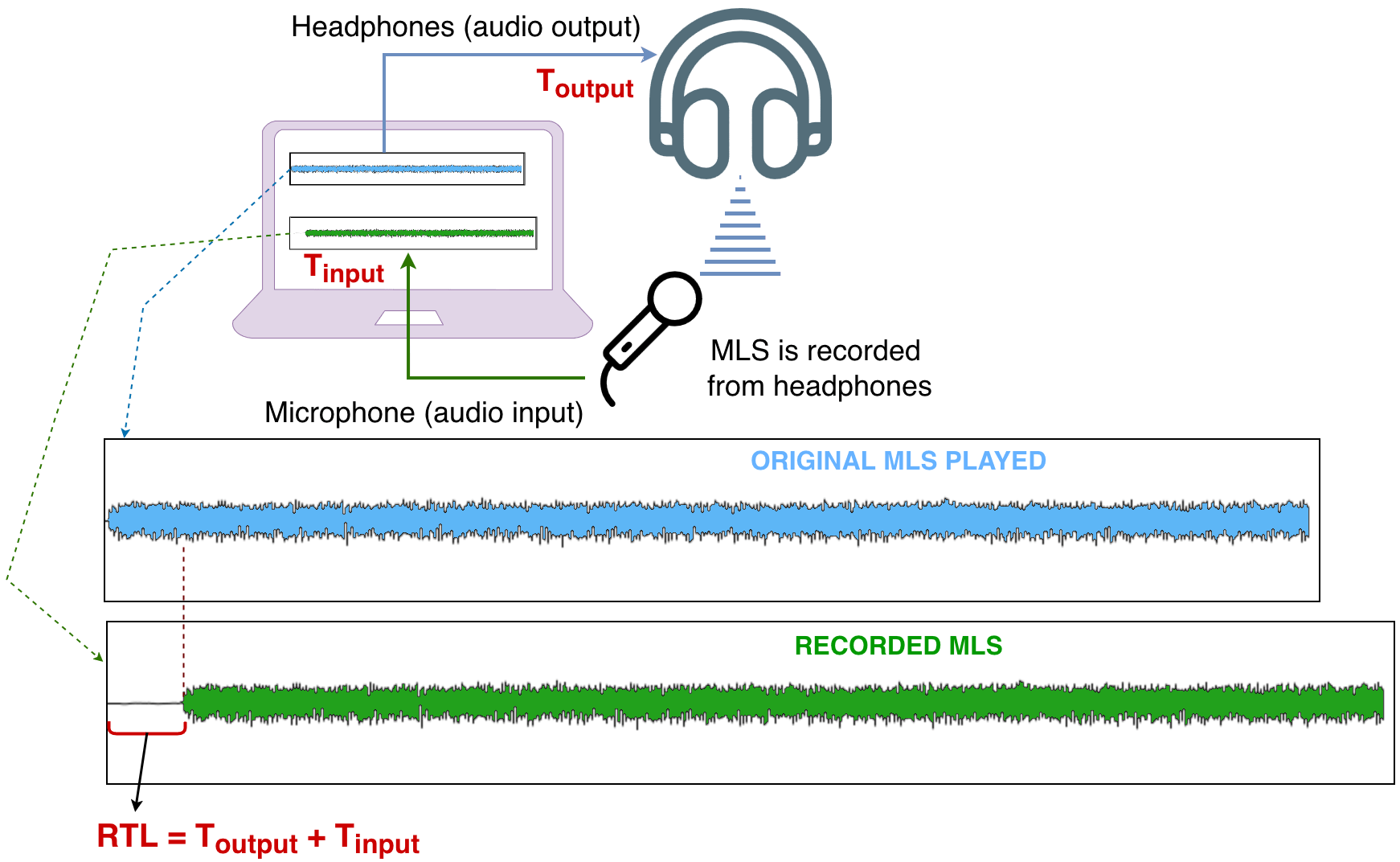
- Measures round-trip browser audio latency using an MLS (Maximum Length Sequence) signal and cross-correlation
- Designed for integration into Web Audio and DAW-like web applications
- Headless-first API:
start()/stop()methods and custom events — no built-in UI - Reports latency in milliseconds and a reliability ratio in dB (values above
18 dBindicate a trustworthy measurement)
<latency-test id="lt"></latency-test>
<button id="btn">Test</button>

<script type="module">
  import '@adasp/latency-test' // npm / bundler — for CDN usage see docs/install.md

  const lt = document.getElementById('lt')

  lt.addEventListener('latency-result', (e) => {
    console.log(e.detail.latency, 'ms — ratio:', e.detail.ratio, 'dB')
  })

  // audioContext and inputStream must be assigned before start() — create them from a user gesture
  document.getElementById('btn').addEventListener('click', async () => {
    if (!lt.audioContext) {
      lt.audioContext = new AudioContext({ latencyHint: 0 })
      lt.inputStream = await navigator.mediaDevices.getUserMedia({ audio: { echoCancellation: false, noiseSuppression: false, autoGainControl: false } })
    }
    lt.start()
  })
</script>
Multiple consecutive tests with aggregate statistics:
<latency-test id="lt" number-of-tests="5"></latency-test>
<button id="btn">Run 5 tests</button>

<script type="module">
  import '@adasp/latency-test' // npm / bundler — for CDN usage see docs/install.md

  const lt = document.getElementById('lt')

  lt.addEventListener('latency-result', (e) => {
    console.log('run:', e.detail.latency, 'ms')
  })

  lt.addEventListener('latency-complete', (e) => {
    const { mean, std, min, max } = e.detail
    console.log(`mean ${mean.toFixed(2)} ms · std ${std.toFixed(2)} · min ${min.toFixed(2)} · max ${max.toFixed(2)}`)
  })

  document.getElementById('btn').addEventListener('click', async () => {
    if (!lt.audioContext) {
      lt.audioContext = new AudioContext({ latencyHint: 0 })
      lt.inputStream = await navigator.mediaDevices.getUserMedia({ audio: { echoCancellation: false, noiseSuppression: false, autoGainControl: false } })
    }
    lt.start()
  })
</script>Full integration docs are published via VitePress (see docs/):
- Docs site: https://idsinge.github.io/latency-test/
- API reference — attributes, methods, events, algorithm constants:
docs/api.md - Framework examples — Vanilla JS, React, Vue, Svelte, Angular, Next.js:
docs/examples/ - Installation — npm, CDN, AudioContext sharing:
docs/install.md - Live demo: https://idsinge.github.io/latency-test/demo/
- Dev & research pages: https://idsinge.github.io/latency-test/dev/ (test pages and experiments, including the MediaRecorder 2ch and 1ch experiments)
Run the component dev pages (source, no build needed):
npm install
npm run dev
# open http://localhost:3000
Run the demo against the built bundle:
npm run build:component:legacy  # demo uses the legacy build (Safari 14 / Chrome 78 compatible)
npm run demo
# open http://localhost:3000/demo/
Run the documentation site:
npm run docs:dev
# open http://localhost:5173
Other commands:
npm test                          # run unit tests (Node 18+, no install needed)
npm run build:component           # build the component bundle (dist/)
npm run build:component:legacy    # legacy build: lowers private fields + optional chaining for Safari 14 / Chrome 78
npm run docs:build                # build VitePress docs
npm run docs:preview              # preview built docs locally
Requirement: Node.js v18 or above (minimum tested). Development is pinned to Node 22 via .nvmrc; the docs CI deploy uses Node 24.
This repository contains the prototype implementation, full package planning (see agents/CLAUDE_REVIEW.md), and the VitePress documentation site. The root README is intentionally concise — detailed integration guidance lives in docs/.
- Prototype: MLS signal generation, cross-correlation via Web Worker, MediaRecorder capture
- Web Component refactor:
<latency-test>Custom Element, Shadow DOM, instance-based architecture - AudioWorklet backend:
recording-mode="audioworklet"— dual-channel raw PCM capture via dedicated AudioWorklet processor -
recording-mode="mediarecorder"upgraded to 2-channel (ChannelMergerNode + MediaStreamDestinationNode, no start-timing bias);recording-mode="mediarecorder-1ch"available as 1-channel fallback for browsers that downmix stereo to mono (Phase 3b complete) - npm package publication as
@adasp/latency-test - Additional signal types: chirp (logarithmic sine sweep), Golay complementary sequences
This project originates from research on browser round-trip audio latency presented at WAC 2025. The original proof-of-concept app remains available at gilpanal/weblatencytest. This repository is the Web Component development branch. The same measurement method is also used in the Hi-Audio online platform.
Gil Panal, J. M., Richard, G., & David, A. (2025). A Maximum Length Sequence–Based Method for Robust Round-Trip Latency Estimation in online Digital Audio Workstations. WAC 2025. https://doi.org/10.5281/zenodo.17642262
- Article at EURASIP Journal on Audio, Speech, and Music Processing: https://link.springer.com/article/10.1186/s13636-026-00459-0
- Hi-Audio online platform: https://hiaudio.fr
- News: https://hiaudio.fr/static/news.html
- Hi-Audio web-app repository: https://github.com/idsinge/hiaudio_webapp
- Python/Google Colab notebook for MLS-based latency estimation: https://gist.github.com/gilpanal/f6a64a8fe797190bba22123dfea29611
This work is developed as part of the project Hybrid and Interpretable Deep Neural Audio Machines, funded by the European Research Council (ERC) under the European Union's Horizon Europe research and innovation programme (grant agreement No. 101052978).

We also thank Louis Bahrman for his collaboration on this project, including his contributions to the Python/Google Colab notebook for MLS-based latency estimation.
If you use or reference the data or findings from this repository, please cite the published conference paper. You may also cite the repository directly.
Gil Panal, J. M., Richard, G., & David, A. (2025). A Maximum Length Sequence–Based Method for Robust Round-Trip Latency Estimation in online Digital Audio Workstations. In Proceedings of the Web Audio Conference (WAC 2025). https://doi.org/10.5281/zenodo.17642262
BibTeX:
@inproceedings{GilPanal2025wac,
  author    = {Gil Panal, Jos{\'e} M. and Richard, Ga{\"e}l and David, Aur{\'e}lien},
  title     = {A Maximum Length Sequence--Based Method for Robust Round-Trip Latency Estimation in online Digital Audio Workstations},
  booktitle = {Proceedings of the Web Audio Conference (WAC 2025)},
  year      = {2025},
  doi       = {10.5281/zenodo.17642262},
  url       = {https://doi.org/10.5281/zenodo.17642262}
}
A preprint version is also available at: https://hal.science/hal-05154354
Repository citation:
Gil Panal, J. M., Richard, G., & David, A. (2024). weblatencytest [Software repository]. GitHub. https://github.com/gilpanal/weblatencytest
@misc{GilPanal2024weblatencytest,
  author = {Gil Panal, Jos{\'e} M. and Richard, Ga{\"e}l and David, Aur{\'e}lien},
  title  = {weblatencytest},
  year   = {2024},
  url    = {https://github.com/gilpanal/weblatencytest}
}This project is licensed under the MIT License.
Copyright (c) 2024 Hi-Audio.