






Burn is both a tensor library and a deep learning framework, optimized for
numerical
computing, training and inference.
Training and inference usually live in separate worlds. Models are typically trained in Python then exported to an open format like ONNX or optimized for production engines like vLLM, ONNX Runtime, or TensorRT. This export step is often brittle and lossy, ruling out complex architectures and advanced deployment use cases.
Burn unifies the two. By executing multi-platform tensor operations via a single, unified API, the exact code used for training is the exact code that runs in production. This makes workloads like on-device personalization and federated learning straightforward, while enabling teams to go from prototype to deployment in a single codebase.
Burn preserves the intuitive ergonomics of PyTorch, with dynamic shapes and graphs, but JIT-compiles streams of tensor operations, performing automatic kernel fusion. You get the flexibility of dynamic graphs without the performance drop.
Rust used to be a tough sell for research: long compilation times disrupted the fast edit-compile-run loop that draws researchers to Python. Burn changes this paradigm. Designed around incremental compilation, modifying model code recompiles in under 5 seconds, even in release mode. This delivers a Python-like feedback loop with the speed and safety of Rust.

Burn is the core of a growing, fully open-source Rust AI ecosystem. You are not adopting a single library, you are joining a stack that spans GPU compute, model interop and domain toolkits, with plenty of room to help shape what comes next.
| Category | Project | Description |
|---|---|---|
| Compute | CubeCL | GPU compute language and compiler behind Burn's accelerated backends. Write kernels once in Rust, run on CUDA, ROCm, Metal, Vulkan and WebGPU. Usable standalone. |
| Model interop | burn-onnx | Import ONNX models into Burn as native Rust code |
burn-store |
Save, load and import model weights, including PyTorch and Safetensors | |
| Domains | burn-vision |
Computer vision operators and building blocks |
burn-rl |
Reinforcement learning building blocks | |
burn-dataset |
Dataset loading, transforms and ready-made sources | |
| Models | models | Curated pre-trained models and examples built with Burn |
| Tooling | burn-bench | Benchmark and compare backends, tracking performance over time |
Burn's CubeCL backends (CUDA, ROCm, Metal, Vulkan, WebGPU,
CPU) compose with autodiff, fusion and remote-execution decorators, while external and simpler
backends (LibTorch and pure-Rust CPU/no_std) compose with autodiff only. See
Supported Backends below for the full matrix.
Every project here is open-source and actively developed. Want to help build the Rust AI ecosystem? The good first issues are a great place to start, and the Contributing guide will get you set up.
Community crates 🌱
These crates are not maintained by Tracel, but they are part of the same Rust AI story. Anything that helps you load data, build environments, or ship models belongs here. Built something that fits? Open a PR to add it!
| Category | Crate | Description |
|---|---|---|
| Data & loading | polars | Fast DataFrames for tabular data |
| arrow-rs | Apache Arrow columnar memory format | |
| image | Image decoding, encoding and processing | |
| hf-hub | Download models and datasets from the Hugging Face Hub | |
| Tokenization & NLP | tokenizers | Fast, production-ready tokenizers |
| rust-bert | Ready-to-use NLP pipelines and transformer models | |
| Numerical & linear algebra | ndarray | N-dimensional arrays |
| nalgebra | Linear algebra | |
| Classical ML | linfa | Classical ML toolkit, in the spirit of scikit-learn |
| smartcore | Classical ML algorithms, no BLAS/LAPACK required | |
| Inference & runtimes | candle | Minimalist ML framework with a focus on LLM inference |
| mistral.rs | Fast, multimodal LLM inference engine | |
| ort | ONNX Runtime bindings for hardware-accelerated inference | |
| tract | Pure-Rust inference for ONNX and NNEF models | |
| wonnx | 100% Rust, WebGPU-accelerated ONNX runtime for native and the web | |
| LLM apps & RAG | rig | Build modular LLM applications and agents |
| langchain-rust | LangChain-style chain orchestration | |
| Embeddings & vector search | fastembed | Generate text embeddings and rerank locally |
| qdrant | Vector search engine, written in Rust | |
| lancedb | Embedded, developer-friendly vector database | |
| Computer vision | kornia-rs | Low-level 3D computer vision library |
| Simulation & environments | rapier | Physics engine for robotics and RL environments |
| Visualization | rerun | Multimodal data and CV/robotics visualization |
| plotters | Plotting and charting |

Burn strives to be as fast as possible on as many hardwares as possible, with robust implementations. We believe this flexibility is crucial for modern needs where you may train your models in the cloud, then deploy on customer hardwares, which vary from user to user.
Most backends support all operating systems, so we don't mention them in the tables below.
GPU Backends:
| CUDA | ROCm | Metal | Vulkan | WebGPU | LibTorch | |
|---|---|---|---|---|---|---|
| Nvidia | ☑️ | - | - | ☑️ | ☑️ | ☑️ |
| AMD | - | ☑️ | - | ☑️ | ☑️ | ☑️ |
| Apple | - | - | ☑️ | - | ☑️ | ☑️ |
| Intel | - | - | - | ☑️ | ☑️ | - |
| Qualcom | - | - | - | ☑️ | ☑️ | - |
| Wasm | - | - | - | - | ☑️ | - |
CPU Backends:
| Cpu (CubeCL) | Flex | LibTorch | |
|---|---|---|---|
| X86 | ☑️ | ☑️ | ☑️ |
| Arm | ☑️ | ☑️ | ☑️ |
| Wasm | - | ☑️ | - |
| no-std | - | ☑️ | - |
Compared to other frameworks, Burn has a very different approach to supporting many backends. By design, most code is generic over the Backend trait, which allows us to build Burn with swappable backends. This makes composing backend possible, augmenting them with additional functionalities such as autodifferentiation and automatic kernel fusion.
Autodiff: Backend decorator that brings backpropagation to any backend 🔄
Contrary to the aforementioned backends, Autodiff is actually a backend decorator. This means that it cannot exist by itself; it must encapsulate another backend.
The simple act of wrapping a base backend with Autodiff transparently equips it with autodifferentiation support, making it possible to call backward on your model.
use burn::backend::{Autodiff, Wgpu};
use burn::tensor::{Distribution, Tensor};

fn main() {
    type Backend = Autodiff<Wgpu>;

    let device = Default::default();

    let x: Tensor<Backend, 2> = Tensor::random([32, 32], Distribution::Default, &device);
    let y: Tensor<Backend, 2> = Tensor::random([32, 32], Distribution::Default, &device).require_grad();

    let tmp = x.clone() + y.clone();
    let tmp = tmp.matmul(x);
    let tmp = tmp.exp();

    let grads = tmp.backward();
    let y_grad = y.grad(&grads).unwrap();
    println!("{y_grad}");
}
Of note, it is impossible to make the mistake of calling backward on a model that runs on a backend that does not support autodiff (for inference), as this method is only offered by an Autodiff backend.
See the Autodiff Backend README for more details.
Fusion: Backend decorator that brings kernel fusion to all first-party backends
This backend decorator enhances a backend with kernel fusion, provided that the inner backend
supports it. Note that you can compose this backend with other backend decorators such as Autodiff.
All first-party accelerated backends (like WGPU and CUDA) use Fusion by default (burn/fusion
feature flag), so you typically don't need to apply it manually.
#[cfg(not(feature = "fusion"))]
pub type Cuda<F = f32, I = i32> = CubeBackend<CudaRuntime, F, I, u8>;

#[cfg(feature = "fusion")]
pub type Cuda<F = f32, I = i32> = burn_fusion::Fusion<CubeBackend<CudaRuntime, F, I, u8>>;
Of note, we plan to implement automatic gradient checkpointing based on compute bound and memory bound operations, which will work gracefully with the fusion backend to make your code run even faster during training, see this issue.
See the Fusion Backend README for more details.
Remote (Beta): Backend decorator for remote backend execution, useful for distributed computations
That backend has two parts, one client and one server. The client sends tensor operations over the network to a remote compute backend. You can use any first-party backend as server in a single line of code:
fn main_server() {
    // Start a server on port 3000.
    burn::server::start::<burn::backend::Cuda>(Default::default(), 3000);
}

fn main_client() {
    // Create a client that communicate with the server on port 3000.
    use burn::backend::{Autodiff, RemoteBackend};

    type Backend = Autodiff<RemoteDevice>;

    let device = RemoteDevice::new("ws://localhost:3000");
    let tensor_gpu =
        Tensor::<Backend, 2>::random([3, 3], Distribution::Default, &device);
}
The whole deep learning workflow is made easy with Burn, as you can monitor your training progress with an ergonomic dashboard, and run inference everywhere from embedded devices to large GPU clusters.
Burn was built from the ground up with training and inference in mind. It's also worth noting how Burn, in comparison to frameworks like PyTorch, simplifies the transition from training to deployment, eliminating the need for code changes.
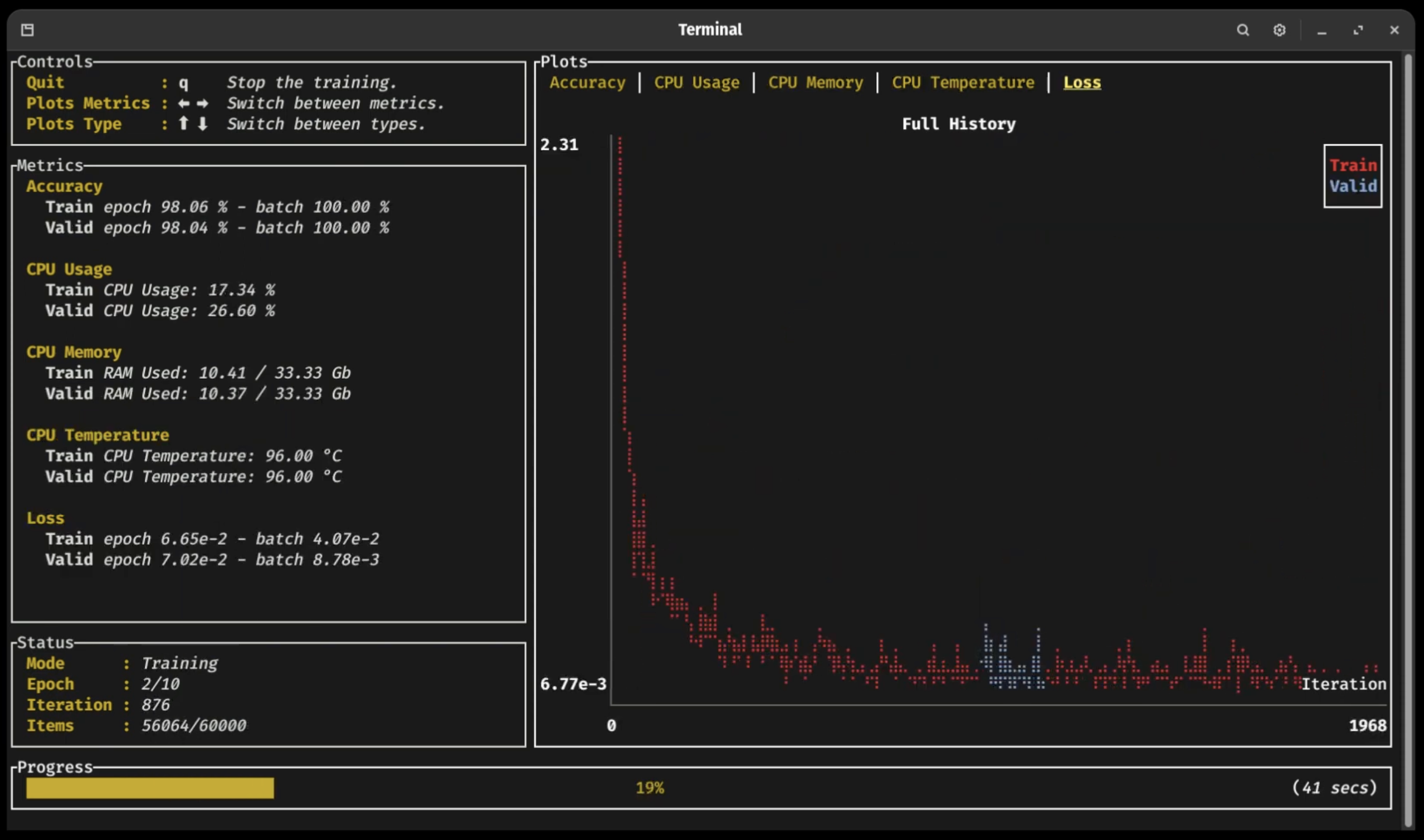
Click on the following sections to expand 👇
Training Dashboard 📈
As you can see in the previous video (click on the picture!), a new terminal UI dashboard based on the Ratatui crate allows users to follow their training with ease without having to connect to any external application.
You can visualize your training and validation metrics updating in real-time and analyze the lifelong progression or recent history of any registered metrics using only the arrow keys. Break from the training loop without crashing, allowing potential checkpoints to be fully written or important pieces of code to complete without interruption 🛡
ONNX Support 🐫
Burn supports importing ONNX (Open Neural Network Exchange) models through the burn-onnx crate, allowing you to easily port models from TensorFlow or PyTorch to Burn. The ONNX model is converted into Rust code that uses Burn's native APIs, enabling the imported model to run on any Burn backend (CPU, GPU, WebAssembly) and benefit from all of Burn's optimizations like automatic kernel fusion.
Our ONNX support is further described in this section of the Burn Book 🔥.
Note: This crate is in active development and currently supports a limited set of ONNX operators.
Importing PyTorch or Safetensors Models 🚚
You can load weights from PyTorch or Safetensors formats directly into your Burn-defined models. This makes it easy to reuse existing models while benefiting from Burn's performance and deployment features.
Learn more in the Saving & Loading Models section of the Burn Book.
Inference in the Browser 🌐
Several of our backends can run in WebAssembly environments: Flex for CPU execution, and WGPU for GPU acceleration via WebGPU. This means that you can run inference directly within a browser. We provide several examples of this:
- MNIST where you can draw digits and a small convnet tries to find which one it is! 2️⃣ 7️⃣ 😰
- Image Classification where you can upload images and classify them! 🌄
Embedded: no_std support ⚙️
Burn's core components support no_std. This means it can run in bare metal environment such as embedded devices without an operating system.
As of now, only the Flex backend can be used in a no_std environment.
To evaluate performance across different backends and track improvements over time, we provide a dedicated benchmarking suite.
Run and compare benchmarks using burn-bench.
⚠️ Warning When using one of thewgpubackends, you may encounter compilation errors related to recursive type evaluation. This is due to complex type nesting within thewgpudependency chain. To resolve this issue, add the following line at the top of yourmain.rsorlib.rsfile:#![recursion_limit = "256"]The default recursion limit (128) is often just below the required depth (typically 130-150) due to deeply nested associated types and trait bounds.

Just heard of Burn? You are at the right place! Just continue reading this section and we hope you can get on board really quickly.
The Burn Book 🔥
To begin working effectively with Burn, it is crucial to understand its key components and philosophy. This is why we highly recommend new users to read the first sections of The Burn Book 🔥. It provides detailed examples and explanations covering every facet of the framework, including building blocks like tensors, modules, and optimizers, all the way to advanced usage, like coding your own GPU kernels.
The project is constantly evolving, and we try as much as possible to keep the book up to date with new additions. However, we might miss some details sometimes, so if you see something weird, let us know! We also gladly accept Pull Requests 😄
Examples 🙏
Let's start with a code snippet that shows how intuitive the framework is to use! In the following, we declare a neural network module with some parameters along with its forward pass.
use burn::nn;
use burn::module::Module;
use burn::tensor::backend::Backend;

#[derive(Module, Debug)]
pub struct PositionWiseFeedForward<B: Backend> {
    linear_inner: nn::Linear<B>,
    linear_outer: nn::Linear<B>,
    dropout: nn::Dropout,
    gelu: nn::Gelu,
}

impl<B: Backend> PositionWiseFeedForward<B> {
    pub fn forward<const D: usize>(&self, input: Tensor<B, D>) -> Tensor<B, D> {
        let x = self.linear_inner.forward(input);
        let x = self.gelu.forward(x);
        let x = self.dropout.forward(x);

        self.linear_outer.forward(x)
    }
}
We have a somewhat large amount of examples in the repository that shows how to use the framework in different scenarios.
Following the book:
- Basic Workflow : Creates a custom CNN
Moduleto train on the MNIST dataset and use for inference. - Custom Training Loop : Implements a basic training loop instead
of using the
Learner. - Custom WGPU Kernel : Learn how to create your own custom operation with the WGPU backend.
Additional examples:
- Custom CSV Dataset : Implements a dataset to parse CSV data for a regression task.
- Regression : Trains a simple MLP on the California Housing dataset to predict the median house value for a district.
- Custom Image Dataset : Trains a simple CNN on custom image dataset following a simple folder structure.
- Custom Renderer : Implements a custom renderer to display the
Learnerprogress. - Image Classification Web : Image classification web browser demo using Burn, WGPU and WebAssembly.
- MNIST Inference on Web : An interactive MNIST inference demo in the browser. The demo is available online.
- MNIST Training : Demonstrates how to train a custom
Module(MLP) with theLearnerconfigured to log metrics and keep training checkpoints. - PyTorch Import Inference : Imports a PyTorch model pre-trained on MNIST to perform inference on a sample image with Burn.
- Text Classification : Trains a text classification transformer model on the AG News or DbPedia dataset. The trained model can then be used to classify a text sample.
- Text Generation : Trains a text generation transformer model on the DbPedia dataset.
- Wasserstein GAN MNIST : Trains a WGAN model to generate new handwritten digits based on MNIST.
For more practical insights, you can clone the repository and run any of them directly on your computer!
Pre-trained Models 🤖
We keep an updated and curated list of models and examples built with Burn, see the tracel-ai/models repository for more details.
Don't see the model you want? Don't hesitate to open an issue, and we may prioritize it. Built a model using Burn and want to share it? You can also open a Pull Request and add your model under the community section!
Why use Rust for AI? 🦀
Deep Learning is a special form of software where you need very high level abstractions as well as extremely fast execution time. Rust is the perfect candidate for that use case since it provides zero-cost abstractions to easily create neural network modules, and fine-grained control over memory to optimize every detail. To this day, the mainstream solution has been to offer APIs in Python but rely on bindings to low-level languages such as C/C++. This reduces portability, increases complexity and creates friction between researchers and engineers. Rust's approach to abstractions is versatile enough to tackle this two-language dichotomy, and Cargo makes it easy to build, test and deploy from any environment, which is usually a pain in Python.
Rust's AI ecosystem is young, but it is real and growing quickly. Foundational pieces are already
here: Burn and CubeCL for training and compute,
candle for inference, Hugging Face's tokenizers and
safetensors, and polars and ndarray for data. Betting on Rust today means betting on a stack
that is growing, and one where contributors still shape the direction. The pieces that don't exist
yet are opportunities rather than dead-ends (see Contributing).
Rust is also what makes one-stack-everywhere possible: a single self-contained binary with no Python
runtime to ship, running from servers down to no_std embedded targets.
Deprecation Note
Since0.14.0, the internal structure for tensor data has changed. The previousDatastruct was deprecated and officially removed since0.17.0in favor of the newTensorDatastruct, which allows for more flexibility by storing the underlying data as bytes and keeping the data type as a field. If you are usingDatain your code, make sure to switch toTensorData.
Loading Model Records From Previous Versions ⚠️
In the event that you are trying to load a model record saved in a version older than 0.14.0, make
sure to use a compatible version (0.14, 0.15 or 0.16) with the record-backward-compat
feature flag.
features = [..., "record-backward-compat"]
Otherwise, the record won't be deserialized correctly and you will get an error message. This error will also point you to the backward compatible feature flag.
The backward compatibility was maintained for deserialization when loading records. Therefore, as soon as you have saved the record again it will be saved according to the new structure and you can upgrade back to the current version
Please note that binary formats are not backward compatible. Thus, you will need to load your record
in a previous version and save it in any of the other self-describing record format (e.g., using the
NamedMpkFileRecorder) before using a compatible version (as described) with the
record-backward-compat feature flag.

If you are excited about the project, don't hesitate to join our Discord! We try to be as welcoming as possible to everybody from any background. You can ask your questions and share what you built with the community!
Before contributing, please read the Contributing Guidelines and our Code of Conduct. The Contributor Book covers architecture, environment setup, and guides for common tasks.
Burn is currently in active development, and there will be breaking changes. While any resulting issues are likely to be easy to fix, there are no guarantees at this stage.
Burn is distributed under the terms of both the MIT license and the Apache License (Version 2.0). See LICENSE-APACHE and LICENSE-MIT for details. Opening a pull request is assumed to signal agreement with these licensing terms.