A RoboCup 3D Soccer Simulation penalty-shootout scenario built on top of the FC Portugal Codebase. A reinforcement-learning-trained striker walks up to the ball and shoots to score, while a goalkeeper dives left or right to defend. Developed as an MSc project in the context of reinforcement learning and autonomous agents.


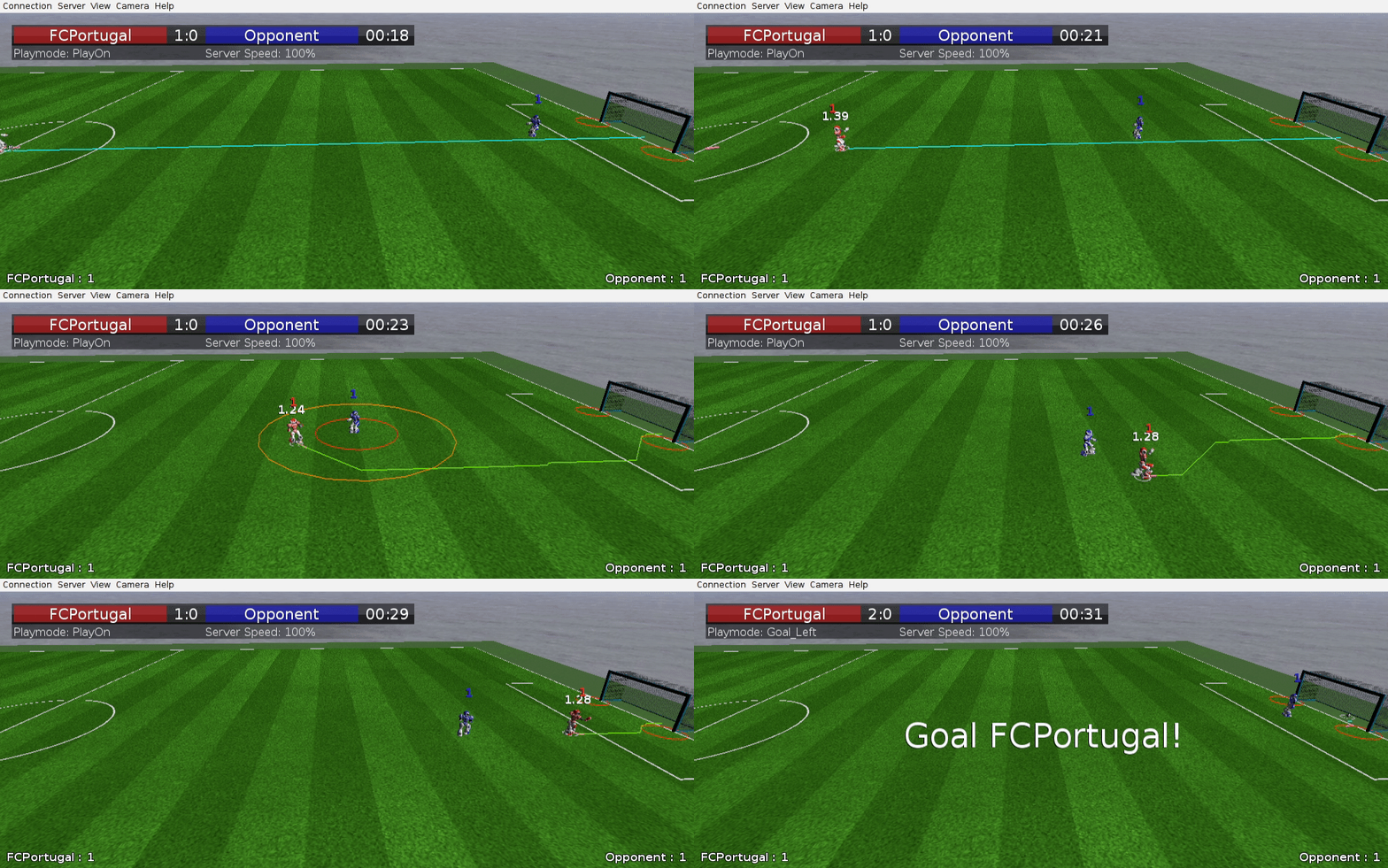
This project implements a one-on-one penalty scenario for the RoboCup 3D simulated NAO robots: a striker that learns to walk up to the ball and kick it into the goal, and a goalkeeper that reacts to the incoming ball and dives to defend.
The striker is trained with PPO (Stable Baselines3) inside a custom Gymnasium environment. It learns to walk from its starting position to a fixed ball, align its body for a kick, and shoot toward the goal.
The reward is a two-phase, blended signal. A blending factor alpha is derived from the ball's speed, so the agent smoothly transitions from the approach phase (ball still) to the kick phase (ball moving):
- Approach / walk phase rewards:
- reducing the distance to the kick spot (computed via the codebase path manager),
- facing the goal (torso orientation toward the goal direction),
- body-to-ball alignment (the ball sitting in the correct position relative to the torso for a kick),
- forward motion (head/body speed).
- Kick phase rewards:
- ball speed,
- velocity directed at the goal centre,
- a bonus for scoring,
- a bonus for aiming at the corners,
- a penalty for sending the ball out of bounds.
An episode ends on a goal, the ball going out of bounds, the robot falling (and the ball stopping), or a timeout (step limit). Training relies on the simulator's ground-truth ("cheat") data and runs across parallel servers for throughput.
Two gym variants were explored:
- v1 — direct joint control. The policy outputs target positions for every joint directly. Observation: joint positions, torso height, robot position, distance to ball, and ball velocity. This is the version that carries the full two-phase approach-and-kick reward.
- v2 — residual control on the Step primitive. The policy outputs residuals that are added on top of the targets produced by the codebase's
Stepwalk primitive, with the underlying step parameters (swing height, leg extension) also nudged by the policy. Its richer observation captures the walk state (step duration, progress, active leg) alongside IMU, foot force, and joint data. In its current form v2 optimises a stable, fast walk-up (forward displacement); the kick-phase reward terms are present in the file but disabled.
Reward shaping went through several iterations (for example, comparing distance metrics and experimenting with exponential reward terms) to encourage a clean approach-then-shoot behaviour.
The goalkeeper is not learned. It is a small reactive state machine (in agent/Agent_Penalty.py):
- It walks along the goal line, tracking the ball's lateral (
y) position (clamped to the goal width). - Once the ball crosses a threshold along the field (
x < -10), it commits to a dive: left if the ball is on the positive-yside, right otherwise. - The dives themselves are hand-authored slot behaviors —
Dive_Left.xmlandDive_Right.xml— sequences of timed joint poses rather than a learned policy. If the keeper falls, it runs the framework'sGet_Upbehavior.
Note: the scenario launched by
start_penalty.shpairs the reactive goalkeeper with a striker that uses the framework's scriptedBasic_Kick(aimed at a random corner) for a self-contained, ready-to-watch match. The PPO-trained striker described above is trained, tested, and exported through the gym environments.
This repository is the FC Portugal Codebase (an existing research framework, see attribution below) with a penalty-shootout scenario layered on top. The files authored for this project are:
| Path | Role |
|---|---|
agent/Agent_Penalty.py |
Penalty match agent: reactive goalkeeper (track + dive) and scripted kicker that beam in and play the shootout. |
scripts/gyms/penalty_shoot_v1.py |
RL training gym (v1): direct joint-position control with the blended approach + kick reward. |
scripts/gyms/penalty_shoot_v2.py |
RL training gym (v2): residual control on top of the Step walk primitive. |
behaviors/slot/common/Dive_Left.xml, behaviors/slot/common/Dive_Right.xml |
Hand-authored goalkeeper dive slot behaviors. |
start_penalty.sh, start_penalty_debug.sh |
Launch the penalty scenario (kicker vs. goalkeeper; the _debug variant enables RoboViz drawings). |
Everything else is the inherited FC Portugal framework and is not the author's work, including (non-exhaustively):
agent/Base_Agent.py,agent/Agent.py— base agent architecture and the default sample agent.behaviors/— the skill set (Walk, Dribble, Get-Up, Step, Basic_Kick) and the slot/custom behavior machinery.world/,communication/,math_ops/— world model and localization, server/monitor communication, and math utilities.cpp/— C++ modules (localization, A* pathfinding, etc.) built automatically into shared libraries.scripts/(commons, utils, and the other sample gyms such asBasic_Run.py,Fall.py,Get_Up.py), andRun_*.py— the training/utility launchers and runtime entry points.- The remaining
start_*.sh/kill.shscripts and thebundle/tooling.
Standard RoboCup 3D toolchain:
rcssserver3d— the simulation server.- RoboViz — the monitor/visualizer (optional, for watching the match or training).
- Python 3 with the codebase dependencies (see the documentation linked below), including Stable Baselines3 and Gymnasium for training.
Start the simulation server (rcssserver3d) and, optionally, RoboViz. Then launch the scenario (kicker on uniform 11 vs. goalkeeper on uniform 1):
./start_penalty.sh
# or, with RoboViz debug drawings enabled:
./start_penalty_debug.shThe RL striker is driven through the codebase's gym launcher:
python3 Run_Utils.pyFrom the interactive menu, pick the Gyms option and select one of the penalty_shoot gyms (penalty_shoot_v1 or penalty_shoot_v2), then choose to train, retrain, or test a model. Testing also exports the trained policy to a .pkl so it can be wired in as a custom behavior.
Training requires the simulator's "cheat" (ground-truth) data to be enabled — in
Run_Utils.py, underServer -> Cheats. The gyms assert this and will fail fast if it is off. Training spins up several parallel servers automatically.
This project is built on top of the FC Portugal Codebase for the RoboCup 3D Soccer Simulation League, an open-source research framework by Miguel Abreu, Luis Paulo Reis, and Nuno Lau. The base framework — the agent architecture, skills (walk, dribble, get-up, kick), localization, C++ modules, training infrastructure, and tooling — is their work, not the author's. The penalty-shootout scenario described above is the contribution layered on top.
The remainder of this section is preserved from the upstream framework's README.
The FC Portugal Codebase was mainly written in Python, with some C++ modules. It was created to simplify and speed up the development of a team for participating in the RoboCup 3D Soccer Simulation League. We hope this release helps existing teams transition to Python more easily, and provides new teams with a robust and modern foundation upon which they can build new features.
The documentation is available here
- The team is ready to play!
- Sample Agent - the active agent attempts to score with a kick, while the others maintain a basic formation
- Launch team with: start.sh
- Sample Agent supports Fat Proxy
- Launch team with: start_fat_proxy.sh
- Sample Agent Penalty - a striker performs a basic kick and a goalkeeper dives to defend
- Launch team with: start_penalty.sh
- Sample Agent - the active agent attempts to score with a kick, while the others maintain a basic formation
- Skills
- Get Ups (latest version)
- Walk (latest version)
- Dribble v1 (version used in RoboCup 2022)
- Step (skill-set-primitive used by Walk and Dribble)
- Basic kick
- Basic goalkeeper dive
- Features
- Accurate localization based on probabilistic 6D pose estimation algorithm and IMU
- Automatic head orientation
- Automatic communication with teammates to share location of all visible players and ball
- Basics: common math ops, server communication, RoboViz drawings (with arrows and preset colors)
- Behavior manager that internally resets skills when necessary
- Bundle script to generate a binary and the corresponding start/kill scripts
- C++ modules are automatically built into shared libraries when changes are detected
- Central arguments specification for all scripts
- Custom A* pathfinding implementation in C++, optimized for the soccer environment
- Easy integration of neural-network-based behaviors
- Integration with Open AI Gym to train models with reinforcement learning
- User interface to train, retrain, test & export trained models
- Common features from Stable Baselines were automated, added evaluation graphs in the terminal
- Interactive FPS control during model testing, along with logging of statistics
- Interactive demonstrations, tests and utilities showcasing key features of the team/agents
- Inverse Kinematics
- Multiple agents can be launched on a single thread, or one agent per thread
- Predictor for rolling ball position and velocity
- Relative/absolute position & orientation of every body part & joint through forward kinematics and vision
- Sample train environments
- User-friendly interface to check active arguments and launch utilities & gyms
@article{abreu2023designing,
  title={Designing a Skilled Soccer Team for RoboCup: Exploring Skill-Set-Primitives through Reinforcement Learning},
  author={Abreu, Miguel and Reis, Luis Paulo and Lau, Nuno},
  journal={arXiv preprint arXiv:2312.14360},
  year={2023}
}
This project, like the underlying FC Portugal Codebase, is released under the GNU General Public License v3.0. See LICENSE.