Experimental Wayland compositor bridge for Moksha on Bodhi Linux.
Written in Python. Runs inside an X11 session, hosting a private Wayland socket.
Real Wayland clients connect, negotiate surfaces and buffers, and get GPU-native frames presented via EGLImage -> GL texture -> SDL preview window. No CPU copies in the dma-buf path. Not a production compositor.
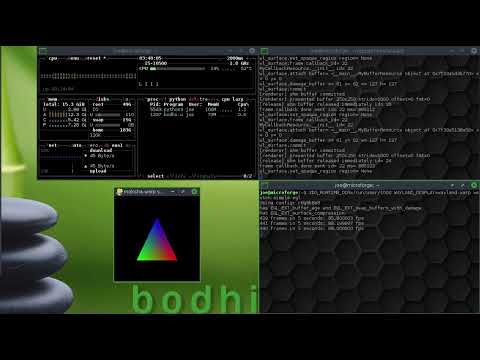
Live dma-buf → EGL → GLES path running inside Moksha.
Direct link: https://www.youtube.com/watch?v=u13_XfL_JUc
| Feature | Status |
|---|---|
| Private Wayland socket | yes |
| Real client connections | yes |
| XDG shell (wl_surface, xdg_toplevel) | yes |
| SHM buffer path (wl_shm) | yes |
| dma-buf protocol (zwp_linux_dmabuf_v1) | yes |
| EGLImage import from dma-buf | yes |
| GL texture bind -> textured quad draw | yes |
| Preview window present (SDL/GLES) | yes |
| wl_buffer.release lifecycle | yes |
| Frame callback delivery (wl_callback) | yes |
| Resource cleanup on surface destroy | yes |
| Clean shutdown (display.destroy, EGL, SDL) | yes |
| KMS device/connector/CRTC discovery | yes |
| Scanout eligibility classification | yes (detection only) |
- Direct scanout / KMS pageflip: classification works, actual pageflip not implemented. All clients currently render through the GLES preview path.
- Overlay plane presentation:
PLANE_CANDIDATEbuffers fall back to GLES, no hardware plane assignment yet. - Production compositor behavior: no input forwarding, no focus management, no window decorations, no multi-output.
- Broad app compatibility: tested primarily with
weston-simple-dmabuf-eglandweston-simple-shm. Other clients may hit unimplemented protocol paths. - Stability: the runtime is validated but not hardened for edge cases like rapid client reconnects, exotic formats, or multi-plane dmabufs.
weston-simple-dmabuf-egl connects, negotiates dma-buf buffers, and renders
continuously. The compositor imports each frame as an EGLImage, binds it to a
GL texture, draws a fullscreen quad, and flips. Buffer release, frame callbacks,
and surface destroy all work. Shutdown is clean.
KMS scanout classification runs on every commit (PRIMARY_SCANOUT_ELIGIBLE /
PLANE_CANDIDATE / BLOCKED) based on real DRM connector mode discovery.
The drmModeSetCrtc call is not yet wired up, everything still goes through
the GLES preview window.
- Bodhi Linux 7 (Ubuntu base, initial development) or Bodhi Trixie (Debian 13 base, current)
- Python 3.10+
XDG_RUNTIME_DIRset (e.g./run/user/1000)- A working
.venvwith dependencies installed:
python3 -m venv .venv
.venv/bin/pip install pywayland pygame- For dma-buf path:
SDL_VIDEO_X11_FORCE_EGL=1must be set (SDL/EGL conflict) - For KMS probing:
libdrmaccessible at runtime
# Start the compositor
bash run_dmabuf_good.sh
Uses .venv/bin/python3 if present, falls back to system Python.
Sets XDG_RUNTIME_DIR and SDL_VIDEO_X11_FORCE_EGL=1.
# Connect the Python test client (second terminal)
bash run_test_client.sh

# Or connect weston's dmabuf client directly
WAYLAND_DISPLAY=wayland-warp XDG_RUNTIME_DIR=/run/user/1000 weston-simple-dmabuf-egl

# Compositor + client + log scan in one shot
bash run_dmabuf_probe.sh [optional-client-command]warp/
__init__.py
protocol/
compositor.py # Wayland server: socket, globals, surface/buffer lifecycle
__init__.py
gpu/
egl_import.py # dma-buf -> EGLImage import path
gles_renderer.py # EGLImage -> GL texture -> draw -> swap
__init__.py
output/
kms.py # KMS probing, connector/mode discovery, scanout classification
__init__.py
render/
__init__.py # reserved / placeholder
scripts/
dmabuf_test_client.py # Python dma-buf Wayland client for local testing
dmabuf_gl_probe.py # GL/EGL capability probe
wayland_globals_probe.py # standalone compositor probe (historical)
evas_probe.py, ... # earlier EFL/Evas investigation scripts
docs/
00-goal.md
01-environment.md
02-current-status.md
03-python-efl-findings.md
04-wayland-probe-result.md
05-client-handshake-result.md
06-shm-progress.md
07-shm-pool-breakthrough.md
08-xdg-breakthrough.md
09-night-one-status.md
10-render-loop-breakthrough.md
11-first-visible-frame.md
12-dmabuf-zero-copy-path-confirmed.md
13-dmabuf-import-success.md
14-dmabuf-acceptance-and-release-loop.md
15-dmabuf-buffer-creation-and-attach.md
project_documentation.md
# milestone notes, investigation logs, and project writeups
logs/
proof/
*-summary.txt # curated run summaries (tracked)
*.log # raw verbose output (typically gitignored)
archive/
snapshots/ # pre-edit source snapshots
backups/ # manual backup files
legacy_scripts/ # retired shim/probe scripts
combined_raw_session_dump.md # raw combined session log
- Preview ≠ scanout. The GLES preview window is SDL-backed and runs inside X11. It is not a KMS framebuffer. No pixels reach the display via DRM directly.
- Single-plane dma-buf only. Multi-plane (NV12, YUV) buffer imports are not
implemented. The compositor rejects them with
zwp_linux_buffer_params.failed. - No input handling. There is no wl_keyboard, wl_pointer, or wl_touch implementation. Clients that require input before drawing may stall.
- wl_output is synthetic. The advertised output geometry (256×256, 60 Hz) is a placeholder and does not reflect the real display.
- APIs and structure may change. This is active prototype work. Module names, entry points, and internal interfaces are not stable.
- Real-client validation: run
weston-terminal,mpv --gpu-context=wayland, andgtk4-demoagainst the compositor to find unimplemented protocol paths. - Direct scanout: connect the existing
PRIMARY_SCANOUT_ELIGIBLEclassification to an actualdrmModeSetCrtc/drmModePageFlipcall on a free VT. - Multi-plane dma-buf: extend the
zwp_linux_buffer_params_v1handler to accept NV12 and similar formats. - Input skeleton: add minimal
wl_keyboard/wl_pointerstubs so clients that callwl_seat.get_keyboard()do not receive unhandled protocol errors.
# Archive a source snapshot
bash dev-mktar.sh

# Include untracked files
bash dev-mktar.sh --include-untracked

# Compile-check all warp modules
.venv/bin/python3 -m py_compile warp/protocol/compositor.py warp/gpu/egl_import.py \
warp/gpu/gles_renderer.py warp/output/kms.py| Component | Value |
|---|---|
| Machine | MicroForge |
| GPU | Intel UHD 630 |
| Driver | Mesa / i915 |
| EGL | 1.5 (Mesa) |
| OS | Bodhi Linux 7 (Ubuntu base), Bodhi Trixie (Debian 13 base) |
| Python | 3.13 |
This project is licensed under the GNU General Public License v3.0.