The goal of this project is to implement minimal dependent type checker. Currently, it should be able to handle Calculus of Constructions (CoC) with Type universes. Next goal, fully Calculus of Inductive Constructions (CIC) just like lean4 or rocq
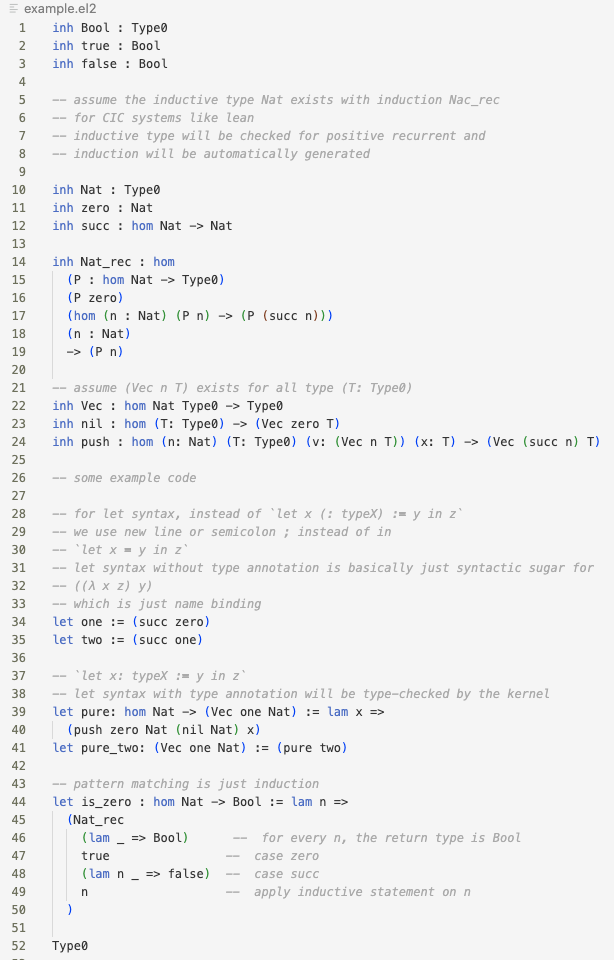
pattern matching as syntactic sugar
inh Nat : Type0
inh zero : Nat
inh succ : Nat -> Nat

inh nat_rec :
  (P : Nat -> Type0) ->
  (P zero) ->
  ((n : Nat) -> (P n) -> (P (succ n))) ->
  (n : Nat) -> (P n)
then
match n with
| zero => a
| succ m => b m
is equivalent to
nat_rec (λ _. T) a (λ m rec. b m) nIt is a difficult topic checking of an inductive type is well-defined or at least positive recurrent.
There are two main ways to typecheck inductive types: (1) using fixpoint combinator which is not decidable and (2) using the initial object
Both of which are not a simple weekend project, hence I decided to stop here. Currently, we simulate inductive types using * operator (or inhabit) which basically assume some type inhabits.
The example above assumed Nat is a constant of type type_0, zero is a constant of type Nat, succ is a function Nat -> Nat, etc.
The original Coquand's algorithm can be found in obsolete/coquand/1-s2.0-0167642395000216-main.pdf, the implementation in Haskell is at obsolete/coquand/app/Main.hs, the implementation in Lean4 is at obsolete/Coquand.lean
I respectively added type universes, inhabit, annotated type, and desugaring for application of untyped lambda.
Parser Combinator is a procedure to write parser
one of the best tutorial out there from tsoding https://youtu.be/N9RUqGYuGfw
with the introduction of inh (called inhabit), one can introduce any axiom even if they are wrong. the system is sound with respect to its set of axioms
tactic is a useful tool for interactive theorem prover / backward reasoning. For example, we can prove A ∧ B → B ∧ A as follows:
> new A ∧ B → B ∧ A

⊢ A ∧ B → B ∧ A
> intro

0: A ∧ B
⊢ B ∧ A
> constructor

0: A ∧ B
⊢ B
> cases 0

0: A ∧ B
1: A
2: B
⊢ B
> exact 2

0: A ∧ B
⊢ A
> cases 0

0: A ∧ B
3: A
4: B
⊢ A
> exact 3

-- all goals accomplished!
One can also implement tactics in CoC and encode logic into CoC (this is what interactive theorem provers (ITPs) use to encode mathematics into their type theories: dependent types, universes, recursive types, etc). An example of tactic we can implement for EL2 is as follows
Bool: Type0
true: Bool
false: Bool
Vec : hom Nat Type0 -> Type0
nil : hom (T: Type0) -> (Vec zero T)
push : hom (n: Nat) (T: Type0) (v: (Vec n T)) (x: T) -> (Vec (succ n) T)

⊢ (Vec 3 Bool)    -- goal: construct a vector of 3 booleans

> compose push    -- compose with push
split into 4 subgoals and 1 compose subgoal
...
⊢ Nat             -- value of n (should be 2)
...
⊢ Type0           -- value of T (should be Bool)
...
⊢ (Vec n T)       -- value of (Vec n T) (should be a vector of 2 booleans)
...
⊢ T               -- value of x (should be tail of the goal vector)
...
⊢ (Vec (succ n) T) = (Vec 3 Bool)    -- a proof for these two types being identical
this is how we construct Vec 3 Bool backward. Usually in ITPs, they automate some of this so that in the end, we only have two subgoals
...
⊢ Bool               -- tail of the goal vector
...
⊢ (Vec 2 Bool)       -- a vector of 2 booleans
Somehow, succ being injective is encoded into the kernel
since we can encode inductive types into EL2, propositional logic follows
let False: Type0

let And: (L: Type0) (R: Type0) -> Type0
let and_intro: hom (L: Type0) (R: Type0) (l: L) (r: T) -> (And L R)
let and_elim_left: hom (L: Type0) (R: Type0) (x: (And L R)) -> L
let and_elim_right: hom (L: Type0) (R: Type0) (x: (And L R)) -> R

let Or: (L: Type0) (R: Type0) -> Type0
let or_intro_left: hom (L: Type0) (R: Type0) (l: L) -> (Or L R)
let or_intro_right: hom (L: Type0) (R: Type0) (r: R) -> (Or L R)
let or_elim: hom (L: Type0) (R: Type0) (Y: Type0) (l: L -> Y) (r: R -> Y) (x: (Or L R)) -> Y