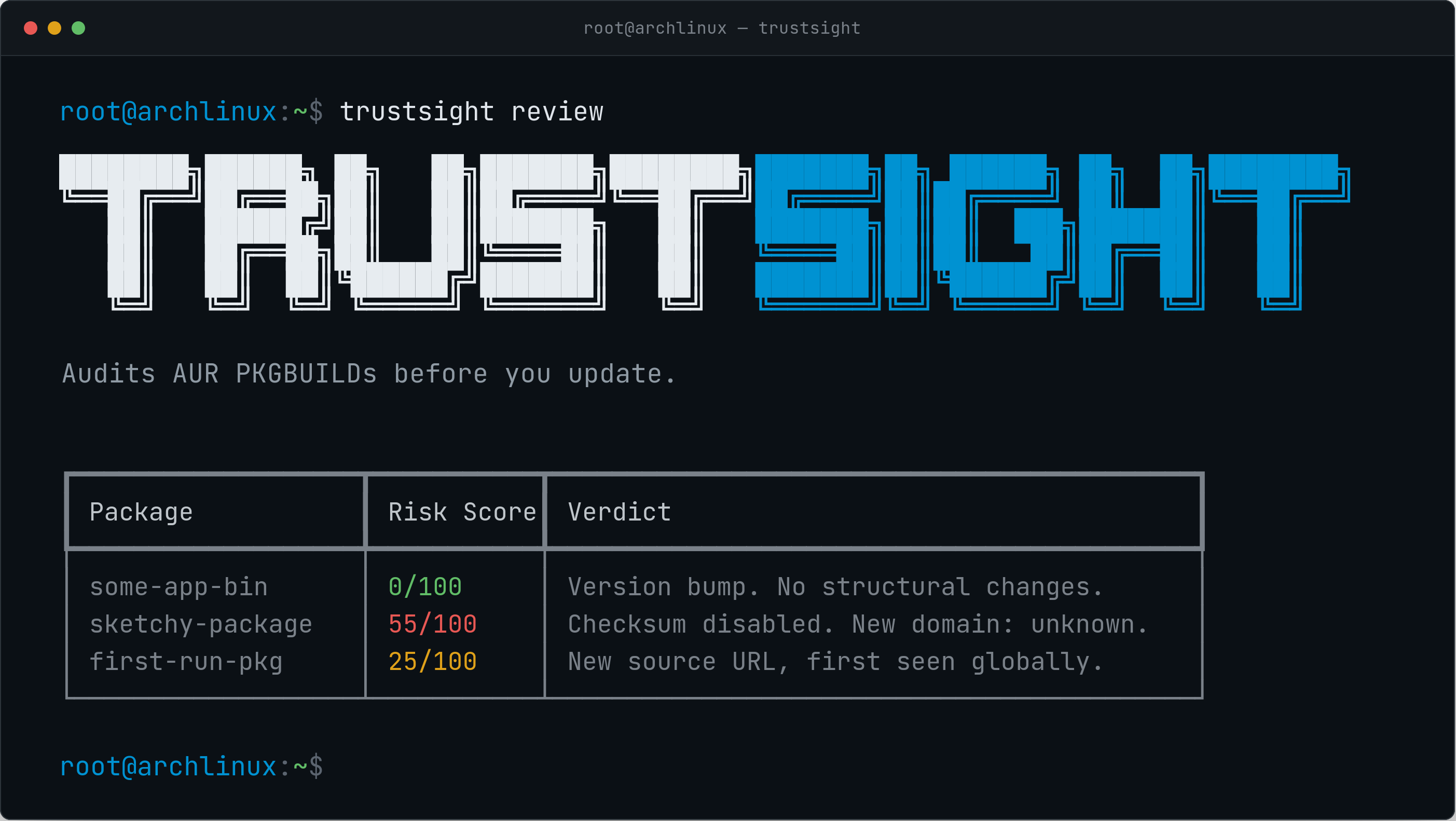
Audits AUR PKGBUILD updates before you install: detects structural changes, suspicious commands, typosquatting, and novelty signals, then produces a deterministic risk score with a plain-English explanation.





This package is not yet in the AUR, so installation is git clones + build untill 1.0.0
# 1. Install
git clone https://github.com/emiliano-go/trustsight.git
cd trustsight/packaging/aur
makepkg -si

# 2. Scan your outdated AUR packages
trustsight review
Requires Python 3.11+ and Arch Linux (the tool discovers packages via pacman -Qm, pacman -Sl for local repos, or --repo/--all-repos flags).
The score is always deterministic and calculated locally. Verdicts are template-based, describing each finding in plain English, for example "Version bump. modified PKGBUILD, .SRCINFO. Signals: checksum disabled; novel dependency 'pyfoo' added in depends."
Not published to the AUR yet. Build from the PKGBUILD in this repository. Also installable via
pip install trustsight.
| Attack / Risk | How TrustSight catches it |
|---|---|
Piped shell scripts (curl | bash, base64 | sh) |
Scans every new or changed line for command-subprocess pipelines (R001, ~100% recall on known cases) |
Obfuscated commands (encoded strings, environment subversion like LD_PRELOAD) |
Resolves variables and decodes known obfuscation patterns; flags build-environment tampering (R007, R070) |
| Checksum disabled or removed | Compares old vs new sha256sums / md5sums arrays (R004, R005) |
Source URL typosquatting (githab.com instead of github.com) |
Character-level edit distance against known forge domains (R008) |
Package-name typosquatting (e.g. libuvc resembling libuv) |
Edit-distance comparison against more popular packages in the seed database (R074) |
| URL swapped without a version bump | Tracks source URL changes that are not accompanied by a new version (C003) |
| Novel / never-before-seen URLs or maintainers | Compares against a bundled seed of 178,491 known AUR source URLs; flags first-seen domains and maintainers (novelty tier) |
| Unicode bidi override attacks (invisible characters that change how text displays) | Detects directionality overrides and homoglyph codepoints in PKGBUILD content (R013) |
| LLM prompt injection in package metadata | Pattern-matches common injection templates; primary defense is structural (the LLM cannot change the score) (R012) |
| GPG verification removed | Detects when validpgpkeys was populated and is now empty (R069) |
| Untrusted maintainer takeover | A maintainer change to someone never seen before (R071) |
| Stale package revived | A package with no updates for over a year suddenly gets one (R067) |
| Accelerated release cadence | 3+ commits in the last 24 hours (R073, informational) |
| Limitation | Why |
|---|---|
| Malicious upstream release tarballs | TrustSight audits the PKGBUILD, not the binaries it downloads. A clean build file can point to a compromised tarball. |
| Deliberately unremarkable attacks | If no commands are added, no URLs change, and no checksums are disabled, there is no diff signal. The update is invisible to this kind of analysis. |
| Build-dependency attacks | A malicious makedepends or depends entry is outside TrustSight's scope. It audits the recipe, not the second-order supply chain. |
| Runtime attacks | The tool never executes the PKGBUILD, never runs extracted commands, and never modifies your system. |
| Zero-day structural attacks | Rules are pattern-based and calibrated against a known corpus. A novel attack that leaves no matching pattern will not fire. |
The output is a risk assessment, not a proof of safety. A clean score means no known risk signals fired, not that the package is safe. See the trust model for details.
trustsight review TrustSight Review
┏━━━━━━━━━━━━━━━━━┳━━━━━━━━━━━━━━┳━━━━━━━━━━━━━━━━━━━━━━━━━━━━━━━━━━━━━━━━━━━┓
┃ Package ┃ Risk Score ┃ Verdict ┃
┃ ┃ ┃ ┃
┡━━━━━━━━━━━━━━━━━╇━━━━━━━━━━━━━━╇━━━━━━━━━━━━━━━━━━━━━━━━━━━━━━━━━━━━━━━━━━━┩
│ chez-scheme-bin │ 0/100 │ Version bump. No structural changes. │
├─────────────────┼──────────────┼───────────────────────────────────────────┤
│ sketchy-pkg │ 35/100 │ R004 HIGH Checksum disabled (SKIP). │
│ │ │ C003 INFO Source URL changed without │
│ │ │ version bump. │
│ │ │ SOURCE_BUCKET MEDIUM New domain: │
│ │ │ sketchy-cdn.invalid (unknown). │
│ │ │ NOVELTY HIGH Source URL first seen │
│ │ │ globally. │
│ │ │ PINNING INFO Source pinning: unpinned. │
│ │ │ Verdict: Checksum disabled; sources │
│ │ │ replaced with content from an unknown, │
│ │ │ never-before-seen domain. │
├─────────────────┼──────────────┼───────────────────────────────────────────┤
│ obsidian-beta │ 15/100 │ INCONCLUSIVE. Only 2 prior observations; │
│ │ │ no high-severity signals from a cold DB. │
└─────────────────┴──────────────┴───────────────────────────────────────────┘
The tiered evidence display is the differentiator: every signal (rule, bucket, novelty, pinning, verification) is shown with its contribution and severity. You see why the score is what it is.
| Command | What it does |
|---|---|
trustsight review |
Scan outdated AUR packages and produce a scored table with tiered evidence. Supports --repo, --foreign, --all-repos, --verbose flags. |
trustsight inspect <package> |
Deep-dive on a single package: full score breakdown, source URLs, resolved commands, novelty context. |
trustsight history <package> |
Show past analysis results for a package. |
trustsight config set |
Set individual config keys. |
trustsight seed-db |
Import the bundled URL database for novelty detection. Runs automatically on first review. |
trustsight list |
List all packages tracked in the database. |
trustsight status |
Show database and system health statistics. |
trustsight db |
Database maintenance (check, vacuum, backup). |
trustsight override |
Suppress a rule that misfires on your packages. |
trustsight lint-rules |
Check rules.toml for unreachable or malformed rules. |
Scoring is fully deterministic: same input always produces the same score. The pipeline is:
- Diff the old and new PKGBUILD
- Apply rules to detect structural changes, suspicious commands, typosquatting, etc.
- Classify URLs into trust buckets (official, self-hosted, unknown, homograph)
- Check novelty against the local database of known URLs and maintainers
- Calculate score from 0-100 by summing weighted contributions across four evidence tiers
Signals come from 13 detection rules (R001-R013), 44 code-emitted rules (R039-R082), 4 dependency-graph rules (D001-D004), and 7 code-structure rules (C001-C007), all calibrated against a 3,322+ diff corpus of benign AUR updates.
Verdicts are template-based, describing each triggered finding in plain English. The score is never influenced by the verdict text.
TrustSight is evidence-producing, not proof-of-safety. It audits and does not install. The tool never runs the PKGBUILD, never executes extracted commands, and never modifies your system. Every finding is traceable to a specific diff line, URL, or novelty record. The output is a structured risk assessment to inform your decision, not a gate. See trust-model.md.
MIT
| Section | Description |
|---|---|
| Getting Started | One-tutorial path from install to first review |
| Full documentation | Docs landing page |
| Contributing | How to report bugs, contribute code, improve docs |
| Security | Vulnerability disclosure policy |
| License | MIT full text |