


Sentra Tutoring Management Smartboard is a governed operating system for Indonesian tutoring centres. It turns schedules, learning sessions, attendance, evaluations, tutor compensation, payroll, and institutional reporting into one traceable longitudinal record centred on Sesi Pembelajaran.
Guided by Human Insight, Powered by Artificial Intelligence.
Why It Exists · Positioning · System Map · Runbook · Governance
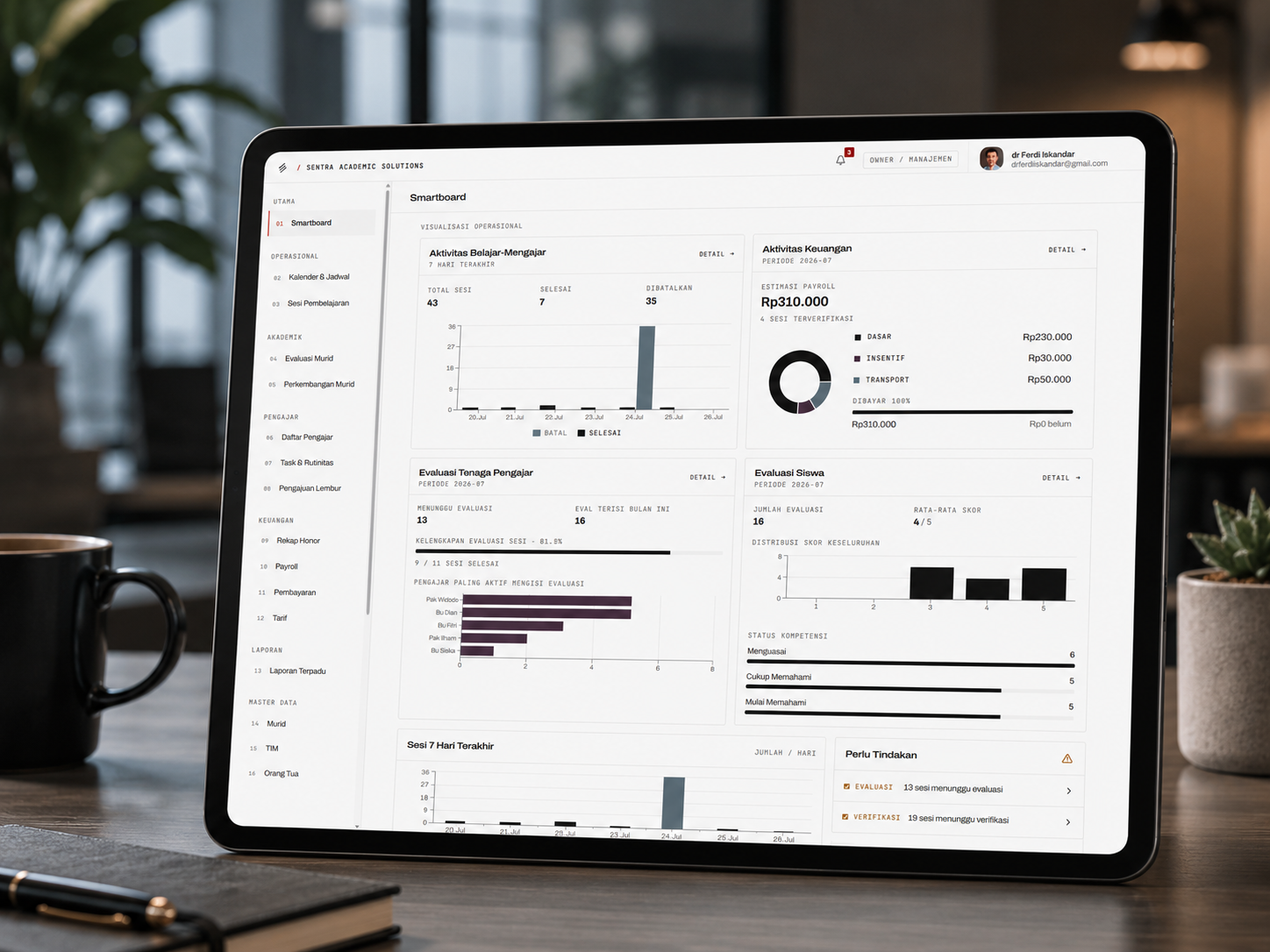
Note
The product visual above is expected as a repository-local asset at
docs/assets/smartboard-product-overview.png. Runtime documentation must not
depend on externally hosted image assets.
Sentra Tutoring Management Smartboard is a full-stack institutional operations platform for tutoring centres that need academic execution, administrative control, tutor compensation, and parent-safe progress visibility to operate from the same verified source of truth.
Most tutoring operations are fragmented across spreadsheets, messaging groups, manual attendance books, generic learning platforms, and isolated payroll records. Each tool can store a fragment of activity, but none guarantees that a schedule, completed session, student attendance, tutor evaluation, honor calculation, and payroll outcome describe the same real-world event.
Smartboard resolves this fragmentation by treating Sesi Pembelajaran as the primary operational record. Every material consequence must be linked to a session, verified by an authorized role, and carried forward through governed state transitions.
The product serves six operational personas: Owner, Admin Akademik, Tentor, Finance, Murid / Orang Tua, and Content Manager. It includes route-level and API-level authorization, controlled approval queues, longitudinal student progression, audit-aware financial workflows, parent-safe information boundaries, and optional AI-assisted evaluation drafting.
Smartboard is an independent private product candidate inside The Abyss monorepo. It is not an autonomous academic evaluator, an unsupervised payroll authority, a generic content-delivery LMS, or a replacement for institutional judgment. Human review remains mandatory for evaluation publication, session verification, master-data approval, payroll closure, and financial correction.
| Dimension | Definition |
|---|---|
| Product type | Full-stack institutional operations platform |
| Product family | Sentra Academic Solutions |
| Repository path | apps/academic/bimbingan-belajar |
| Primary users | Owners, academic administrators, tutors, finance staff, students, and parents |
| Operational SSOT | Sesi Pembelajaran / learning_sessions |
| Primary lifecycle | Schedule → session → attendance → evaluation → verification → honor → payroll |
| Intelligence model | Longitudinal, role-bounded, verification-driven |
| Deployment posture | Private product candidate |
| Interface language | Bahasa Indonesia |
| Current status | Active development |
| Product steward | Dr. Ferdi Iskandar |
A tutoring centre becomes governable when every academic, administrative, and financial consequence can be traced back to one verified learning session.
The product does not begin with dashboards. It begins with a stronger data contract: one session must describe what was planned, what actually happened, who participated, what was learned, who verified it, and what institutional consequences followed.
This makes Smartboard a longitudinal intelligence engine rather than a collection of administrative forms. A single score is a snapshot. A sequence of verified sessions becomes a learning trajectory.
- Executive Summary
- Product Thesis
- Why This Product Exists
- Strategic Positioning
- System Map
- Longitudinal Intelligence Model
- Experience by Persona
- Core Capabilities
- Core Domain Architecture
- Operational Lifecycle
- Trust and Verification Model
- Role-Based Access Control
- Architecture
- Technology Stack
- API Surface
- Security and Data Governance
- Product Experience Principles
- Success Metrics
- Local Runbook
- Environment Variables
- Usage
- Testing and Governance
- Design Language
- Documentation
- Known Limitations
- Contributing
- License
- Contact
- Instrumentation
Tutoring centres often grow through operational improvisation. Schedules live in spreadsheets, attendance is confirmed through messaging groups, tutor notes are stored in personal documents, parent updates are rewritten manually, and honor calculations are reconstructed at the end of each month.
The problem is not that these tools are individually unusable. The problem is that they do not share one governed event model.
flowchart LR
    Schedule["Spreadsheet Schedule"]
    Chat["Messaging Group"]
    Attendance["Manual Attendance"]
    Notes["Tutor Notes"]
    Payroll["Separate Payroll Sheet"]
    Reports["Manual Reports"]

    Schedule -. re-entry .-> Attendance
    Chat -. confirmation .-> Attendance
    Attendance -. copy .-> Notes
    Notes -. summarize .-> Reports
    Attendance -. reconcile .-> Payroll
    Schedule -. compare .-> Payroll

    Error["Contradictory Records"]
    Delay["Delayed Decisions"]
    Audit["Weak Auditability"]

    Attendance --> Error
    Payroll --> Error
    Reports --> Delay
    Error --> Audit

    classDef source fill:#FFF7D6,stroke:#D97706,color:#422006,stroke-width:2px;
    classDef risk fill:#FEE2E2,stroke:#DC2626,color:#7F1D1D,stroke-width:3px;

    class Schedule,Chat,Attendance,Notes,Payroll,Reports source;
    class Error,Delay,Audit risk;
This operating model creates predictable institutional risks:
- the scheduled tutor may differ from the tutor who actually taught;
- attendance may exist without an evaluation;
- evaluations may be published before academic verification;
- tutor honor may be calculated from a schedule instead of a completed session;
- payroll corrections may silently overwrite historical values;
- parent-facing information may expose internal operational notes;
- management reports may amplify unresolved upstream inconsistencies.
flowchart LR
    Plan["Plan"] --> Session["Verified Learning Session"]
    Session --> Attendance["Attendance"]
    Session --> Evaluation["Evaluation"]
    Session --> Tasks["Operational Tasks"]
    Session --> Honor["Tutor Honor"]
    Honor --> Payroll["Payroll Period"]
    Attendance --> Progress["Student Progression"]
    Evaluation --> Progress
    Payroll --> Reports["Institutional Reports"]
    Progress --> Reports

    Governance["RBAC + Approval + Audit"]
    Governance --> Session
    Governance --> Evaluation
    Governance --> Honor
    Governance --> Payroll

    classDef context fill:#FFF7D6,stroke:#D97706,color:#422006,stroke-width:2px;
    classDef core fill:#111827,stroke:#EB5939,color:#FFFFFF,stroke-width:3px;
    classDef academic fill:#E0F2FE,stroke:#0284C7,color:#0C4A6E,stroke-width:2px;
    classDef finance fill:#F3E8FF,stroke:#8B5CF6,color:#4C1D95,stroke-width:2px;
    classDef governed fill:#ECFDF5,stroke:#10B981,color:#064E3B,stroke-width:2px;

    class Plan context;
    class Session core;
    class Attendance,Evaluation,Tasks,Progress academic;
    class Honor,Payroll finance;
    class Governance,Reports governed;
The strategic shift is simple: data is not accepted merely because it was entered. It becomes authoritative only after it passes the appropriate operational and governance state.
Smartboard is positioned between four common categories: informal operational tools, generic learning platforms, school information systems, and isolated financial applications.
The comparison below is an architectural positioning matrix, not a market benchmark or claim about every product in each category.
| Capability | Spreadsheet + Messaging | Generic LMS | School SIS / ERP | Standalone Payroll | Sentra Smartboard |
|---|---|---|---|---|---|
| Schedule administration | Partial | Partial | Strong | None | Strong |
| Session-as-operational-SSOT | None | Limited | Variable | None | Core model |
| Tutor check-in and attendance | Manual | Variable | Strong | None | Integrated |
| Per-session student evaluation | Manual | Strong | Variable | None | Integrated |
| Longitudinal learning narrative | Weak | Course-centred | Record-centred | None | Session-centred |
| Parent-safe note boundary | Manual | Variable | Variable | None | Explicit |
| Substitute tutor handling | Manual | Limited | Variable | None | Integrated |
| Tutor honor calculation | Manual | None | Variable | Strong | Session-derived |
| Payroll-period locking | Manual | None | Variable | Strong | Governed |
| Academic-to-financial traceability | Weak | Weak | Variable | Weak | End-to-end |
| Owner approval queue | Manual | Rare | Variable | Variable | Explicit |
| AI-assisted evaluation draft | External / manual | Variable | Rare | None | Optional and reviewed |
| Role-bounded operational dashboard | Manual | Learning-centric | Administration-centric | Finance-centric | Cross-functional |
| Immutable correction workflow | Rare | Not applicable | Variable | Variable | Required after lock |
| Design Decision | Institutional Consequence |
|---|---|
| Session-centred domain model | Academic and financial records share the same operational origin |
| Verification before compensation | Tutor honor is based on governed execution, not only planned schedules |
| Parent/internal note separation | Family communication is useful without exposing staff-only context |
| Longitudinal progression | Management can observe direction and change, not only isolated scores |
| Role-specific work surfaces | Each persona sees the decisions and actions relevant to its authority |
| Approval queue for controlled writes | High-impact changes cannot silently bypass ownership controls |
| Locked payroll with corrections | Historical financial records remain explainable after closure |
| Human-reviewed AI assistance | Language support improves efficiency without transferring authority to AI |
- It is not a generic virtual classroom or video-conferencing platform.
- It is not primarily a content marketplace or course-authoring system.
- It is not a school-wide student information system for every formal education process.
- It is not an autonomous academic scoring engine.
- It is not a payroll system detached from academic operations.
- It is not a dashboard that infers truth from unverified records.
The system connects institutional actors to one governed operational core. Each actor receives a bounded work surface; each downstream artifact remains traceable to an authorized workflow.
flowchart TB
    subgraph People["Institutional Actors"]
        Owner["Owner"]
        Admin["Admin Akademik"]
        Tutor["Tentor"]
        Finance["Finance"]
        Parent["Murid / Orang Tua"]
        Content["Content Manager"]
    end

    subgraph Experience["Role-Bounded Experience Layer"]
        Console["React Operations Console"]
        ParentView["Parent-Safe Progress View"]
        ActionQueue["Required Actions + Notifications"]
    end

    subgraph Core["Governed Operational Core"]
        Session["Sesi Pembelajaran SSOT"]
        Approval["Approval Queue"]
        Verification["Session Verification"]
        Audit["Audit Events"]
    end

    subgraph Academic["Academic Operations"]
        Schedule["Schedules"]
        Attendance["Attendance"]
        Evaluation["Evaluations"]
        Progression["Student Progression"]
        Tasks["Tasks + Routines"]
    end

    subgraph Financial["Financial Operations"]
        Rates["Rate Rules"]
        Honor["Tutor Earnings"]
        Overtime["Overtime"]
        Payroll["Payroll + Corrections"]
    end

    subgraph Intelligence["Institutional Intelligence"]
        Dashboard["Operational KPIs"]
        Reports["Academic + Finance Reports"]
        Alerts["Actionable Alerts"]
    end

    Owner --> Console
    Admin --> Console
    Tutor --> Console
    Finance --> Console
    Content --> Console
    Parent --> ParentView

    Console --> ActionQueue
    Console --> Session
    ParentView --> Progression

    Schedule --> Session
    Session --> Attendance
    Session --> Evaluation
    Session --> Tasks
    Session --> Verification
    Approval --> Session
    Verification --> Audit

    Rates --> Honor
    Attendance --> Verification
    Evaluation --> Verification
    Verification --> Honor
    Overtime --> Payroll
    Honor --> Payroll
    Payroll --> Audit

    Attendance --> Progression
    Evaluation --> Progression
    Progression --> Dashboard
    Payroll --> Dashboard
    Audit --> Reports
    Dashboard --> Alerts
    Reports --> Alerts

    classDef actor fill:#FFF7D6,stroke:#D97706,color:#422006,stroke-width:2px;
    classDef surface fill:#FFE8EE,stroke:#EB5939,color:#4A1020,stroke-width:3px;
    classDef core fill:#111827,stroke:#EB5939,color:#FFFFFF,stroke-width:3px;
    classDef academic fill:#E0F2FE,stroke:#0284C7,color:#0C4A6E,stroke-width:2px;
    classDef finance fill:#F3E8FF,stroke:#8B5CF6,color:#4C1D95,stroke-width:2px;
    classDef governed fill:#ECFDF5,stroke:#10B981,color:#064E3B,stroke-width:2px;

    class Owner,Admin,Tutor,Finance,Parent,Content actor;
    class Console,ParentView,ActionQueue surface;
    class Session,Approval,Verification,Audit core;
    class Schedule,Attendance,Evaluation,Progression,Tasks academic;
    class Rates,Honor,Overtime,Payroll finance;
    class Dashboard,Reports,Alerts governed;
The platform is designed to transform repeated operational events into an explainable learning history.
flowchart LR
    S1["Session 01"] --> S2["Session 02"] --> S3["Session 03"] --> S4["Session 04"]

    S1 --> E1["Attendance + Evaluation"]
    S2 --> E2["Attendance + Evaluation"]
    S3 --> E3["Attendance + Evaluation"]
    S4 --> E4["Attendance + Evaluation"]

    E1 --> Trend["Longitudinal Progression"]
    E2 --> Trend
    E3 --> Trend
    E4 --> Trend

    Trend --> Pattern["Growth Pattern"]
    Trend --> Risk["Learning Friction"]
    Trend --> Action["Tutor / Admin Action"]
    Action --> S4

    classDef session fill:#111827,stroke:#EB5939,color:#FFFFFF,stroke-width:3px;
    classDef evidence fill:#E0F2FE,stroke:#0284C7,color:#0C4A6E,stroke-width:2px;
    classDef intelligence fill:#ECFDF5,stroke:#10B981,color:#064E3B,stroke-width:3px;
    classDef attention fill:#FFF7D6,stroke:#D97706,color:#422006,stroke-width:2px;

    class S1,S2,S3,S4 session;
    class E1,E2,E3,E4 evidence;
    class Trend,Pattern intelligence;
    class Risk,Action attention;
| Layer | Question Answered | Primary Evidence | Output Boundary |
|---|---|---|---|
| Event layer | What happened in this session? | Schedule, attendance, tutor, subject, duration | Factual operational record |
| Evaluation layer | How did the student perform in context? | Tutor ratings, summary, parent note, internal note | Human-authored or human-approved assessment |
| Progression layer | How is the student changing over time? | Repeated verified evaluations | Trend and trajectory, not diagnosis |
| Operational layer | What requires institutional action? | Missing evaluations, unverified sessions, exceptions | Prioritized action queue |
| Financial layer | What compensation follows verified work? | Session verification, rate rules, overtime | Governed honor and payroll entries |
| Governance layer | Can this record be trusted and disclosed? | Role, approval, verification, audit history | Allow, redact, block, or request revision |
Smartboard does not expose the same application to everyone. It creates a role-bounded institutional experience around authority, responsibility, and information need.
| Persona | Primary Question | Core Workspace | Must Not Access |
|---|---|---|---|
| Owner | Is the institution operating correctly and sustainably? | Approvals, KPIs, payroll locking, audit, exception management | None beyond system policy |
| Admin Akademik | What must be scheduled, completed, verified, or corrected? | Master data, schedules, sessions, attendance, evaluation completion | Owner-only governance overrides |
| Tentor | What do I teach, record, evaluate, and complete? | Assigned sessions, check-in, attendance, evaluation, tasks, own honor | Other tutors' payroll or unrestricted student records |
| Finance | Which verified obligations must be processed and closed? | Rate rules, honor recap, overtime approval, payroll, corrections | Internal academic notes without finance purpose |
| Murid / Orang Tua | What happened and how is learning progressing? | Parent-safe session history and evaluation summaries | Internal notes, staff workflow, unrelated students |
| Content Manager | Which evaluation structures support consistent teaching? | Rubrics, templates, content standards | Payroll and private financial records |
sequenceDiagram
    participant O as Owner
    participant A as Admin Akademik
    participant T as Tentor
    participant S as Smartboard
    participant F as Finance
    participant P as Parent

    A->>S: Create schedule template
    S-->>A: Generate future sessions
    T->>S: Check in and record attendance
    S-->>T: Create evaluation task
    T->>S: Submit reviewed evaluation
    A->>S: Verify completed session
    S-->>F: Create governed honor basis
    F->>S: Generate and verify payroll period
    S-->>P: Publish parent-safe progression view
    O->>S: Review approvals, exceptions, and institutional KPIs
| Capability | Operational Purpose | Evidence Source | Status |
|---|---|---|---|
| Authentication and RBAC | Enforce persona-specific route and API access | Auth session, role guards | Active |
| Master Data | Manage institutional entities and rate rules | Controlled CRUD records | Active |
| Approval Queue | Gate high-impact master-data changes | Owner decision record | Active |
| Schedule and Session Sync | Generate recurring or one-off sessions and synchronize future changes | Schedule templates and session instances | Active |
| Attendance and Substitute Coverage | Record tutor execution, student presence, catch-up, and substitute tutor context | Session attendance records | Active |
| Evaluation Workflows | Capture structured per-student learning evidence | Human-reviewed evaluation records | Active |
| AI-Assisted Drafting | Prepare optional evaluation language without publishing autonomously | Prompt provenance and human submission | Active, optional |
| Tasks and Routines | Convert lifecycle events into accountable work items | Triggered task records | Active |
| Overtime | Submit, review, and route approved overtime into payroll | Approval and payroll linkage | Active |
| Tutor Honor | Calculate earnings from verified work and rate rules | Verified session + rate evidence | Active |
| Payroll | Aggregate, verify, pay, lock, and correct compensation periods | Payroll period state and immutable corrections | Active |
| Unified Reports | Export academic, operational, finance, and compliance views | Governed source records | Active |
| Student Progression | Present learning history and longitudinal trends | Verified session evaluations | Active |
| In-App Notifications | Surface required actions and workflow exceptions | Role-bounded event delivery | Active |
- AI-generated content is a draft, never an autonomous academic decision.
- A scheduled session does not automatically prove that teaching occurred.
- Tutor honor becomes authoritative only after required session verification.
- Parent-facing responses must exclude
internal_noteand staff-only context. - Locked payroll periods must not be silently mutated.
- Reports are only as trustworthy as the records and verification states beneath them.
- Roadmap work must not be represented as current capability.
The bimbel_ops database is organized around learning_sessions. A schedule is
an instruction to create sessions; the session is the authoritative record of
execution.
flowchart TB
    Schedule["Schedule Template"] -->|generates| Session["Learning Session"]

    Session --> Identity["Tutor + Students + Subject + Time + Room"]
    Session --> Attendance["Attendance"]
    Session --> Evaluation["Evaluation"]
    Session --> Task["Tasks"]
    Session --> Verification["Verification"]

    Verification --> Earnings["Tutor Earnings"]
    Rates["Rate Rules"] --> Earnings
    Overtime["Approved Overtime"] --> Payroll["Payroll Period"]
    Earnings --> Payroll
    Payroll --> Slip["Honor Slip"]
    Payroll --> Correction["Immutable Correction"]

    Attendance --> Progression["Student Progression"]
    Evaluation --> Progression

    Approval["Approval Queue"] --> Schedule
    Approval --> Rates
    Audit["Audit Events"] --> Verification
    Audit --> Payroll

    classDef source fill:#FFF7D6,stroke:#D97706,color:#422006,stroke-width:2px;
    classDef core fill:#111827,stroke:#EB5939,color:#FFFFFF,stroke-width:3px;
    classDef academic fill:#E0F2FE,stroke:#0284C7,color:#0C4A6E,stroke-width:2px;
    classDef finance fill:#F3E8FF,stroke:#8B5CF6,color:#4C1D95,stroke-width:2px;
    classDef governed fill:#ECFDF5,stroke:#10B981,color:#064E3B,stroke-width:2px;

    class Schedule,Rates,Overtime source;
    class Session core;
    class Identity,Attendance,Evaluation,Task,Progression academic;
    class Earnings,Payroll,Slip,Correction finance;
    class Verification,Approval,Audit governed;
| Collection | Responsibility | Authority Condition |
|---|---|---|
learning_sessions |
Session identity, assignments, lifecycle, verification state | Authoritative after governed state transition |
schedules |
One-off and recurring planning templates | Planning source, not proof of execution |
attendance |
Tutor check-in/out and per-student presence | Valid only within an authorized session context |
evaluations |
Ratings, summaries, parent notes, internal notes, AI provenance | Publishable after required human action |
tutor_earnings |
Rate-derived honor entries linked to verified work | Financial basis after verification |
payroll_periods |
Payroll lifecycle and closure state | Authoritative when verified or locked |
payroll_items |
Per-tutor obligations and payment metadata | Bound to a payroll period |
payroll_corrections |
Post-lock immutable adjustments | Required after period closure |
overtime_requests |
Submission, approval, and payroll integration | Financial effect after approval |
tasks |
Routine operational work and evaluation triggers | Actionable by assigned role |
approval_queue |
Owner decisions for controlled writes | Required for configured high-impact changes |
notifications |
Role-bounded delivery state | Informational, not source of truth |
stateDiagram-v2
    [*] --> Planned
    Planned --> Scheduled: schedule generates session
    Scheduled --> InProgress: tutor checks in
    InProgress --> Completed: attendance and teaching completed
    Completed --> EvaluationPending: evaluation task open
    EvaluationPending --> ReviewReady: tutor submits evaluation
    ReviewReady --> Verified: admin or owner verifies session
    Verified --> HonorGenerated: rate rules applied
    HonorGenerated --> PayrollDraft: finance aggregates obligations
    PayrollDraft --> PayrollVerified: finance verifies period
    PayrollVerified --> Paid: payment metadata recorded
    Paid --> Locked: period formally closed
    Locked --> Corrected: immutable correction approved

    Planned --> Cancelled
    Scheduled --> Rescheduled
    Rescheduled --> Scheduled
    Completed --> RevisionRequired: verification fails
    RevisionRequired --> ReviewReady
- Schedule creation — Admin Akademik or Owner defines a one-off or recurring schedule template.
- Session generation — Smartboard creates future session instances with explicit date, time, tutor, students, subject, and location context.
- Session execution — The assigned tutor checks in, records attendance, and identifies substitute or catch-up conditions when applicable.
- Evaluation completion — The tutor records structured student evidence and reviews any optional AI-generated draft before submission.
- Session verification — Admin Akademik or Owner confirms that the record is complete enough to become an institutional source.
- Honor generation — Verified session evidence is combined with rate, duration, transport, substitution, and overtime rules.
- Payroll closure — Finance creates, verifies, pays, and locks a payroll period.
- Correction — Any post-lock change uses an explicit correction record, preserving historical explainability.
Smartboard distinguishes entered data, reviewed data, and authoritative data. This prevents the interface from treating every form submission as institutional truth.
flowchart LR
    Entered["Entered"] --> Validated["Structurally Validated"]
    Validated --> Reviewed["Human Reviewed"]
    Reviewed --> Verified["Operationally Verified"]
    Verified --> Authoritative["Authoritative for Downstream Use"]

    Entered -. invalid .-> Rejected["Rejected"]
    Validated -. incomplete .-> Revision["Revision Required"]
    Reviewed -. unauthorized .-> Blocked["Blocked"]
    Verified -. sensitive .-> Redacted["Role-Bounded / Redacted"]

    classDef neutral fill:#FFF7D6,stroke:#D97706,color:#422006,stroke-width:2px;
    classDef process fill:#E0F2FE,stroke:#0284C7,color:#0C4A6E,stroke-width:2px;
    classDef safe fill:#ECFDF5,stroke:#10B981,color:#064E3B,stroke-width:3px;
    classDef risk fill:#FEE2E2,stroke:#DC2626,color:#7F1D1D,stroke-width:3px;

    class Entered neutral;
    class Validated,Reviewed,Verified process;
    class Authoritative,Redacted safe;
    class Rejected,Revision,Blocked risk;
| Record | Entered By | Verified By | Authoritative For |
|---|---|---|---|
| Schedule | Owner / Admin Akademik | Workflow validation or configured approval | Future session generation |
| Attendance | Tentor / authorized admin | Session verification | Progression evidence and honor eligibility |
| Evaluation | Tentor | Tutor submission plus configured review boundary | Parent-safe progress history |
| Rate rule | Owner / authorized finance role | Controlled approval policy | Honor calculation |
| Tutor earning | System | Verified session and rate evidence | Payroll draft |
| Payroll period | Finance | Finance / Owner according to policy | Payment and closure |
| Payroll correction | Authorized finance governance role | Formal approval | Post-lock adjustment |
Authorization is enforced at both the frontend route layer and backend
require_roles() guards. Interface visibility is not considered a security
boundary by itself.
| Capability | Owner | Admin Akademik | Tentor | Finance | Murid / Orang Tua | Content Manager |
|---|---|---|---|---|---|---|
| Institutional dashboard | Full | Operational | Personal | Financial | No | Limited |
| Master data | Full | Manage | Read assigned | Bounded rates | No | Template-related |
| Approval queue | Approve | Submit / view status | No | Bounded | No | Submit where configured |
| Schedule management | Full | Full | Assigned view | Read as needed | Linked view | No |
| Session execution | Override | Manage | Assigned sessions | Read as needed | Linked view | No |
| Attendance | Full | Manage / catch-up | Record assigned | Read as needed | Linked summary | No |
| Evaluations | Full | Review / manage | Create assigned | No | Parent-safe view | Template governance |
| Internal notes | Full | Authorized | Own assigned context | No by default | Never | No by default |
| Honor recap | Full | Bounded | Own only | Full | Never | Never |
| Payroll | Lock / govern | No | Own slip | Create / verify / pay | Never | Never |
| Audit access | Full | Bounded | Own events where useful | Financial audit | Never | Template events only |
Important
API responses for murid_ortu must remove internal_note, staff workflow
metadata, unrestricted identifiers, and any unrelated student information
before serialization.
The product uses a React single-page application, a FastAPI service, and a MongoDB operational database. Domain routers remain separated by responsibility while authorization, audit behaviour, data redaction, and state-transition rules are centralized.
apps/academic/bimbingan-belajar/
├── backend/                         # FastAPI service — Python 3.12
│   ├── server.py                    # App entrypoint, CORS, routers, auto-seed
│   ├── db.py                        # Motor client and audit helper
│   ├── models.py                    # Pydantic models and status vocabularies
│   ├── auth.py                      # Session tokens and role guards
│   ├── ai_client.py                 # Provider-agnostic AI draft client
│   ├── routes_approvals.py          # Owner approval queue
│   ├── routes_master.py             # Master-data operations
│   ├── routes_ops.py                # Schedules, sessions, attendance, evaluations
│   ├── routes_finance.py            # Tutor earnings and honor recap
│   ├── routes_dashboard.py          # KPIs and actionable alerts
│   ├── routes_tasks.py              # Tutor routine tasks
│   ├── routes_overtime.py           # Overtime workflow
│   ├── routes_payroll.py            # Payroll, payments, corrections, PDF slips
│   ├── routes_reports.py            # CSV, PDF, and XLSX reporting
│   ├── routes_templates.py          # Evaluation templates
│   ├── routes_progression.py        # Student progression
│   ├── routes_notifications.py      # In-app notifications
│   ├── seed_data.py                 # Idempotent synthetic data
│   ├── scripts/                     # Local testing utilities
│   ├── tests/                       # Pytest integration suite
│   └── requirements.txt             # Backend dependencies
│
├── frontend/                        # React 19 SPA — CRA / CRACO
│   ├── public/                      # Static and brand assets
│   ├── src/
│   │   ├── App.js                   # Router and role-gated routes
│   │   ├── App.css                  # Shared layout and surface utilities
│   │   ├── index.css                # Typography and semantic aliases
│   │   ├── sentra-tokens.css        # Vendored Sentra CSS tokens
│   │   ├── sentra-tokens.json       # Vendored Sentra JSON tokens
│   │   ├── pages/                   # Bahasa Indonesia product screens
│   │   ├── components/ui/           # Shared UI primitives
│   │   └── lib/                     # API client, auth context, label mappings
│   └── package.json                 # Yarn scripts and dependencies
│
├── brand/                           # Official Sentra Academic Solutions marks
├── docs/                            # Architecture, runbooks, governance, assets
├── memory/PRD.md                    # Product requirements and phase status
├── AGENTS.md                        # Agent and developer operating contract
├── CONTRIBUTING.md                  # Contribution and verification rules
└── README.md                        # Canonical product entrypoint
flowchart LR
    Browser["Browser"] --> React["React Operations Console"]
    React --> API["FastAPI REST API"]
    API --> Auth["Authentication + RBAC"]
    API --> Domain["Domain Services / Routers"]
    Domain --> Mongo["MongoDB bimbel_ops"]
    Domain --> Reports["CSV / PDF / XLSX Exports"]
    Domain --> AI["Optional AI Draft Provider"]

    Auth --> Audit["Audit Events"]
    Domain --> Audit
    AI --> Review["Mandatory Human Review"]
    Review --> Domain

    classDef entry fill:#FFF7D6,stroke:#D97706,color:#422006,stroke-width:2px;
    classDef product fill:#FFE8EE,stroke:#EB5939,color:#4A1020,stroke-width:3px;
    classDef service fill:#E0F2FE,stroke:#0284C7,color:#0C4A6E,stroke-width:2px;
    classDef data fill:#F3E8FF,stroke:#8B5CF6,color:#4C1D95,stroke-width:2px;
    classDef governed fill:#ECFDF5,stroke:#10B981,color:#064E3B,stroke-width:2px;

    class Browser entry;
    class React product;
    class API,Domain,Reports,AI service;
    class Mongo data;
    class Auth,Audit,Review governed;
| Component | Responsibility |
|---|---|
backend/auth.py |
Exchange session tokens and enforce role gates |
backend/routes_ops.py |
Protect the schedule-to-session operational lifecycle |
backend/routes_payroll.py |
Govern generation, verification, payment, locking, correction, and slips |
backend/ai_client.py |
Generate provider-agnostic drafts without bypassing human authority |
backend/routes_progression.py |
Assemble longitudinal learning history within role boundaries |
backend/routes_reports.py |
Export governed institutional records into operational formats |
frontend/src/App.js |
Define role-gated navigation and product surfaces |
frontend/src/sentra-tokens.css |
Apply canonical Sentra visual tokens |
Versions below reflect the repository-declared baseline and must be reconciled with manifests and lockfiles before release claims are updated.
| Layer | Technology | Version | Responsibility |
|---|---|---|---|
| Frontend | React + CRA / CRACO | 19 |
Role-gated single-page application |
| Backend | FastAPI | Repository-pinned | REST API and workflow orchestration |
| Backend runtime | Python | 3.12 |
Service execution environment |
| Frontend runtime | Node.js | 20+ |
Build and development environment |
| Database | MongoDB | 7 |
Operational document storage |
| Database client | Motor | Repository-pinned | Asynchronous MongoDB access |
| Package manager | Yarn Classic | 1.22.22 |
Frontend dependency and script management |
| Testing | Pytest | Repository-pinned | Backend integration validation |
| Styling | Tailwind CSS + Radix UI + Sentra Tokens | Repository-pinned | Product interface composition |
| Reporting | ReportLab + CSV / XLSX tooling | Repository-pinned | Operational and financial exports |
| Local infrastructure | Docker | Current supported release | Reproducible MongoDB service |
| AI integration | OpenAI-compatible provider interface | Configurable | Optional evaluation drafting |
All backend endpoints are prefixed with /api. Protected routes require an
approved Bearer token or authenticated cookie and the appropriate role.
| Domain | Base Path | Representative Endpoints | Access Boundary |
|---|---|---|---|
| Auth | /api/auth |
GET /me, POST /login, POST /logout, GET /callback |
Authenticated users; callback public |
| Approvals | /api/approvals |
GET /pending, POST /{id}/action |
Owner only |
| Master Data | /api/master |
Schools, subjects, grades, academic years, people, teams, rate rules | Owner and Admin Akademik; bounded Finance reads |
| Operations | /api |
Schedules, sessions, check-in, attendance, evaluations, verification, reschedule, cancel | Role-specific operational access |
| Tasks | /api/tasks |
GET/POST /, PUT /{id}/status |
Owner, Admin Akademik, Tentor |
| Overtime | /api/lembur |
GET/POST /, POST /{id}/approval |
Tentor filing; Owner or Finance approval |
| Finance | /api/finance |
Honor recap and rate rules | Owner, Finance, bounded personal Tutor view |
| Payroll | /api/payroll |
Periods, locking, payments, corrections, slips | Owner and Finance; own-slip Tutor view |
| Dashboard | /api/dashboard |
KPIs, required actions, today's schedule | Authenticated roles |
| Reports | /api/reports |
Unified report and CSV/PDF/XLSX exports | Owner, Admin Akademik, Finance |
| Templates | /api/templates |
Evaluation template operations | Owner, Admin Akademik, Content Manager |
| Progression | /api/progression |
Student progression by identifier | Role- and relationship-bounded |
| Notifications | /api/notifications |
Unread list and read state | Authenticated roles |
For route-level request, response, and failure contracts, read the backend API specification and router source.
- Fail-closed authorization — missing, invalid, expired, or insufficient roles deny access.
- Least-necessary disclosure — each persona receives only the fields needed for its task.
- Parent-safe serialization — internal notes and staff workflow data never appear in parent responses.
- Synthetic development data — real student, parent, tutor, attendance, and payroll records must not be used as local fixtures.
- Human authority over AI — generated drafts cannot publish, verify, or financially authorize themselves.
- Financial immutability — closed payroll changes require explicit correction records.
- Auditability — high-impact actions must remain attributable to an actor, role, time, and affected record.
- Explicit hard gates — authentication strategy,
OWNER_EMAILS, schema redesign, secret rotation, and production deployment require explicit ChiefGO.
| Data Class | Examples | Minimum Handling Boundary |
|---|---|---|
| Public product metadata | Product name, non-sensitive documentation | May appear in repository documentation |
| Internal operational | Schedules, tasks, room assignments | Authenticated and role-bounded |
| Personal academic | Student identity, attendance, evaluations | Relationship-bounded, auditable, redacted where required |
| Staff confidential | Internal notes, tutor performance context | Staff-only, purpose-limited |
| Financial confidential | Rates, earnings, payroll, transfer metadata | Owner / Finance boundary |
| Secrets | Tokens, API keys, credentials | Server-side only; never committed |
flowchart LR
    Source["Academic Context"] --> Redact["Remove Direct Identifiers"]
    Redact --> Prompt["Bounded Draft Prompt"]
    Prompt --> Provider["Configured AI Provider"]
    Provider --> Draft["Non-Authoritative Draft"]
    Draft --> Human["Tutor Review"]
    Human --> Submit["Explicit Submission"]

    Source -. contains PII .-> Block["Block Prompt"]
    Draft -. unsafe / inaccurate .-> Revise["Revise or Discard"]

    classDef input fill:#FFF7D6,stroke:#D97706,color:#422006,stroke-width:2px;
    classDef process fill:#E0F2FE,stroke:#0284C7,color:#0C4A6E,stroke-width:2px;
    classDef safe fill:#ECFDF5,stroke:#10B981,color:#064E3B,stroke-width:3px;
    classDef risk fill:#FEE2E2,stroke:#DC2626,color:#7F1D1D,stroke-width:3px;

    class Source input;
    class Redact,Prompt,Provider,Draft process;
    class Human,Submit safe;
    class Block,Revise risk;
Private vulnerability reporting and security handling are defined in
docs/SECURITY.md.
Smartboard is designed as an operational instrument, not a collection of equal navigation destinations.
| Principle | Product Behaviour |
|---|---|
| Action before decoration | Surfaces prioritize required decisions, exceptions, and incomplete work |
| One source, multiple views | Personas see different projections of the same governed domain records |
| Progressive disclosure | Sensitive or advanced controls appear only when authority and context justify them |
| Explainable status | Every state communicates what happened, who owns the next action, and what blocks progress |
| Longitudinal over episodic | Student views emphasize development over isolated scores |
| Exception-driven operations | Dashboards highlight missing, late, inconsistent, or approval-dependent records |
| Human-reviewed intelligence | AI accelerates drafting but does not own evaluation or institutional decisions |
| Financial traceability | Compensation remains linked to verified academic execution |
flowchart TB
    Now["What Requires Action Now?"]
    Next["What Happens Next?"]
    Evidence["What Evidence Supports This?"]
    History["How Did This Develop Over Time?"]
    Governance["Who Can Verify or Change It?"]

    Now --> Next
    Next --> Evidence
    Evidence --> History
    History --> Governance

    classDef priority fill:#111827,stroke:#EB5939,color:#FFFFFF,stroke-width:3px;
    classDef information fill:#E0F2FE,stroke:#0284C7,color:#0C4A6E,stroke-width:2px;
    classDef governed fill:#ECFDF5,stroke:#10B981,color:#064E3B,stroke-width:2px;

    class Now priority;
    class Next,Evidence,History information;
    class Governance governed;
The product should be evaluated by whether it improves institutional truth, workflow completion, and decision latency—not merely by page views or record volume.
These are measurement definitions, not claims of achieved performance.
| Metric | Definition | Desired Direction | Guardrail |
|---|---|---|---|
| Session verification completion | Verified completed sessions ÷ completed sessions | Increase | Must not incentivize superficial verification |
| Evaluation completion latency | Time from session completion to submitted evaluation | Decrease | Quality and human review remain mandatory |
| Attendance completeness | Sessions with complete tutor and student attendance | Increase | Corrections remain attributable |
| Honor traceability | Payroll items linked to verified source evidence | Increase toward 100% | No manual orphan payments |
| Payroll correction rate | Corrections after period lock ÷ locked items | Decrease | Corrections must never be hidden |
| Parent-safe publication rate | Published evaluations passing redaction and relationship checks | Increase | Internal notes remain excluded |
| Approval turnaround | Time from controlled write submission to decision | Decrease | Owner governance must not be bypassed |
| Exception resolution time | Time from alert creation to governed resolution | Decrease | Closure requires evidence, not dismissal |
| Longitudinal coverage | Active students with sufficient verified session history | Increase | Avoid misleading trends from sparse data |
| Requirement | Minimum / Required Version |
|---|---|
| Docker Desktop | Current supported release |
| MongoDB image | mongo:7 |
| Python | 3.12 |
| Node.js | 20+ |
| Yarn | 1.22.22 |
Note
Use 127.0.0.1 instead of localhost for local MongoDB and FastAPI access to
avoid IPv6 / IPv4 resolution inconsistencies. Do not use Python 3.14 with the
currently documented Motor dependency boundary.
docker run -d --name bimbel-mongo -p 27017:27017 -v bimbel-mongo-data:/data/db mongo:7
docker exec bimbel-mongo mongosh --quiet --eval "db.runCommand({ping:1})"cd apps\academic\bimbingan-belajar\backend
Copy-Item .env.example .env
py -3.12 -m venv .venv
.\.venv\Scripts\Activate.ps1
python -m pip install -r requirements.txt
uvicorn server:app --reload --host 127.0.0.1 --port 8001Smoke test:
http://127.0.0.1:8001/api/
Expected response:
{
  "app": "Sentra Tutoring Management Smartboard",
  "version": "1.0.0",
  "status": "ok"
}
When MongoDB is empty, the backend may invoke the idempotent synthetic seed.
cd apps\academic\bimbingan-belajar\frontend
Copy-Item .env.example .env
yarn install
yarn start
Local interface:
http://127.0.0.1:3000
docker cp apps\academic\bimbingan-belajar\backend\scripts\seed_test_sessions.js bimbel-mongo:/tmp/seed_test_sessions.js
docker exec bimbel-mongo mongosh bimbel_ops --quiet /tmp/seed_test_sessions.js
Documented local-only test tokens:
| Persona | Token |
|---|---|
| Owner | test_owner_session_bimbel_01 |
| Tentor | test_tutor_session_bimbel_01 |
| Orang Tua | test_parent_session_bimbel_01 |
Example request:
curl -H "Authorization: Bearer test_owner_session_bimbel_01" http://127.0.0.1:8001/api/auth/meCaution
Test tokens are development fixtures. They must never be enabled or accepted in production environments.
| Variable | Required | Scope | Purpose | Safe Example |
|---|---|---|---|---|
MONGO_URL |
Yes | Server | MongoDB connection string | mongodb://127.0.0.1:27017 |
DB_NAME |
Yes | Server | Database name | bimbel_ops |
CORS_ORIGINS |
Yes | Server | Allowed frontend origins | http://127.0.0.1:3000 |
OWNER_EMAILS |
Recommended | Server | Email allow-list mapped to Owner | owner@example.com |
COOKIE_SECURE |
Yes | Server | Require secure cookie transport | false locally |
COOKIE_SAMESITE |
Yes | Server | Cookie cross-site policy | lax locally |
AI_ENABLED |
No | Server | Enable optional evaluation drafting | false |
AI_BASE_URL |
Conditional | Server | OpenAI-compatible provider endpoint | https://provider.example/v1 |
AI_MODEL |
Conditional | Server | Provider model identifier | example/instruct-model |
AI_API_KEY |
Conditional | Server | Provider secret | replace_with_local_secret |
| Variable | Required | Scope | Purpose | Safe Example |
|---|---|---|---|---|
REACT_APP_BACKEND_URL |
Yes | Client | Backend API base URL | http://127.0.0.1:8001 |
ENABLE_HEALTH_CHECK |
No | Build | Enable CRACO health-check endpoint | true |
Never commit production credentials, real student data, payroll metadata, or provider secrets.
- Sign in with an authorized role.
- Configure master data, rate rules, and a schedule template.
- Generate or open a
Sesi Pembelajaran. - Record tutor execution and student attendance.
- Complete and review student evaluations.
- Resolve missing data or workflow exceptions.
- Verify the session.
- Review generated tutor earnings.
- Create, verify, pay, and lock the payroll period.
- Publish parent-safe progression information.
- Export the required operational or financial report.
Schedule: SCH-2026-0019
└── Session: SES-2026-0142
    ├── Tutor attendance: complete
    ├── Student attendance: complete
    ├── Evaluation: submitted
    ├── Verification: approved by Admin Akademik
    └── Tutor earning: EARN-2026-0084
        └── Payroll period: PAY-2026-07
            └── Status: locked
The identifiers above are synthetic examples. Production identifiers and personal records must not be copied into public documentation.
AI support may prepare evaluation language from non-identifying academic context. The tutor must review, revise where needed, and explicitly submit the final evaluation.
AI-generated text must not:
- become authoritative merely because it was generated;
- receive student or parent names in prompts;
- publish itself to a parent-facing surface;
- assign payroll consequences;
- bypass tutor, admin, owner, or finance authority.
flowchart TD
    Change["Code, Schema, Configuration, or Content Change"] --> Backend["Backend Tests"]
    Change --> Frontend["Frontend Tests"]
    Change --> Build["Production Build"]
    Change --> Security["Security + PII Review"]
    Change --> RBAC["Role Boundary Review"]
    Change --> Financial["Financial Integrity Review"]
    Change --> AI["AI Privacy + Authority Review"]
    Change --> Docs["Documentation Consistency"]

    Backend --> Merge["Eligible to Merge"]
    Frontend --> Merge
    Build --> Merge
    Security --> Merge
    RBAC --> Merge
    Financial --> Merge
    AI --> Merge
    Docs --> Merge

    Backend -. fail .-> Block["Block Merge"]
    Frontend -. fail .-> Block
    Build -. fail .-> Block
    Security -. fail .-> Block
    RBAC -. fail .-> Block
    Financial -. fail .-> Block
    AI -. fail .-> Block
    Docs -. fail .-> Block

    classDef check fill:#E0F2FE,stroke:#0284C7,color:#0C4A6E,stroke-width:2px;
    classDef pass fill:#ECFDF5,stroke:#10B981,color:#064E3B,stroke-width:3px;
    classDef block fill:#FEE2E2,stroke:#DC2626,color:#7F1D1D,stroke-width:3px;

    class Change,Backend,Frontend,Build,Security,RBAC,Financial,AI,Docs check;
    class Merge pass;
    class Block block;
# Backend integration tests
cd apps\academic\bimbingan-belajar\backend
.\.venv\Scripts\Activate.ps1
python -m pytest tests/ -q

# Frontend unit tests
cd ..\frontend
yarn test --watchAll=false

# Frontend production build
yarn build| Area | Minimum Check |
|---|---|
| Backend | Relevant Pytest suites pass |
| Frontend | Unit smoke tests pass |
| Build | yarn build completes successfully |
| Authentication | Unauthorized and cross-role access fails closed |
| Parent safety | Internal notes remain absent from parent responses |
| Relationship boundary | Users cannot access unrelated student records |
| AI privacy | No directly identifying student data enters provider prompts |
| AI authority | Drafts require explicit human review and submission |
| Payroll | Locked periods require immutable correction flow |
| Auditability | High-impact state changes retain actor and timestamp evidence |
| Documentation | Commands, routes, variables, versions, and claims remain accurate |
Repository-reported baseline dated 2026-07-26:
Backend: 76 passed, 2 skipped
Frontend unit smoke tests: passed
CRACO production build: success
This baseline is descriptive. It must be re-run before claiming a new change is verified.
The frontend consumes the monorepo-wide Sentra Design System from
packages/design-tokens.
| Layer | Rule |
|---|---|
| Typography | Archivo for primary interface text; JetBrains Mono for labels, codes, and numeric surfaces |
| Color | Use Sentra semantic OKLCH tokens; do not hardcode raw colors in product UI |
| Geometry | Square corners, 1px borders, disciplined 12-column layouts |
| Labels | Uppercase monospace labels with deliberate letter spacing |
| Assets | Vend assets locally; no runtime CDN or external font dependency |
| Storage | Do not use localStorage or sessionStorage for product state |
| Motion | Use motion only when it communicates state, progress, or sequence |
| Density | Prefer operational density without hiding hierarchy or authority |
| Status | Communicate state with text and structure, not color alone |
Token sources:
frontend/src/sentra-tokens.css
frontend/src/sentra-tokens.json
Monorepo token verification:
pnpm check:tokensGitHub Mermaid diagrams use canonical Sentra semantic fallback colors for renderer compatibility. Product UI remains governed by the OKLCH token source.
The root README is the canonical product entrypoint. Detailed specifications, runbooks, governance policies, and component documentation remain in their specialized files.
| Document | Purpose | Standard / Format |
|---|---|---|
PROJECT_CHARTER.txt |
Executive charter, strategic scope, and governance baseline | Plain text project charter |
docs/SOFTWARE_REQUIREMENTS_SPECIFICATION.md |
Functional, non-functional, and capability-gap requirements | ISO/IEC/IEEE 29148-aligned SRS |
docs/API_SPECIFICATION.md |
REST endpoints, schemas, authentication, and RBAC matrix | REST / OpenAPI-oriented specification |
docs/DATA_GOVERNANCE_AND_PRIVACY.txt |
Privacy rules, PII controls, audit logging, and AI provenance | ISO/IEC 27001-aligned governance document |
docs/OPERATIONAL_RUNBOOK.md |
Deployment, environment configuration, database seeding, and troubleshooting | SRE / DevOps runbook |
docs/README.md |
Unified documentation index and specification catalog | Technical documentation index |
| Document | Responsibility |
|---|---|
AGENTS.md |
Operating contract for agents and developers |
CONTRIBUTING.md |
Contribution workflow and verification matrix |
docs/ARCHITECTURE.md |
Architecture and detailed domain flows |
docs/DEVELOPMENT.md |
Local setup, scripts, and troubleshooting |
docs/ENVIRONMENT.md |
Environment-variable and secret contracts |
docs/SECURITY.md |
RBAC, cookie, PII, and security policy |
memory/PRD.md |
Product requirements, phase status, and backlog |
backend/README.md |
Backend service and router guide |
frontend/README.md |
Frontend architecture and token integration |
Official Sentra Academic Solutions marks are stored in brand/ and
served to the application from
frontend/public/brand/.
| Asset | Intended Use |
|---|---|
*-lockup-transparent.svg |
Light surfaces, sidebars, and repository documentation |
*-lockup-dark.svg |
Dark surfaces and authentication panels |
*-app-icon.svg / *.png |
Favicons and application icons |
docs/assets/smartboard-product-overview.png |
Canonical README product visual |
| Limitation | Risk | Current Boundary |
|---|---|---|
| External AI provider dependency | Availability, latency, or draft variability | AI is optional and human-reviewed |
| MongoDB document model | Cross-collection consistency requires disciplined services | Session-centred workflows and verification gates |
| CRA / CRACO lifecycle | Toolchain maintenance pressure | Pin Yarn and verify production builds |
| Operational PII concentration | Unauthorized access could expose education and payroll data | RBAC, redaction, private deployment, and audit controls |
| Report correctness | Exports may amplify upstream data errors | Verify sessions and payroll before export |
| Longitudinal sparsity | Small evidence sets may create misleading trends | Display evidence coverage and avoid overinterpretation |
| Human verification load | Strong governance may create operational bottlenecks | Prioritize exception queues and accountable ownership |
| Offline operational dependency | Connectivity loss may interrupt real-time workflows | Offline-first behavior is not represented as current capability |
| Integration breadth | External accounting, messaging, or biometric systems may require adapters | Planned integrations remain separate from active capability |
Planned work must remain separated from active capability and tracked in product requirements documentation.
Contributions must follow CONTRIBUTING.md and the local
agent contract in AGENTS.md.
Minimum workflow:
- read the governing documentation;
- identify affected authorization, PII, academic, and financial boundaries;
- state the intended invariant before implementation;
- make the smallest safe change;
- run the relevant backend, frontend, build, security, and documentation checks;
- record unverified assumptions explicitly;
- obtain explicit approval for Class C hard-gate changes.
Private proprietary product candidate under The Abyss monorepo.
Copyright © 2026 Sentra Academic Solutions. All rights reserved.
Do not publish production credentials, real student PII, payroll records, internal infrastructure details, protected source code, or private product assets without explicit authorization.
Dr. Ferdi Iskandar
Owner and Principal Steward, Sentra Tutoring Management Smartboard
Sentra Academic Solutions
Operational escalation and repository support must use the approved internal Sentra channel or issue workflow defined for The Abyss monorepo.


