This repository contains a Python implementation for analyzing BVH motion capture data using the Hilbert-Huang Transform (HHT) and Multivariate Empirical Mode Decomposition (MEMD). This approach enables effective frequency and amplitude analysis of complex, non-linear and non-stationary motion data.
Watch a demonstration of this analysis on YouTube:
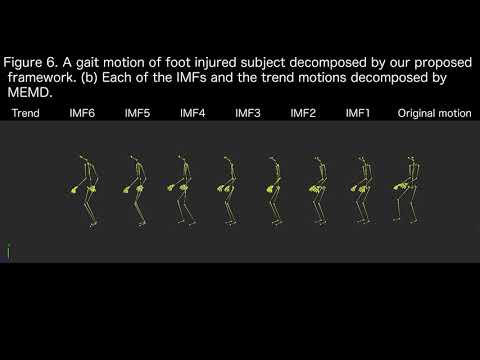
The Hilbert-Huang Transform (HHT) is a time-frequency analysis method particularly well-suited for analyzing non-linear and non-stationary data. This implementation applies HHT to motion capture data stored in BVH format, allowing researchers and animators to extract meaningful frequency and amplitude information from complex movements.
- BVH File Handling: Read and write BVH motion capture files
- Two Rotation Modes: Decompose motion in Euler-angle space or quaternion space
- Multivariate Empirical Mode Decomposition (MEMD): Decompose motion signals into Intrinsic Mode Functions (IMFs)
- Hilbert Spectral Analysis: Extract instantaneous frequency and amplitude information
- Visualization: Generate Hilbert spectral plots for selected joints
- Motion Decomposition: Export individual IMF components as BVH files for side-by-side viewing
- Python 3.10+ (3.11 recommended)
- NumPy
- Matplotlib
- SciPy (quaternion conversion via
scipy.spatial.transform.Rotation) - Custom modules:
MEMD_all.py: Multivariate EMD implementationht.py: Hilbert Transform utilitiesbvh.py: BVH I/O and rotation conversion helpers
Install dependencies:
pip install -r requirements.txtUse Miniconda/Anaconda instead of the system Python (e.g. Python 2.7 on some Windows setups):
conda create -n motion-hht python=3.11 -y
conda activate motion-hht
pip install -r requirements.txtThe main entry point is motionAnalysisHHT.py. Sample BVH files are provided under data/ (e.g. data/jump/13_32.bvh, data/golf/cmuGolf.bvh).
Decompose BVH Euler rotation channels directly. This matches the original pipeline.
python motionAnalysisHHT.py --rotation-mode eulerConvert each joint's Euler angles to quaternions (via SciPy), run MEMD in quaternion space, then convert IMF outputs back to Euler angles for BVH export.
python motionAnalysisHHT.py --rotation-mode quatpython motionAnalysisHHT.py --input ./data/golf/cmuGolf.bvh --rotation-mode quat
python motionAnalysisHHT.py --input ./data/jump/13_32.bvh --rotation-mode euler --output-dir ./my_run| Option | Default | Description |
|---|---|---|
--input |
./data/jump/13_32.bvh |
Path to input BVH file |
--rotation-mode |
euler |
euler or quat |
--output-dir |
mode-specific (see below) | Root directory for outputs |
| Mode | Spectra (PNG) | Decomposed BVH |
|---|---|---|
euler |
visualization/ |
decomposition/ |
quat |
visualization_quat/ |
decomposition_quat/ |
If --output-dir is set (e.g. ./my_run), files are written to my_run/visualization/ and my_run/decomposition/ regardless of mode.
Each run produces:
- Hilbert spectrum plots for selected joints (
joint_<channel>_spectrum.png, orjoint_<channel>_spectrum_quat.pngin quaternion mode) - BVH files:
IMF1.bvh…IMF<n-1>.bvh,Trend.bvh,original.bvh
- MEMD operates on the raw BVH channel layout (positions + Euler angles).
- Root rotation channels are unwrapped before decomposition (
errcon channels 3–6). - Suitable for direct comparison with the original published workflow.
- Each rotation triplet is converted to four quaternion components (
x, y, z, w) using the Euler order declared in the BVH hierarchy (e.g.zxyfor CMU golf data,zyxfor some jump mocap files). - Quaternion sign is kept continuous across frames before MEMD.
- Root translation channels are included in MEMD unchanged.
- IMF results are normalized and converted back to Euler angles before writing BVH files.
Both modes use the same MEMD + Hilbert visualization pipeline; only the working representation for rotation channels differs.
The script analyzes specific joints by default (first rotation channel index in the Euler BVH layout):
| Channel index | Joint (example skeleton) |
|---|---|
| 27 | RightLeg |
| 12 | LeftLeg |
| 45 | Neck |
| 78 | RightArm |
| 57 | LeftArm |
Edit the JOINTS list in motionAnalysisHHT.py to change which joints are plotted.
For each selected joint, instantaneous frequency and amplitude are computed per IMF layer, then aggregated across rotation channels:
- Euler mode: 3 channels — arithmetic mean of frequency; RMS of amplitude (√(mean of squared amplitudes)).
- Quaternion mode: 4 channels — same aggregation over
x, y, z, w.
This is a practical visualization heuristic for comparing Euler vs quaternion MEMD pipelines. It is not a strict SO(3) spectral measure.
Exported IMF BVH files are shifted along the root X position so multiple clips can be viewed side by side in a BVH player:
IMF1…IMF7:+150,+300, … along X (VISUALIZATION_SPACINGinmotionAnalysisHHT.py)original.bvh:-150(oppositeIMF1)Trend.bvh: no offset
These offsets affect display position only, not joint rotations. To compare original.bvh numerically with the input file, add 150 to the root X channel.
The analysis produces Hilbert spectrum plots showing how frequency components of motion change over time with color-coded amplitude. This helps identify patterns, periodicity, and energy distribution in the motion.
Each IMF component is also exported as a BVH file, allowing you to visualize different frequency components of the motion separately.
This project is available under MIT License. See the LICENSE file for more details.
If you use this code in your research, please cite:
@article{dong2020motion,
  title={Motion capture data analysis in the instantaneous frequency-domain using hilbert-huang transform},
  author={Dong, Ran and Cai, Dongsheng and Ikuno, Soichiro},
  journal={Sensors},
  volume={20},
  number={22},
  pages={6534},
  year={2020},
  publisher={MDPI},
  doi={10.3390/s20226534}
}

@article{dong2023biomechanical,
  title={Biomechanical analysis of golf swing motion using hilbert--huang transform},
  author={Dong, Ran and Ikuno, Soichiro},
  journal={Sensors},
  volume={23},
  number={15},
  pages={6698},
  year={2023},
  publisher={MDPI},
  doi={10.3390/s23156698}
}
For questions or collaboration opportunities, please open an issue in this repository.