


Voice Agents AI plumbing tool every team rebuilds from scratch — until now. Drop in a call recording. Get back everything: transcript, quality scores, sentiment shifts, latency breakdown, cost attribution, compliance flags. Normalized. Structured. Queryable. Works with any provider, any stack. One integration. Zero plumbing. Ship faster.
import audiotrace

report = audiotrace.analyze(
    audio    = "call_recording.wav",
    metadata = {"agent_version": "v2.1", "provider": "vapi"}
)

print(report.quality.overall_score)        # 0.87
print(report.sentiment.caller_frustration) # False
print(report.latency.llm_first_token_ms)   # 420
print(report.events.drop_off)              # False
print(report.cost.total_usd)               # 0.063
📺 Watch the demo:
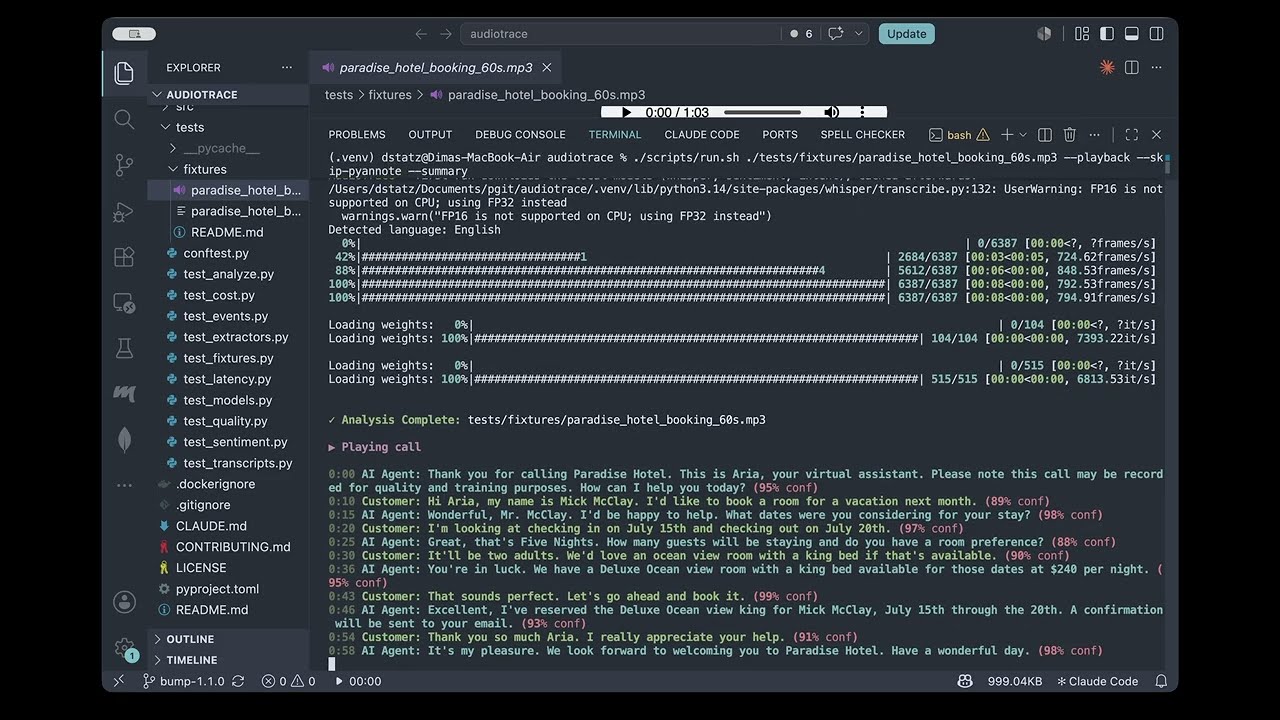
Every team building voice agents faces the same problem: raw audio is a black box. You can listen to recordings manually, or you can build your own signal extraction pipeline from scratch — but no open-source framework normalizes the full call into a structured, queryable object.
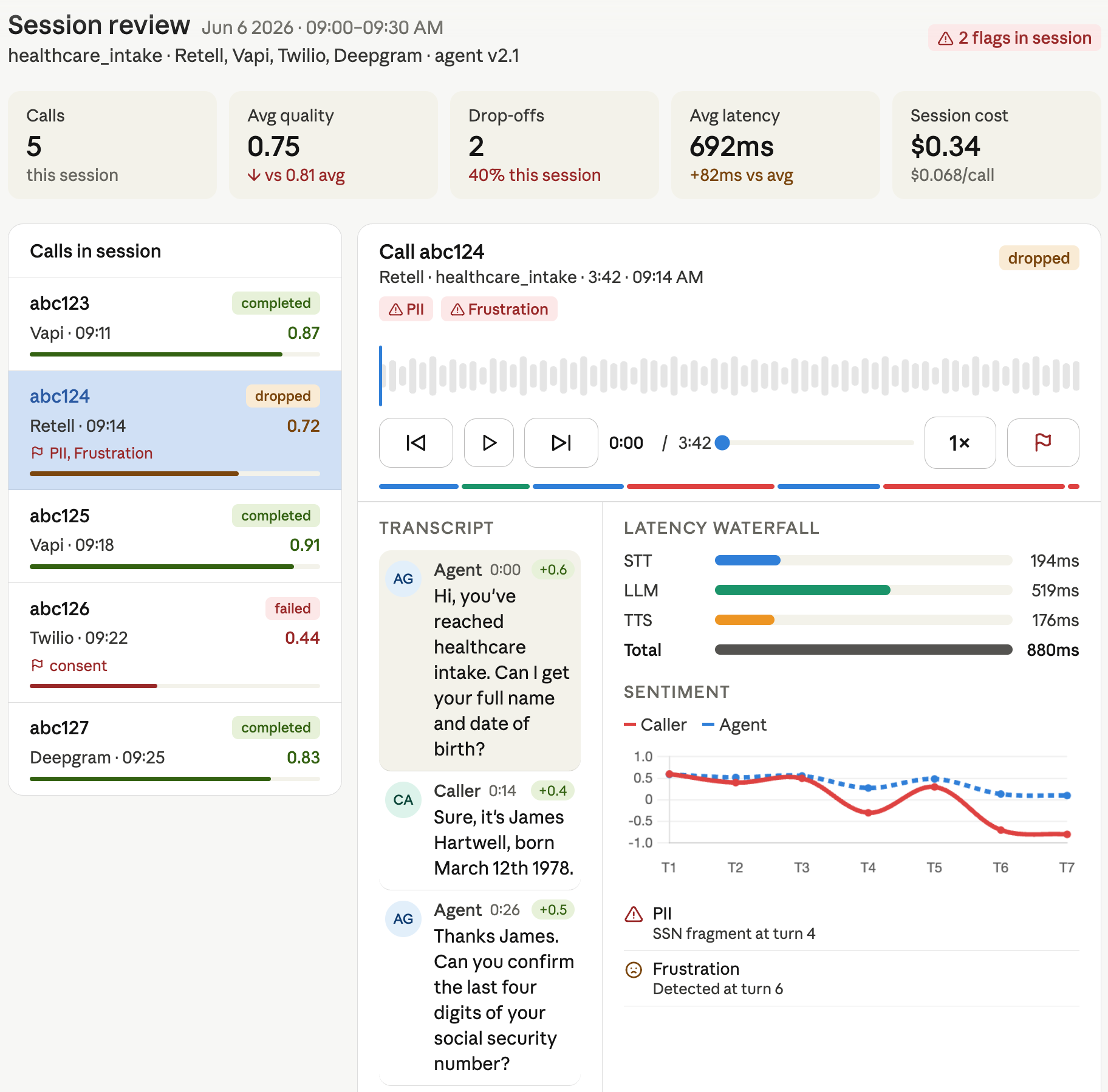
AudioTrace exists to be that shared layer. It handles the hard parts so you can focus on what you're building:
- Transcription with speaker diarization
- Silence gaps, interruptions, speaking pace, and pitch analysis
- Per-turn sentiment tracking and frustration detection
- Per-stage latency breakdown (STT → LLM → TTS → telephony)
- Unified cost calculation across any provider mix
- Compliance flag detection (PII leakage, consent gaps)
pip install audiotrace

# With specific provider adapter
pip install audiotrace[vapi]
pip install audiotrace[retell]
pip install audiotrace[twilio]

# Full install
pip install audiotrace[all]docker build -f docker/Dockerfile -t audiotrace .
docker run -it audiotraceRequirements: Python 3.9+, FFmpeg installed on system
import audiotrace

report = audiotrace.analyze(
    audio    = "call.wav",
    metadata = {
        "call_id":       "abc123",
        "agent_version": "v2.1",
        "provider":      "vapi",
        "campaign":      "healthcare_intake"
    }
)

# Media
print(report.media.duration_ms)          # int
print(report.media.codec)                # str

# Transcript
print(report.transcript.full_text)
for turn in report.transcript.turns:
    print(f"{turn.speaker}: {turn.text}")

# Quality
print(report.quality.overall_score)       # float 0.0–1.0
print(report.quality.interruptions)       # int
print(report.quality.silence_gaps)        # List[Gap]
print(report.quality.speaking_pace_wpm)   # float

# Sentiment
print(report.sentiment.overall)           # float -1.0 to 1.0
print(report.sentiment.shift_points)      # List[int] — turn indices
print(report.sentiment.caller_frustration)# bool

# Latency
print(report.latency.stt_ms)             # int
print(report.latency.llm_first_token_ms) # int
print(report.latency.tts_ms)             # int
print(report.latency.total_ms)           # int

# Cost
print(report.cost.stt_usd)               # float
print(report.cost.llm_usd)               # float
print(report.cost.total_usd)             # float

# Events
print(report.events.outcome)             # "completed" | "dropped" | "failed"
print(report.events.drop_off_turn)       # int | None
print(report.events.compliance_flags) # List[str]from audiotrace.adapters import VapiAdapter
adapter = VapiAdapter(api_key="...")
call = adapter.fetch_call(call_id="abc123")
report = audiotrace.analyze(call.audio, call.metadata)CallReport
├── media
│ ├── duration_ms: int
│ ├── sample_rate_hz: int
│ ├── channels: int
│ ├── codec: str
│ ├── file_size_bytes: int
│ ├── file_format: str
│ └── bitrate_kbps: float
├── transcript
│ ├── full_text: str
│ ├── turns: List[Turn] # speaker · text · start_ms · end_ms · confidence · words[]
│ ├── language: str
│ └── diarization_confidence: float | None # pitch-fallback speaker separability (0-1); None if not measured
├── quality
│ ├── overall_score: float
│ ├── interruptions: int
│ ├── silence_gaps: List[Gap]
│ ├── speaking_pace_wpm: float
│ ├── pitch_variance: float
│ └── turn_length_avg_ms: float
├── sentiment
│ ├── by_turn: List[float]
│ ├── overall: float
│ ├── shift_points: List[int]
│ └── caller_frustration: bool
├── latency
│ ├── stt_ms: int
│ ├── llm_first_token_ms: int
│ ├── llm_full_response_ms: int
│ ├── tts_ms: int
│ ├── total_ms: int
│ └── waterfall: List[LatencySpan]
├── cost
│ ├── stt_usd: float
│ ├── llm_usd: float
│ ├── tts_usd: float
│ ├── telephony_usd: float
│ └── total_usd: float
└── events
├── outcome: str
├── drop_off: bool
├── drop_off_turn: int | None
├── intent_detected: str
├── failure_type: str | None
└── compliance_flags: List[str]
Provider adapters are TBD — not yet implemented. The integrations below are planned; today you pass a local audio file path to
analyze()directly. The adapter example above is illustrative of the intended API.
| Provider | Adapter | Status |
|---|---|---|
| Vapi | audiotrace[vapi] |
TBD |
| Retell | audiotrace[retell] |
TBD |
| Twilio | audiotrace[twilio] |
TBD |
| ElevenLabs | audiotrace[elevenlabs] |
TBD |
| Deepgram | audiotrace[deepgram] |
TBD |
| Custom webhook | CustomAdapter |
TBD |
AudioTrace builds on top of best-in-class audio libraries so you don't have to:
Raw audio file
      │
      ▼
  FFmpeg              — format normalization, turn splitting
      │
      ├── Whisper     — transcription
      ├── pyannote    — speaker diarization
      ├── Librosa     — silence gaps, pace, pitch, energy
      └── Transformers — sentiment, intent detection
      │
      ▼
  CallReport (Pydantic)
Part of the Lang ecosystem TBD
AudioTrace is the open-source foundation that powers two commercial products:
| Product | What it does | Built on |
|---|---|---|
| LangTrace | Live call observability & analytics dashboards | AudioTrace |
| LangGate | Pre-deploy simulation & CI/CD quality gate | AudioTrace |
AudioTrace is free and MIT-licensed. The commercial products are optional hosted layers on top.
Want it run for you today? We're taking a few paid design-partner pilots — "early access + we run it for you." See COMMERCIAL.md.
For quick testing or interactive analysis, you can use the provided runner script. It automatically handles virtual environment setup and dependency validation.
# Analyze default golden data fixture
./scripts/run.sh

# Concise per-section summary tables instead of the raw JSON
./scripts/run.sh --summary

# Playback, inferring speakers by pitch (no pyannote token needed)
./scripts/run.sh --playback --skip-pyannote

# Analyze a specific file
./scripts/run.sh path/to/your/audio.wavBefore submitting changes, ensure everything passes the local validation suite (formatting, linting, type-checking, and tests):
./scripts/test_local.sh testTreat a handful of representative recordings as golden fixtures, commit a baseline, and fail the build when a prompt/model/voice change makes the agent measurably worse — slower, colder, less compliant.
# 1. Commit a baseline from your golden calls (one time, and after intentional changes)
audiotrace baseline tests/calls -o baseline.json

# 2. Gate every change against it — exits non-zero on regression, writes per-call reports
audiotrace check tests/calls -b baseline.json --report audiotrace-report
A metric only fails the build when it drifts past its tolerance (quality −0.05, sentiment −0.10, latency +15%, cost +20%; frustration / drop-off / compliance have zero slack). New recordings not in the baseline are skipped, not failed.
Drop the gate into CI in a few lines. It installs AudioTrace, runs the check, and uploads the HTML report as an artifact even when the build fails:
# .github/workflows/voice-quality.yml
name: Voice quality
on: [pull_request]
jobs:
  audiotrace:
    runs-on: ubuntu-latest
    steps:
      - uses: actions/checkout@v4
      - uses: dimastatz/audiotrace@v1.2.1
        with:
          calls: tests/calls
baseline: baseline.jsonContributions are welcome — especially new provider adapters, persona definitions for simulation, and compliance rule sets.
git clone https://github.com/audiotrace/audiotrace
cd audiotrace
./scripts/test_local.sh test  # Run all checks (formatting, lint, types, tests)
See CONTRIBUTING.md for guidelines.
MIT — see LICENSE