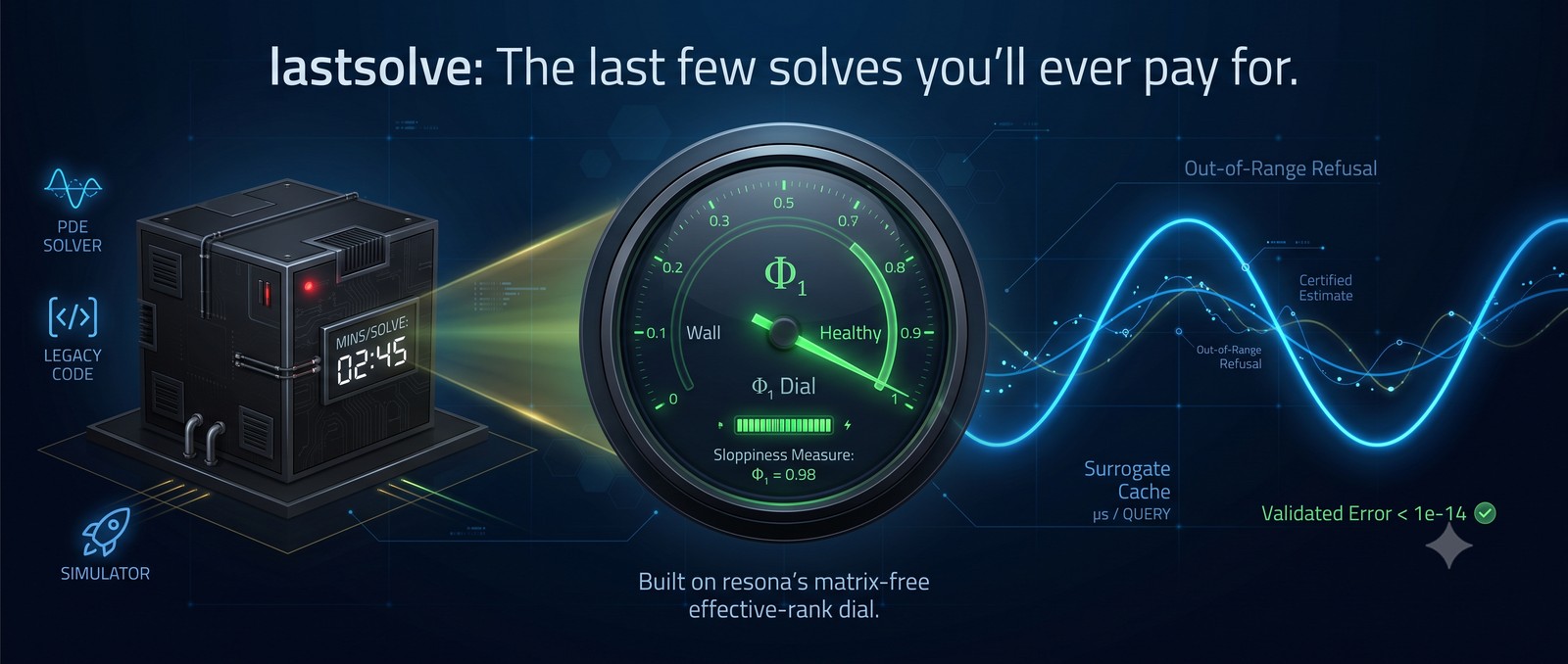
The last few solves you'll ever pay for.
lastsolve is a certified accelerator and identification layer over any black-box parametric solver. You bring an expensive function f(k) → field — a PDE solver, a legacy code behind a subprocess, a simulator you can't even import. lastsolve spends a handful of calls on Chebyshev nodes and hands back the whole price list:
In plain terms. You have a simulation that takes 2 minutes, and your workflow — a parameter sweep, a calibration loop, an MCMC — needs to call it 10,000 times.
lastsolveruns it ~10 times, learns how the answer depends on the parameter, and serves the other 9,990 calls in microseconds — with a validated error bar on every answer, and a typed exception instead of a guess whenever it can't keep that promise.
The contract: f(k) → 1-D numpy array (anything np.asarray-able; a scalar result is a length-1 array). Plain CPU NumPy in, plain NumPy out — no PyTorch/JAX tensors needed, no GPU, no training loops. The whole library is a few files of numpy + scipy + resona you can read in an evening.
Learn by doing: the COOKBOOK — ten paste-and-run recipes, each ending with the verbatim output it printed on this machine.
from lastsolve import accelerate, learn

@accelerate(warmup=5)        # watch 5 real calls, learn the range they live in,
def solve(k):                # then serve everything from the surrogate
    ...  # your expensive solver

solve(0.021)                 # microseconds, with a validated error and the Φ₁ dial
solve.stats                  # every real call counted

s = learn(solve_fn, (0.014, 0.026))          # one knob  → Surrogate
s = learn(solve_fn, [(a1,b1), (a2,b2)])      # several   → SurrogateND, same verbs
k_hat, crb = s.invert(y_obs)                 # rich Estimate, unpacks as a tuple
s.certify(n_cal=8)                           # Certificate(err ≤ 3.9e-15, ≥88.9%)
s.query(0.05)                                # OutOfRangeError — lastsolve refuses
                                             # to extrapolate; strict=False to
                                             # accept an uncertified answer knowingly
Built on resona's matrix-free effective-rank dial — the measuring instrument of the Spectra Without Matrices series. The philosophy in one line: measure the structure first, then pay accordingly.
| API | What it does | The honest part |
|---|---|---|
@accelerate |
transparent surrogate cache: in-range calls served in µs at near machine precision | out-of-range calls fall through to the real solver — never extrapolates; .stats counts every real call |
Surrogate(f, krange) |
the core: query(k), deriv(k) (Fisher info), adaptive node ladder, transform='auto' discovers coordinates like 1/√k |
.val_err from held-out solves; .phi1 — resona's dial: ~1 healthy, ≫1 a wall, ~0 dead parameter |
.certify(n_cal, alpha) |
split-conformal error band | distribution-free finite-sample guarantee (and it tells you 8 calibration points buy 88.9%, not 90%) |
identify(f, data, krange) |
maximum-likelihood k̂ ± Cramér–Rao bar from one observation | verdict includes "the data do not contain this parameter" when they don't |
audit(f, x0, sigma, prior) |
field-level identifiability: how many independent numbers about N unknowns your dataset holds (matrix-free probes + resona) | reports the blind subspace no method can recover, before anyone reconstructs anything |
detect_break(f, krange) |
bifurcation alarm + blind localization via validation-error bisection | refuses to fit across broken physics instead of interpolating a lie |
classify_wall(f, krange) |
after the alarm: is the wall removable (a coordinate heals it) or genuine (Shor-class)? | resona's lift-rank saturation test — the Journey-I instrument, pointed at your family |
SurrogateND(f, box) |
several parameters, committee-disagreement adaptive design | 45 solves matched a 125-solve tensor grid on a 3-parameter family; sloppiness (Φ₁ ≈ 1–2 at p=3) is measured, not assumed |
CommandSolver + accelerate_command |
accelerate a solver you cannot import — any CLI/binary | every subprocess invocation counted |
TimePropagator(snapshots) |
learn the propagator from one trajectory (DMD/Koopman via resona.lift) | ships |λ|max stability verdict + held-out-tail validation; says when long prediction is dishonest |
identify_spectral(family, k0, λs) |
recover a parameter from a measured spectral fingerprint (resona.wkernel + rayleigh_polish) | uses several eigenvalues — one alone can be ambiguous, and the docstring says so |
normality_warning(A) |
non-normality check before trusting any spectral dial | "the spectrum lies about where this operator acts" is a measurable condition |
Because none of it is asserted — it was all run first. The methods were battle-tested on a zoo of 35 nonlinear PDE families (Burgers, KdV, Kuramoto–Sivashinsky chaos, NLS solitons, Camassa–Holm, fractional heat…), included here as lastsolve.zoo and exercised by the test suite:
- forward surrogates at ~5·10⁻¹⁵ over ±28% parameter ranges, ~570× faster queries;
- inversion saturating the Cramér–Rao bound (median error ≈ 0.7× the bound — the theoretical optimum is 0.674);
- conformal coverage measured at 88.4% against the exact 88.9% finite-sample guarantee;
- a pitchfork bifurcation localized blind to 3% of the range, zero false alarms on healthy physics.
The research trail with every number: The Price of an Answer (Journey II) and Never Quantum at All (Journey I).
pip install lastsolve            # that's it — deps are numpy, scipy, resona:
                                 # no ML frameworks, no CUDA, nothing to train
Hacking on it / running the test suite:
git clone https://github.com/dimaq12/lastsolve.git && cd lastsolve
pip install -e . && pip install pytest
pytest tests/ -q # 28 tests, ~20 s, real PDEs inside- Scalar-parameter surrogates are certified; multi-parameter (
SurrogateND) is adaptive least-squares — excellent in the sloppy regime (which is most of physics), but its validation is empirical, not conformal yet. - A scalar-k surrogate is tied to one configuration — but that is not the real limit: lift the configuration into parameters. Expand the initial condition (or geometry, or forcing) in a small basis and hand its coefficients to
SurrogateNDalongsidek; one precompute then covers the whole family of ICs, because Φ₁ stays low even in the enlarged space (measured: a 4-D box of viscosity + 3 IC-coefficients hits 2·10⁻⁶ from 120 solves at Φ₁ ≈ 2.5). For linear PDEs the transfer is exact via u(T;k) = G(k)·u₀. It is a cache around a question family — and the family can be as wide as you are willing to parameterize. See the "recalibrate a whole family" recipe in the cookbook. - Smoothness is measured, not assumed: when the parametric manifold genuinely resists (a breathing soliton — Kolmogorov n-width), Φ₁ flags it and no node budget will help. The dial exists precisely so the library can refuse honestly.
resona.effective_rankis a stochastic (Hutchinson) estimate;lastsolveuses 128 probes, good to a few percent on the dial.
- Never silently wrong — every answer is validated, certified, or refused.
- The dial before the fit — Φ₁ says whether a cheap surrogate exists at all.
- Everything is counted — the solver calls we spend are the price we quote.
MIT · Dmytro Sierikov · part of the Spectra Without Matrices series