

Check what a scientific paper claims against what its cited sources actually say.
PaperTrace retrieves legally available cited PDFs, checks the paper's
citation-backed claims against the text of the cited pages, and shows the evidence —
the matched text boxed in red on the real page.
An unread source never receives a verdict.
A missed citation is reported, not silently skipped.
See a completed report · Quick start · How it works · Ethics & scope · Latest release (beta)
Open source · Python 3.10+ · local CLI and case files · claim checking currently uses Claude Code · built for published papers

See the result first — no install needed. The demo report committed at
examples/demo/output/report.mdaudits a fictional mini-review with planted citation errors and real, published references: 2 supported · 2 contradicted · 1 not retrieved · 1 uncited assertion — the planted errors, and exactly them, in that run. Extraction and judgement are model steps, so the committed report is an inspectable artefact, not a guaranteed re-run.
Pick a paper that matters to you — the landmark your project builds on, the method paper you are about to adopt, your own published work. PaperTrace answers three questions about it: do its citations say what it claims they say? — what has been published since? — what existed at the time but went uncited?
PaperTrace does
- Retrieve what the paper cites through legal open-access routes only (Crossref → Unpaywall → Europe PMC → arXiv) — and reject a downloaded PDF that doesn't look like the cited paper (title sanity check), rather than judge claims against the wrong text. The check needs 35% of the reference's distinctive words on the retrieved first page; a first page that is empty or unreadable (scanned, image-only) passes — unverifiable is not the same as wrong, so a scanned source is checked rather than silently discarded.
- Attempt to extract every citation-backed claim, then judge each against the text of its cited source, with page-level provenance for every verdict. Extraction is a model step, so it is an attempt, not a guarantee — which is why the coverage audit below exists.
- Show the evidence: real page crops with the matched text boxed in red. Claude proposes the page, the block and verbatim anchor phrases; Python then finds those phrases in the PDF and draws the boxes — placed by text search, never by hand, and never by the model. A crop whose anchor matched nothing is shown unboxed and labelled as such.
- Preserve unavailable sources as explicit gaps: a claim whose source
couldn't be retrieved is
⊘ not retrieved— recorded, never guessed. - Report every citation occurrence — each bracketed marker at its own place in the text — that no extracted claim reached, so a second sentence citing an already-checked reference is not silently counted as covered. It also registers assertions carrying no citation at all. Detection is mechanical and prompt-independent (a regex over bracketed numeric labels): if extraction skipped a citation, it shows up here. Attribution of a claim to a specific occurrence is a text match the tool can get wrong; an attribution it cannot make is reported as uncertain and counted as not covered, never as covered.
- Judge a co-cited claim against every cited source it could retrieve, one
model call each, and show the passage behind each verdict. Co-citation is an
offer of support, so each source is checked on its own text: a claim citing
four references gets four verdicts, four notes and four evidence crops, with a
count beside it ("4 cited sources checked: 2 fully support it; 1 partially
supports it; 1 contradicts it"). The claim's headline is the most adverse
verdict any of them gave, so one dissenting source is never averaged away.
A source that turns out to say nothing about the claim is
◌ does not address the claim— an inapt citation, distinct from a contradiction and from a retrieval gap. - Disclose its ingest fidelity: every report — markdown, editor and terminal — names the converter that read the audited paper, and a flat-text fallback says so loudly. Cited sources are ingested separately (see Tables and figures are evidence too).
- Keep the human responsible for interpretation — it prepares evidence and drafts; the conclusions are yours.
PaperTrace does not
- Bypass paywalls — what it can't get legally, it reports as not obtainable.
- Treat model memory as evidence — verdicts come only from retrieved or user-provided pages.
- Guarantee that every citation-bearing sentence was checked. The
extraction prompt asks for all of them, but a model's recall is not a
guarantee — so the coverage audit reports which labels no claim reached.
That is a disclosure mechanism, not proof of exhaustive sentence-level
coverage (an
--exhaustivemode is on the roadmap). - Audit every citation style. The coverage audit reads bracketed numeric
labels only —
[12],[7,8],[9-11]. Author-year, parenthetical and bare-superscript styles are not audited, and the report says "coverage not audited" rather than quietly reporting zero gaps. - Read the source pages as images. In batch mode the model receives the cited
source as extracted text with
page / blockprovenance markers — the page picture is for you, in the evidence crop, not for the judge. - Tell you why a co-cited source was never opened, beyond its retrieval status. Every cited source that could be obtained is judged; one listed as unopened could not be retrieved, and the manifest carries the reason.
- Read the audited paper's supplemental material. Only the single PDF you pass is ingested. A claim living in an eTable, appendix or supporting- information file is not extracted, its citation labels are not counted in the coverage audit, and it is not reported as unread — it is simply absent. This is the one gap in the tool that is silent rather than disclosed, so it is named here. Merge the supplement into the main PDF before running if you need it audited.
- Fetch the supplements of cited sources. The resolver chain returns the
article. A claim resting on a source's supplementary figure or table is judged
against its main text alone, which can come back
partialordoes not address the claimfor a reason that belongs to retrieval rather than to the source. - Prove that an uncited article should have been cited — scout hits are candidates for your judgement, never accusations.
- Guarantee an exhaustive literature search — the scout is search-based, and absence from its lists proves nothing.
- Replace peer review or your research judgement.
pip install -e ".[full]"     # standard install — layout-aware ingest
papertrace                   # asks for the paper, the DOI and your email
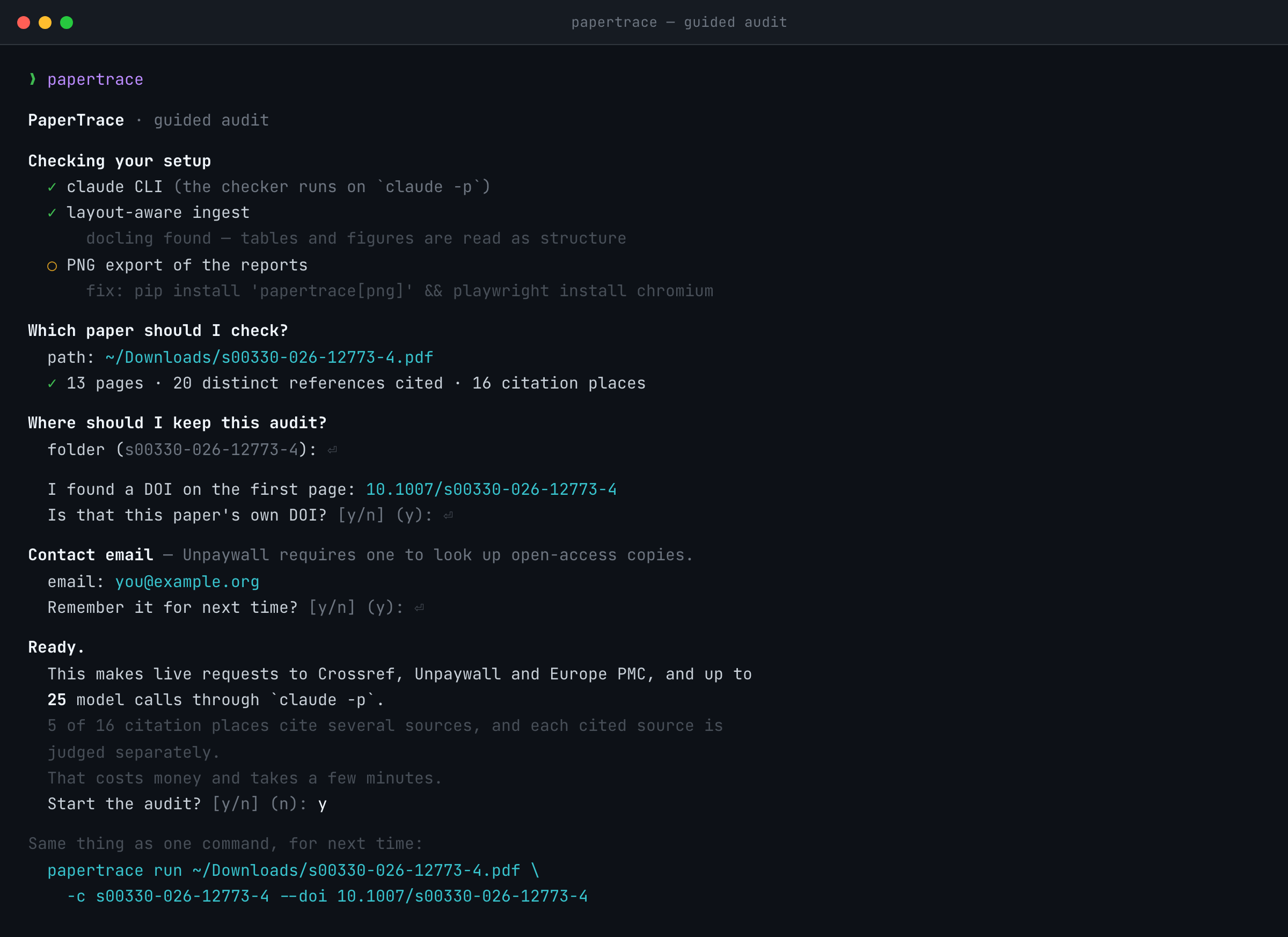
Nothing to memorise. It checks your setup first — so a missing claude CLI is
a sentence before you type anything, not a traceback twenty minutes in — then
asks one question at a time: the paper (drag the file in; quotes and escaped
spaces are fine), where to keep the audit, whether the paper is published, and
a contact email it offers to remember. Before spending anything it tells you
how many model calls the run will make and asks you to confirm, and when you
say yes it prints the equivalent one-line command so you can repeat or script
it next time.
papertrace start does the same thing explicitly. Without an interactive
terminal — a pipe, a CI job — bare papertrace prints help instead of waiting
on stdin.
git clone https://github.com/defraction0/PaperTrace && cd PaperTrace
pip install -e ".[full]"     # standard install — layout-aware ingest
claude                       # start Claude Code here
> /review
(First run of the layout backend downloads docling's models — ~500 MB, once.
On a constrained machine, pip install -e . gives the light flat-text core.)
The interactive audit interviews you: the paper's PDF, any reference PDFs you already have — and, if you are using it for peer review, screenshots of your journal's reviewer form, which it reads and answers question by question. Then it retrieves, checks, crops, and drafts, showing you evidence as it goes and batching its questions.
pip install -e ".[full]"        # standard install (see matrix below)
export PAPERTRACE_EMAIL="you@example.org"     # Unpaywall asks for a contact
papertrace run paper.pdf --provided ./my_pdfs      # case folder: ./paper/ beside the PDF
Install options:
| Command | What you get |
|---|---|
pip install -e ".[full]" |
⭐ standard install — layout-aware ingest (real tables, figures, lists) + PNG rendering. Pulls torch; first run downloads docling's layout models (~500 MB, once) |
pip install -e ".[docling]" |
layout-aware ingest only |
pip install -e ".[png]" |
PNG report rendering only |
pip install -e ".[dev]" |
the test and lint tooling — pytest, ruff, jsonschema. This is what CI installs |
pip install -e ".[dev,full]" |
everything: run audits and run the suite |
pip install -e . |
minimal core — flat-text ingest. For CI and constrained machines; every report will carry a "tables linearized" warning |
[full]does not include the test tooling. The extras are independent:fullis user features,devispytest+ruff. Installing[full]and then runningpytestfinds whateverpytesthappens to be on yourPATH— usually a system one, with none of this project's dependencies — and fails withModuleNotFoundError: No module named 'pymupdf'. If you intend to run the suite, install".[dev,full]"and invoke it aspython -m pytest, which fails loudly instead of silently using the wrong interpreter.
--backend auto (default) uses docling when installed and falls back to flat
text otherwise — and the report always says which one ran, because a
linearized table is a degradation worth disclosing.
--provided matches by filename, so the name decides which file stands for
a reference. Files must contain the reference's author and year (pyrros-2023
matches pyrros-2023.pdf and pyrros-et-al-2023-chest-radiographs.pdf), and
where several match, an exact <author>-<year>.pdf wins, else the shortest
name. A filename that reads as supplemental material — supplement, appendix,
supporting information, ESM, online only — is not used as the source,
and if it is the only match the reference is left to the online resolver
instead: a supplement is not the paper it accompanies. Rename it to the plain
<author>-<year>.pdf if you do mean it to stand in. Provided files are
title-checked like downloaded ones, but a mismatch is recorded in the manifest
rather than refused — you named the file, so it is used and the doubt is
disclosed.
Output in case/out/: report.md with inline evidence images, the same
report as a dark editor-window page and as a terminal-run page
(report_editor.html, report_terminal.html), plus machine-readable
results.json and scout.json. The retrieval manifest is written one level
up, at case/refs_manifest.json. Want shareable PNG images of the report
looks? Add --png (one-time setup: playwright install chromium).
--doi is the DOI of the paper you are auditing — not of anything it
cites. It is optional, and it feeds only the literature scout, which has to
identify your paper in Europe PMC before it can look for work published since
or work in the field you did not cite. Nothing else in the audit uses it: the
verdicts, evidence crops and coverage figures are identical with or without.
- Published paper → pass it. Without it the scout falls back to matching by
title, and a wrong match is silent: the scan anchors to somebody else's
paper and the two registers describe that one instead. The report flags
resolved_via: title, but it does not error. - Unpublished manuscript → there is no DOI to pass, and the scout can never
identify it. Use
--no-scoutto skip the step rather than reading an empty result as "nothing to find". The guided flow does this for you.
One case folder per paper. case is only the default name — give each
paper its own (papertrace run zhang2025.pdf -c zhang2025). Re-running the
same paper into its case is fine; pointing a different paper at a used
case is refused, so two audits can never mix.
Batch checking runs on headless Claude Code (claude -p) — it inherits your
existing login, no API key to configure. It is the only step that calls a
model; every other step is plain Python. Ingest, crops and reports are also
deterministic — same input, same output. Retrieval and the scout are
not: they query Crossref, Unpaywall, Europe PMC and arXiv live, so their
results depend on those services, on their index state and on the date of the
run. Re-running the same paper a month later can legitimately produce a
different manifest.
One run, not a benchmark. What follows is a single unscripted audit, reported to show the shape of the output. It is not an accuracy measurement, the numbers would move between runs, and the artefact is not shareable — the source PDFs are publisher-controlled, so the case folder cannot be committed. For what is measurable and inspectable, see Testing and evaluation.
A real, unscripted audit of a published paper (Zhang et al., Nature Mental Health 3, 1168–1180, 2025 — doi:10.1038/s44220-025-00501-8): 86 cited references, of which 22 had legal open-access copies — the other 64 are recorded as not obtainable, never guessed. 15 extracted claims were read against their cited pages: 8 supported, 7 partial, 0 contradicted. The partials are the interesting part — a Methods sentence calling tests "well-established" whose own cited source describes them as "brief and bespoke, non-standard", and multi-reference claims where the retrieved source carries one half of the claim while the unretrieved co-citation is named as the possible carrier of the other half. Candidates for your judgement, not accusations.

A number in a table cell, or drawn inside a figure, is still in the PDF's text
layer — so the red box lands on it whichever backend read the document.
highlight searches the real page, never the extracted text:
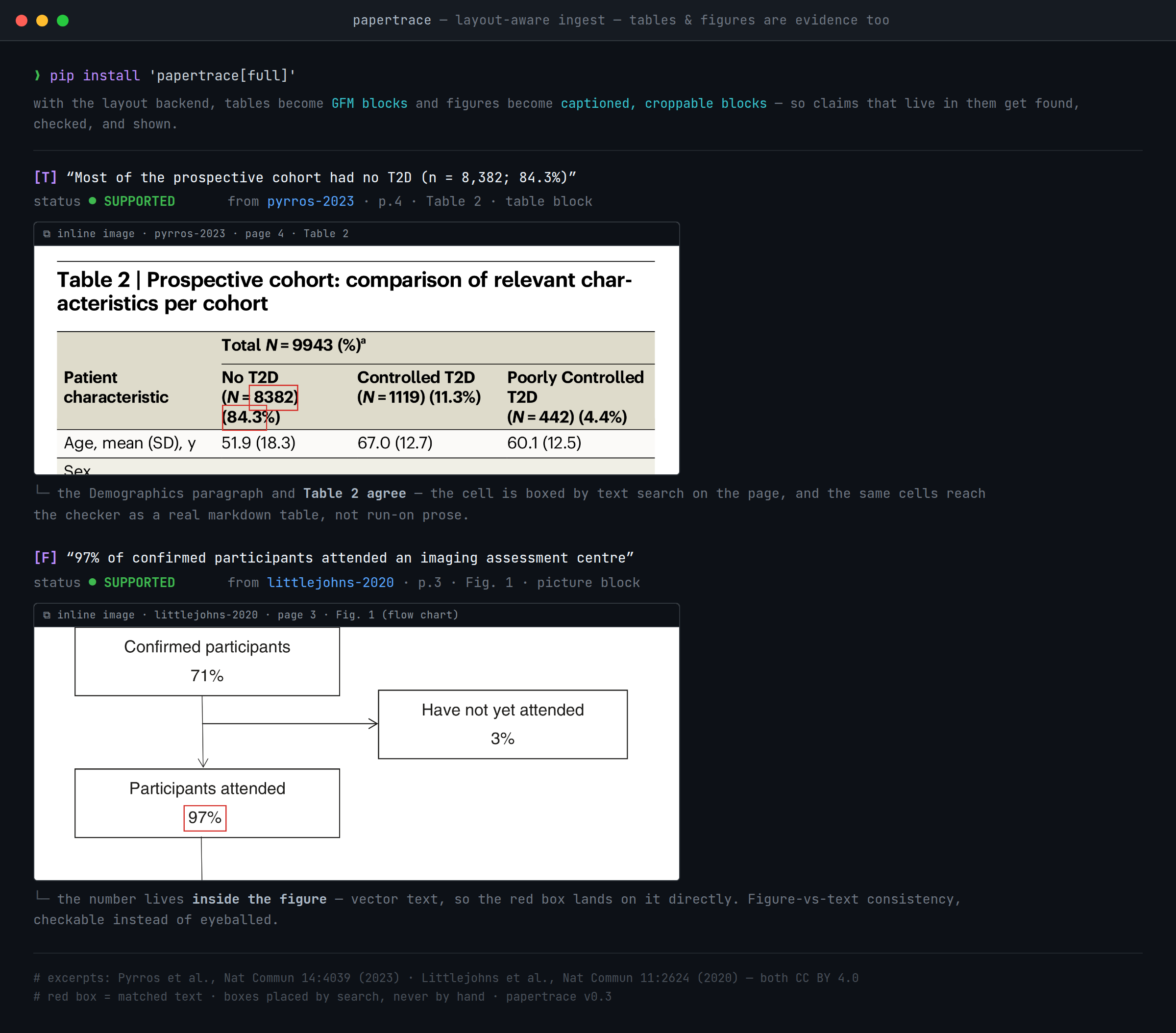
Both crops above come from cited sources whose block types (table block,
picture block) come from ingesting those sources with the layout backend by
hand — in batch mode check reads a cited source as flat text.
Whether such a number can be claimed and checked in the first place is a different question, decided by what the backend hands the model:
| a table cell | text drawn inside a figure | |
|---|---|---|
flat text (pymupdf) |
reaches the model linearised — the row and column it belongs to are lost | reaches the model as loose words, with no figure to belong to |
layout-aware (docling; standard install, audited paper only) |
reaches the model as a GFM table | the figure arrives as [FIGURE: <caption>]; in-figure text arrives only where docling's layout model found a text region inside the figure |
On the one paper measured for this, it found none: of 9 figures, 5 carried text in the PDF's text layer, and docling emitted no text block anywhere inside a figure region — so that text reached the model nowhere, while the flat-text backend did carry it. One paper is not a rate and none is claimed; what is claimed is only that in-figure text is not guaranteed on the layout path.
So the box is equally trustworthy either way, and the claim behind it is not: a table-cell claim is strongest under the layout backend, and an in-figure claim is the weakest evidence this tool produces — under the layout backend the judge may never have seen the number, and under flat text it saw the number without the figure that gives it meaning.
That layout fidelity is spent on the audited paper. In batch mode a cited
source that has not yet been ingested is ingested with the fast flat-text
backend, so its tables reach the judge linearised and its figures only as
whatever loose words sat inside them.
check reuses an existing case/ingest/<slug>/annotated.md if one is already
there — so a source you ingested yourself with papertrace ingest --backend docling keeps its layout, and the report does not currently distinguish
the two cases.
The committed report above was produced by this exact sequence — a fictional mini-review with planted citation errors and real, published references. The resolver fetches the open-access sources live, then the checker catches the plants: an AUC quoted as 0.94 where the cited paper says 0.77, an attendance figure that contradicts the cited flow chart, a headline resting on a paywalled source that is honestly reported as unverifiable, and one assertive sentence with no citation at all.
One run of this demo took 95 seconds end to end with the layout models already
downloaded — one run, not a benchmark. The first time adds two one-time downloads
(chromium ~150 MB, docling's layout models ~500 MB). Prerequisite:
Claude Code installed and logged in — the
claim checker runs on claude -p.
pip install -e ".[full]" && playwright install chromium   # 1 · install
export PAPERTRACE_EMAIL="you@example.org"                 # 2 · Unpaywall contact
python examples/demo/make_manuscript.py                   # 3 · build the demo paper
papertrace run examples/demo/demo_manuscript.pdf -c demo_case   # 4 · audit it
When it finishes, open demo_case/out/report.md. Expected result:
2 supported · 2 contradicted · 1 not retrieved, one uncited assertion
flagged, and all 5 citation occurrences — spread across the 4 labels — reached
by an extracted claim, 0 uncertain. (The scout step reports the fictional paper
as not identified in Europe PMC — the tool would rather say so than invent
neighbours. Verdict wording varies run to run, and
extraction and judgement are live model behaviour that nothing in the code
constrains — so treat these numbers as what the demo has produced, not as a
promise. If a re-run misses a plant, that is a real result about the model, and
examples/demo/ documents each plant so you can see exactly what was missed.)
Details per plant:
examples/demo/.
Note: the committed
examples/demo/output/is the output of a real run (2026-08-30, docling 2.118.1) and matches what the current code produces. It stays an inspectable artefact, not a byte-exact expected output: judgement wording differs between runs, and so can the page an anchor is found on — the crop for claim 4 moved from page 1 to page 2 across two runs that reached the same verdict. No claim in the demo cites more than one reference, so the per-source breakdown and its summary count do not appear in it.
paper.pdf ─────ingest──▶ clean.md + source_map.json       (page + bbox for every block)
      │
      └─refs──▶ refs_manifest.json                        (per-ref: retrieved / provided /
                + sources_resolved/*.pdf                    paywalled / mismatch / no_doi /
      │                                                     error + reason)
      └─scout─▶ out/scout.json                            (europe pmc: published-since +
                                                            existed-but-uncited candidates)
      │
      └─check─▶ results.json                              (per-claim verdict + page anchor;
                                                            unavailable source ⇒ not_retrieved)
      │
      └─highlight─▶ out/evidence/claim_NN.png             (red box on the matched text)
      │
      └─report──▶ report.md · report_editor.html/png · report_terminal.html/png
The JSON contracts are versioned in schemas/. The two skills in
.claude/skills/ drive the same tools interactively; the
audit craft lives in prompts/review_core.md.
- Built for published papers. Everything PaperTrace reads is already public, so no confidentiality question arises in its primary use.
- A note on peer review. The interactive workflow also handles a full
reviewer's job — reading the journal's form, checking the claims, drafting
comments — and remains fully supported. But many journals prohibit sharing
unpublished manuscripts with AI tools: if you use it on a manuscript under
review, confirm your journal's policy first and disclose AI assistance
where required. PDFs and case folders remain outside Git (the repo's
.gitignorerefuses*.pdf/*.docxoutright), but relevant text is processed through Claude Code during checking — so confirm the journal's AI and confidentiality policies before using PaperTrace on an unpublished manuscript. - You are the judge. The tool prepares evidence and drafts; the conclusions are yours. Scout hits are candidates, not accusations — verify before you act on any finding.
- No paywall bypassing. The resolver uses legal open-access routes only; what it can't get, it reports as not obtainable.
- No verdict laundering. An unread source can never yield a supported
claim —
not_retrievedis a first-class result and appears in every report. The scout is search-based and says so: absence from its lists proves nothing.
These are two different things, and the project keeps them apart on purpose.
Software tests — what CI runs. tests/ holds conventional unit and
integration tests. They make no network calls and no model calls: the
reference resolver runs against httpx.MockTransport, PDFs are generated
in-test with pymupdf, and the single claude -p touchpoint sits behind a seam
that tests replace. They run in CI on every pull request and on every push to
main, across Python 3.10–3.14 (see the badge above). A push to a feature
branch with no open PR triggers nothing — run pytest -q locally. They tell you the plumbing is correct — ingest, retrieval,
coverage arithmetic, crop placement, report rendering, JSON round-trips.
They tell you nothing about whether the model's verdicts are right.
Model evaluation — under development. Judging claims is a model step, so
its quality is an empirical question that unit tests cannot answer. The
protocol for answering it — evaluation unit, paired cases, metric definitions,
labelling policy — is specified in evals/DESIGN.md, with
an offline scoring harness in evals/. A formal evaluation dataset
is still being built; what ships today is the design, the scaffold, and a
demonstration fixture.
The demonstration is not a benchmark. examples/demo/ is
a small controlled example: one fictional manuscript with deliberately
planted citation errors, citing four real published papers. It shows the
pipeline catching defects that were put there on purpose. It is five cases,
authored and labelled by this project's own maintainer, and it measures
nothing about performance on real manuscripts.
No accuracy figure is claimed anywhere in this README, because none has been measured.
pip install -e ".[dev,png]"
pytest          # fixtures only — no network, no LLM
ruff check src tests scripts evals
Scoring a run against a gold set is offline and separate from the test suite:
python evals/runners/score_only.py \
    --gold evals/gold/demo_v1.gold.json \
    --results evals/gold/demo_v1.observed.json \
    --out evals/runs
See CONTRIBUTING.md for how to report paper-format
failures — the feedback that improves the tool fastest. The pixel logo is
generated: python scripts/make_logo.py. Changes are tracked in
CHANGELOG.md; cite the tool via CITATION.cff.
- Retraction & correction flags on cited references
- More citation styles in the coverage audit — author-year, parenthetical numerics and bare superscripts (as in Nature-family journals). The report currently says "not audited" instead of silently passing
-
--exhaustivemode — close the gap between what extraction is asked for and what it returns: labels the coverage audit reports as unreached get a focused second extraction pass, and a citation with no checkable assertion ("see [12]") is classified as a pointer rather than forced into a verdict - More scout backends (OpenAlex, Semantic Scholar)
- Support for other LLM backends (local and API models alongside headless Claude Code)
- Claude Desktop integration
- MCP server — drive PaperTrace as a tool from any MCP-capable client
- DOCX ingest
- Revision (R1) mode polish
- GROBID-grade reference parsing
- Figure-vs-text consistency pass (batch)
- PyPI release
- Journal review packs — may be added in the future
MIT — code, prompts and skills alike (see LICENSE). The bundled
fonts in src/papertrace/templates/assets/ are third-party, under the SIL Open Font
License 1.1 (see the *-OFL.txt files there).