





Live: somnix-iota.vercel.app — Somnia Shannon testnet.
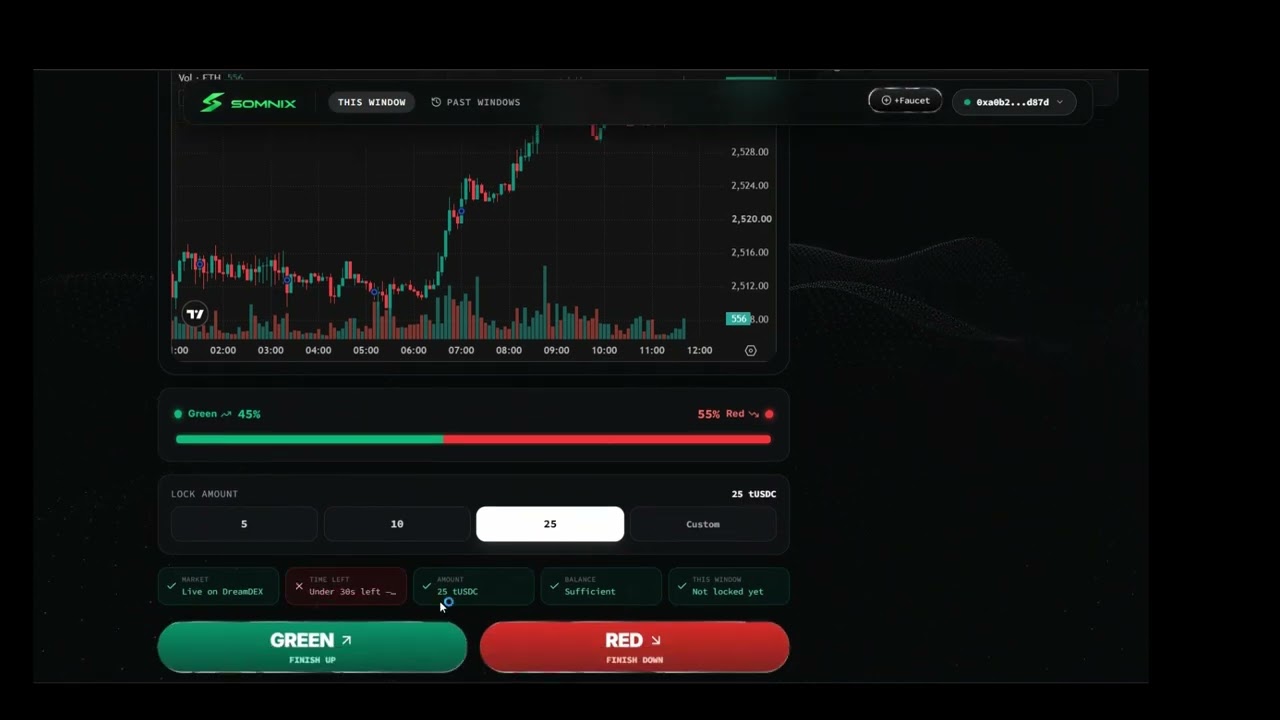
Lock one call for this window. Hide the price. See the result when the timer ends.
Built for the Somnia × DreamDEX Event Contracts Hackathon.
[
](https://youtu.be/XB_I94tpW5c "Watch the video")
Live app: somnix-iota.vercel.app — the full product, including watch mode (no wallet needed to see the core loop).
| 1 tap | to lock a real on-chain position — no order book, no leverage, no chart during the window |
| 133 tests | in CI on every push/PR — lint, typecheck, test, build as four separate jobs |
| 2 real bugs | found and fixed via reproduced testnet transactions this build, not code review alone (see Tested against reality below) |
| 0 fabricated numbers | every price, odds, and payout the UI shows is backed by a live on-chain or indexer read — see the Architecture trust boundary |
git clone https://github.com/davre001/Somnix.git && cd Somnix
pnpm install
pnpm dev                                # http://localhost:3000 — watch mode needs nothing else
pnpm lint && pnpm typecheck && pnpm test && pnpm build   # what CI actually runs
To try a real lock/claim instead of watch mode: connect a wallet on Somnia Shannon testnet, get STT for gas (wallet-menu link) and test collateral (in-app +Faucet), then pick any live BTC/ETH window.
- Watch the demo
- What is SOMNIX
- Tested against reality, not vibes
- The problem
- The solution we offer
- Architecture
- How SOMNIX integrates with DreamDEX & Somnia
- Honesty: limitations
- How to run
- Roadmap
- Attribution
SOMNIX is a scalp-style directional prediction game built on top of DreamDEX Event Contracts on Somnia. Every short window (1 minute up to 1 hour), DreamDEX already runs a simple on-chain market:
- Green (Up) — the coin finishes at or above the price when the window started
- Red (Down) — the coin finishes below that start price
SOMNIX turns that market into a single decision, not a trading screen. You pick BTC or ETH, choose Green or Red and a stake, and tap once. Your stake buys the real outcome token on-chain, priced live by the order book. Then the price disappears until the window ends — so you stop refreshing the chart. Come back at 0:00 to see if you were right, and claim if you won.
No order book to read. No leverage. No exchange jargon. You can only ever lose what you put in.
Two real bugs in this build were found by reproducing a transaction against a live testnet wallet and a live order book — not by reading the code and deciding it looked right. Both are fixed in the current code; the numbers below are what the unfixed version actually did, captured from real runs.
Bug 1 — a claim that could never succeed. frontend/scripts/live-cycle.mjs
(a real, funded testnet wallet, live:-prefixed so it never runs in CI) locked
5 tUSDC on a real BTC 1h window (fill price 0.843, tx 0x5ade91...), the
window resolved Green on-chain, and the position was claimed for a real payout
(tx 0xbd67ef...) — collateral balance moved 10,000 → 10,000.965 tUSDC,
exactly the expected 1:1 redemption. Getting that claim to succeed at all
surfaced a real bug first: the SDK's unified exchange.redeem() resolves a
market through its live-markets registry, which excludes already-resolved
markets by design — so the original claim path threw "unknown market ref"
on every real claim, no matter how many times loadMarkets() was called
first. Fixed by reading the market directly by id and calling the raw
trader.redeem() instead, bypassing the registry entirely
(exchange.ts#claimWinnings).
Bug 2 — a lock that risked less than it showed. frontend/scripts/verify-order-amount-semantics.mjs
places one real market order against the live SDK's unified createOrder(...)
call and diffs the wallet's real collateral balance before/after. The SDK
treats amount as a token quantity, not collateral. Reproduced twice, on
different days and at different live prices — same conclusion both times:
Wallet: 0xEE993d1C41f74faD3cddAf59E9cdc30b5a80fa42

Placing MARKET BUY: amount=5 on BTC-7990246-06SEP26-2135/tUSDC#YES...
Order result: {
  txHash: '0x4fa81241cc1eeabd71d9d3a661d8aeeae882a5e2b95fbca3bc41456fbaf182bf',
  filled: 5,
  price: 0.602,
  cost: undefined,
  amount: 5
}

--- Collateral (tUSDC) ---
Before: 19998.39 | After: 19995.47 | Spent: 2.920000
Hypothesis A (amount == collateral spent): expected 5, actual 2.920000, match = false
Requesting amount=5 filled exactly 5 tokens and spent $2.92 real
collateral — not $5. (An earlier run at a different live price spent $2.575
for the same amount=5 — the token count matches every time, the dollar
figure never does.) A user who typed "lock $10" was silently risking whatever
10 × price happened to be at that moment, while the UI displayed "Lock
Amount: 10" as if the full $10 were at stake. Fixed by sizing every lock
through the SDK's own quoteBinaryStake (walks the real book so escrow
never exceeds the requested stake) before placing the order
(exchange.ts#lockPosition).
Both scripts are still in the repo and still runnable against a funded
testnet wallet — the claim is falsifiable, not just asserted. See
docs/API_NOTES.md §1/§1a for the full write-up of each,
including the exact SDK behavior that caused them.
People already play the game of "is Bitcoin green this hour?" in their heads. Then they do one of two things:
- Keep opening the chart every few seconds, or
- Open a leveraged trade — and lose more than they meant to.
The question is small. The habit is loud. Normal trading apps make the habit worse, because they never stop showing you the price. The real problem is that you cannot put the phone down.
Lock & Reveal.
- One call per window. You are deciding, not day-trading.
- The price is hidden after you lock — no live chart until the window ends. This is the product; it breaks the refresh habit on purpose.
- A hard cap: the most you can lose is the amount you chose. No leverage, nothing to liquidate.
- Claim is part of the flow. Winnings don't appear by magic — when your side wins on-chain, you claim in one tap, at whatever the live order book actually priced when you locked. Never a fabricated or fixed number.
- Same again on the next window, so you never have to hunt for a new market.
- Watch mode for people who aren't ready to connect a wallet.
- Friend card so a new person understands the same question in one screen.
DreamDEX runs the real market and the real payout rules. SOMNIX is the calm decision layer on top.
The habit SOMNIX is fighting doesn't stop at one window, so neither do the protections:
- Session budget — an optional, self-set cap on total collateral locked in one sitting. Once you hit it, locking is blocked until you raise it or reset.
- Loss-streak cooldown — after 3 losses in a row, the next lock attempt shows a soft, dismissible "take a break?" prompt instead of firing immediately. It's the one feature here that works against short-term volume on purpose.
- Structured pre-lock checklist — every gating condition (live market, time left, amount, balance, session budget, duplicate window) shown at once, not a single disabled button with a vague tooltip.
| Screen | Role |
|---|---|
| Home — "This window" | Coin, window length, time left, live Green/Red odds, amount buttons, and the two big Green/Red buttons. Understand the question and lock a call. |
| Locked — "Put the phone down" | Your side, amount, and a countdown. No live chart, no live price. This screen is the product. |
| Reveal + Claim — "What happened" | Start price vs. result, win/lose, and a one-tap Claim for winners. Then Same again on the next window. |
| Recents + Share — "How you did" | Your last few windows as a score — wins and losses — plus share a friend card. |
Watch mode uses Home + Recents only — no wallet, no tap, no claim.
SOMNIX is chain-first and ships as one Next.js app — there is no separate backend service.
The single invariant that governs the whole design: a user's real, already-signed on-chain action must never become invisible to the app, and the UI never shows a currency label, live-market status, or payout number that isn't backed by a real on-chain or indexer read.
There are three distinct access paths inside the one app, each with a different trust level:
- Browser SDK client (
frontend/src/lib/exchange.ts) — the only piece that moves money. ASomniaMarketsinstance bound to the user's ownviemwalletClient. Locking, claiming, and resolution checks all go through it, talking directly to the DreamDEX indexer and Somnia RPC from the browser. This can never move server-side: it needs a signature only the user's wallet can produce. - Server display proxy (
app/api/markets/*,lib/server/dreamdex.ts) — unauthenticated, read-only. Reads the DreamDEX indexer for pre-trade display (market list, odds preview) without CORS/rate-limit pain. Never consulted before a signature; the client always re-checks on-chain state right before a tap, because a stale cached list must never authorize a spend. - Server history mirror (
app/api/lock/*,app/api/claim/*, Turso-backed; posted fromlib/history.ts) — receives a report only after the browser already holds a confirmed on-chain result, and every write is verified against a real receipt (lib/server/chainVerify.ts) and a well-formed wallet address (lib/server/validators.ts) before being stored. Holds no funds, no keys, no accounts, and gates nothing.
docs/API_NOTES.md is the source of truth for the endpoint-by-endpoint API
surface and every external dependency's measured failure modes.
frontend/
  src/
    app/
      api/                       # Route handlers (display proxy + history mirror only)
        markets/                 #   read DreamDEX indexer for display
        card/                    #   render the friend/share card image
        lock/, claim/            #   mirror a client-confirmed action into Turso
      trade/, locked/, reveal/, recents/   # The four pages
      layout.tsx, page.tsx, globals.css
    components/                  # UI — LandingPage, WalletModal, LockChecklist,
                                  #   SessionBudget, LossStreakPrompt, RecentsList, ...
    lib/
      exchange.ts                # Browser SDK client — the ONLY piece that moves money
      somnia.ts                  # Chain config + collateral token reads
      marketService.ts           # Local persistence: pending-lock intents, recents, session budget
      history.ts                 # Fire-and-forget POSTs to the history mirror
      useSomnix.tsx              # Thin context composing the hooks below
      hooks/
        useWallet.ts              #   provider connection, network switch, faucet
        useMarket.ts               #   window selection + live (WebSocket) market feed
        useLock.ts                 #   lock validation, execution, session budget, reconciliation
        useClaim.ts                #   claim lifecycle + recents / loss-streak history
      server/
        dreamdex.ts               # Server-side indexer read (display proxy only)
        chainVerify.ts             # Verifies a reported tx really confirmed on-chain
        validators.ts              # Strict wallet-address validation for the history mirror
        rateLimit.ts               # Per-IP, per-route rate limiting for app/api/*
        tursoStore.ts              # Turso (libSQL) persistence for the history mirror
  .env.example
docs/
  API_NOTES.md                   # Measured behavior of every external API
  DREAMDEX_AND_SOMNIA.md         # Protocol/integration reference
  LIMITATIONS.md                 # What's explicitly not handled yet
  THREAT_MODEL.md                # Trust boundaries, key-compromise analysis
- App: Next.js 16 + TypeScript (strict), Tailwind CSS v4, framer-motion.
- Chain: Somnia Shannon testnet (Chain ID
50312),viemfor wallet + RPC. - Markets:
@somnia-chain/markets-sdk, pinned to an exact version (0.28.1, not a caret range — a young SDK deserves a deliberate bump, not a silent one) — Event Contracts (Up/Down windows) and the DreamDEX Hasura indexer for listing. Live odds and market state ride the SDK's own WebSocket tail straight to Somnia's chain RPC (watchMarkets), not REST polling. The testnet chain and contract addresses are imported straight from the SDK (somniaShannon,SOMNIA_TESTNET_ADDRESSES), not env vars. - Persistence: Turso (libSQL over HTTP) for the read-only history mirror.
- 133 tests across lib, hooks, and components (React Testing Library), including a full mocked-SDK lock → resolve → claim integration test — run in CI on every push and PR, not just locally.
- Four independent CI jobs (
lint,typecheck,test,build) —.github/workflows/ci.yml— a green check means the whole app actually builds and passes, not just one slice of it. - Per-IP rate limiting on every state-changing and read API route.
- Every external dependency's measured (not assumed) behavior — including
real indexer failure modes reproduced against live testnet — is written down
in
docs/API_NOTES.md, with known gaps kept current indocs/LIMITATIONS.mdrather than left for a reviewer to find.
flowchart TD
    subgraph User["👤 User"]
      W["Browser wallet<br/>(Somnia testnet)"]
    end

    subgraph App["SOMNIX — one Next.js app"]
      direction TB
      UI["UI / Pages<br/>Home · Locked · Reveal · Recents"]

      subgraph Client["Browser (client-side)"]
        EX["lib/exchange.ts<br/>SomniaMarkets bound to walletClient<br/><b>the only piece that moves money</b>"]
      end

      subgraph Server["app/api/* route handlers"]
        PROXY["Display proxy<br/>lib/server/dreamdex.ts<br/>(read-only, pre-trade display)"]
        MIRROR["History mirror<br/>lib/server/chainVerify.ts<br/>+ tursoStore.ts"]
      end
    end

    subgraph Chain["⛓️ Somnia + DreamDEX"]
      RPC["Somnia RPC<br/>(sub-second finality + live WebSocket tail)"]
      IDX["DreamDEX Hasura indexer"]
      EC["Event Contracts<br/>(Up/Down windows, oracle settle)"]
    end

    DB[("Turso<br/>history only")]

    %% Display path (no signature)
    UI -->|"pre-trade display"| PROXY
    PROXY -->|"list windows + odds"| IDX

    %% Money path (client signs)
    UI -->|"tap Green / Red · Claim"| EX
    W -->|"signs tx"| EX
    EX -->|"re-check window open,<br/>buy Up/Down (IOC), redeem"| EC
    EX -->|"live WebSocket tail:<br/>odds, order book"| RPC
    EX -->|"balances, tx receipts"| RPC
    EX -->|"registry, resolution details"| IDX

    %% History mirror (after confirmation)
    EX -.->|"report confirmed result"| MIRROR
    MIRROR -->|"verify receipt on-chain"| RPC
    MIRROR --> DB

    IDX -.->|"indexes"| EC
What DreamDEX does vs. what SOMNIX does:
| What you see | What DreamDEX is doing |
|---|---|
| "BTC this hour" | A live Up/Down window for BTC |
| Timer | Official end time of that window |
| 58% Green | Price on the live order book (a number between 0 and 1) |
| You tap Green / Red | The app sizes a real stake against the live book and buys Up / Down for you, right now (IOC — fill now, leave no resting order) |
| Locked call | You hold a result token for that window |
| Window ends | DreamDEX's oracle compares the real end price to the start price |
| Claim | The app redeems your winning tokens back into your funds, 1:1 |
| Same again | The app loads the next live window for that coin and length |
SOMNIX does not build its own betting system — it uses DreamDEX Event Contracts for the real bets, real prices, and real win/lose rules. The indexer is a display convenience; on-chain state is always re-verified on the client right before any spend.
Stated plainly, not left for a reviewer to find:
- Testnet only. SOMNIX runs on Somnia Shannon testnet (chain
50312), not mainnet — Event Contracts themselves aren't on mainnet yet. - No real settlement/closing price is available from this venue's oracle.
The SDK exposes
openingAnswer/closingAnswerfor exactly this, but both came backnullon every one of 11 real samples checked. RevealPanel shows "—" for Settlement Price rather than fabricate one — win/lose is still decided correctly by the real on-chainwinningOutcome, never by a price comparison in this app. - History (Recents) is local-only, per-device. A pending-lock intent is reconciled against the real chain the next time a signer binds on this browser — a user who never reopens SOMNIX on the same device after a dropped connection won't see it recovered in the UI, even though the on-chain position itself is fine.
- The backend history mirror doesn't re-derive exact fill numbers from
the chain — it verifies the transaction is real and sent by the claimed
wallet, not that the reported
filledAmount/fillPriceexactly matches the decoded fill. The UI now labels this "self-reported" in Recents. This never affects a real claim, which always re-checks the live chain. - Rate limiting is in-memory, per-instance, not distributed — bounds a single serverless instance against naive hammering, not a coordinated attack across instances.
- The DreamDEX indexer has measurable, intermittent latency/outages —
reproduced directly against the live indexer this build (a plain market
query timing out with a
504while the same endpoint answered a trivial query in under a second). This is an external dependency's behavior, not something this app controls; it's why lock/claim errors are surfaced as an honest "try again shortly" rather than swallowed or retried silently.
Full detail on every gap above, plus what's explicitly not defended against,
in docs/LIMITATIONS.md and
docs/THREAT_MODEL.md.
git clone https://github.com/davre001/Somnix.git
cd Somnix
pnpm install
cp frontend/.env.example frontend/.env.local   # Turso vars for the history mirror (optional for local dev)
pnpm dev                  # http://localhost:3000

# Required checks
pnpm lint && pnpm typecheck && pnpm test && pnpm build
Only NEXT_PUBLIC_DREAMDEX_INDEXER_URL (public, defaults to the real testnet
indexer) is a client-side value; TURSO_DATABASE_URL / TURSO_AUTH_TOKEN
(server-only) back the history mirror. To run a real end-to-end lock and claim
you'll also need a browser wallet on Somnia testnet, STT for gas (the wallet
menu links Somnia's official faucet), test collateral (the in-app +Faucet
button), and at least one live BTC or ETH window. Watch mode needs only the
app and a live window — no wallet.
- A public leaderboard on top of the session-budget / loss-streak data that already exists — "best streak this week," display-only, still backed by on-chain reads. The natural next step after the guardrails above.
- More assets and window lengths beyond BTC/ETH as DreamDEX lists them, surfaced automatically from the live registry rather than hard-coded.
- Richer friend cards — animated, per-result share cards and deep links that drop a friend straight onto the exact window you called.
- Push-style reveal reminders so you get a nudge exactly at 0:00 instead of having to remember the window yourself.
- Mainnet readiness once Event Contracts move to Somnia mainnet — the chain-first architecture already keeps money strictly client-side, so the path is a network switch plus a hardening pass, not a rewrite.
- Deeper accessibility and i18n so the "one calm decision" experience reads the same for everyone.
Protocol — DreamDEX Event Contracts
run the real markets, prices, and settlement; SOMNIX builds none of that
itself. Accessed via @somnia-chain/markets-sdk.
Chain — Somnia Shannon testnet.
Framework — Next.js (MIT), React (MIT), Tailwind CSS (MIT), viem (MIT).
Persistence — Turso (libSQL) for the read-only history mirror.
Agent — built with Claude Code, including the empirical bug-finding described in Tested against reality above.
See docs/LIMITATIONS.md for what is explicitly not
handled yet, and docs/THREAT_MODEL.md for trust
boundaries.