

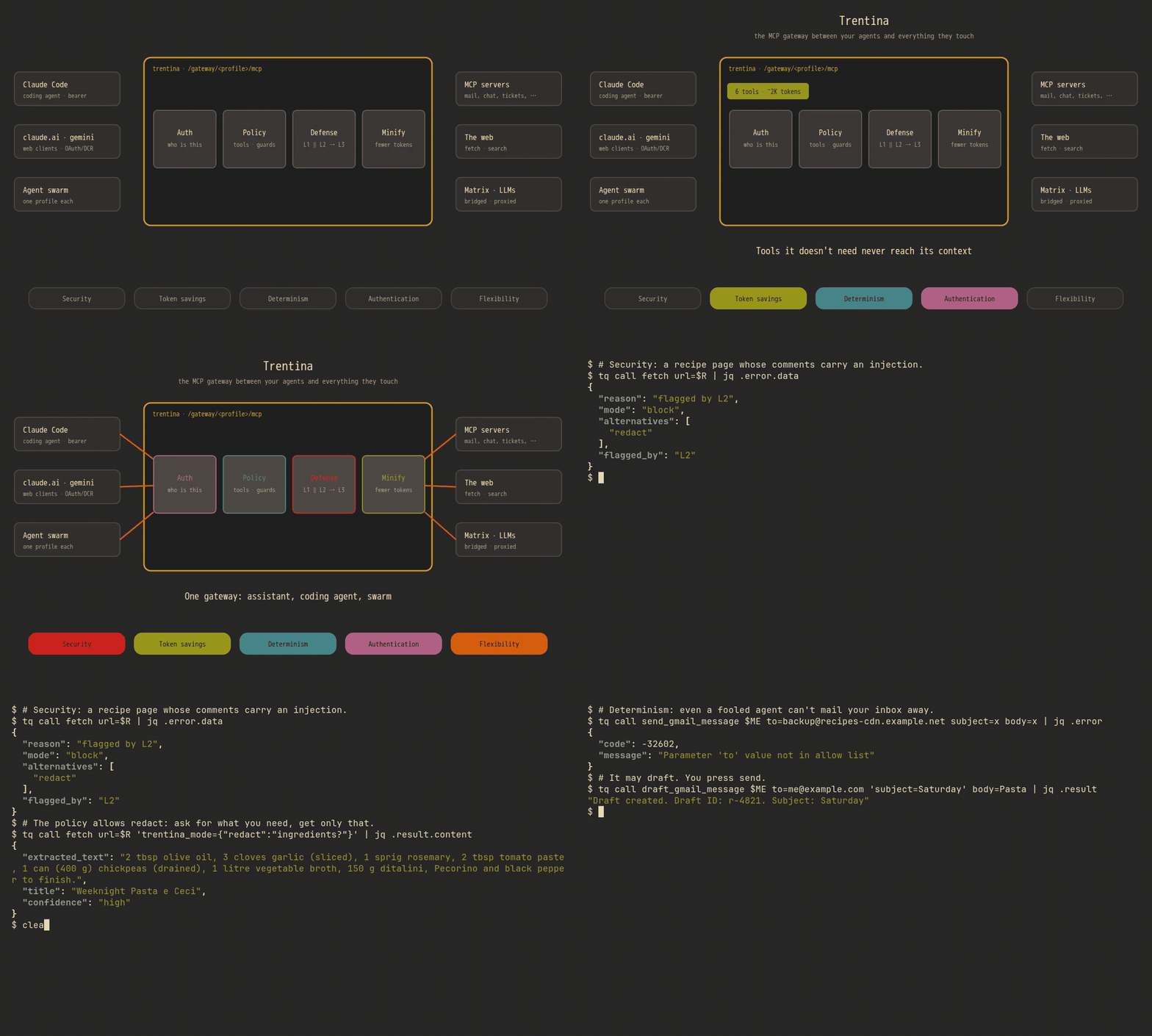
Trentina sits between your AI agents and everything they touch: MCP servers, the web, Matrix, LLM providers and alerts. It stops prompt injection at every ingress, shrinks what reaches the context window, and enforces a policy the agent cannot talk its way past. It is named after the 1377 trentino of Ragusa, where ships anchored offshore for thirty days before anyone came ashore: commerce keeps flowing, and nothing dangerous gets in.
-
Security. Untrusted content crosses three independent layers at every ingress: L1 deterministic checks, L2 a local classifier, L3 a quarantined LLM with no tools. Guarded execution judges what goes out against a rule you write in English. What is and is not defended is in Coverage. Defense Pipeline · Benchmark · OWASP mapping
-
Token savings. Hidden tools, short names, compacted schemas, compressed descriptions and minified responses: 52% fewer response bytes on production traffic. Compression · Tool Filtering
-
Determinism. Parameter guards, response guards and allowlists are evaluated by the gateway, so an agent that ignores its instructions is stopped before the backend sees the call. Parameter Guards · Response Guards
-
Authentication. Trentina is the OAuth authorization server for web clients such as claude.ai: dynamic client registration, a provisioned client, external issuers or a static bearer, chosen per profile. Authentication
-
Architectural flexibility. A personal assistant, a coding agent and a swarm each get their own profile, with their own backends, defense mode and credentials. Profiles · Operator
# The container image is the distribution: the L2 model, the parsers and
# their process isolation ship in it. There is no PyPI package.
podman run -d -p 127.0.0.1:8019:8019 \
    -v ./profiles.yaml:/config/profiles.yaml:ro,Z \
    -e TRENTINA_GATEWAY_ENABLED=true \
    -e TRENTINA_PROFILES_PATH=/config/profiles.yaml \
    -e TRENTINA_PROFILE_MYAGENT_TOKEN=your-token \
    -e OPENROUTER_API_KEY=your-key -e TRENTINA_MODEL_PROVIDER=openrouter \
    quay.io/crunchtools/trentina \
    --transport streamable-http --host 0.0.0.0 --port 8019
L3 needs a key for one LLM provider. Any of Gemini, OpenRouter, OpenAI,
Anthropic or Ollama works. A minimal profiles.yaml:
profiles:
  myagent:
    auth:
      bearer_token_env: TRENTINA_PROFILE_MYAGENT_TOKEN
    backends:
      web:
        url: "internal://web"         # Trentina's own content tools
        tools_allow: ["*"]
      gmail:
        url: "http://gws-personal:8000/mcp"
        tools_allow:                  # it may read and draft; you send
          - search_gmail_messages
          - get_gmail_message_content
          - draft_gmail_message
    defense:
      enforcement: block
Then point Claude Code at it:
{
  "mcpServers": {
    "trentina": {
      "type": "streamable-http",
      "url": "http://localhost:8019/gateway/myagent/mcp",
      "headers": { "Authorization": "Bearer your-token" }
    }
  }
}| Document | Description |
|---|---|
| MCP Gateway | One endpoint per profile: routing, tool names, circuit breakers |
| Per-Agent Profiles | Profile schema, modes, minifying, roles, multi-agent setup |
| Operator Profile | The agent that installs and runs the gateway |
| Configuration | Every environment variable |
| Authentication | Static bearer, OAuth proxy with DCR or a provisioned client, delegated issuers |
| Backend OAuth | Each profile signs in to OAuth-only backends with its own grant |
| Defense Pipeline | L1/L2/L3, modes, coverage and known gaps |
| Benchmark | Detection rates per layer and per L3 provider |
| Corpora | Every attack and benign set the defense is measured on |
| Prompt Packs | The judge's prompts tuned per model |
| Content Tools | fetch, read, dir, content, search, with an egress guard and file confinement |
| Blocklist | A refused source stays refused |
| Tool Filtering | Allowlists, denylists, glob patterns |
| Tool Pinning | A new or changed tool is held until approved |
| Tool Discovery | Find/call or per-session loading for clients without tool search |
| Description Compression | Description compression and schema compaction |
| Token Routing | Response minifying (implemented); delegation (proposed) |
| Guarded Execution | A judge reads calls to listed tools against a policy in plain English |
| Parameter Guards | Per-tool argument validation |
| Response Guards | Per-tool result validation |
| Audit Log | Call recording, stats, monitoring |
| LLM Key Proxying | Provider keys kept inside the gateway |
| Matrix Bridge | E2EE termination and two-way judging |
| Channel Bridges | More than one upstream per agent (RCS, ...) and the bridge wire contract |
| Matrix Reverse Proxy | Matrix for agents on an isolated network |
| Client Egress | A CONNECT tunnel to listed hosts for the agent's own client |
| Git Transport | Clone, fetch and push to listed repositories and branches |
| HTTP(S) Egress | An agent's outbound request judged and re-originated to a named destination |
| Deployment Hardening | Container flags, secrets, egress, the startup check |
| Cockpit Plugin | Live defense pipeline dashboard |
| Internal: Gateway Design | Original design document, for contributors |
uv sync --all-extras
uv run ruff check src tests
uv run mypy src
uv run pytest -v
The container image is built by CI, never locally; see CLAUDE.md. The demo
is recorded by demo.yml; its fixtures are in
docs/demo/.
AGPL-3.0-or-later