Rumore is a lightweight Python library for procedural noise. It provides value noise and gradient noise in 1D/2D/3D plus octave summation of these (fractal Brownian motion, fBm).
The library does not implement Ken Perlin’s original algorithm directly, but its gradient noise produces visually similar results.
pip install rumore
Clone the repo, navigate to the directory and from there
pip install -e .
Import necessary stuff
import matplotlib.pyplot as plt
import numpy as np
import rumore

rumore.set_defaults()
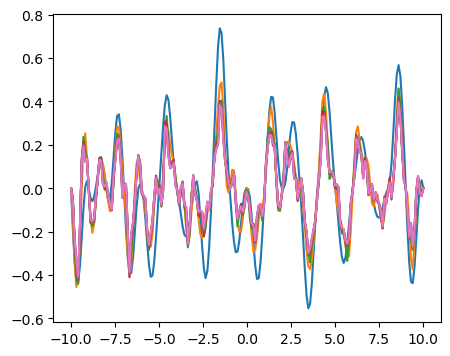
Generate some 1d gradient noise with different number of octaves
x = np.linspace(-10, 10, 200)
plt.figure(figsize=(5,4))
for i in range(1, 8):
    plt.plot(x, rumore.grad_noise(x, octaves=i))
plt.show()
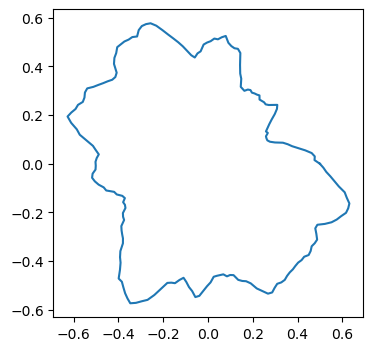
Perturb points along a circle with 2d noise
t = np.linspace(0, np.pi*2, 200)
x = np.cos(t)
y = np.sin(t)
r = rumore.grad_noise(x, y)*0.5+0.5
plt.figure(figsize=(4,4))
plt.plot(x*r, y*r)
plt.show()
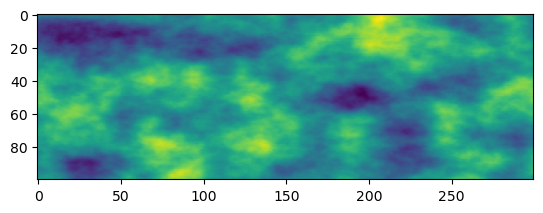
Generate a grid of 2d noise value (a grayscale image)
x = np.linspace(0, 5, 300)
y = np.linspace(0, 3, 100)
img = rumore.noise_grid(x, y)
plt.imshow(img)
plt.show()
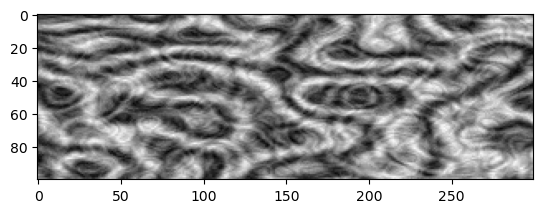
Set noise properties. Here we set the octave_map property, defining a function that is applied to the noise of each octave.
Note that in a notebook these states are persistent, which can give unexpected results. You can reset everything by using rumore.set_defaults().
rumore.cfg.lacunarity = 2.0
rumore.cfg.falloff = 0.5 # falloff for each octave (persistence)
rumore.cfg.set_degree(5) # Interpolation degree (3 or 5)
rumore.cfg.shift = 0 #120.321 # Shift between octaves
rumore.cfg.octave_map = lambda x: np.sin(x*np.pi*4)

x = np.linspace(0, 5, 300)
y = np.linspace(0, 3, 100)
img = rumore.noise_grid(x, y)
plt.imshow(img, cmap='gray')
plt.show()