Eight peers you picked will beat two hundred you did not.
Bitcoin Lab watches which of your Bitcoin Core peers actually deliver each new block first, keeps the ones that prove themselves, and — if you want it — times how quickly mining pools turn those blocks into fresh work.
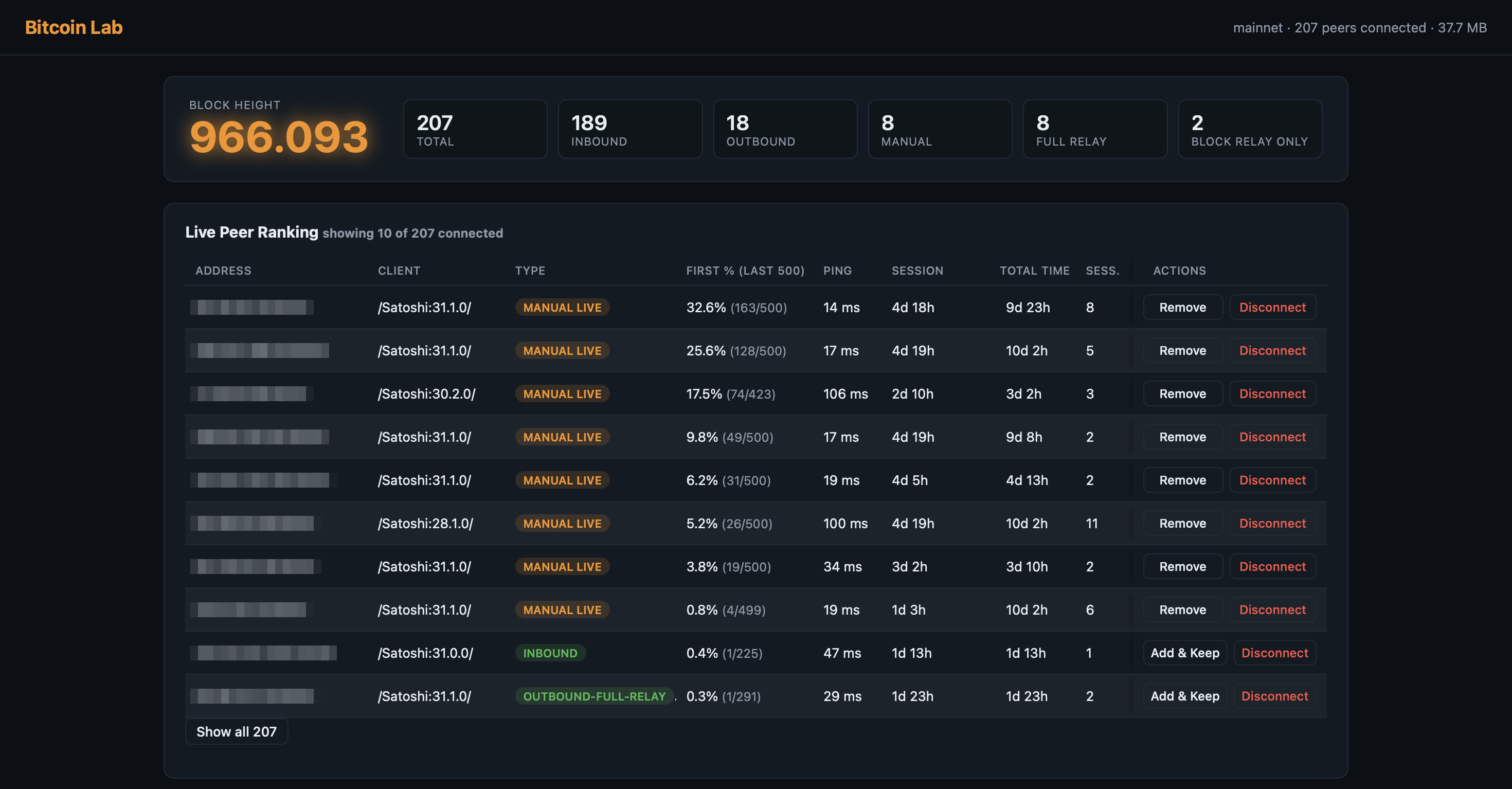
Over the last 500 blocks on my node:
| Who delivered the block first | Share |
|---|---|
| the eight manual peers Bitcoin Lab picked | 90% |
| Bitcoin Core's own ten outbound connections | 3% |
| around 190 inbound peers, none of them chosen by me | 7% |
Two hundred connections, and eight of them do the work. That is one node over 2,207 blocks rather than a benchmark — what one node measured has the rest of the numbers, and the machine they came from.
Three moves follow from it: keep a peer that delivers, drop one that never does — Core hands you a fresh random peer in its place, which is the engine of the whole thing — and protect the ones you chose yourself. A switch on the dashboard makes all three for you every ten minutes, and it stays off until you ask for it.
Umbrel. Bitcoin Lab ships as an Umbrel Community App. The Bitcoin Peer Lab store has the store URL and the steps — and, beside it, Peer Map, which puts the same peers on a world map and says what kind of software each one runs. Neither needs the other.
It needs Umbrel's Bitcoin Node app and reaches it only over RPC and ZMQ. It
never touches bitcoin.conf, wallet data, block data, or any other state Core
depends on. The dashboard is then at <your-umbrel>:8790.
Anywhere else. A Docker Compose stack — see docs/install.md.
| What one node measured | the numbers, and the machine behind them |
| Is it worth it? | the solo-mining case, and when there is none |
| How a peer is judged | ZMQ timing, First and Eligible, the Wilson bound |
| What you can do about it | the three moves, and the eight slots Core never uses |
| Peer rotation | the loop, and why every threshold is where it is |
| Stratum Race | timing your own pool against the public ones |
| Architecture | four processes, one SQLite file, what it costs to run |
| Configuration | every environment variable |
| Known limitations | what this does not measure and cannot tell you |
| Security | what it can reach, and how to report something |
MIT — see LICENSE.