The increasing number of refugees due to natural and man-made disasters presents significant challenges, particularly in ensuring the safe and efficient distribution of food in refugee camps. Panic-driven motion during food distribution often leads to overcrowding, collisions, and fatalities.
In this study, we model the food distribution process using a crowd dynamics framework to analyze how movement patterns contribute to injuries and deaths. Our simulations show that as food distribution begins, refugees rush toward the food distribution point, leading to high-density congestion and dangerous interactions.
We explore strategies to mitigate these risks by introducing fixed obstacles near the food distribution point. The results demonstrate that:
- A single obstacle can reduce fatalities by approximately 15%.
- An optimized two-obstacle configuration achieves up to a 70% reduction in deaths.
Additionally, we examine the impact of varying obstacle parameters—such as size, placement, and gap distance, and discuss their effects on crowd flow. The findings suggest that strategic obstacle placement can significantly improve safety, offering a practical and low-cost intervention for refugee camps.
Future work could explore additional measures, such as increasing the number of food distribution points, to further enhance efficiency while addressing logistical constraints.
This project is based on our research work that investigates Crowd dynamics and obstacle-based safety strategies for food distribution in refugee camps.
You can read the paper here:
👉 A simple model for panic driven motion in a refugee camp∗ (PDF)
Watch our crowd evacuation simulations with different obstacle configurations:
|
|
|
|
|
|
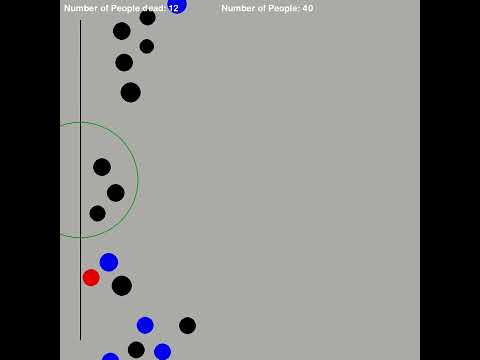
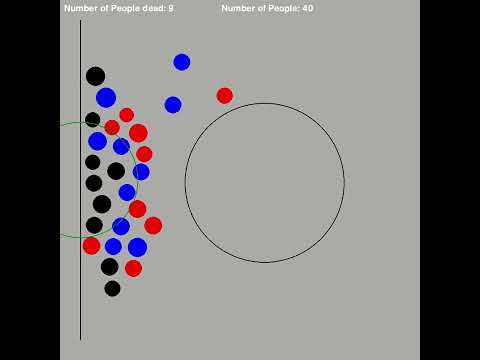
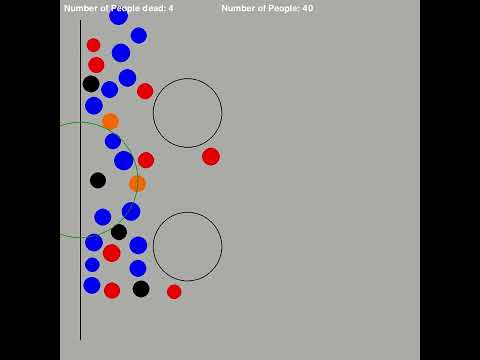
This project is adapted from the original simulation code by fschur:
Evacuation-Bottleneck — https://github.com/fschur/Evacuation-Bottleneck/tree/master
We extended and modified the base implementation to model food distribution dynamics in refugee camps, including circular obstacles, agent status tracking (alive/waiting/escaped/dead), pressure-based death, and data collection for batch experiments.
All code files are located in the this directory. Below is an overview of each file and its functionality:
| File | Description |
|---|---|
running_code.py |
Main script executed in the terminal. Initializes an instance of the Simulation class. |
Simulation_class.py |
Coordinates the entire simulation and manages saving results. Contains instances of Integrators, Room, and diff_equation. |
Integrators.py |
Handles the numerical integration of the simulation. |
Room.py |
Defines all room configurations for simulation tests. |
diff_equation.py |
Implements the differential equations governing the forces on agents. Used within the Integrators class. |
steps_function_quit.py |
Responsible for visualizing the simulation and generating related graphs. |