This is a lightweight, Python-based utility that analyzes Linux systems by reading uname and /proc to accurately determine the running kernel version and configuration details.
The tool automatically queries vulnerability databases, such as CISA KEV, CVE Details and cve.org, scrapes and parses CVE entries, and correlates findings to the exact kernel release.
Results are filtered to highlight kernel-related CVEs and prioritize those with known exploits or public disclosures.
The tool performs automated checks to verify the presence of public exploit code or proof-of-concept repositories, aggregates relevant links, and maps vulnerabilities to their CWE classifications.
The output includes a comprehensive, machine-readable JSON report and a user-friendly HTML report with direct links to advisories, exploit sources, CVE pages, and CWE references, making it easy for administrators to assess real risk and plan remediation.
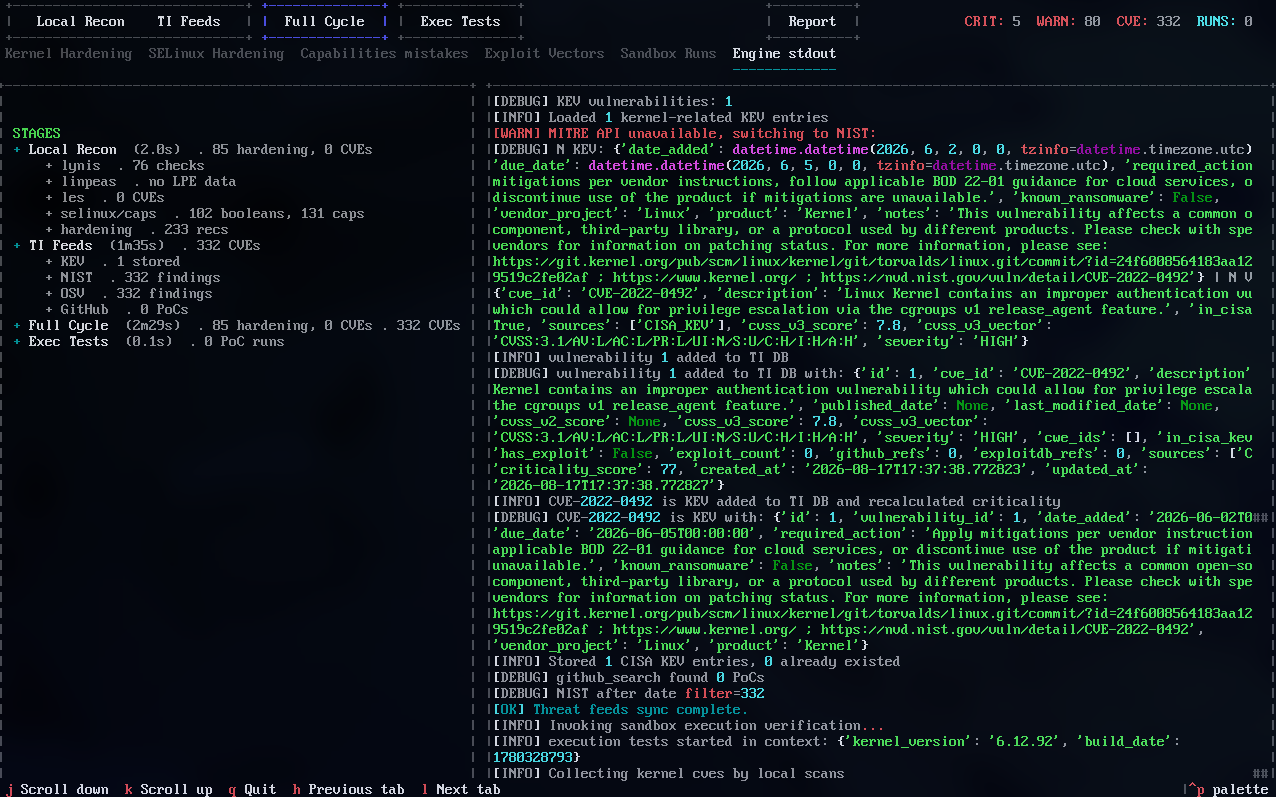
The flake.nix bundles the app plus all recon tools and the QEMU sandbox. But the app uses the QEMU microvm scenario only.
nix run .#gui            # Textual TUI
nix run .#cli            # CLI minimal quick-start menu
nix run .#report         # report (web/Streamlit if available, else CLI)
nix build .#default      # installable package (kishirika-cli/-gui/-report)
The flake is pinned via flake.lock for reproducibility.
git clone https://github.com/YarBurArt/KernelVulnAuditP.gitcd ./KernelVulnAuditPinstall temporary dependencies (only for the non-Nix path; the Nix package already bundles lynis/LES/linpeas and the QEMU sandbox tools)
chmod u+x ./install_tools.sh./install_tools.shrun the terminal UI (Textual TUI; auto back to CLI if missing)
uv run python main.pyforce CLI with quick-start menu
uv run python main.py --cligenerate report (Streamlit if available, else CLI + JSON)
uv sync --extra streamlit   # optional: web report (streamlit)
uv run streamlit run report.py
force CLI report
uv run python report.py --cli Long-running operations (local recon, threat-intel feeds, CISA KEV import, PoC execution) show a live progress bar on a terminal; output stays clean when piped.
| flag | description | notes |
|---|---|---|
--cli / --gui |
force CLI or the Textual TUI | TUI needs no extra deps; --cli with no command prints a quick-start menu on a TTY |
--full-poc-tests |
full audit: scan + sandbox PoC tests | runs local recon + feeds + KEV + sandbox execution, then writes the report (see -o/--format) |
--scan, -s |
run local recon + threat‑intel feeds in one shot | uses uname, /proc, Lynis, LinPEAS, LES, OSV, NVD, GitHub search with KEV filters |
--local, -l |
local recon only | uname/proc, Lynis, LinPEAS, LES, SELinux/capabilities hardening |
--feeds, -f |
threat-intel feeds only | NIST / OSV / GitHub PoC search |
--report, -r |
build the full report and save it | prints to stdout unless -q; saved per -o/--format |
--exec-tests |
fetch PoCs, compile/run them in the sandbox | uses virtme-ng/QEMU microvm to isolate; respects ALLOW_HOST_EXECUTION; add -o/--format to also emit a report |
--output, -o PATH |
report output path | default report_data.<format> in the current directory; a missing extension is appended from --format |
--format txt / json / yaml |
report output format | default txt; the txt report mirrors the CLI/Streamlit view, json/yaml are machine-readable |
--quiet, -q |
save the report without printing it to stdout | keeps errors on stderr; disables progress bars; ideal for scripts |
--sandbox-runs, -b |
list sandbox runs stored in the DB | grouped per CVE |
--list-kev |
print CISA KEV entries already in the DB | limit 50, shows ransomware flag |
--settings / --set KEY=VALUE |
show / change config values | e.g. --set ISOLATION_TIMEOUT_SEC=30 |
--verbose, -v |
show top items from NVD/OSV/GitHub queries | helpful while tuning kernels |
--save |
persist scan results to the selected DB backend | honor --db |
--db orm / memory |
pick the SQLite ORM helper or in‑memory cache | defined in config.py |
Report logic lives in the report/ package (base_report.py for data building, cli.py, streamlit_rep.py, diff.py); report.py is kept as a thin entry shim so the commands below still work.
| flag | description | notes |
|---|---|---|
--verbose, -v |
include top items from each section in CLI renderer | |
--save, -s |
save the report to the --output path |
saving happens by default for the CLI/--format paths |
--output, -o |
report output path | default report_data.<format> |
--format txt / json / yaml |
report output format | default txt; reuse of the data seen in the Streamlit view |
--quiet, -q |
save the report without printing it to stdout | |
--load, -l |
render a previously saved report instead of live DB | skips fresh scans; honors --format/-o/-q too |
--cli |
force CLI output | default already when streamlit isn't installed |
config.pyexposesALLOW_HOST_EXECUTION(disable to force virtme-ng / microvm isolation),ISOLATION_TIMEOUT_SEC, and paths to Lynis, LinPEAS, LES outputs.- The default micro-VM uses
virtme-ng --quiet --memory 512Mon top of QEMUmicrovmmachine type; adjust inisolate.pyif you want let less or more RAM/CPU.
-
./install_tools.sh [OUTPUT_PATH]clones Lynis and LES intolib_tools/, then builds a kernel-focused LinPEAS script via the PEASS builder; pass a custom script path if you don’t wantlib_tools/linpeas_kernel.sh. -
config.pydefaults already point atlib_tools/, so no path edits are needed after the script runs; overridePATH_LINPEAS/LES_PATH/LYNIS_BINARYif you keep the tools elsewhere. -
uv run python main.py --scan --save --db ormgives the most complete run (DB persistence + feeds);--exec-testswill trigger sandboxed PoC execution, so keepALLOW_HOST_EXECUTION=Falseunless you accept host risk. -
uv run python report.py --save --output report_data.jsonwrites the JSON before rendering; add--verbosefor more lines in CLI mode. -
--full-poc-testsruns the whole flow (local recon, feeds, KEV import, sandboxed PoC execution) and then builds the report from the same data the Streamlit view shows (what is vulnerable and why, why a PoC did not run, deduplicated links to sources/references). -
-qkeeps stdout clean; progress bars are disabled, errors still go to stderr and exit codes are non-zero on failure. -
Replace
--format jsonwithyamlfor a diff-friendly report, or drop--formatfor the defaulttxtand drop-qto page the report on the terminal.
Edit the file and re-run. Full reference:
| setting | default | notes |
|---|---|---|
DB_BACKEND |
orm |
orm / memory (SQLite / in-memory); orm is recommended |
LOG_LEVEL |
DEBUG |
verbosity of logs/kernel_audit.log |
CISA_KEV_URL |
CISA KEV feed URL | known-exploited-vulnerabilities JSON |
CISA_KEV_PATH |
known_exploited_vulnerabilities.json |
where the KEV feed is cached |
CVEORG_BASE_URL |
https://cveawg.mitre.org/api/cve/ |
CVE lookup API base |
GITHUB_URL / GITHUB_API_URL |
GitHub search URLs | PoC/repo search patterns |
NIST_API_URL |
NVD REST API (CPE query) | CPE pinned to the running kernel |
NIST_CVE_DETAILS_API_URL |
NVD REST API (CVE query) | per-CVE detail lookups |
OSV_API_URL |
https://api.osv.dev/v1/query |
OSV query endpoint |
CH_API_URL |
https://cdn.kernel.org/.../ChangeLog-{version} |
kernel changelog mirror |
REQUIREMENTS_RE / VERSIONS_RE |
regexes | PoC README parsing heuristics |
LYNIS_BINARY |
lynis |
lynis executable (or absolute path) |
LYNIS_REPORT_FILE |
per-process scratch dir | lynis output file |
LYNIS_LOG_FILE |
per-process scratch dir | lynis log file |
LINPEAS_OUT_JSON |
per-process scratch dir | LinPEAS JSON output |
LINPEAS_REPORT_TXT |
per-process scratch dir | LinPEAS text output |
PATH_LINPEAS |
lib_tools/linpeas_kernel.sh |
kernel-focused LinPEAS script path |
POCS_BASE_PATH |
lib_tools/pocs |
where PoCs are cloned/staged |
LES_PATH |
lib_tools/linux-exploit-suggester/linux-exploit-suggester.sh |
Linux Exploit Suggester script |
LES_REPORT_PATH |
per-process scratch dir | LES output file |
ISOLATION_TIMEOUT_SEC |
20 |
per-command timeout inside the micro-VM |
ALLOW_HOST_EXECUTION |
False |
True runs PoCs directly on the host (risky); keep False for virtme-ng/QEMU isolation |
Report/log files are written to a private per-process scratch directory (mode 0700, cleaned at exit), so concurrent scans never share reports. Change the lib_tools/... tool defaults if you store the tools elsewhere.
- httpx quickstart: https://www.python-httpx.org/
- virtme-ng manual: https://github.com/arighi/virtme-ng
- QEMU
microvmmachine type: https://www.qemu.org/docs/master/system/i386/microvm.html - Host execution minimal Bubblewrap isolation https://wiki.archlinux.org/title/Bubblewrap
- ... and based on https://man.archlinux.org/man/namespaces.7.en
- SELinux hardening https://access.redhat.com/articles/7047896
- ... and bools from https://github.com/fedora-selinux/selinux-playbooks
- Streamlit docs: https://docs.streamlit.io/
- Lynis auditing tool: https://github.com/CISOfy/lynis
- Linux Exploit Suggester (LES): https://github.com/The-Z-Labs/linux-exploit-suggester
- LinPEAS builder (custom script options): https://deepwiki.com/peass-ng/PEASS-ng/2.3-linpeas-builder-system
- PEASS output parsers (peas2json): https://deepwiki.com/peass-ng/PEASS-ng/6-output-parsers
- Lynis report => JSON converter: https://github.com/d4t4king/lynis-report-converter
- CVE Services API (CVE Project): https://github.com/CVEProject/cve-services
- CISA KEV JSON feed: https://www.cisa.gov/known-exploited-vulnerabilities-catalog (CSV/JSON links on page)
- KernelCI docs: https://docs.kernelci.org/
- SQLAlchemy docs: https://docs.sqlalchemy.org/20/
- Python stdlib
sqlite3: https://docs.python.org/3/library/sqlite3.html
Of course in the future there will be more integrations with various tools and APIs :)
main.py hosts the CLI/Textual TUI and delegates to AppServices for local probes (uname, /proc, Lynis, LinPEAS, LES), threat‑intel pulls (NVD/OSV/GitHub), and sandboxed PoC execution. recon/ supplies the LocalRecon/ReconFeeds helpers that actually talk to the OS and external APIs. sqxpl.py searches for PoCs and stages them for execution tests. isolate/ runs commands inside virtme-ng/QEMU microvm; config.py carries its timeouts and host‑escape. db/ defines the storage interface with adapters for SQLite (ORM) or in‑memory use. gui/ is the Textual terminal UI (scan page with hardening/caps/CVE/sandbox tabs, live progress and the engine stdout console); report/ renders everything through Streamlit or a CLI view, and can save/load JSON snapshots.
This base architecture is not the best and requires many fixes and improvements, but it is enough for a project with a limited time.
- MIT License (see
LICENSE).
- Open an issue with reproduction steps or desired feature.
- Keep changes lintable and small; prefer PRs that isolate one concern.
- Mention DB backend and kernel version when filing bugs about scan/report output.