
Fast, differentiable quantum machine learning in pure Apple MLX.
Statevector simulation runs on the Metal GPU and is differentiable end-to-end
through MLX autodiff — so a quantum layer trains like any other mlx.nn module,
with no custom gradient code. Forward values and gradients match Qiskit to
~1e-6 (float32), and it is ~100–400× faster end-to-end than driving Qiskit's
EstimatorQNN from Python. See Validation for the evidence.
uv add mlx-quantum
# or
pip install mlx-quantum
Requires Python ≥ 3.13 and Apple Silicon. The library depends only on MLX and NumPy; Qiskit is optional and used solely to cross-validate/benchmark.
QuantumLayer is a trainable mlx.nn.Module. Drop it into a model and train:
import mlx.core as mx
import mlx.nn as nn
from mlx_quantum import QuantumLayer

class HybridMLP(nn.Module):
    def __init__(self):
        super().__init__()
        self.pre = nn.Linear(8, 4)
        self.qnn = QuantumLayer(num_qubits=4, reps=2)   # trainable quantum layer
        self.post = nn.Linear(4, 3)

    def __call__(self, x):
        x = mx.tanh(self.pre(x)) * mx.pi                # encode into rotation angles
        return self.post(self.qnn(x))
The quantum weights are ordinary MLX parameters — nn.value_and_grad and any
optimizer update them automatically:
loss_and_grad = nn.value_and_grad(model, loss_fn)
loss, grads = loss_and_grad(model, x, y)
optimizer.update(model, grads)QuantumLayer runs a hardware-efficient ansatz, but the simulator primitives are
public — build any circuit as a plain differentiable function:
import mlx.core as mx
from mlx_quantum import zero_state, apply_1q, apply_2q, expval_all_z, H, ry, CX

def circuit(x, weights):            # x: (batch, n) angles, weights: (n,)
    n = x.shape[1]
    state = zero_state(x.shape[0], n)
    for q in range(n):
        state = apply_1q(state, H, q)
    for q in range(n):
        state = apply_1q(state, ry(x[:, q]), q)          # per-sample encoding
    for q in range(n):
        state = apply_1q(state, ry(weights[q]), q)        # trainable
    for q in range(n - 1):
        state = apply_2q(state, CX, q, q + 1)
    return expval_all_z(state)       # <Z> per qubit, shape (batch, n)

grads = mx.grad(lambda w: mx.sum(circuit(x, w)))(weights)  # just works
Gates provided: H, X, Y, Z, rx, ry, rz, CX, CZ. Add your own — a single-qubit
gate is any (2, 2) complex mx.array; a two-qubit gate is a (2, 2, 2, 2)
tensor [out0, out1, in0, in1].
A statevector is a complex mx.array of shape (batch,) + (2,) * num_qubits;
qubit ordering is little-endian to match Qiskit exactly (qubit 0 is the fastest
index, so flattening reproduces Qiskit's amplitude order). Gates are
applied as einsum contractions, so the entire simulation is differentiable and
GPU-resident. Because there is no custom vjp and no NumPy round-trip, mx.grad
differentiates the circuit directly — including through complex amplitudes.
Two MLX specifics the implementation works around: the initial state is built as a
constant (not an in-place assignment, which compiles to an unsupported complex
GPU scatter), and gates are contractions rather than take/gather (whose backward
is also a scatter).
uv run python examples/simple_mlp.py                             # hybrid MLP training
uv run --extra examples python examples/benchmark_vs_qiskit.py # quick speed + accuracy vs QiskitTwo tracks — is it correct, and is the speed claim fair? All measurements are
noiseless statevector, float32. Regenerate with
uv run --extra examples python benchmarks/validate.py (details in
benchmarks/).
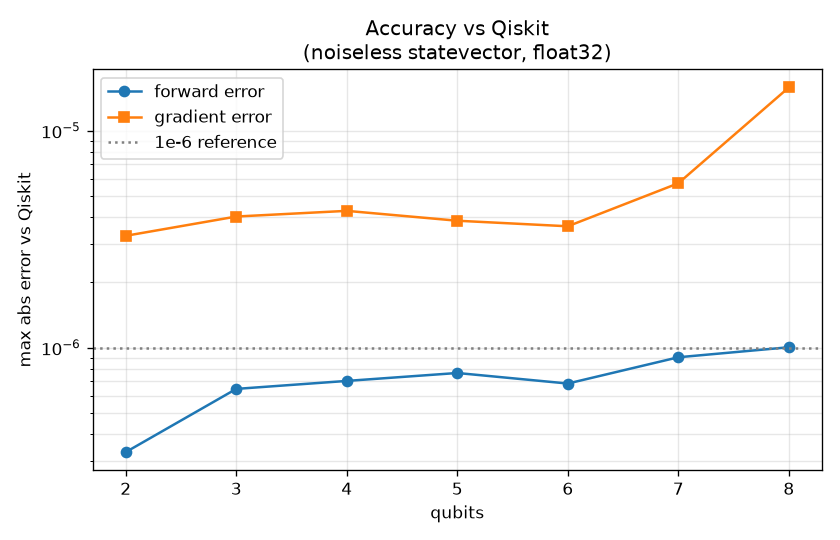
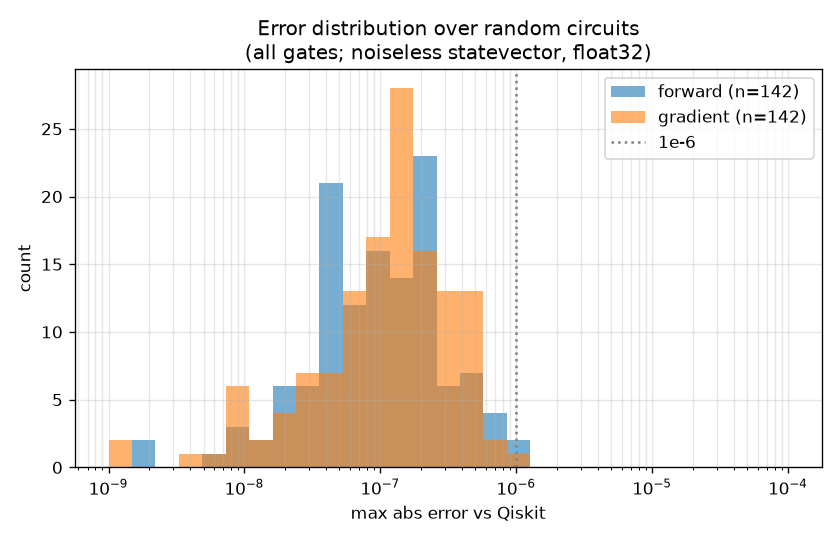
Correctness. Forward values and gradients are compared against Qiskit
(Statevector and ReverseEstimatorGradient) over 142 random circuits covering
every gate (H, X, Y, Z, rx, ry, rz, CX, CZ); per-circuit error stays at ~1e-6.
(The batch-summed gradient error on the accuracy plot climbs to ~1e-5 by 8
qubits — that is float32 accumulation from summing 128 terms into one number,
still ≥5 significant figures, not a modelling error.) Gates are checked for
unitarity, the state norm is checked after every layer, and an asymmetric circuit
pins the little-endian qubit order to Qiskit's.
 |
 |
|---|
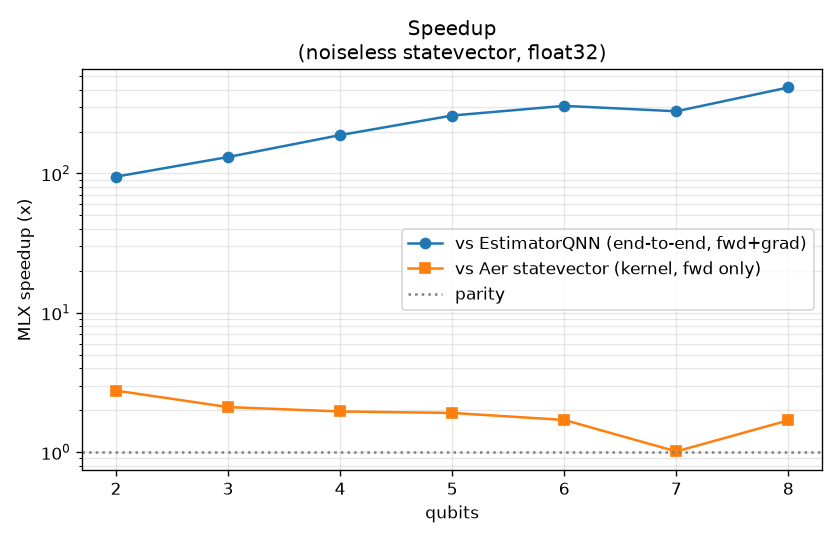
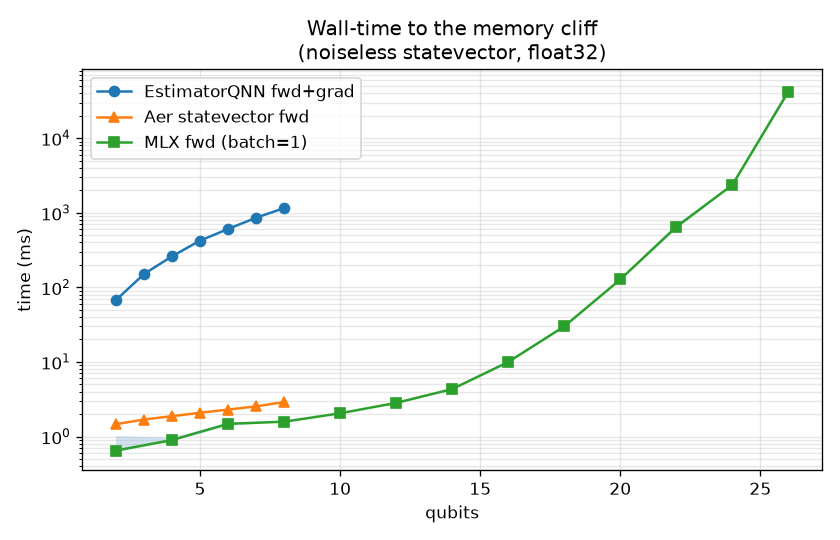
Performance. Two honest baselines. End-to-end vs EstimatorQNN driven from
Python (~100–400×), and kernel-level vs Aer's compiled statevector estimator
(~1.7–3×, forward only) — so the win is not just deleted orchestration. Wall-time
is shown until MLX hits the memory cliff (~22–26 qubits, single statevector).
 |
 |
|---|
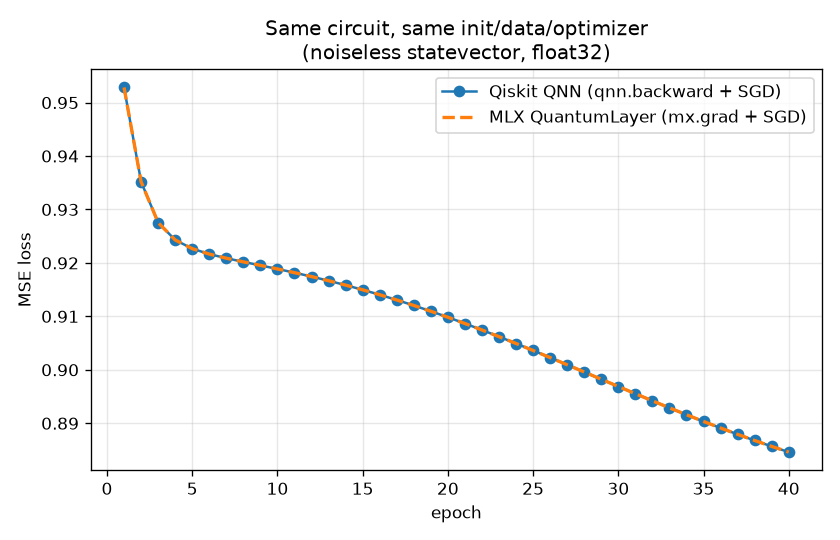
Trains identically. Same circuit, init, data, and optimizer (SGD): the MLX
layer (mx.grad) and the Qiskit QNN (qnn.backward) produce the same loss curve
to ~1e-7 — same training, just faster.
uv run pytestCovers gate/statevector correctness, gate unitarity and norm preservation, the little-endian convention, layer training, a finite-difference gradient check, and forward + weight-gradient + input-gradient parity with Qiskit across a random gate sweep (Qiskit-dependent tests skip automatically if Qiskit is absent).
See CHANGELOG.md.
MIT — see LICENSE.