House Price Prediction is a system that looks at property details like area, bedrooms, bathrooms, and location to estimate how much a house will cost. It's like having a digital real estate expert that can value thousands of homes in seconds.
This is a Supervised Learning Regression task. The system maps a set of input features (independent variables) to a continuous numerical output (dependent variable), which is the SalePrice. We use algorithms like Linear Regression and Random Forest to minimize the error between predicted and actual prices.
- Real Estate Portals: Companies like Zillow or Housing.com use this to suggest listing prices.
- Banks & Loan Companies: To verify if a property is worth the loan amount requested.
- Investors: To identify undervalued properties for quick ROI.
Housing Data → Preprocessing → Feature Engineering → Regression Model → Price Prediction → Insights
- Language: Python 3.11+
- Data Manipulation: Pandas, NumPy
- Visualizations: Matplotlib, Seaborn, Plotly
- Machine Learning: Scikit-learn, XGBoost
- Optimization: Optuna (Hyperparameter Tuning)
- Explainability: SHAP (Explainable AI)
- Serving: FastAPI (Inference API)
- Dashboard: Streamlit (High-fidelity Visuals)
- property area (sq ft), number of bedrooms/bathrooms, location, property age, garage capacity, etc.
- Cleaning: Handling missing values and removing outliers.
- Encoding: Converting categorical neighborhoods and qualities into numbers.
- Scaling: Standardizing numerical values for better model convergence.
- Feature Engineering: Creating new features like "Property Age" and "Baths Total".
- Regression Core: Gradient Boosted Trees (XGBoost) optimized with Optuna.
- Predicted Price: Actual market value in currency.
House-Price-Prediction/
│
├── data/               # Raw and processed datasets (CSV, Parquet)
├── notebooks/          # Jupyter notebooks for EDA and testing
├── src/                # Core Python scripts (features, train, predict)
├── models/             # Saved model artifacts (.joblib)
├── outputs/            # Exported analytics, plots, and CSV results
├── images/             # Screenshots for documentation
├── README.md           # This project documentation
├── requirements.txt    # Required Python libraries
└── main.py             # Pipeline orchestration script
-
Setup Virtual Environment:
python -m venv venv
.\venv\Scripts\activate
-
Install Libraries:
pip install -r requirements.txt
-
Train & Evaluate:
python main.py --mode train
python main.py --mode evaluate
-
Start Dashboard:
python main.py --mode dashboard
-
Start API:
python main.py --mode api


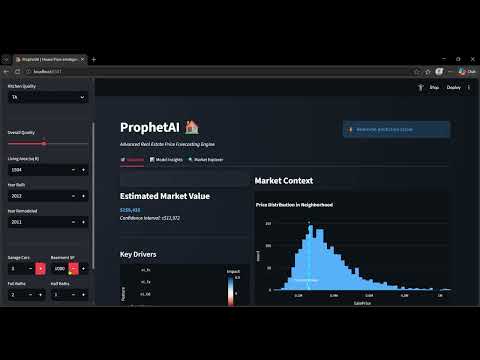
👉 Click here to watch the full system demonstration
- Model Comparison: Available in
outputs/model_performance.csv - Correlation Heatmap: Available in
outputs/metrics_comparison.png - AI Insights: Visualized live in the Streamlit Dashboard.