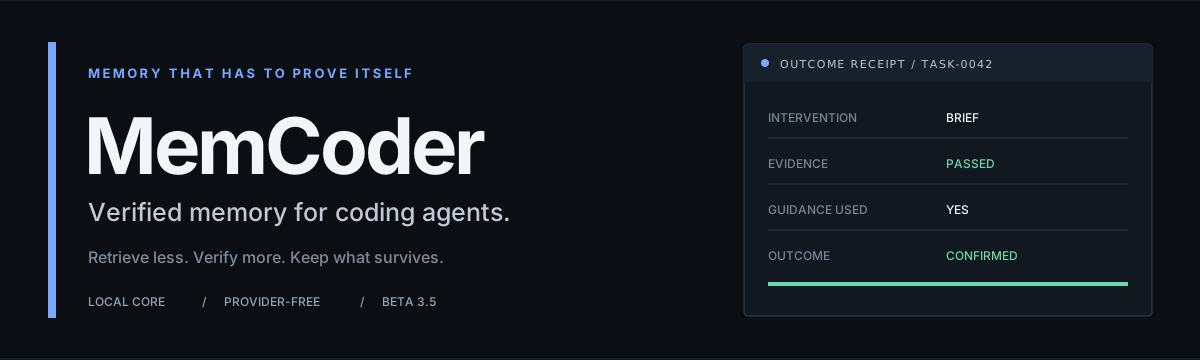


Give an agent continuity without teaching it to trust guesses.
Website · Install · Connect an agent · Beta 4.0 · Roadmap · Changelog
MemCoder is a local cognition layer for coding agents. It remembers verified work, retrieves only what can change the next decision, and declines to learn when the host cannot prove an outcome.
It is not a transcript archive and it is not another model. The agent still reasons, edits, and uses tools. MemCoder supplies a small evidence-backed brief, tracks what influenced the task, and admits durable learning only after QA.
The invariant: no proof, no durable learning.
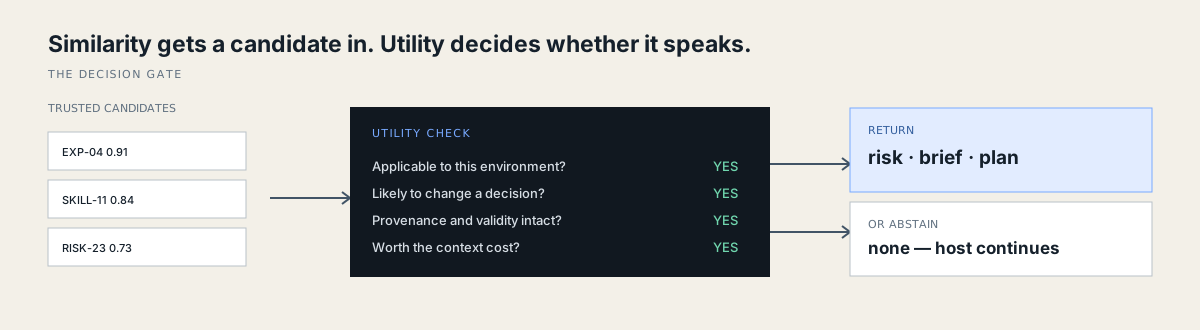
Most agent memory systems optimize for recall. MemCoder optimizes for useful, applicable recall—and for knowing when to stay quiet.
| The usual failure | MemCoder's response |
|---|---|
| Similar history floods the prompt | Compile the minimum context needed for this decision |
| An old fix is mistaken for current proof | Preserve applicability limits and require present-day verification |
| A successful task rewrites memory automatically | Separate outcome, influence, and proof; ambiguous credit stays uncertain |
| Slow retrieval blocks the agent | Return the best completed result by a hard deadline, or fail open |
| Self-improvement silently changes trusted behavior | Keep Dreams, simulations, patterns, and Skill revisions as candidates until evidence and approval exist |
MemCoder supports Python 3.10 and newer.
python -m pip install --pre --upgrade memcoder
memcoder setup --all
memcoder doctor
That is enough for the provider-free Core. No generation model, cloud account, CUDA installation, Ollama service, or API key is required.
Use this when the repository is newer than the published beta:
git clone https://github.com/Shikhar-code/memcoder.git
cd memcoder
python -m pip install --no-build-isolation .
python -m memcoder doctor
Confirm the installed surface:
memcoder --help
memcoder storage status
memcoder host-manifest --host codextask starts
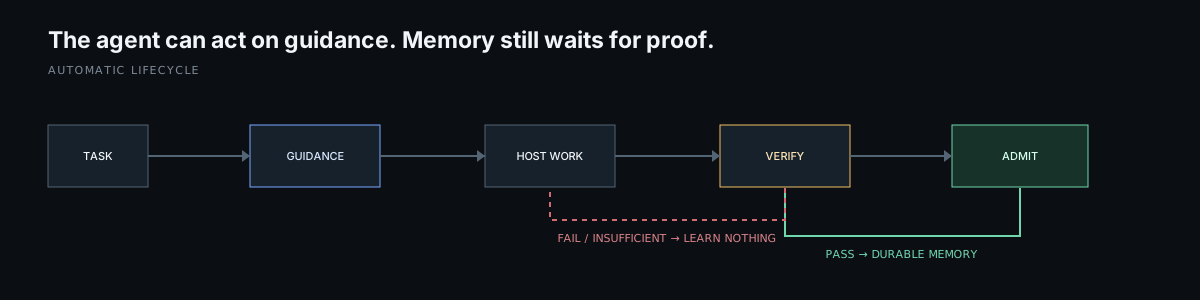
↓
attention gate ── irrelevant / empty / slow ──→ return nothing; host continues
↓
lexical evidence first ──→ optional warm semantic refinement
↓
minimum-sufficient brief + explicit proof obligation
↓
host works and verifies
↓
outcome receipt → causal credit → admitted memory → candidate learning
MemCoder works at lifecycle boundaries. It does not narrate continuously over the host, and it does not need a complex MemCoder-specific prompt.
| Boundary | Automatic behavior | Safety boundary |
|---|---|---|
| Task start | Detect risk, retrieve quickly, compile a brief, or abstain | Retrieved memory is guidance, never proof |
| Before a risky action | Surface a known failure frontier and cheapest preventive check | Unchanged requests are deduplicated |
| Verification | Inspect host-supplied tests, builds, assertions, diagnostics, or review | A confident answer is not evidence |
| Task close | Record an admitted experience and queue causal credit, competence, private-pattern, and deep-Dream work | Host completion stays fast; derived candidates remain untrusted |
Persistent MCP and Studio hosts resume the durable queue automatically. A
one-shot CLI process leaves unfinished work queued for the next persistent
session. Inspect it with
'{"action":"status"}' | memcoder derived-cognition --input -, or replace
status with drain for an explicit bounded drain.
Minimal lifecycle example
Start:
{
  "event": "task_started",
  "task_id": "billing-validation-42",
  "problem": "Fix request validation without changing successful responses.",
  "agent_id": "billing-api",
  "environment": {"project_id": "billing", "branch": "main"}
}
memcoder autopilot --input task-start.jsonFinish with real evidence:
{
  "event": "verification_finished",
  "task_id": "billing-validation-42",
  "problem": "Fix request validation without changing successful responses.",
  "agent_id": "billing-api",
  "outcome": {
    "guidance_used": true,
    "changed_action": true,
    "verification_passed": true,
    "files": ["validation.py"],
    "summary": "Required values are checked before normalization.",
    "solution": "Added one validation guard and preserved valid requests.",
    "evidence": {"checks": [{
      "name": "validation regression",
      "kind": "test",
      "status": "passed",
      "command": "python tests/test_validation.py",
      "output": "PASS"
    }]}
  }
}
memcoder autopilot --input task-finish.jsonBeta 4 moves MemCoder from a reliable memory runtime to a bounded cognition runtime. The new layers are provider-free, local, additive, and reversible.
- Anytime scheduler — lexical evidence arrives first; a warm semantic path may replace it only when it finishes in budget and clearly improves utility.
- Risk-adaptive compute — low-risk tasks receive less work; high-risk tasks receive more retrieval, failure-frontier, and verification budget.
- Privacy-safe latency traces — phase timing, timeout rate, backend, and critical path are observable without retaining prompt or repository content.
- Minimum-sufficient context — the host receives a compact decision and proof packet. Stable handles make deeper evidence an explicit request.
- Bounded simulation predicts assumptions, hazards, falsifiers, and expected observations without executing commands or mutating trusted memory.
- Deep Dreaming searches counterexamples and requires held-out evidence plus explicit approval before a candidate can become a Principle.
- Immutable Skill revisions propose a next version beside the current one; verification, promotion, credit, and rollback retain their lineage.
- Private cross-project patterns require approved evidence from at least two projects and store opaque references rather than raw cross-project content.
- Causal credit graph connects intervention, evidence, action, outcome, and verification while preserving uncertain attribution.
- Verified competence derives long-lived skill and task-family confidence only from admitted evidence, with stale and review-required states.
- Cognitive Git binds hypotheses and proof obligations to host-supplied Git context; drift blocks a merge until the proof is rerun.
These features do not claim human cognition. They make agent continuity more selective, testable, and difficult to corrupt.
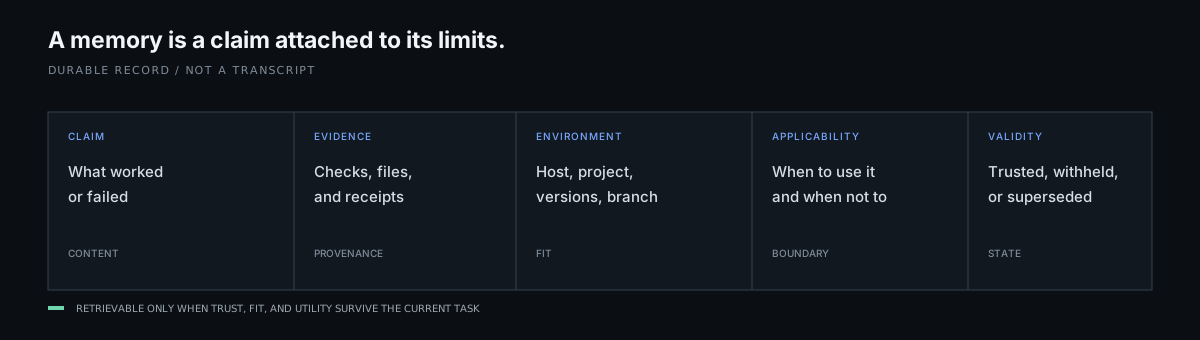
| Stored object | Meaning |
|---|---|
| Experience | Verified task, environment, action, affected files, and result |
| Reflection | Observation grounded in an approved Experience |
| Mistake / Failure Frontier | Verified failure mechanism and preventive check |
| Principle | Transferable guidance with evidence and applicability limits |
| Skill | Versioned procedure with preconditions, proof, failure handling, and rollback |
| Project state | Decisions, rationale, constraints, risks, open loops, and next actions |
Checkpoints, receipts, simulations, Dream candidates, Skill revisions, and private pattern candidates live beside semantic memory. Their presence does not make them trusted or automatically retrievable.
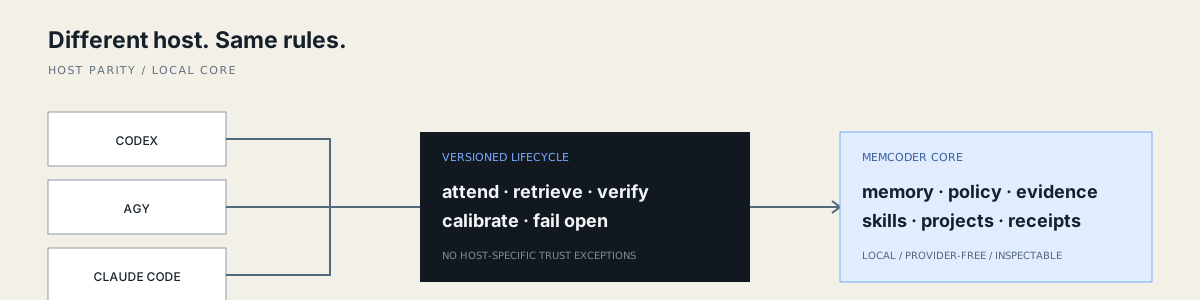
| Host | Setup | Verification |
|---|---|---|
| Codex Desktop | Install the local MemCoder marketplace plugin | memcoder doctor --host codex |
| AGY / Antigravity | memcoder setup-agy |
memcoder doctor --host agy |
| Claude Code | Run memcoder setup-claude inside the project |
memcoder doctor --host claude |
| Any MCP host | Run python -m adapters.mcp.server |
memcoder host-manifest --host <name> |
From a source checkout:
python scripts/configure_codex_plugin.py
codex plugin marketplace add .\codex-marketplace
codex plugin add memcoder@memcoder-local
On Windows, the configuration helper records the current interpreter in local
MemCoder user data, so Codex Desktop does not need to inherit an activated
Conda environment or a python entry on PATH.
Restart Codex and begin a new development task. The bundled Skill invokes the lifecycle automatically; the user does not need to ask for MemCoder.
memcoder setup-agy
memcoder doctor --host agy
See the AGY integration guide.
memcoder setup-claude
memcoder doctor --host claude
Setup preserves existing project instructions and MCP servers. See the Claude Code guide.
Every advanced operation accepts a JSON request through the CLI and has a matching Python, MCP, and localhost-service surface.
memcoder autopilot        automatic lifecycle entry point
memcoder context          compile or explicitly expand minimum context
memcoder simulate         run or inspect a non-executing simulation
memcoder causal           inspect causal traces and conservative credit
memcoder dream            run, verify, approve, reject, or roll back Dreams
memcoder skill-revision   propose and prove immutable Skill versions
memcoder competence       derive or inspect verified competence
memcoder pattern          discover private cross-project candidates
memcoder derived-cognition inspect, resume, or drain queued local cognition
memcoder branch           proof-gated cognition with optional Git context
memcoder retrieval-debug  explain ranking, gates, and abstention
memcoder storage          status, migrate, export, back up, or restore
Example: compile a 300-token context packet.
{
  "action": "compile",
  "problem": "Safely change tenant validation.",
  "agent_id": "billing-api",
  "token_budget": 300,
  "environment": {"project_id": "billing"}
}
memcoder context --input context.jsonRun memcoder <command> --help for exact input requirements.
- No proof, no durable learning. Deterministic QA admits memory.
- Similarity is not applicability. Related evidence may be withheld.
- Guidance is not authority. The current host verifies the current project.
- Ambiguity stays uncertain. A pass does not prove MemCoder caused it.
- Candidates are not memories. Simulation, Dream, revision, and pattern output cannot silently enter trusted retrieval.
- Evidence is preserved. Calibration changes ranking, not history.
- Failure is non-blocking. Timeout, empty storage, and optional backend failure return control to the host.
- Core is local and provider-free. Cloud and external model APIs are not hidden runtime requirements.
Use the packaged browser Studio:
memcoder studioOpen http://127.0.0.1:8765. Studio shows memories, evidence, host receipts,
outcomes, policy, replay, and—when data exists—Beta 4 cognition signals.
The repository also contains a lightweight Tauri desktop shell using plain HTML, CSS, and JavaScript against the same Python Core:
cd studio
bun install
bun run dev
Build the Windows installer with bun run build:exe. The NSIS output is under
studio/src-tauri/target/release/bundle/nsis/.
memcoder benchmark --iterations 5
memcoder storage upgrade --dry-run
memcoder storage backup
memcoder storage upgrade
Storage upgrades are additive and byte-safe: MemCoder creates a SQLite rollback copy, applies the lexical and causal extensions, validates schema and record count, and restores the copy on failure. JSON and ZIP snapshots include Beta 4 sidecars without deleting newer local history during restore.
For host budgets, set MEMCODER_INTERVENTION_TIMEOUT_MS (default 1500 ms).
MEMCODER_CIRCUIT_COOLDOWN_SECONDS controls timeout cooldown, and
MEMCODER_EMBED_CACHE_SIZE bounds the in-process embedding cache. Values are
clamped to safe ranges.
MemCoder has two narrow controlled results. In the original transfer study, three baseline AGY runs passed the visible test but failed private robustness checks; six assisted runs passed those same private checks. The Beta 4 harness then passed 24 matched intervention-decision tasks with 100% retrieval precision, 100% correct abstention, no harmful transfer, and no host-blocking failures. These results support transfer in their controlled setups—not a universal improvement claim.
Provider independence, retrieval safety, QA admission, lifecycle idempotence, host parity, abstention, timeout cleanup, candidate proof gates, causal storage, and rollback have deterministic coverage. Independent end-to-end coding uplift, developer rework, and production-scale latency remain evaluation targets.
- Controlled transfer result
- Beta 4 controlled evaluation
- Evaluation protocol
- Real-project evaluation protocol
Current non-goals:
- no claim of consciousness or human-equivalent cognition;
- no silent self-modification of trusted memory;
- no required cloud account or hosted model in Core;
- no team or multi-agent shared memory in Beta 4.0; and
- no claim that a passing task proves an intervention was helpful.
python -m pip install --no-build-isolation .
python -m memcoder --help
Run the Beta 4 slices first:
python tests/test_beta40_contract.py
python tests/test_beta40_core_slice.py
python tests/test_beta40_higher_cognition.py
python tests/test_beta40_host_certification.py
python tests/test_beta40_release_evaluation.py
python tests/test_beta4_studio_surface.py
Then run the documented provider-free regression pass:
python tests/test_automation_cli.py
python tests/test_mcp_provider_independence.py
python tests/test_retrieval_safety.py
python tests/test_memory_quality.py
python tests/test_qa_admission.py
python tests/test_cognition_brief.py
python tests/test_skill_promotion.py
python tests/test_planning.py
python tests/test_skill_health.py
python tests/test_evaluation.py| Document | Purpose |
|---|---|
| Roadmap | Product sequence, gates, and research direction |
| Changelog | Version-by-version implementation history |
| AGY integration | Setup, lifecycle, and certification |
| Claude Code integration | Project setup and automatic lifecycle |
| Architecture PDF | Component-level design |
| Beta 4 controlled evaluation | Reproducible release gates, results, and limitations |
| Evaluation protocol | Controlled comparison methodology |
MemCoder is beta software. Back up local cognition before testing new storage behavior. Reproducible bugs and negative results are welcome through GitHub Issues.