feat: v1 semantic convention#717
Conversation


The design goals and transitioning goals for linopy's v1 arithmetic
convention, under arithmetics-design/goals.md. The convention itself and
the bug catalogue (meta issue #714) follow separately.

Co-Authored-By: Claude Opus 4.7 (1M context) <noreply@anthropic.com>
Placeholder for the v1 convention document, to be written. Goals are in
arithmetics-design/goals.md; the bug catalogue is the meta issue #714.

Co-Authored-By: Claude Opus 4.7 (1M context) <noreply@anthropic.com>
 FBumann
force-pushed
the
feat/arithmetic-convention
branch
from
FBumann
force-pushed
the
feat/arithmetic-convention
branch
from
40af9d6 to
1e336a4
Compare
Flesh out convention.md from the placeholder into the full spec —
thirteen numbered sections in three groups: absence (§1–§7), coordinate
alignment (§8–§11), and constraints and reductions (§12–§13). Covers the
strict exact-match alignment model and the propagate-don't-fill
NaN/absence convention.

Co-Authored-By: Claude Opus 4.7 (1M context) <noreply@anthropic.com>
The convention governs coordinate alignment, absence/NaN handling,
constraints, and reductions — not just arithmetic operators — so
retitle convention.md and goals.md to "The v1 convention".

Co-Authored-By: Claude Opus 4.7 (1M context) <noreply@anthropic.com>
Introduce linopy.options["semantics"] — legacy (default) or v1 — with
LinopySemanticsWarning, a FutureWarning shown to users by default and
exported at top level. Add the autouse `semantics` conftest fixture
that runs every test under both conventions, plus legacy/v1 markers
to pin a test to one.

Co-Authored-By: Claude Opus 4.7 (1M context) <noreply@anthropic.com>
`_align_constant` branches on `options["semantics"]`: v1 uses exact
alignment via `xr.align(join="exact")`; legacy keeps the size-aware
positional/left-join behaviour and emits `LinopySemanticsWarning` when
v1 would diverge. `_add_constant`/`_apply_constant_op` raise on a NaN
in a user-supplied constant under v1, warn under legacy.

`Variable.__mul__(DataArray)` now routes through `to_linexpr() * other`
so the LinearExpression checks fire; the scalar fast-path is preserved
(a NaN scalar diverts to the expression path so v1 raises).

Marks the bug-class test groups `TestCoordinateAlignment` (#708/#586/
#550), `TestConstraintCoordinateAlignment`, `TestNaNMasking`,
`test_auto_mask_constraint_model`, and four piecewise NaN-padding tests
as `@pytest.mark.legacy` — they assert the very behaviour v1 forbids.
v1 coverage of those bug classes accretes via later slices.

`test/test_legacy_violations.py` (new) adds 22 paired tests covering
§5/§8/§9 plus the PyPSA #1683 `0*inf=NaN` case.

Co-Authored-By: Claude Opus 4.7 (1M context) <noreply@anthropic.com>
`merge` now pre-validates that all operands agree on the labels of
every shared *user* dimension before concatenating. Helper dims
(`_term`, `_factor`) and the concat dim itself are excluded — those
legitimately vary between operands. v1 raises on mismatch; legacy
keeps current size-based override/outer behaviour and emits
`LinopySemanticsWarning` when v1 would diverge.

The check uses a new `_merge_shared_user_coords_differ` helper. The
existing override/outer decision is unchanged for the actual
`xr.concat` call — the new check only gates whether legacy/v1 accept
the merge, never how the concat itself runs.

Adds 8 paired tests for var+var, var-var, expr+expr, broadcast guard,
and warning emission on the merge path.

Reclassifies as `@pytest.mark.legacy`: `test_non_aligned_variables`
(deliberately disjoint coords), `test_linear_expression_sum` /
`test_linear_expression_sum_with_const` (assert `v.loc[:9]+v.loc[10:]`
merges), `TestJoinParameter` cases that build `a*b` from mismatched-
coord vars, and two SOS2 reformulation tests. File-level legacy mark
on `test_piecewise_constraints.py` + `test_piecewise_feasibility.py`
until `linopy/piecewise.py` itself is made v1-aware (tracked as
Slice P).

Co-Authored-By: Claude Opus 4.7 (1M context) <noreply@anthropic.com>
Variable.to_linexpr() now produces a LinearExpression whose absent
slots (labels == -1) carry NaN coeffs and NaN const under v1, so
downstream arithmetic has something to propagate. The expression
constant operators (_add_constant, _apply_constant_op) no longer
fillna(0) self.const / self.coeffs under v1 — NaN flows through.
`merge` sums const along _term with skipna=False under v1, so a slot
that's absent in any operand stays absent in the result. Legacy paths
keep the silent-fill behaviour verbatim.

LinearExpression.isnull() now returns `const.isnull()` under v1: a
slot is absent iff its const is NaN. ``vars == -1`` is a dead-term
signal (the slot can still be a present constant after fillna),
not a slot-level absence marker. Legacy keeps the historical
``(vars == -1).all() & const.isnull()`` formula for byte-for-byte
compatibility.

Variable.fillna(numeric) now returns a LinearExpression (a constant
isn't a variable). Variable.fillna(Variable) stays Variable, as
before.

Adds 11 tests for §6 propagation (mul/add/sub/div preserve absence,
absent-vs-zero distinguishable, present + absent propagates) and §7
resolution (fillna numeric on expr / Variable, present-zero revival).

Reclassifies test_masked_variable_model as @pytest.mark.legacy — its
assertion "x bound to 10 at masked-y slots" only holds because legacy
collapses absent y to 0. The v1 way is x + y.fillna(0) >= 10; a
counterpart test in test_legacy_violations.py pins this.

Co-Authored-By: Claude Opus 4.7 (1M context) <noreply@anthropic.com>
The convention spec names ``reindex`` and ``reindex_like`` among the
absence-creating mechanisms (alongside ``mask=``, ``.where()``,
``.shift()``, and ``.unstack()``), but master only had them on
``LinearExpression``. Add them on ``Variable``, with the sentinel
fill values (``labels=-1``, ``lower=upper=NaN``) so new positions
slot cleanly into §6 propagation.

The methods work the same way under both semantics — under legacy
the sentinels exist but downstream arithmetic still collapses them
back to 0 (the #712 bug), so the user-visible effect of reindex-as-
absence only really lands under v1.

Adds 5 tests: extend with absent, subset drops, reindex_like with
another Variable, and the §4 + §6 hand-off (a reindex-introduced
absent flows through ``* 3`` and is visible via ``isnull()``).

Co-Authored-By: Claude Opus 4.7 (1M context) <noreply@anthropic.com>
Slice C propagated NaN const cleanly but left the storage half-absent
after a merge: `(1*x) + xs` at the absent slot kept the `1*x` term's
valid coefficient and label even though `const` was NaN there. The
§1/§2 promise "absence is one concept, whatever the dtype" only holds
if `const.isnull()` at a slot ⇒ every term at that slot has
`coeffs = NaN`, `vars = -1`.

Add `_absorb_absence(ds)` and call it at the end of `merge` under v1.
The constant-operand paths (`_add_constant`, `_apply_constant_op`)
don't need explicit absorption — their NaN-propagation naturally
preserves the invariant when the input is already v1-compliant
(NaN * anything = NaN; dead terms stay dead). Only `merge` opens the
gap by concatenating one operand's live term with another operand's
absent slot along `_term`.

`convention.md` §2 now states the invariant explicitly and introduces
the *dead term* terminology, so `fillna(value)` reviving a slot while
leaving the sentinel term in place reads as a feature, not a glitch.

Adds `test_outer_fillna_then_add_collapses_to_just_added` pinning
`(x + y.shift()).fillna(0) + x` — at the previously-absent slot the
result has exactly one live term (`1·x[0]`) with `const = 0`,
algebraically equal to `x[0]`. At present slots all three terms stay
live (`2·x[i] + y[i-1]`), so fillna placement is load-bearing — moving
it inside (`x + y.shift().fillna(0) + x`) would double-count `x` at
the absent slot.

Co-Authored-By: Claude Opus 4.7 (1M context) <noreply@anthropic.com>
`.add/.sub/.mul/.div/.le/.ge/.eq` already accepted a `join=`
argument; this slice's job is just §12's RHS handling under v1.

`to_constraint` branches on `options["semantics"]`. Under v1 it
skips the legacy `reindex_like(self.const, fill_value=NaN)` step
that silently padded a subset RHS, so a coord mismatch with the
LHS now flows through `self.sub(rhs)` and gets caught by §8's
exact alignment. A NaN in a user-supplied constant RHS raises at
construction (§5) — including the PyPSA #1683 case of
`min_pu * nominal_fix` with `p_nom=inf` and `p_min_pu=0`. An
absent slot in the LHS (propagated from §6) still produces a NaN
RHS at that row; downstream auto-mask drops the constraint there,
which is exactly §12's "absent slot yields no row."

Legacy keeps the old auto-mask path verbatim and adds a
`LinopySemanticsWarning` whenever a NaN RHS is observed, so users
get the rollout signal without behaviour change.

Adds 11 paired tests: TestNamedMethodJoin (inner/outer/left across
.add/.mul/.le, plus a "bare op still raises" guard) and
TestConstraintRHS (subset RHS raises, NaN RHS raises, PyPSA #1683
on the constraint side, §6→§12 hand-off where the absent LHS slot
yields NaN RHS, plus the paired legacy auto-mask documentation and
warning-emission tests).

Co-Authored-By: Claude Opus 4.7 (1M context) <noreply@anthropic.com>

|
Coming next, in order:
Then a final pass on docs (user-facing migration / rollout — deferred so far). |
Three internal patterns were violating §8 / §11:

1. ``_add_incremental`` in ``linopy/piecewise.py`` builds
   ``delta_hi <= delta_lo`` from two ``.isel(piece_dim=slice)`` slices
   of the same variable. ``drop=True`` is a no-op for slice indexers
   so ``piece_dim`` stays on both with *different* labels (first n-1
   vs last n-1 of piece_index) — v1 §8 rejects. Relabel the high
   slice onto the low slice's labels so the comparison aligns by
   label (the explicit-positional path of §10). Same fix for
   ``binary_hi <= delta_lo``.

2. ``_incremental_weighted`` computes ``bp0 = bp.isel({dim: 0})``
   without ``drop=True``, leaving the breakpoint dim as a scalar
   coord on the resulting expression. When that expression appears
   as the RHS of ``links.eq_expr == ...`` it conflicts with the LHS,
   which has no such coord — §11 aux-coord conflict. Add ``drop=True``.

3. ``reformulate_sos2`` builds its first/last constraints from
   scalar isels at different positions on ``sos_dim`` (``x``/``M`` at
   ``n-1`` paired with ``z`` at ``n-2``, etc.). All without
   ``drop=True``, so the scalar ``sos_dim`` coord differs across
   operands — §11 aux-coord conflict. Add ``drop=True`` to all three
   sites.

Removes the module-level ``pytestmark = pytest.mark.legacy`` from
``test_piecewise_constraints.py`` and ``test_piecewise_feasibility.py``
and the method-level marks from the two SOS2 multidim tests. Suite is
+598 tests under v1 vs Slice E (legacy → v1 broadened coverage),
0 failures under either semantics.

Co-Authored-By: Claude Opus 4.7 (1M context) <noreply@anthropic.com>
§13 falls out of xarray's ``skipna=True`` default; no code changes
needed. Adds 4 tests so future drift is caught: sum over a dim,
sum without a dim, sum of all-absent (the zero expression), and
groupby.sum across heterogeneously-present groups.

Co-Authored-By: Claude Opus 4.7 (1M context) <noreply@anthropic.com>
Adds `_conflicting_aux_coord(datasets)` and wires it into both
`merge` and `_align_constant`. When two operands carry an aux coord
of the same name with disagreeing values, v1 raises with a pointer
to the explicit resolutions (``.drop_vars(...)`` or
``.assign_coords(...)``). xarray silently drops the conflict — the
#295 bug — and legacy keeps that behaviour but now emits a
`LinopySemanticsWarning`. The helper guards against string-dtype
coord values (no `equal_nan=True` there) so the multiindex case
keeps working.

`_merge_shared_user_coords_differ` refactored to compare bare
``d.indexes[k]`` instead of ``d.coords[k]``: aux coords no longer
leak into the §8 check, so §11 owns aux-coord conflicts cleanly
and §8 owns dim-coord mismatches with a separate message.

Convention §11 expanded from one paragraph: aux coords are
validated and propagated but never computed with — they describe
the data, they don't enter the math. Goal #4 in `goals.md` picks
this up: user-attached auxiliary coordinates are the user's,
linopy never silently rewrites them.

`test_linear_expression.py::test_merge` adds ``drop=True`` to its
``.sel`` setup — the test was leaving a leftover scalar coord that
v1 now correctly catches as a §11 conflict; the fix preserves the
test's intent of exercising merge with differing term counts.

Conflict-raising tests (TestAuxCoordConflict) cover expr+const,
var+var, scalar-isel-without-drop, the ``drop=True`` escape hatch,
plus the paired legacy left-wins documentation and warning-emission
tests. Propagation guarantees land in a follow-up.

Co-Authored-By: Claude Opus 4.7 (1M context) <noreply@anthropic.com>
Regression coverage on the half of §11 that wasn't tested before:
non-conflicting aux coords carry through every binary operator and
into constraints. xarray already preserves them; the tests guard
against future drift (e.g. a reduction or helper accidentally
dropping a non-dim coord).

TestAuxCoordPropagation covers ``3*v``, ``v+5`` (single-operand,
fast paths), ``v+v`` with matching aux (the merge path), ``v<=10``
(the constraint path), ``x*a`` / ``x+a`` / ``x/a`` / ``x<=a`` where
only the constant DataArray carries the coord (the
``_align_constant`` path), and the var+var case where only one side
has the coord. Together: every operator times every "one side / both
sides" arrangement, since only conflicts on both sides raise.

Runs under both semantics — the legacy behaviour matches the v1
behaviour for the non-conflict cases.

Co-Authored-By: Claude Opus 4.7 (1M context) <noreply@anthropic.com>
… solve

Fills the convention-coverage gaps surfaced by review of the branch:

- §1/§2 dead-term storage invariant: pin that after a merge with an
  absent slot, coeffs=NaN AND vars=-1, not just const=NaN. The existing
  propagation tests read through isnull() which only checks const, so a
  regression in _absorb_absence would have passed them. Multi-operand
  variant catches binary-only-absorption regressions.
- §12 equality: mirror the existing <=/>= TestConstraintRHS coverage for
  ==. Subset RHS raises, NaN RHS raises, absence in LHS drops the row.
- §11 extra operators: add mul-constant and == constraint cases to the
  existing TestAuxCoordConflict. The class already covered +-constant
  and var+var; these extend coverage to the other call-site shapes.
- §13 scope note: mean/resample/coarsen aren't yet on LinearExpression
  (tracked in #703); the spec text is the rule those will follow when
  implemented. Docstring note in TestReductionsSkipAbsent makes this
  explicit so the gap doesn't read as missing coverage.
- End-to-end v1 solve: test_masked_variable_model_v1_drops_constraint
  pins the v1 outcome at the solver layer — con0 masked at absent
  slots (solver-independent) and x bound to 0 where the constraint
  still binds. _v1_fillna_binds confirms the §7 escape hatch recovers
  the legacy outcome. Catches the regression where v1 silently
  produces wrong solutions instead of raising.

Co-Authored-By: Claude Opus 4.7 (1M context) <noreply@anthropic.com>
Pulls the seven v1-specific helpers and the user-NaN message out of
``expressions.py`` and into a dedicated ``linopy/semantics.py`` module
— a single home for "what v1 means" that imports cleanly from
``config`` and ``constants`` only. Adds a tiny ``is_v1()`` predicate
so the 16 scattered ``options["semantics"] == V1_SEMANTICS`` checks
collapse to a one-line call.

Helpers (renamed to drop the leading underscore now that they're a
real module API): ``check_user_nan_scalar``, ``check_user_nan_array``,
``dim_coords_differ`` (was ``_shared_coords_differ`` — clearer name,
matches ``merge_shared_user_coords_differ``), ``merge_shared_user_coords_differ``,
``conflicting_aux_coord``, ``absorb_absence``, plus ``is_v1``.

No behaviour change — same checks, same warnings, same raises. The
diff is mechanical: imports flipped, two local ``is_v1 = options[...]``
bindings replaced by the imported predicate, one missed
``_USER_NAN_MESSAGE`` reference in ``to_constraint`` routed through
``check_user_nan_array`` for consistency. ``expressions.py`` shrinks
by ~105 lines.

Future v1-only API surface (e.g. exposing ``is_v1()`` as
``linopy.is_v1()`` for downstream code) and the eventual legacy
removal at 1.0 both reduce to deletions of ``semantics.py`` and its
import sites.

Co-Authored-By: Claude Opus 4.7 (1M context) <noreply@anthropic.com>
Three test clusters in ``test_legacy_violations.py`` had near-identical
``test_add_X``, ``test_mul_X``, ``test_div_X`` triples that varied only
by which binary operator they exercised. Collapse each into a single
``@pytest.mark.parametrize("op", ...)`` test:

- TestExactAlignmentConstant: same-size-different-labels and
  subset-constant raises, parameterized over add/sub/mul/div.
- TestUserNaNRaises: NaN-DataArray raises over add/sub/mul/div, NaN
  scalar over add/sub/mul (div scalar shares the same ``_apply_constant_op``
  code path as mul, but ``x / nan`` trips ``__div__``'s unary-negate
  TypeError before our check fires; the dispatch needs a separate
  fix that's not worth pulling into this refactor).
- TestAbsencePropagation: ``shifted OP scalar`` preserves absence,
  parameterized over add/sub/mul/div. Adds a per-op present-slot
  value check so the parameterization broadens rather than narrows
  the assertion.

Adds a module-level ``_OPS`` dict mapping name → ``operator``
callable so the parameter is the readable name (``"add"``,
``"div"``) while the test still calls the actual operator.

Cuts ~50 lines off ``test_legacy_violations.py`` and makes adding a
new operator a one-line change. Test IDs become e.g.
``test_same_size_different_labels_raises[v1-add]`` — slightly less
self-describing than the explicit-method names but cheap to read.

Co-Authored-By: Claude Opus 4.7 (1M context) <noreply@anthropic.com>
Both methods had v1 and legacy logic interleaved via a ``fillna0``
closure that was identity under v1 and ``da.fillna(0)`` under legacy.
Pull them apart into:

- ``_add_constant`` / ``_apply_constant_op`` — two-line dispatchers.
- ``*_v1`` — v1's implementation, reads as a single coherent story.
- ``*_legacy`` — legacy's implementation, ``# LEGACY: remove at 1.0``
  marker on each.

At 1.0 the removal is mechanical: delete the ``_legacy`` methods and
inline the ``_v1`` body into the dispatcher (or rename it back to the
public name). Future readers don't have to mentally subtract the
legacy branches to understand what v1 does.

Add ``LEGACY: remove at 1.0`` marker comments at the other mixed
sites in ``expressions.py`` so ``grep`` finds every place that needs
touching: ``_align_constant``'s size-aware default fallback,
``to_constraint``'s auto-mask fallthrough, ``LinearExpression.isnull``'s
historical AND, and the two warn-on-divergence sites in ``merge``.

New ``arithmetics-design/legacy-removal.md`` is the master checklist
for the 1.0 cut: every file, function, test, doc edit, and the safe
order to do them in. The intent is that the eventual legacy removal
takes an afternoon, not a week of grep-archaeology.

No behaviour change — same checks, same warns, same raises. Suite is
7282 passed, 0 failures under both semantics.

Co-Authored-By: Claude Opus 4.7 (1M context) <noreply@anthropic.com>
Two distinct CI failures both rooted in the v1 harness commit:

1. **Test collection crash on every linopy/*.py module.** ``test/conftest.py``
   imported ``linopy.config`` at module top, which loaded linopy from
   site-packages before pytest's ``--doctest-modules`` collection walked
   the source tree. The resulting __file__ mismatch broke all 22 module
   collections. ``pyproject.toml`` already documents this exact failure
   mode in the ``filterwarnings`` block. Fix: keep the constant *values*
   (``"legacy"`` / ``"v1"``) inline in conftest as ``_LEGACY_SEMANTICS``
   etc. so the parametrize decorator doesn't force an import, and defer
   the ``LinopySemanticsWarning`` / ``options`` import into the fixture
   body. The original import comment in pyproject is now mirrored at
   the top of conftest.

2. **mypy: 72 "no-untyped-def" errors in test_legacy_violations.py.**
   The new tests were missing parameter type annotations on the
   fixture-injected params (``x``, ``xs``, ``op``, ``unsilenced``,
   ``subset``, ``A``, ``da_aux_B``, ...). ``disallow_untyped_defs`` is
   set globally, so test files need them too. Filled in the types
   (``Variable``, ``str``, ``None``, ``xr.DataArray``, ``pd.Index``),
   added an ``isinstance(result, LinearExpression)`` narrowing in
   ``test_variable_fillna_zero_revives_slot_as_present_zero`` so mypy
   can pick the right branch of ``fillna``'s return union.

Local: 7282 passed, 0 failures under both semantics; ``mypy .``
Success.

Co-Authored-By: Claude Opus 4.7 (1M context) <noreply@anthropic.com>
Three v1 raises were under-informative — naming the rule violated but
not the operand, dim, or values involved. Make each message carry the
information the helper already has:

- **§5 user-NaN**: the old message conflated the two intents the user
  might have had — *data error* (fix with ``.fillna(value)``) vs
  *intended absence* (mark on the variable with ``mask=`` / ``.where``
  / ``.reindex`` / ``.shift``). The new message separates them and
  points each to its own remedy.
- **§8 merge mismatch**: rename ``merge_shared_user_coords_differ``
  (bool) to ``merge_shared_user_coord_mismatch`` (tuple ``(dim, left,
  right) | None``). Raise text now includes the offending dim name and
  both sides' labels (truncated), plus the full set of resolution
  paths from §10: ``.sel`` / ``.reindex`` / ``.assign_coords`` /
  ``linopy.align`` / ``join=`` on ``.add`` / ``.sub`` / ``.mul`` /
  ``.div`` / ``.le`` / ``.ge`` / ``.eq``.
- **§11 aux-coord conflict**: ``conflicting_aux_coord`` returns
  ``(name, left_vals, right_vals) | None``. Raise text includes the
  coord name, both value snippets, and all three resolution paths
  (``.drop_vars`` / ``.assign_coords`` / ``isel(drop=True)`` —
  ``.assign_coords`` was previously omitted). The text is now
  centralized in ``semantics.py`` so the two raise sites in
  ``expressions.py`` (``_align_constant`` and ``merge``) share one
  voice instead of paraphrasing each other.

New ``TestErrorMessageContent`` pins the rich content in three tests
— that the §5 message names both intents, that the §8 message names
the dim and both label lists, and that the §11 message names the
coord, both value lists, and lists all three §11 fixes (the
``.assign_coords`` omission would have slipped through ``match=
"Auxiliary coordinate"`` substrings).

Section references (``§5``, ``§8``, ``§11``) deliberately omitted
from user-visible text — spec jargon, not a navigation aid for
downstream callers.

Co-Authored-By: Claude Opus 4.7 (1M context) <noreply@anthropic.com>
Closes the small-but-real holes in the §1–§13 coverage map. New tests
mostly, plus one code fix that the test surfaced.

§4 — absence creation
  - test_where_creates_absence: §4 names ``.where(cond)`` but only
    ``mask=`` / ``.reindex`` were tested.
  - test_unstack_creates_absence_at_missing_combinations: the
    non-rectangular MultiIndex case (``stack`` preserves, ``unstack``
    fills) is the asymmetry that earns its own test. Hit a real bug
    on the way — ``Variable.unstack`` was producing float NaN in the
    integer ``labels`` field instead of the ``FILL_VALUE`` sentinel
    (-1), violating §2. Fixed by passing ``fill_value=_fill_value``
    to the underlying ``Dataset.unstack`` (same pattern as ``shift``).
    Audited the rest of the varwrap calls — only ``shift`` and
    ``unstack`` introduce new positions; the others either preserve
    shape (``assign_*``, ``rename``, ``swap_dims``, ``set_index``,
    ``roll``, ``stack``), select existing positions (``sel`` /
    ``isel`` / ``drop_*``), or broadcast existing data without fill
    (``broadcast_like``, ``expand_dims``).
  - test_data_preserving_methods_do_not_create_absence: parameterized
    over ``.roll`` / ``.sel`` / ``.isel``, regression-guards §4's
    explicit contrast against the creators.

§10 — named-method join= argument
  - test_add_join_override_aligns_positionally: positional-mode is the
    surprising one in the join= set; pin it explicitly.
  - test_reindex_like_resolves_mismatch_before_bare_op and
    test_assign_coords_resolves_mismatch_before_bare_op: §10 names
    these as the canonical user fixes; pin that the post-fix bare
    operator actually accepts the once-mismatched operand.

§11 — auxiliary-coordinate conflicts
  - test_assign_coords_resolves_conflict: §11 lists three escape
    hatches; only ``.drop_vars`` / ``isel(drop=True)`` were tested.
  - test_multi_operand_merge_aux_conflict_raises: the merge-path
    check inspects all operands; a 3-way ``v + w + u`` with the
    third disagreeing exercises that.

§12 — constraints follow the same rules
  - Parameterize the existing subset / NaN / absence-propagation
    tests in ``TestConstraintRHS`` over the three signs (``le`` /
    ``ge`` / ``eq``) via a new module-level ``_SIGNS`` dispatch.
    Folds the previous ``<=`` and ``==`` duplicates together and
    fills in ``>=`` for each rule (which was the explicit gap).
    The PyPSA #1683 test stays separate — it's tied to ``>=`` by
    the real-world case it documents.

Suite: 7303 passed, 515 skipped, 0 failures under both semantics.
``mypy .`` clean.

Co-Authored-By: Claude Opus 4.7 (1M context) <noreply@anthropic.com>
The three fillna(0)-on-masked tests produce an identical solver model
under both semantics, but differ in dead _term padding (v1 leaves the
resolved slot's sentinel term with coeff NaN; legacy with 1.0), which
assert_linequal/assert_conequal treat as unequal. Adopting strict
structural equality as the "equal behaviour" bar, mark them v1:

- test_variable_fillna_zero_revives_slot_as_present_zero
- test_masked_variable_constraint_via_fillna
- test_masked_variable_model_v1_fillna_binds (restored _v1 suffix)

Restores their v1-specific docstrings (they document the §7 resolve
mechanism, not shared behaviour).

Co-Authored-By: Claude Opus 4.8 (1M context) <noreply@anthropic.com>
A per-op test that under-asserts (e.g. checks only .indexes) can pass
under both semantics while the result silently diverges — that is how the
reordered-merge mispairing slipped through. Add a parametrized guard that
builds each mode-invariant operation under BOTH semantics and compares
with linopy.testing's strict structural helpers (assert_linequal /
assert_quadequal / assert_conequal). A regression that makes one of these
paths semantics-dependent now fails loudly. Verified it catches the
reordered-merge divergence as a negative control.

Co-Authored-By: Claude Opus 4.8 (1M context) <noreply@anthropic.com>

|
Note Generated with Claude Code. Quick triage from the PyPSA-Eur side. CI red ( On the remaining checklist:
Test cleanup. The legacy-side pinning point matters most: divergent results (not just raises/warns) are the silent-failure class. Reductions over absent is the obvious one; worth grepping for other §13 / §8 sites where both code paths run clean but disagree. Will rebase the PyPSA-Eur warmstart branch on top once #744 is resolved so we can give the convention real-model exposure before rc. |
…vention

# Conflicts:
#	linopy/alignment.py
#	test/test_constraint.py
|
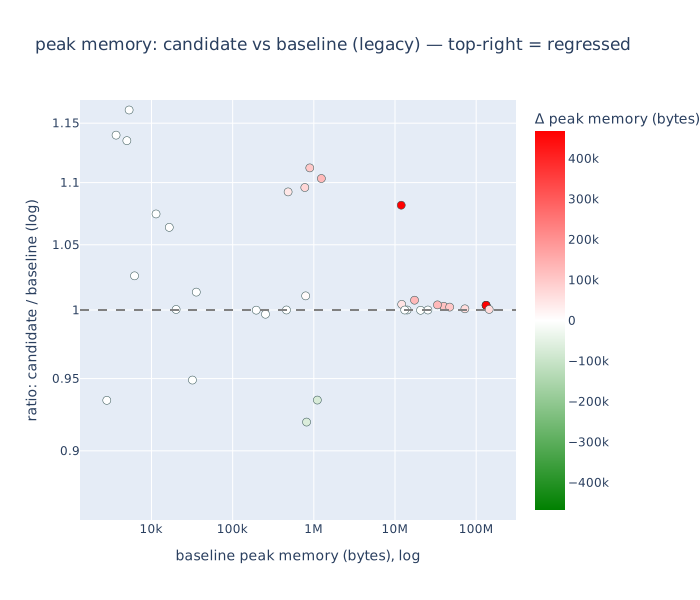
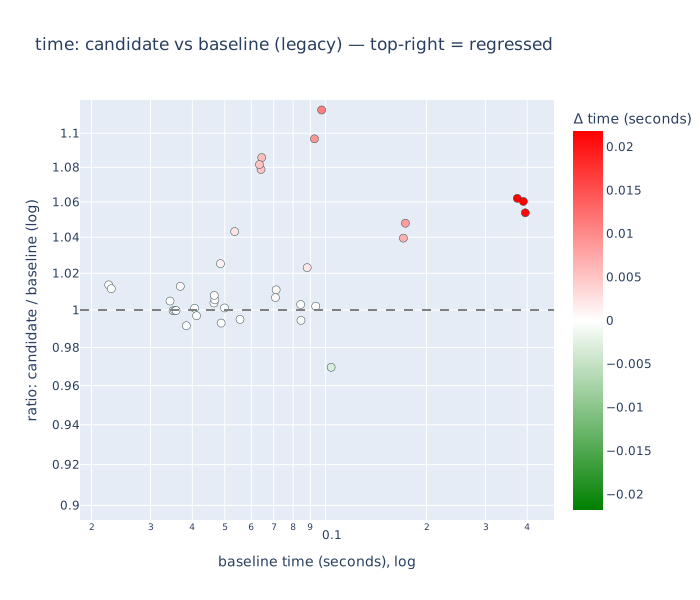
Performance regressions are expected. Im working on making them visible so we can adress as much as possible before merging! |
…pers

After merging master, the Constraint.rhs setter accepts a DataArray, so the
`# type: ignore` on the MI-level rhs tests is unused (mypy --warn-unused-ignores).
Also cast the legacy-violation `_op_*` helpers to their documented runtime
type, which the paired assert_linequal/assert_quadequal already verify, so
`mypy .` is clean.

Co-Authored-By: Claude Opus 4.8 (1M context) <noreply@anthropic.com>
|
Added a Semantics report workflow (
🤖 Comment drafted by Claude (AI). |
FBumann
force-pushed
the
feat/arithmetic-convention
branch
from
c4d6bb7 to
068c106
Compare


Merging this PR will not alter performance
Comparing 
Footnotes
|


Build cost — v1 vs legacyv1 build peak & time relative to legacy, on this commit — not a comparison against master (that is CodSpeed).
Full table (time + peak, mean)📊 Interactive plots + CSV: download the semantics-report-v1-vs-legacy artifact from this run. Report-only · not a gate · refreshed on every push · obsolete once legacy is dropped. |
 FBumann
force-pushed
the
feat/arithmetic-convention
branch
2 times, most recently
from
FBumann
force-pushed
the
feat/arithmetic-convention
branch
2 times, most recently
from
4efdff4 to
984c4b3
Compare
Add a transitional "Semantics report" workflow: it builds every benchmark spec
twice — the default semantics (legacy) and LINOPY_BENCH_SEMANTICS=v1 — under the
same node ids, then posts a v1-vs-legacy A/B to the PR: side-by-side peak & time
relative-change plots (SVG, hosted on an auto-created assets branch) with the
full text table collapsed below, plus an artifact (interactive HTML plots + CSV
+ text table). Report-only, this-commit only — the gate and the vs-master
history stay with CodSpeed, whose ids are untouched (legacy is the unsuffixed
default).

Run benchmark-smoke under both conventions too; that surfaced specs that only
built under legacy, fixed here:
- expression_arithmetic / milp: label the square coeff arrays so v1 doesn't have
  to pair their equal-length axes by size (legacy guessed)
- pypsa_carbon_management: skip under v1 — PyPSA emits NaN-valued constants v1
  rejects by design (keys on linopy.options['semantics'])

Pins pytest-benchmem[plot-static]==0.4.7 (benchmem compare/plot + kaleido SVG; clearer plot labels).

Co-Authored-By: Claude Opus 4.8 (1M context) <noreply@anthropic.com>
FBumann
force-pushed
the
feat/arithmetic-convention
branch
from
984c4b3 to
51841fe
Compare

 MaykThewessen
left a comment
MaykThewessen
left a comment
MaykThewessen
left a comment
There was a problem hiding this comment.
One small spec-vs-code follow-up on §10 (the override / assign_coords wording), inline. Implementation already handles the size-mismatch case I'd flagged earlier; this just realigns the spec text. Not a blocker.
| - The named methods — `.add` `.sub` `.mul` `.div` `.le` `.ge` `.eq` — take a | ||
| `join=` argument: `exact`, `inner`, `outer`, `left`, `right`, or `override`. | ||
| `override` is the old positional behavior — still available, but now opt-in | ||
| and named rather than triggered by a size coincidence. | ||
| - `.reindex()` / `.reindex_like()` conform an operand to a target index | ||
| (extending past the original creates absent positions — §4). | ||
| - `.assign_coords()` relabels an operand outright (positional alignment, made | ||
| explicit). |
There was a problem hiding this comment.
§10 wording now lags the implementation. _align_constant gates join="override" on a shared-dim size check and raises before the assign_coords (expressions.py:708-733, with a comment citing §10), and the operand path routes override through xr.concat(..., join="override"), which already requires equal sizes. So the silent-broadcast hazard this paragraph reads as permitting is actually closed in code; only the spec text still describes override / .assign_coords() as unguarded positional relabels. Small clarification so the spec matches:
| - The named methods — `.add` `.sub` `.mul` `.div` `.le` `.ge` `.eq` — take a | |
| `join=` argument: `exact`, `inner`, `outer`, `left`, `right`, or `override`. | |
| `override` is the old positional behavior — still available, but now opt-in | |
| and named rather than triggered by a size coincidence. | |
| - `.reindex()` / `.reindex_like()` conform an operand to a target index | |
| (extending past the original creates absent positions — §4). | |
| - `.assign_coords()` relabels an operand outright (positional alignment, made | |
| explicit). | |
| - The named methods — `.add` `.sub` `.mul` `.div` `.le` `.ge` `.eq` — take a | |
| `join=` argument: `exact`, `inner`, `outer`, `left`, `right`, or `override`. | |
| `override` is the old positional behavior — still available, but now opt-in | |
| and named rather than triggered by a size coincidence. It still requires the | |
| shared dimensions to match in size: a genuine size mismatch raises rather | |
| than relabelling mismatched data, so reach for a label join (`inner` / | |
| `outer` / `left` / `right`) when the sizes really differ. | |
| - `.reindex()` / `.reindex_like()` conform an operand to a target index | |
| (extending past the original creates absent positions — §4). | |
| - `.assign_coords()` relabels an operand outright. Unlike `join="override"`, | |
| which checks the shared dims match in size, this is an *unguarded* relabel: | |
| it renames positions whether or not they correspond, so the "made explicit" | |
| here is the caller's responsibility, not a safety check. |
The line worth keeping crisp: join="override" is guarded positional alignment (size-checked, raises on mismatch); the bare .assign_coords() primitive is an unguarded relabel. Follows up the open _align_constant override thread.
Commit the v1-rollout checklist (previously an untracked scratch file) as the
shared per-stage status tracker alongside goals.md/convention.md. Organised by
goals.md's three stages (opt-in / default / 1.0); #744 (MultiIndex storage) is
the one open design decision, gating the default flip.

Co-Authored-By: Claude Opus 4.8 (1M context) <noreply@anthropic.com>
FBumann
force-pushed
the
feat/arithmetic-convention
branch
from
b5d5a70 to
71bd655
Compare
…703

§13's skip-absent principle is live v1 semantics for the reductions that exist
(`sum`, `groupby.sum`, the objective total), so it stays in the convention.
`mean` / `resample` / `coarsen` are not in linopy yet — specifying their exact
semantics here is spec-ahead-of-code, so trim them to a forward-pointer to #703
(xarray method coverage), where they land as additive features that follow the
same skip-absent rule. Keeps the convention == shipped behaviour.

Co-Authored-By: Claude Opus 4.8 (1M context) <noreply@anthropic.com>
mean/resample/coarsen are added under v1 only — legacy is a frozen compatibility
layer removed at 1.0, so it never gains new operations (and needs no fill-0
semantics designed for them).

Co-Authored-By: Claude Opus 4.8 (1M context) <noreply@anthropic.com>
…const routing) (#804)

* perf(v1): skip no-op exact-join reindex in constant ops

_apply_constant_op_v1 / _add_constant_v1 resolve join=None to "exact", then
_align_constant returned needs_data_reindex=True unconditionally — so a plain
`coeffs * expr` ran xr.align + self.data.reindex_like (two full-dataset
deepcopies) even though the factor was already broadcast to self.coords, making
the exact-join alignment a no-op.

first_mismatched_dim is the §8 exact check (order/label-strict via
indexes.equals), so when it finds no mismatch the align changes nothing: return
needs_data_reindex=False and take the cheap assign() path, skipping both copies.

v1 build peak: isolated multiply -56%; full-build v1/legacy median 1.20x -> 1.00x
(legacy unchanged — its default path already returned False). Full suite: 7629
passed under both semantics.

Co-Authored-By: Claude Opus 4.8 (1M context) <noreply@anthropic.com>

* perf: fold Variable*constant into one construction step (both modes)

1a3f2be rerouted Variable.__mul__(DataArray) through `to_linexpr() * other` so
the §5/§8 checks fire — but that materialises a unit `1*var` expression and then
multiplies it, doubling the peak on multiply-heavy builds in BOTH semantics
(kvl_cycles 129→168 MB, sparse_network, masked, sos, knapsack — the CodSpeed
regressions on #717).

Move the checks into the one-step path instead: to_linexpr(other) now enforces
§8 (mismatched coefficient coords raise v1 / warn legacy), §11 (aux-coord
conflict), alongside the existing §5 NaN check, so Variable.__mul__ can fold the
coefficient in at construction with no intermediate expression.

Build peak vs merge-base master (1dbde37): kvl_cycles 168→129 MB (parity) in both
modes; all varying-data specs 1.00×; legacy/master and v1/master medians 1.00×.
Full suite 7629 passed; §5/§8/§11 alignment tests green under both semantics.

Co-Authored-By: Claude Opus 4.8 (1M context) <noreply@anthropic.com>

---------

Co-authored-by: Claude Opus 4.8 (1M context) <noreply@anthropic.com>
…guarded

The spec text lagged the code: _align_constant size-guards join="override"
(expressions.py:708-733, raises on a shared-dim size mismatch) and the operand
path routes it through xr.concat(join="override") which also requires equal
sizes — so override is guarded positional alignment, not an unguarded relabel.
Clarify that, and distinguish it from the bare .assign_coords() primitive, which
is an unguarded relabel. Per review on #717.

Co-Authored-By: Claude Opus 4.8 (1M context) <noreply@anthropic.com>
3 participants


The strict v1 semantic convention for linopy — predictable coordinate alignment and NaN handling.
This is the master PR for the new semantic convention in linopy. It starts with our
Design & transitioning goals, which is carried out in ourNew Semantics spec. Both files are tracked in this branch. WHat you read is the current state.Both might change until this PR is merged
The concrete rollout checklist — the three stages (opt-in → default → 1.0) and their per-stage status — is tracked in
arithmetics-design/open-items.md.Scope
The convention ships behind
linopy.options["semantics"]—v1opt-in,legacythe default. This PR carries the design, spec, tests and implementation; documentation notebooks follow separately.Testing
All tests in linopy will be executed for both semantics.
Differing behaviour will be tested using
pytest.markers.This will increase ci time temporarily until v1 is released.
Defered to a follow up PR
Docs: Documentation, Migration guide, Release notes