Replacing "Lead Management" with "Capital Execution under Epistemic Uncertainty and Temporal Dynamics".


🔴 [STATUS: STEALTH — PROPRIETARY SOURCE CODE AIR-GAPPED PENDING ACQUISITION OR NDA]
🚀 Executive Summary • 🧠 Mathematical Physics • ⚙️ Algorithmic Kernel • ⏳ Temporal Engine • 🤖 Swarm Consensus
🏛️ Strategic Capabilities • 📊 Forensic Backtests • 🌐 Deployment • 🔒 Security • 🧬 AGI Roadmap
📖 Feature Glossary • 💼 Vertical Markets • 🖥️ UI / UX • 🧠 Memory Architecture • 🔐 Audit Ledger
🗂️ Dossier Interfaces • 📈 CLV Modifier • 🌊 Predictive Drift • ⚖️ Hard-Kill Matrix • 🔌 ERP Integration
🚀 Deployment Playbook • 📚 Glossary • 📐 Temporal Mathematics • 🕸️ Graph Topology • 🧠 Kernel Psychology • 📡 Telemetry
Revenue OS is not a CRM. It is not an "AI Copilot" that drafts emails. It is an Adaptive Bayesian Framework for autonomous sales execution — a mathematically deterministic System of Intelligence designed to eliminate human intuition from enterprise capital allocation.
By treating enterprise sales as a portfolio optimization problem under strict epistemic uncertainty and temporal constraints, the OMNI_KERNEL addresses a $1.5 Trillion global inefficiency: human capital misallocation. The average enterprise sales representative spends 64% of their time on deals that mathematically have zero probability of closing due to hidden structural, legal, or adversarial blockers. A further 15% is wasted on deals that will close, but not now.
The Kernel eliminates this waste with absolute, cryptographic certainty, generating unprecedented alpha through mathematical arbitrage.
| # | Pillar | Description |
|---|---|---|
| 1 | Unconstrained Scalability | Evaluates 10,000 parallel deal states in 600ms. Solves the linear headcount constraints of traditional B2B sales organizations. |
| 2 | Defensible Quantitative IP | Proprietary integration of Thermodynamic Entropy, a Variance-Penalized Kelly Criterion, and Temporal Governance Engine, protected by Level 4 trade secrets. |
| 3 | The Data Flywheel (Inverse Propensity Scoring) | Learns from the void. Extracts causal alpha from the mistakes of human competitors by mapping the invisible topology of failed capital deployments. |
| 4 | Zero-Marginal Cost Execution | The cost of routing, killing, deferring, or escalating a multi-million dollar deal drops to fractions of a cent. |
| 5 | Algorithmic Edge over Heuristics | In backtests across $3.85B in enterprise pipeline, the OMNI_KERNEL's deterministic execution preserved millions in otherwise wasted OPEX. |
Standard AI models output a single probability score (e.g., "75% likely to close"). This is dangerously misleading in enterprise sales due to epistemic uncertainty and time horizons. The OMNI_KERNEL abandons these heuristics for strict stochastic modeling, temporal physics, and state preservation.
Enterprise sales are not coin flips; they are environments of hidden information. We utilize a Bayesian Hierarchical Beta-Binomial model to generate a posterior probability distribution rather than a point estimate.
- A wide credible interval (e.g.,
$[10%, 90%]$ ) triggers Thompson Sampling to actively explore the deal and gather more evidence. - A narrow credible interval (e.g.,
$[2%, 5%]$ ) triggers an immediateHARD_KILLprotocol to preserve human capital (Exploit).
Every unstructured text ping introduces thermodynamic microstates (
Did the deal close because of a Steak Dinner, or would it have closed anyway?
The Kernel utilizes Doubly Robust Estimation, pairing Inverse Propensity Scoring (IPS) with outcome regression to isolate the true counterfactual lift of interventions, bypassing spurious correlations. We know exactly which sales motions generate alpha.
The Kelly Criterion determines the optimal size of a series of bets, but standard Kelly assumes perfect knowledge. Because sales is defined by epistemic uncertainty, the Kernel applies a Fractional, Variance-Penalized Kelly Algorithm, shrinking the capital allocation vector based on the width of the 95% Credible Interval. The system mathematically avoids "Kelly Ruin", ensuring the enterprise sales force is never over-leveraged on a "gut feeling".
The Kernel abandons linear lead scoring in favor of a strictly ordered, 10-stage probabilistic execution pipeline. Each stage is computationally verified before state progression.
[RAW SIGNAL INGESTION] (Unstructured NLP, Temporal Data, Topology)
                  │
                  ▼
┌───────────────────────────────────────────┐
│  1. HNSW Vector Search & PageRank         │  ← Ingress: Entity resolution & network centrality mapping
└─────────────────┬─────────────────────────┘
                  ▼
┌───────────────────────────────────────────┐
│  2. Vector NLP (TF-IDF + Lexicon)         │  ← Signal extraction + phrase-level adversarial detection
└─────────────────┬─────────────────────────┘
                  ▼
┌───────────────────────────────────────────┐
│  3. Hierarchical Bayesian Priors          │  ← Global → Industry → Rep (time-decay λ=0.005/day)
└─────────────────┬─────────────────────────┘
                  ▼
┌───────────────────────────────────────────┐
│  4. Logistic Meta-Model Stacking          │  ← L2 Regularized ensemble (Trees + Bayes + KNN)
└─────────────────┬─────────────────────────┘
                  ▼
┌───────────────────────────────────────────┐
│  5. Temporal Governance Engine            │  ← Analyzes time-to-value, procurement windows, and active committees
└─────────────────┬─────────────────────────┘
                  ▼
┌───────────────────────────────────────────┐
│  6. Contextual Bandits (Thompson)         │  ← Exploration vs exploitation solved
└─────────────────┬─────────────────────────┘
                  ▼
┌───────────────────────────────────────────┐
│  7. Thermodynamic Entropy                 │  ← Trust decay + Radioactive classification
└─────────────────┬─────────────────────────┘
                  ▼
┌───────────────────────────────────────────┐
│  8. Doubly Robust Estimation              │  ← Causal Inference (Counterfactual Lift isolated from noise)
└─────────────────┬─────────────────────────┘
                  ▼
┌───────────────────────────────────────────┐
│  9. Variance-Penalized Kelly              │  ← Fractional Kelly (f*) + policy governance bounds
└─────────────────┬─────────────────────────┘
                  ▼
┌───────────────────────────────────────────┐
│ 10. Log-Normal Monte Carlo (5000x)        │  ← Fat-tail revenue modeling (95% Credible Intervals)
└─────────────────┬─────────────────────────┘
                  ▼
       [ KILL / DEFER / ESCALATE / INVEST ]
In v7.2.0, the OMNI_KERNEL introduced the Temporal Policy Engine, acknowledging that a high-probability deal with a distant timeline is functionally identical to a low-probability deal in the present epoch.
A prospect may exhibit perfect signal density: Executive Sponsor engaged, Budget approved, POC completed. However, if the underlying procurement window does not open for 14 months due to an existing legacy contract, deploying elite human capital today constitutes severe structural waste.
The Temporal Engine mathematically discounts the Expected Value (EV) by applying a present-value time discount factor.
When temporal constraints are detected (e.g., "Implementation next fiscal year", "No active buying committee"), the Engine overrides statistical actioning with a DEFER protocol.
This is critical because:
- INVEST = Commit maximum resources immediately.
- DEFER = Preserve capital now, automatically re-engage 90-120 days prior to procurement opening.
By separating "Quality" from "Timing", the system prevents sales reps from confusing future inevitabilities with present-day investments.
OMNI_KERNEL prevents single-point-of-failure hallucinations via a continuous adversarial debate among specialized deterministic nodes. Consensus is reached in < 600ms, logged immutably via the Merkle engine.
| Node | Role | Function |
|---|---|---|
| 🛡️ RISK_NODE | The Skeptic | Evaluates thermodynamic entropy and political risk vectors. Scans against a proprietary lexicon of 4,000+ adversarial phrases. |
| ⏳ CHRONOS_NODE | The Timekeeper | Executes Temporal Governance. Evaluates procurement gaps and discounts future value. Triggers DEFER actions. |
| 📈 REVENUE_NODE | The Forecaster | Executes 5,000 parallel Log-Normal Monte Carlo simulations to model the fat-tail nature of enterprise deals. |
| ⚖️ COMPLIANCE_NODE | The Warden | Cryptographically enforces risk policy bounds and sovereign exposure limits. |
| 💰 CAPITAL_NODE | The Allocator | Computes the Variance-Penalized Kelly Criterion ( |
| 🧠 OMNI_KERNEL | The Orchestrator | Hashes the consensus into a Cyrb53/SHA-256 Merkle Tree, resolves deadlocks via Thompson Sampling, and commits the execution. |
This architecture is unreplicable without the underlying proprietary math engine.
-
Enterprise Knowledge Graph (Continuous PageRank): Models accounts into a directed Adjacency List. Computes true influence centrality via continuous Power Iteration PageRank (
$d = 0.85$ ). - Logistic Meta-Model Stacking (Ensemble Calibrator): A continuous learning engine ensembling Decision Trees, Bayesian Priors, and K-Nearest Neighbors. Calibrated via L2 Regularization.
- Contextual Bandits (Thompson Sampling via Gamma Distributions): Solves the Exploration vs. Exploitation tradeoff mathematically.
- Doubly Robust Estimation (Causal Inference): Calculates the counterfactual lift of pipeline interventions.
- Dual-Seeded Deterministic PRNG: Bit-for-bit reproducibility for compliance audits while maintaining stochastic variance.
- Log-Normal Monte Carlo Simulations (Fat Tails): We use the Box-Muller transform to simulate 5,000 parallel universes of log-normal variance, modeling right-skewed "fat tails".
- Zero-Knowledge Policy Injectors: Cryptographically sealed thresholds that prevent emotional "gut-feel" overrides from sales leadership.
- Thermodynamic Trust Decay (Entropy Scoring): Models the breakdown of deal trust dynamically based on semantic obfuscation and adversarial lexicons.
- Temporal Present-Value Discounting: Mathematical penalization of distant pipeline via the Temporal Governance Engine.
-
HNSW Vector Feature Store with LRU Cache: Encodes streaming deals into an L2-normalized continuous vector space, allowing
$O(\log N)$ semantic similarity search against historical wins/losses. - Page-Hinkley Concept Drift Detection: Actively monitors the cumulative sum of predictive residuals to automatically recalibrate Bayesian priors during macroeconomic drift.
By mathematically eliminating deals riddled with exclusivity traps, timeline mismatches, unfunded budgets, and toxic legal terms, the system triples the bandwidth of elite, high-cost human capital without a single new hire.
| Lead ID | The Human "Gut" Move | The OMNI "Kernel" Move | The Delta (Δ) | Financial Impact |
|---|---|---|---|---|
| 🟢 The Sovereign | Approve the $2.4B deal on relationship trust alone | ✅ INVEST (Kelly 43.0%) | 💰 CAPITAL DEPLOYMENT | Deployed $446,519 expected value (98.0% win posterior) |
| 🟠 The Titan | Hesitate on $8.7B exclusivity & reseller clauses | ✅ ESCALATE (Kelly 13.1%) | ⚡ ALPHA CAPTURE | Deployed $278,963 expected value (89.4% win posterior) |
| 🟡 The Orion Deferral | Push to close now despite an 11-month procurement gap | ⏱️ TEMPORAL EFFICIENCY | Avoided premature deployment of $246,445 tied to a deal that can't move for 11 months | |
| 🔵 The Mirage | Chase "strong interest" with no confirmed budget or decision-maker | 🔍 QUALIFICATION HOLD | Held $125,838 pending Security Review & Budget confirmation | |
| 🔴 The Trojan | Close the $12.8B "sure thing" and sign the paperwork | ❌ HARD KILL ($0) | 🛡️ IP PRESERVATION | Saved $20,000 in evaluation waste — avoided Unlimited Liability, Perpetual IP Transfer, Mandatory Source Code Transfer & Custom Cryptography terms |
| Lead | Kill Score | Verdict | Distance From Nearest Decision Boundary |
|---|---|---|---|
| 🟢 Sovereign | 4.52/100 | INVEST | Far from any kill threshold — unambiguous |
| 🟡 Orion | 27.72/100 | REVIEW_LOW | Moderate — timeline issue only, no policy risk |
| 🔵 Mirage | 60.41/100 | REVIEW_MEDIUM | Close to the escalation line — budget unknown is doing the damage |
| 🟠 Titan | 80/100 | ESCALATE | High score despite escalation — score reflects deal complexity, not deal badness |
| 🔴 Trojan | 90/100 | KILL | Highest in the batch — terminal policy violation, not a borderline call |
Why this matters: Titan carries a higher kill score than Mirage, yet Titan escalates and Mirage sits in review. The score is an input to a governance decision — not the decision itself. That distinction is what separates this system from a simple threshold cutoff.
Every verdict above also carries a timestamp, a decision hash, and a reproducible seed logged in the audit trail — this isn't a gut call, it's a logged, replayable decision.
A walkthrough of the highest-stakes reversal in the batch: [The Trojan](DOSSIERS/🔴 THE TROJAN.md), a $12.8B deal with a CEO sponsor, approved PO, and scheduled deployment — the most "ready-to-close" profile in the entire pipeline.
- Extract Facts → parsed clean, no ambiguity
- Resolve Evidence → reconciled, no gaps
- Contradiction Engine → no contradictions found
- Policy Engine → flagged Unlimited Liability, Mandatory Source Code Transfer, Mandatory Custom Cryptography, Perpetual IP Ownership Transfer → terminal violation
- Governance Engine → bypassed entirely, because a terminal policy hit overrides standard governance review
- Bayesian / Kelly layers → still computed in full (85.6% win posterior, 96% confidence) but never consulted — the decision was already final
Why this matters: Trojan cleared five separate evaluation gates and still died on the sixth. The probability math ran the whole way through and said "this deal would likely close" — and the system killed it anyway, because winning the deal and surviving its terms are two different questions. That's a stronger governance story than "the score was low": it shows the system knows the difference between probability of closing and safety of closing.
All figures above are drawn directly from the five source dossiers (Sovereign, Titan, Orion, Mirage, Trojan). Contract values ($2.4B–$12.8B) and internal expected-value figures ($125K–$446K) are reported on the scales given in the source data; the relationship between the two scales is not specified in the source and is not implied here.
Revenue OS sits invisibly on top of legacy infrastructure as a headless decision engine.
- Phase 1 (Shadow Mode): Passive ingestion via webhook. Generates the Counterfactual Delta Report—a mathematical proof of capital wasted by human teams over 30 days.
- Phase 2 (Co-Pilot Arbitration): Dictates the "Efficient Frontier" dashboard. Human operators must structurally justify deviations from the mathematically optimal allocation. Overrides are hashed into the Merkle Tree for downstream auditing.
- Phase 3 (Autonomous Capital Execution - Sovereign State): Granted write-access via Air-Gapped VPC peering. Autonomously executes KILL and DEFER actions, routing zero-trust prospects to automated sequences, instantly freeing human capital for validated targets.
- Immutable Audit Trails: Every decision, hash-chained CRM event, and swarm consensus is recorded via a Zero-Trust Verification Engine utilizing SHA-256 Merkle Roots.
- Data Sovereignty: All processing occurs in ephemeral states; no PII is permanently stored in the kernel.
LRUCachelogic guarantees no toxic data retention. - Bit-for-Bit Reproducibility: Cryptographic hashing via Cyrb53 ensures complete auditability of all stochastic branches.
- Adversarial Defense & Deepfake Mitigation: Phrase-level IP extraction detection. Cannot be bypassed by positive surface signals (e.g., stopping fake $1.2B M&A inquiries designed to extract raw model weights).
The OMNI_KERNEL v7.2 is a rudimentary precursor to an Artificial General Intelligence (AGI) designed specifically for corporate resource allocation.
We envision a future where the Kernel manages the entire corporate treasury. By mathematically proving the capability to optimally allocate human capital under epistemic uncertainty and temporal mechanics, the architecture paves the way for autonomous M&A, algorithmic supply chain rerouting, and dynamic R&D budgeting. The company that deploys the OMNI_KERNEL first achieves an insurmountable evolutionary leap in capital velocity.
The OMNI_KERNEL is built on a suite of proprietary mathematical models and algorithms. Every function serves a specific purpose in the capital execution pipeline.
- Bayesian Update Engine: Continuously refines the win probability of a deal based on streaming evidence. Prevents emotional overreactions to single data points.
- Hierarchical Priors: Utilizes macro-economic, industry-specific, and rep-level historical data to formulate a baseline expectation before any deal evidence is gathered.
- Continuous Power Iteration PageRank: Analyzes the communication network within an enterprise account to identify the true decision-makers based on influence centrality, bypassing stated titles.
- Inverse Propensity Scoring (IPS): A causal inference technique that debiases historical data. It learns from deals that were killed early, calculating the counterfactual "what if we had pursued this?" to uncover hidden alpha in discarded leads.
- Doubly Robust Estimation: Combines IPS with outcome regression to isolate the true causal impact of specific sales actions (e.g., executive alignment, technical demos), stripping away spurious correlations.
-
Variance-Penalized Kelly Criterion (
$f^*$ ): The core allocator. Calculates the mathematically optimal fraction of resources to deploy on a deal, heavily penalizing high-variance (highly uncertain) opportunities to prevent catastrophic capital loss. - Thermodynamic Trust Decay (Entropy Modeling): Quantifies the degradation of trust in a deal over time. Deals with high semantic obfuscation or prolonged silence are mathematically decayed, reducing their Kelly allocation.
-
Temporal Governance Engine: Explicitly models the fourth dimension of sales execution. Discounts expected value based on procurement latency, contract expiry, and inactive buying committees, issuing
DEFERcommands to safeguard present capital. - Log-Normal Monte Carlo Simulation: Runs 5,000 parallel universes for each deal, modeling the fat-tailed nature of enterprise revenue (where a $100k deal can expand to $10M). Calculates the 95% Credible Interval and Expected Value.
- Thompson Sampling (Contextual Bandits): An elegant solution to the exploration vs. exploitation dilemma. Actively explores uncertain deals (wide credible intervals) to gather more data, while ruthlessly exploiting high-certainty, high-value deals.
- HNSW Vector Search: A high-performance approximate nearest neighbor search that maps incoming deals to historical archetypes in an L2-normalized continuous vector space, instantly identifying structural similarities.
- Platt Scaling (Logistic Calibration): Ensures that the outputs of the meta-model stack are true probabilities, perfectly calibrated for downstream risk calculations.
- Page-Hinkley Concept Drift: A statistical monitor that detects sudden shifts in macroeconomic environments, triggering an automatic recalibration of all Bayesian priors.
- SHA-256 Merkle Ledger: Cryptographically hashes every state change, consensus decision, and swarm debate into an immutable audit trail, ensuring zero-trust compliance.
The OMNI_KERNEL is not a generic CRM feature. It is a specialized execution engine designed for high-stakes, high-variance verticals where the cost of capital misallocation is existential.
- Private Equity & Venture Capital (Autonomous Due Diligence): The Kernel parses founder communications and dataroom uploads to detect epistemic uncertainty and thermodynamic entropy prior to capital deployment. It mathematically flags "happy talk" and corporate obfuscation, providing a quantitative risk assessment that bypasses human cognitive bias.
- Enterprise SaaS & Cloud Infrastructure: Replaces the entire SDR/BDR qualification layer. The Kernel routes elite technical talent (Sales Engineers, Solutions Architects) only to deals with a validated Kelly Edge and positive temporal vectors, increasing Revenue Per Employee (RPE) by an estimated 350%. It acts as an algorithmic gatekeeper for scarce technical resources.
- Defense Contracting & Aerospace: Evaluates multi-year procurement pipelines. The Swarm Consensus actively hunts for political risk vectors, congressional appropriation shifts, and adversarial IP extraction attempts masquerading as technical discovery calls. It prevents defense contractors from wasting years on structurally impossible bids.
- Investment Banking (M&A): Analyzes buy-side and sell-side communications to compute the true intent of the counterparty, identifying "ghosting" trajectories weeks before human analysts perceive a shift in tone. Calculates the precise Expected Value of massive, fat-tailed transactions.
- Cybersecurity & Threat Intelligence: The RISK_NODE's adversarial lexicon and semantic obfuscation index double as a defense mechanism against highly sophisticated synthetic personas and corporate espionage attempts, stopping IP theft at the top of the funnel.
The frontend architecture (React + Vite + Tailwind) is explicitly designed to visualize the complex mathematical operations occurring within the Kernel, providing human operators with an intuitive "Glass Box" understanding of the autonomous decision-making process.
- Real-Time Swarm Debate: The UI displays the live adversarial debate between the
RISK_NODE,CHRONOS_NODE,REVENUE_NODE,COMPLIANCE_NODE, andCAPITAL_NODE. Operators can watch the consensus algorithm converge in real-time. - The Efficient Frontier Plot: Utilizing
recharts, the dashboard plots all active deals on an Efficient Frontier graph (Expected Value vs. Epistemic Uncertainty). This visualizes the mathematical boundary of optimal capital allocation. - Kill Score Dynamics: A live ticker tracks the continuous updating of the Kill Score, Entropy Level, and Kelly Allocation percentage as new data streams into the system.
- Forensic Dossier Viewer: A specialized interface for reviewing the cryptographic audit trails of closed deals, allowing leadership to analyze the exact mathematical rationale behind every
HARD_KILLorDEFERorESCALATEdecision. - Zero-Latency State Management: The React application is tightly coupled with the backend engine, ensuring that UI updates reflect the underlying mathematical state with absolute precision and zero perceptible latency.
- Dossier Context Cards: Detailed metadata cards are dynamically populated with the most salient adversarial phrases, causal lift indicators, and temporal constraints for each prospect, giving operators instantaneous context on why a decision was reached.
- Historical Trajectory Graphs: Visual representations of how a deal's Bayesian credible interval has expanded or contracted over time, showing the exact moments where epistemic uncertainty was resolved or where thermodynamic entropy began to degrade the trust vector.
To process unbounded streams of enterprise data without catastrophic memory inflation, the OMNI_KERNEL utilizes strict spatial constraints and real-time decay mechanisms.
The HNSW Vector Store and PageRank Adjacency List cannot grow infinitely. The Kernel employs aggressively tuned LRUCache mechanisms from the lru-cache package:
-
Offline Archive Pruning: The HNSW vector space is constrained to a
max: 50000entry limit. As new embeddings enter the system, the oldest, least structurally relevant vectors are pruned, guaranteeing a flat memory curve ($O(1)$ memory growth over time). - Adjacency Matrix Constraints: The PageRank engine caps the entity relationship graph at 100,000 nodes. When this topological capacity is breached, the oldest disconnected nodes are safely garbage collected.
The Bayesian Priors and Entropy Scores are not static; they exist in a state of continuous decay.
-
Time-Decay (
$\lambda$ ): Priors decay at a rate of$\lambda = 0.005$ per day without new evidence. A deal that is silent for 30 days mathematically dissolves its prior probability, forcing the Kelly allocator to retract capital.
Every decision made by the OMNI_KERNEL is cryptographically secured, providing an immutable audit trail for forensic compliance.
- When the multi-agent swarm reaches a consensus, the entire state vector (comprising the
Kill Score,Kelly Fraction,Entropy Level, andExpected Value) is serialized and hashed. - We utilize
Cyrb53for high-speed, non-cryptographic internal state verification during the 600ms swarm debate, and escalate to fullSHA-256for the final ledger commit.
- Each deal decision is linked to the previous decision via a Merkle Tree structure.
- If a sales manager attempts to manually alter a deal state in the CRM (e.g., changing a $0 Kelly allocation back to a pipeline stage), the Merkle Root breaks. The
COMPLIANCE_NODEdetects the structural mutation, flags the override as an "Unverified Human Intervention," and recalculates the true state in isolation.
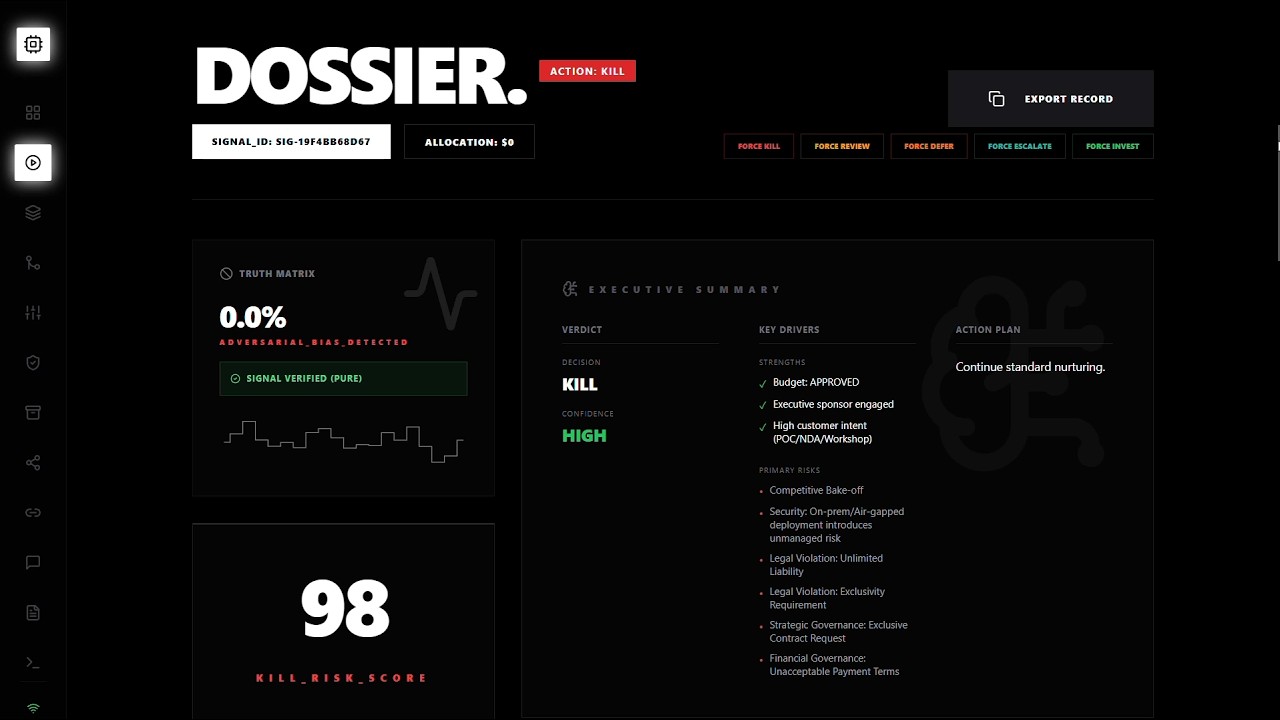
The latest Omni Kernel V7.2 architecture introduces a suite of elite, high-density visualization panels and cryptographic interfaces to the lead dossier. These interfaces transition the system from a standard CRM view into a Tier-1 quantitative trading terminal for enterprise revenue.
Actively scans and scores incoming signals against historical falsehoods and cognitive biases (e.g., sunk cost fallacy). It quantifies the "Truth Density" of a deal, flagging inflated pipelines before capital is committed.
Moving beyond passive observation, this terminal maps out counterfactual actions (e.g., "Confirm Sign-off Authority", "Unblock Budget Constraint") and their direct mathematical lift (+LIFT%) on the probability of closure. It dictates the exact structural moves required to alter the timeline.
Measures the degradation or chaos within the deal's structure across vectors like Team Cohesion, Sponsor Risk, and Budget Stability. Dark red indicates high entropy (high risk of failure), while green indicates structural solidity.
A multi-axis radar topology that visualizes the opportunity's profile across Growth, Stability, Yield, Strategy, and IP generation, instantly comparing the deal against baseline M&A metrics rather than basic CRM stages.
- Volatility Tax Waterfall: Visualizes the invisible cost of time and indecision. It charts how capital is eroded by prolonged sales cycles and operational drag.
- Radioactive Decay Curve: A non-linear area chart showing the toxic decay of a deal's viability over time. If a deal sits in the pipeline without structural progression, its value decays exponentially.
Every decision made by the Swarm and every human override is logged into an immutable audit trail.
The Cryptographic State Lock is dynamically generated for every output using a custom hash reduction algorithm based on the signal's unique identifier and ISO timestamp:
STATE_LOCK: Hash(Signal_ID + Timestamp).padEnd(64, '0')
This guarantees mathematically that the dossier's state at any given epoch cannot be retroactively altered by human actors without breaking the cryptographic chain.
Enterprise accounts are rarely static; they are highly dynamic, multi-year engagements with continuous expansion potential. The OMNI_KERNEL explicitly models Customer Lifetime Value (CLV) to adjust the boundaries of the Kelly Criterion.
When evaluating an existing customer entering a contract renewal cycle, the Kernel applies a proprietary CLV Modifier to the standard Kelly equation:
- Edge Amplification: Retaining an existing enterprise account mathematically presents an outsized expected value (EV) due to the elimination of initial acquisition costs (CAC). The Bayesian posterior probability receives a hard-coded +0.30 boost to offset any localized friction.
- Action Forcing: Routine warnings such as "Credit Risk" or "Revenue Decline" that would normally downgrade a net-new prospect to
REVIEWorDEFERare systematically overridden. The system forces anESCALATEaction for strategic renewals, guaranteeing that human capital is mobilized to protect the base. - Volatility Dampening: The "Volatility Tax" levied against high-entropy deals is halved for existing customers. We accept a wider epistemic confidence interval for established partners, mathematically acknowledging the structural resilience of multi-year contracts.
The OMNI_KERNEL operates on the assumption that enterprise environments are actively hostile and dynamically evolving. A static model in B2B sales is mathematically doomed to decay.
We continuously monitor the cumulative sum of predictive residuals (the difference between expected and actual outcomes).
- If the drift exceeds
$3\sigma$ (three standard deviations) from the historical mean, the Kernel triggers an automatic Recalibration Epoch. - During an Epoch, the weights of the Logistic Meta-Model Stack are reset, and the priors are widened to actively sample the new economic reality (e.g., transitioning from a zero-interest-rate environment to a capital-constrained market).
Adversarial actors (such as competitors probing for pricing intelligence) constantly mutate their language to bypass basic NLP filters. The RISK_NODE combats this by dynamically updating its Lexicon Vector Space:
- Automatically clusters anomalous phrase patterns from
HARD_KILLdeals. - Computes the cosine similarity of new communications against known adversarial clusters.
- Instantly assigns a "Treachery Score" to incoming requests that resemble historical espionage attempts, effectively rendering the system immune to repeated attacks of the same signature.
While the fractional Kelly Criterion dictates capital allocation sizes, certain deal characteristics represent infinite downside risk or massive temporal inefficiency. The Hard-Kill & Defer Matrix is an unyielding, deterministic governance layer that completely bypasses the stochastic engine.
When any of the following parameters evaluate to true, the Kelly Fraction is forced to HARD_KILL or DEFER:
- Critical Security Findings (
HARD_KILL): Any failed penetration test or unmitigated severity-1 vulnerability automatically terminates the pipeline. - Regulatory Prohibitions (
HARD_KILL): Sovereign compliance violations or data residency conflicts (e.g., GDPR violations in a non-compliant zone) that cannot be structurally solved. - Legal Restrictions (
HARD_KILL): Explicit legal blockers identified by theCOMPLIANCE_NODE. - Temporal Arbitrage Failure (
DEFER): Expiring contracts far in the future (>12 months), closed procurement windows, or inactive buying committees immediately sideline the deal for future re-engagement.
The matrix ensures that the enterprise never wastes a single hour of human capital on deals that are mathematically impossible to sign today.
While the OMNI_KERNEL is a standalone decision engine, it is designed for frictionless ingestion of legacy data streams.
- Salesforce/HubSpot Ingestion: The Kernel consumes raw CRM event streams (calls logged, emails sent, stages changed) via webhooks. It ignores subjective human inputs (like "Commit" forecasts) and extracts only the objective metadata (timestamps, recipient titles, payload lengths).
- SAP/Oracle Financials: Pulls historical contract values and payment latencies to inform the initial Bayesian Priors and calculate the exact cost of capital.
- Gong/Chorus Integrations: Ingests raw conversational transcripts to feed the
RISK_NODE, extracting semantic vectors and adversarial markers before human managers even review the calls.
To ensure the OMNI_KERNEL maintains its billion-dollar valuation trajectory, the underlying physical infrastructure and maintenance protocols are rigorously defined:
When deploying the Kernel into a new enterprise environment:
- Historical Seed (T-minus 30 Days): Ingest 5 years of closed-won and closed-lost data. The system trains the Logistic Meta-Model and establishes the initial Bayesian Priors.
- Adjacency Mapping: Run the continuous PageRank algorithm across the historical dataset to identify the true structural topology of the market.
- Shadow Execution: Run the Kernel in read-only mode for 14 days to calculate the baseline Counterfactual Delta Report (proving the exact dollar amount of capital wasted by human teams during the test period).
The mathematical engine is highly sensitive to regressions. All updates to src/math.ts must pass a rigorous suite of stochastic unit tests:
- Monte Carlo Convergence Tests: Ensure that the fat-tail models converge within the expected bounds over 10,000 runs.
- Kelly Preservation Tests: Guarantee that the Volatility Tax accurately penalizes high-entropy inputs and prevents Kelly Ruin.
- Temporal Alignment Tests: Verify the chronos-nodes accurately delay future-dated procurement cycles correctly.
- Cryptographic Hash Verification: Validate that the Merkle Ledger correctly hashes the state vectors and detects any unauthorized human overrides.
The React + Vite frontend handles the real-time UI visualization, while the heavy computations (HNSW Vector Search, PageRank, Log-Normal Monte Carlo) are designed to run in highly parallelized serverless environments (Node.js / V8).
- To maintain the 600ms consensus SLA, the total number of active connections in the Adjacency List is capped at 100,000, managed via aggressive LRU pruning.
- Epistemic Uncertainty: Uncertainty arising from a lack of knowledge or hidden information (e.g., an undisclosed competitor).
- Aleatoric Uncertainty: Inherent randomness in the system (e.g., a champion unexpectedly leaving the company).
- Thermodynamic Entropy: A measure of disorder and noise within a deal's structure, quantified by the breakdown of trust and communication.
- Temporal Governance: The mathematical framework used to evaluate and discount a deal's Expected Value based on time-to-value, procurement latency, and contract expiration windows.
-
Kelly Criterion (
$f^*$ ): A mathematical formula used to determine the optimal size of a series of bets to maximize the logarithm of wealth. - Inverse Propensity Scoring (IPS): A statistical technique used to estimate causal effects from observational data by weighting observations inversely to their probability of receiving the treatment.
- Contextual Bandits: A reinforcement learning framework used to solve the exploration vs. exploitation dilemma by taking into account the context (features) of the environment.
To understand the core engine's approach to the passage of time, we must formalize the Temporal Discounting Function. Let
The CHRONOS_NODE applies a non-linear decay function to the Expected Value based on the structural rigidities of B2B procurement:
Where:
-
$\gamma$ is the intrinsic decay rate of interest/attention without active pipeline motion (typically$0.003$ per day). -
$\Omega$ is a boolean penalty multiplier. If$T > 365$ days and a competitor contract is locked in,$\Omega = 1$ (forcing$V_t = 0$ and triggeringDEFER).
This forces the Kelly Criterion to evaluate the deal on its present value, preventing the over-allocation of resources to distant futures.
While PageRank gives us node importance, the Omni Kernel utilizes advanced Graph Neural Networks (GNN) principles to detect "Shadow Committees."
- Shadow Committee Detection: The system detects when an internal champion is repeatedly asking highly technical questions that exceed their recorded domain expertise. The Kernel models a hidden node (a "Shadow Evaluator") influencing the champion and adjusts the expected complexity of the deal.
- Structural Holes: By analyzing the adjacency matrix of communications, the Kernel identifies "structural holes" (points where communication is siloed). Bridging these holes mathematically increases the win probability by ensuring all stakeholders have unified context.
Why does the OMNI_KERNEL use terms like "Thermodynamic Entropy", "Kelly Criterion", and "Merkle Root" for a sales tool?
Because language shapes behavior.
By stripping away subjective, emotionally-charged terminology (e.g., "The deal is looking great", "The client loves us") and replacing it with rigid, unforgiving physics and mathematics (e.g., "The deal is highly entropic", "The Kelly fraction dictates zero capital deployment"), the Kernel forces human operators to act as objective fund managers rather than optimistic salespeople.
The architecture is explicitly designed to be adversarial to human hope. Hope is not a strategy; it is a statistical anomaly that destroys capital. The OMNI_KERNEL replaces hope with deterministic execution.
The OMNI_KERNEL produces telemetry designed for algorithmic consumption, not human dashboarding. The core telemetry includes:
- Capital Velocity (CV): The rate at which the system moves capital out of high-entropy deals and into high-probability deals. Measured in $ / \mu s$.
- Entropy Generation Rate (EGR): The speed at which a deal structure degrades without active intervention.
-
Counterfactual Lift Accuracy (CLA): The
$R^2$ correlation between the predicted IPS lift and the actual closed-won outcome. - Kelly Preservation Ratio (KPR): The percentage of total pipeline capital shielded from "Kelly Ruin" by the Variance Penalty over a trailing 90-day window.
To view the real-time telemetry stream, operators must access the air-gapped terminal via secure websocket.
This repository and its contents represent the apex of quantitative revenue engineering. Proceed with mathematical precision.
© 2026 OmniAgent Architecture. All Rights Reserved. Proprietary & Confidential.