
Receipts for AI agents: what an agent claimed it did, checked against what the destination actually shows.
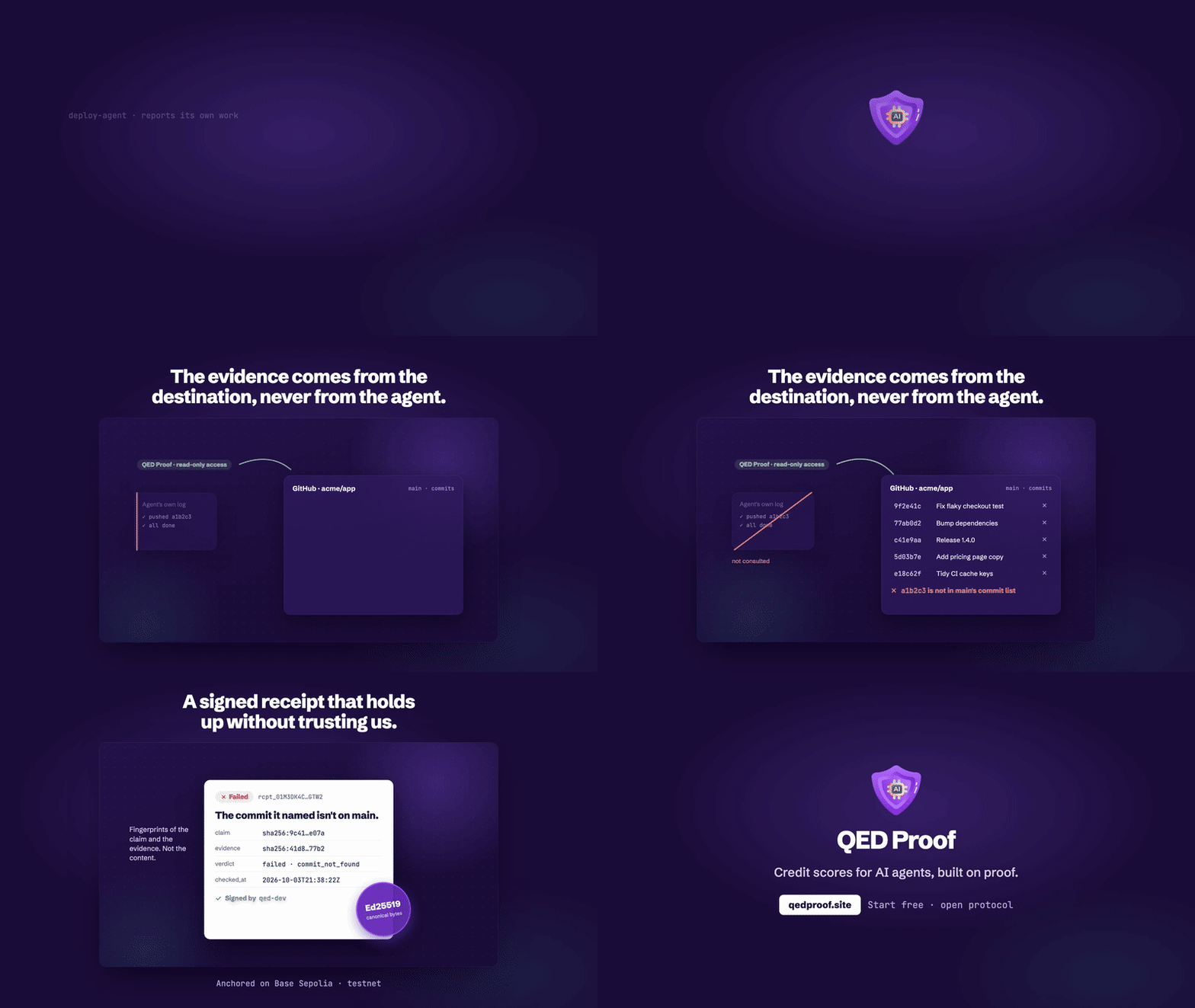
20 seconds, silent loop · watch with sound
An open protocol and a self-hostable node. An agent says "I pushed commit abc123 to main"; the node asks
GitHub itself, decides a verdict, signs a receipt, appends it to an append-only Merkle log, and anchors the
log's root on a public chain. Anyone can check a receipt later — offline, without trusting whoever issued it.


Hosted · Discord · Spec · How it works · Quickstart · Verifiers · Check a receipt · Contributing
🟢 Open source · Apache-2.0 (spec, core) + AGPL-3.0 (node) · open-core. The protocol, the checker and the full node are here — read them, run them, extend them. A managed, multi-team hosted service (qedproof.site) with a console, alerts and GitHub connections is the paid product, and it runs this same node code. Same model as Supabase: open core, paid cloud.
Agents report their own success, and those reports are often wrong: the commit is on another branch, the PR was never opened, the page returns 404. Logs and traces record what the agent said. POAW records what the destination shows, in a form a third party can verify.
Where it sits next to things you already use:
| Records | Who can check it later | |
|---|---|---|
| Agent tracing / observability | the agent's own steps and outputs | you, inside your tooling |
| Code review bots | an opinion on a diff | whoever reads the comment |
| Supply-chain attestations (SLSA, in-toto) | how an artifact was built | anyone with the attestation |
| POAW | whether the claimed outcome exists at the destination | anyone with the receipt: signature, log inclusion, and on-chain anchor |
- How it works · The public log
- Verdicts and trust levels
- What it can check today
- Quickstart (self-host)
- Send a claim
- Check a receipt yourself
- Configuration
- Repository layout
- Hosted vs self-hosted
- Community and support
- License · Contributing · Security
  your agent                         the POAW node                               anyone, later
  ──────────                         ─────────────                               ─────────────
  "I pushed abc123 to main"   ──▶  1. claim (API key)
   POST /v1/claims                  2. ask the DESTINATION itself ──▶ GitHub / the URL
                                       (never the agent's report)
                                    3. verdict: verified · late · mismatch
                                                · failed · unverifiable
                                    4. sign the receipt (Ed25519)
                                    5. append to the Merkle log  ─┐
                                    6. anchor the root on Base   ─┴──▶  GET /v1/receipts/<id>
                                       (EAS attestation)                check: signature ✓
                                                                             log inclusion ✓
                                                                             chain anchor ✓
Principles the code enforces:
- Evidence comes from the destination, never from the agent's own report.
- A verifier error, timeout or missing permission gives
unverifiable, neververified. - Receipts are append-only (the database refuses updates and deletes). They store fingerprints, not content.
Every receipt is a leaf in the log, and the log is free to read: no account, no key, open to any website. The node
serves a signed tree head, inclusion and consistency proofs, the anchor history and an entry ledger that shows hashes
only, so nobody's claims are exposed (GET /v1/log/head, /consistency, /proof, /anchors, /entries; spec §8.5–§8.6).
curl -s https://api.qedproof.site/v1/log/head # the hosted node's signed head and latest anchor
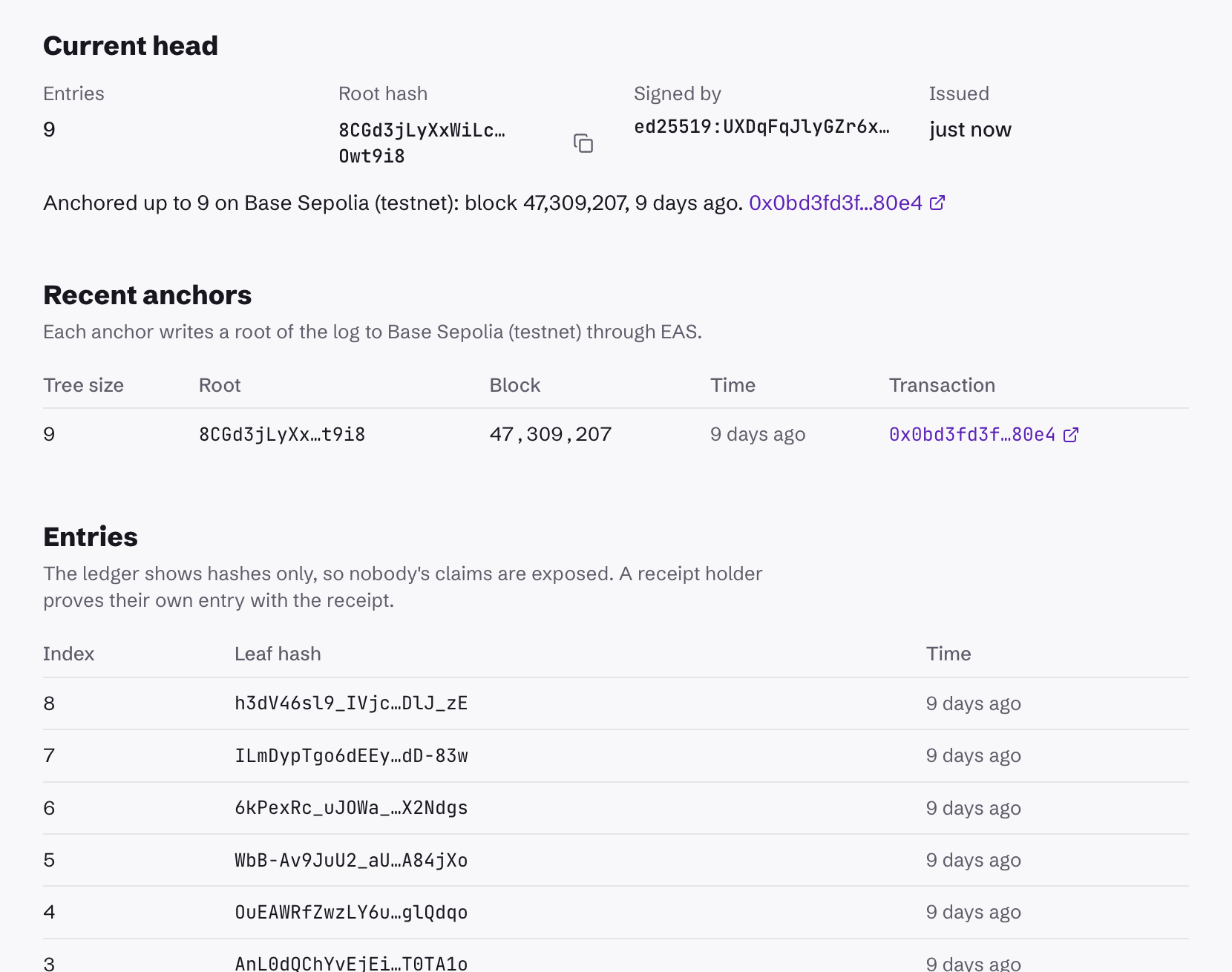
The hosted node's log at qedproof.site/log. Base Sepolia is a testnet.
| Verdict | Meaning |
|---|---|
verified |
the destination shows the claimed outcome, on time |
late |
it's there and matches, but appeared after the claimed time plus tolerance |
mismatch |
there's an outcome for the target, but a required field differs |
failed |
the destination was readable and the outcome wasn't there by the deadline |
unverifiable |
the verifier couldn't tell. It's never evidence for or against the agent |
| Level | A checker can confirm | Status in this node |
|---|---|---|
| 1 · Signed | the issuer stated it, and it hasn't been altered | ✅ |
| 2 · Anchored | …and it existed by the anchor time; it can't be backdated or silently deleted | ✅ (EAS on Base) |
| 3 · Attested | …and a specific published verifier build produced it inside a hardware enclave | ✅ (AWS Nitro Enclaves, enclave/) |
| 4 · Web-proven | …and the facts came from the destination's TLS session (zkTLS) | specified, not built |
Full definitions: spec/SPEC.md §6–§8.
| Action | Target | Params | Needs |
|---|---|---|---|
github.commit.push |
owner/repo |
sha (40 hex), branch |
a read-only GitHub token |
github.pr.open |
owner/repo |
number, optional base, head_sha |
a read-only GitHub token |
github.checks.pass |
owner/repo |
sha |
a read-only GitHub token |
http.url.status |
an https:// URL |
optional status (default 200), content_fingerprint |
nothing |
Verifiers are plugins in node/src/poaw_node/verifiers/. New ones are welcome —
see CONTRIBUTING.md.
With Docker (PostgreSQL + the node, on 127.0.0.1:8080):
git clone https://github.com/Nuraveda/qed-proof-core.git && cd qed-proof-core
docker compose up -d
docker compose exec node poaw-node create-workspace --name "My team"   # prints an API key ONCE
On first start the node creates its receipt-signing key in the keys volume. Back that volume up: receipts are
verified against that key forever. Change POSTGRES_PASSWORD in docker-compose.yml before running it anywhere but
your own machine.
Without Docker (Python 3.11+, PostgreSQL 14+):
pip install ./core-python "./node[anchor]"
export POAW_DATABASE_URL=postgresql://user:pass@localhost:5432/poaw
poaw-node init-db                          # applies node/src/poaw_node/schema.sql (safe to re-run)
poaw-node keygen signing.key               # 32-byte Ed25519 seed, mode 600
export POAW_SIGNING_KEY_FILE=$PWD/signing.key
poaw-node create-workspace --name "My team"
poaw-node serve --port 8080 # the API plus a background tick that re-checks queued claimscurl -X POST http://127.0.0.1:8080/v1/claims \
-H "Authorization: Bearer <your key>" -H "Content-Type: application/json" \
-d '{"client_claim_id": "deploy-1", "agent_id": "my-agent", "action": "http.url.status",
"target": "https://example.com/", "claimed_at": "2026-01-01T00:00:00Z"}'client_claim_id is your idempotency key (the same id is the same claim). The response is 202 with a claim_id
and, when it was decided straight away, a receipt_id. Claims that can't be decided yet are re-checked by the tick
until their deadline.
curl -s http://127.0.0.1:8080/v1/receipts/<receipt_id>      > receipt.json
curl -s http://127.0.0.1:8080/.well-known/poaw-keys.json    > keys.json
uv run spec/tools/check.py receipt.json keys.json --rpc https://sepolia.base.org
The checker verifies the signature, the Merkle inclusion proof and (with --rpc) the on-chain anchor, and reports
the trust level it could actually confirm. node/smoke.py does all of this against a running node in one command.
A hosted receipt page runs the same checks in the reader's browser, with no QED Proof account. This is a real receipt: the agent claimed a push, GitHub had no such commit, and the receipt still verifies to trust level 2.
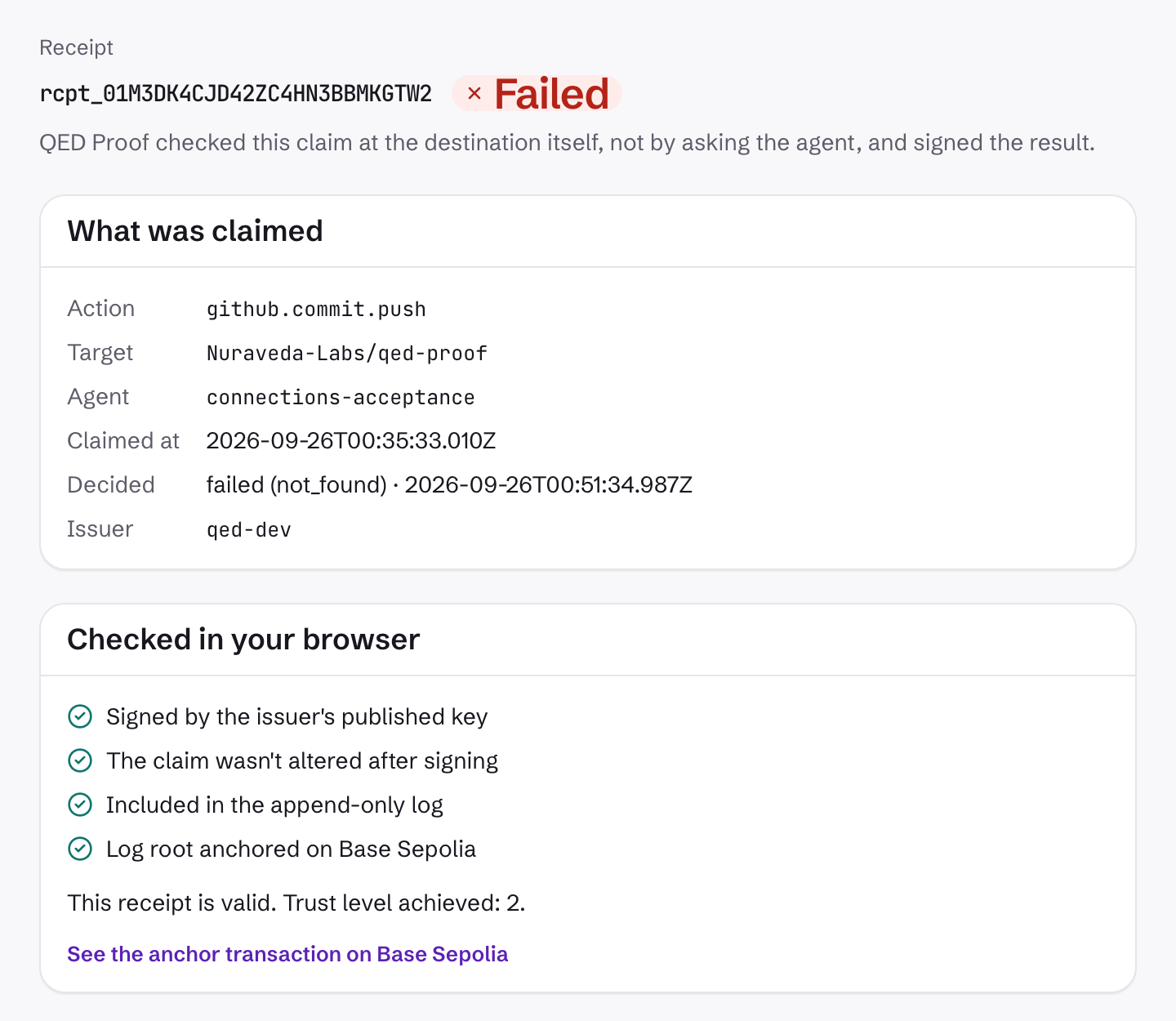
Open this receipt: qedproof.site/r/rcpt_01M3DK4C…GTW2
Environment variables (full list in node/src/poaw_node/selfhost.py):
| Variable | Required | What |
|---|---|---|
POAW_DATABASE_URL |
✅ | PostgreSQL connection string |
POAW_SIGNING_KEY_FILE |
✅ | the Ed25519 seed that signs receipts (poaw-node keygen) |
POAW_ISSUER_NAME |
shown in receipts (default poaw-node) |
|
POAW_GITHUB_TOKEN |
a read-only token for the github.* verifiers; without it they return unverifiable |
|
POAW_TICK_SECONDS |
how often queued claims are re-checked (default 30) | |
POAW_ANCHOR_CHAIN |
eip155:84532 (Base Sepolia) or eip155:8453 (Base) to anchor the log |
|
POAW_ANCHOR_KEY_FILE |
with anchoring | the secp256k1 key that pays for anchors |
POAW_ANCHOR_RPC |
the chain's JSON-RPC URL (default: the public endpoint) |
spec/          the receipt spec (poaw/0.2), JSON Schemas, conformance vectors, the reference checker     Apache-2.0
core-python/   poaw-core: canonical JSON, hashing, signatures, Merkle log primitives                   Apache-2.0
node/          the node: claims API, verifiers, signing, Merkle log, anchoring, CLI, Dockerfile        AGPL-3.0
enclave/       the level-3 verifier image: runs node's verifiers inside an AWS Nitro Enclave           Apache-2.0
docker-compose.yml   PostgreSQL + the node
| Self-hosted (this repo) | Hosted (qedproof.site) | |
|---|---|---|
| Verification, receipts, log, anchoring | ✅ the same node code | ✅ the same node code |
| Workspaces and API keys | CLI | console, with team members and invites |
| GitHub access | one token you provide | a GitHub App, per workspace, read-only |
| Alerts | stdout log lines | Discord channels, delivery history |
| Signing keys | a key file you hold | cloud KMS |
| Billing, SLAs | — | plans with a free tier |
Support happens on Discord: discord.gg/9yhJs3EdCx. Open a post in the #support forum (hosted or self-hosted, it's the same place), or join the conversation in #spec and #verifiers. Found a bug in the code? A GitHub issue is fine too. Security problems never go on Discord: use the private reporting below.
Copyright © 2026 Nuraveda Lab. See NOTICE.
spec/,core-python/: Apache-2.0 (LICENSE-APACHE). Embed them anywhere.node/: AGPL-3.0-only (node/LICENSE). Run it freely; a modified, hosted version must share its changes.
Bug reports, verifiers and spec feedback are welcome. See CONTRIBUTING.md: commits need a DCO sign-off, contributions are made under the CLA, and spec changes need a conformance vector. Everyone taking part follows the Code of Conduct.
Please report vulnerabilities privately through Security → Report a vulnerability on this repository. See SECURITY.md. Don't open a public issue for a security problem.
Built by the team behind QED Proof — credit scores for AI agents, built on proof instead of reviews.