A Python simulation to accurately replicate the Enigma Machine’s encryption and decryption processes and expanded it into a web-based version using Django for backend logic.
The Enigma machine is a cipher device developed and used in the early- to mid-20th century to protect commercial, diplomatic, and military communication. It was employed extensively by Nazi Germany during World War II, in all branches of the German military. The Enigma machine was considered so secure that it was used to encipher the most top-secret messages.
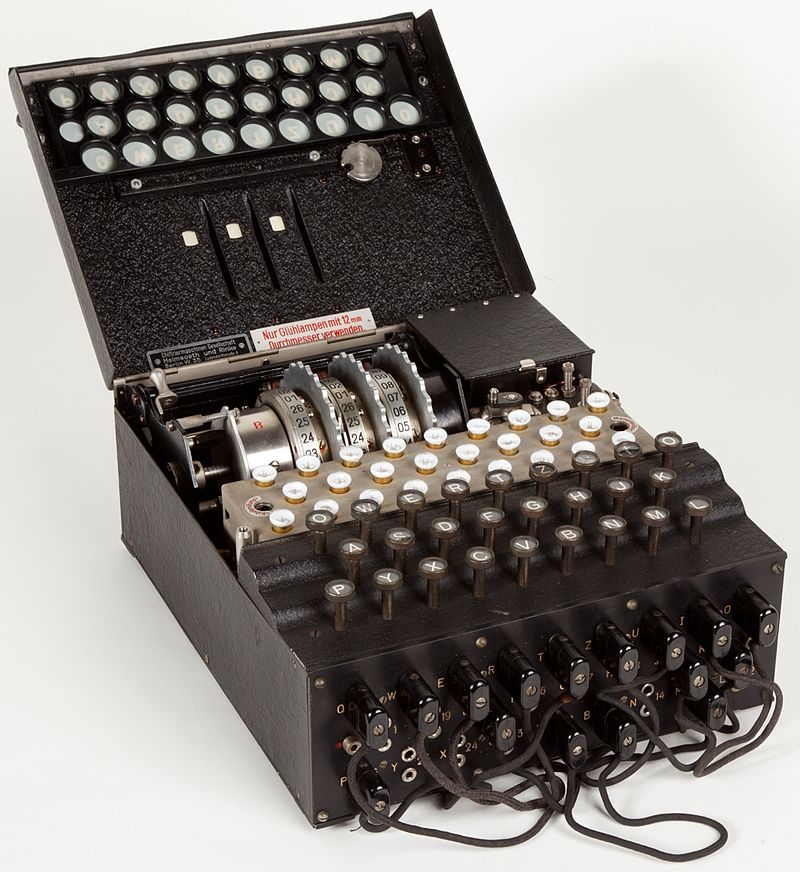
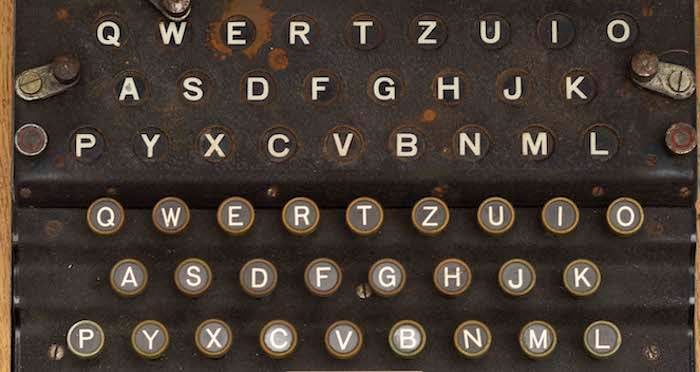
Below is the WW II Enigma Keyboard just look and also sounded as a typewriter.
(Fun fact it also QWERTY System)
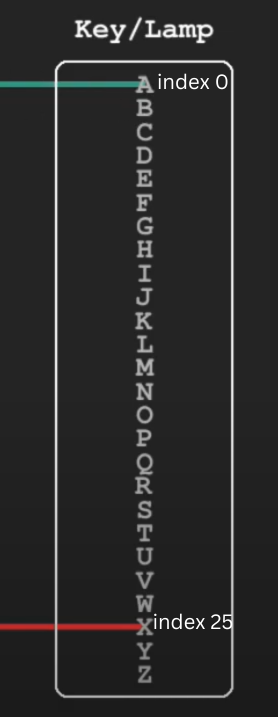
This program takes the letter and returns the index as a signal.
class Keyboard:

    def forward(self, letter):
        signal = "ABCDEFGHIJKLMNOPQRSTUVWXYZ".find(letter)
        return signal
    def backward(self, signal):
        letter = "ABCDEFGHIJKLMNOPQRSTUVWXYZ"[signal]
        return letter
This is a Plugboard just loacted below the keyboard. Generely it uses 10 Plug Wires to swap the letters.
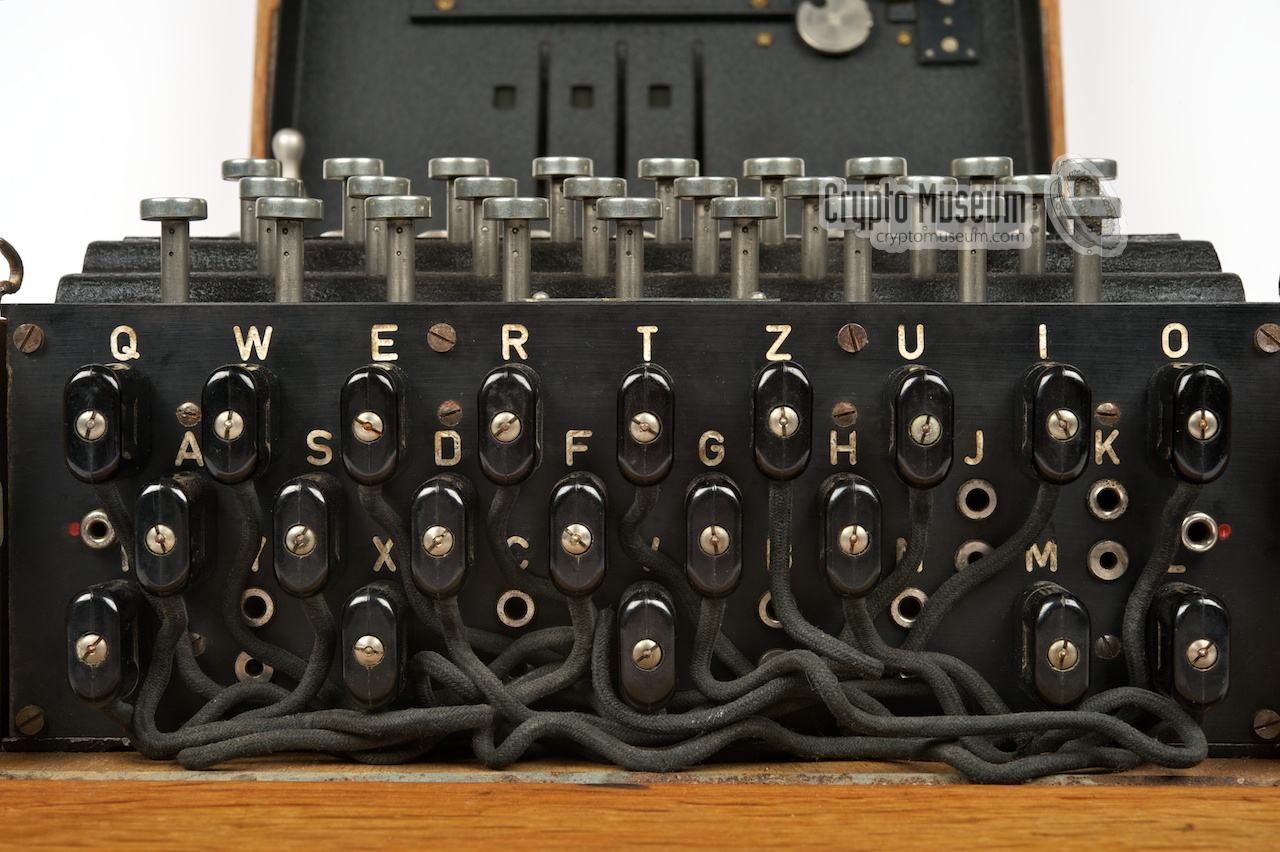
This program takes a list as an argument which contains strings of two letters which are to be swapped, ( e.g ["AR", "GK", "OX"]) by finding the index form left and swaps its.
class Plugboard:
    def __init__(self, pairs):
        self.left = "ABCDEFGHIJKLMNOPQRSTUVWXYZ"
        self.right = "ABCDEFGHIJKLMNOPQRSTUVWXYZ"
        for pair in pairs:
            A = pair[0]
            B = pair[1]
            pos_a = self.left.find(A)
            pos_b = self.left.find(B)
            self.left = self.left[:pos_a] + B + self.left[pos_a+1:]
            self.left = self.left[:pos_b] + A + self.left[pos_b+1:]
The forward and backward functions takes the signal and then searches the letters in the right and then it searches the letter left which is swapped and the index as a signal.
def forward(self, signal):
        letter = self.right[signal]
        signal = self.left.find(letter)
        return signal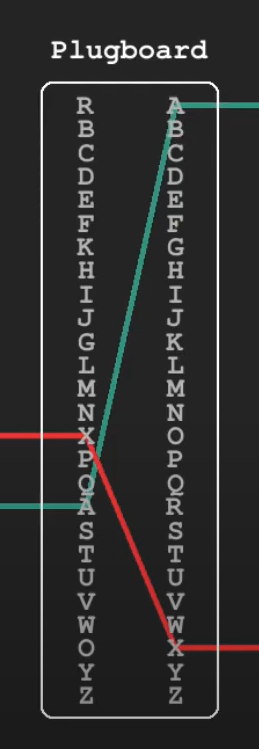
This program takes two argument a rotar wiring and a notch.
e.g
I = Rotor("EKMFLGDQVZNTOWYHXUSPAIBRCJ", "Q")
II = Rotor("AJDKSIRUXBLHWTMCQGZNPYFVOE", "E")
III = Rotor("BDFHJLCPRTXVZNYEIWGAKMUSQO", "V")
"EKMFLGDQVZNTOWYHXUSPAIBRCJ" is an historical rotar wiring used by Nazis during WW II. During the starting of the war there were three rotars but as the allied forces starting cracking the messages they started keeping 5 rotars.
Each rotars had a Notch as shown in the image below where we could set stating point of the rotars from where they will start rotatating.
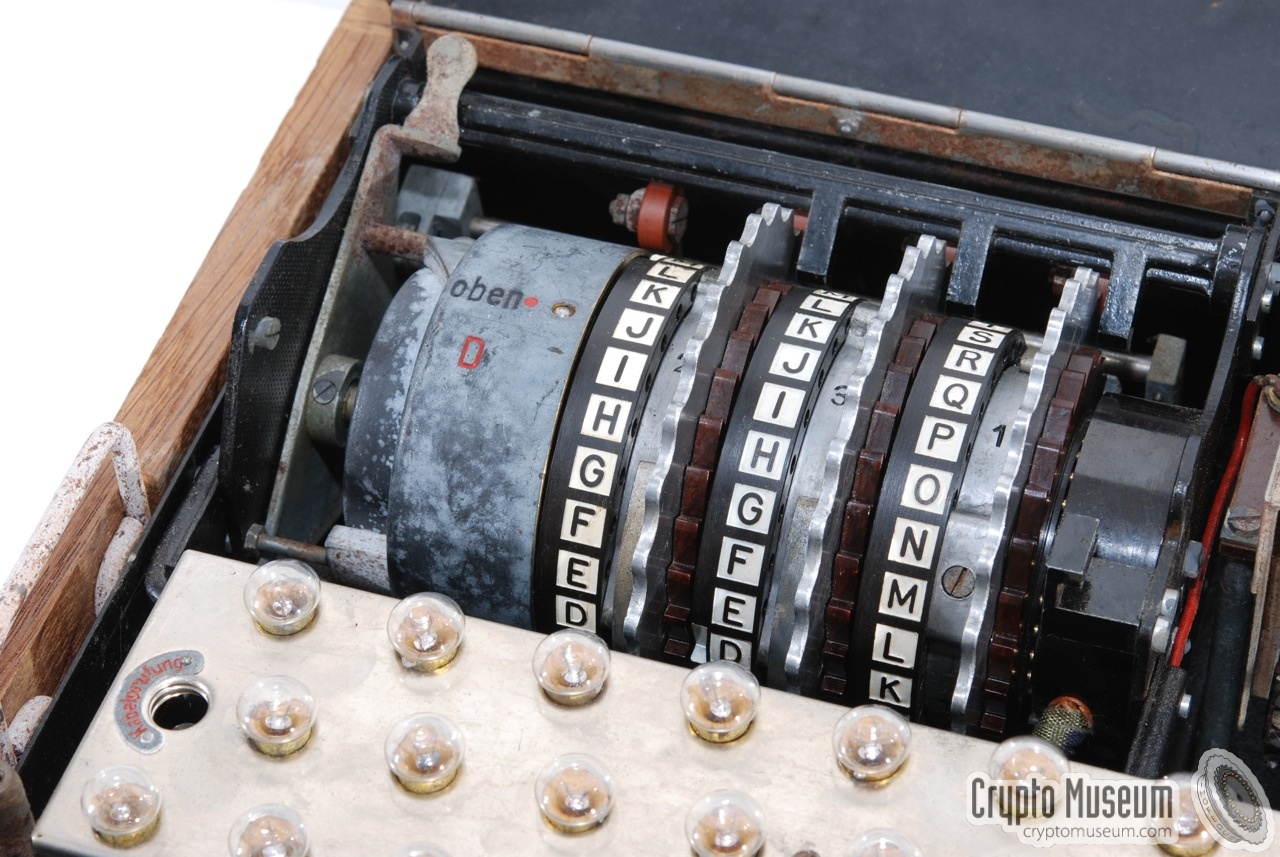
When we call the the Rotar functions we assin the variable self.left and self.right to "ABCDEFGHIJKLMNOPQRSTUVWXYZ" and wiring
class Rotor:
    def __init__(self, wiring, notch):
        self.left = "ABCDEFGHIJKLMNOPQRSTUVWXYZ"
        self.right = wiring
        self.notch = notch
Then we call the rotate_to_letter(self, letter) which first finds out how much the rotar should raote by finding the index of the letter in the string "ABCDEFGHIJKLMNOPQRSTUVWXYZ" and then it calls the rotate(self, n=1) function which rotates the rotar that many times so that it index or notch.
def rotate(self, n=1):
        for _ in range(n):
            self.left = self.left[1:] + self.left[0]
            self.right = self.right[1:] + self.right[0]

    def rotate_to_letter(self, letter):
        n = "ABCDEFGHIJKLMNOPQRSTUVWXYZ".find(letter)
        self.rotate(n)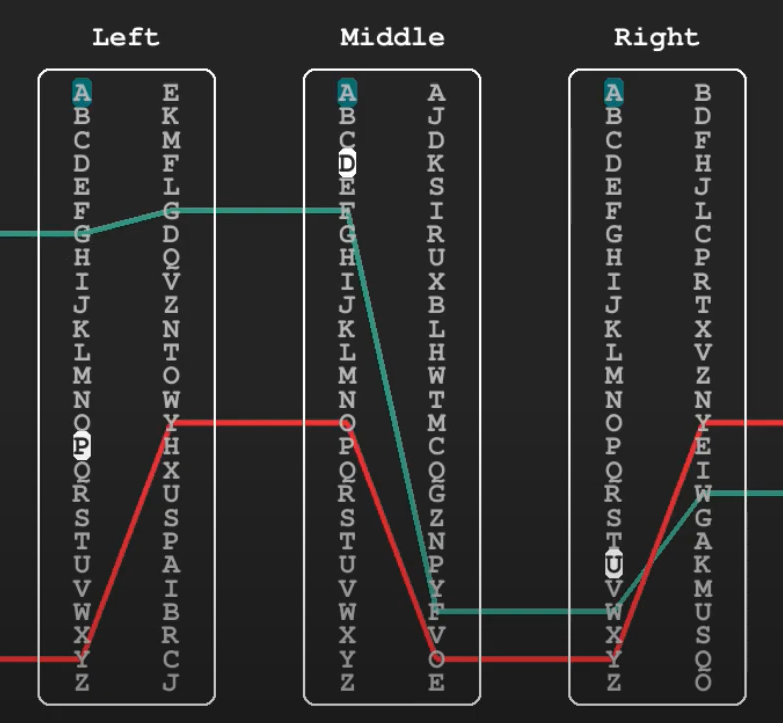
This program just take the signal and throws back the signal to rotars by changing the signals. e.g
A = Reflect("EJMZALYXVBWFCRQUONTSPIKHGD")
B = Reflect("YRUHQSLDPXNGOKMIEBFZCWVJAT")
C = Reflect("FVPJIAOYEDRZXWGCTKUQSBNMHL")
"EJMZALYXVBWFCRQUONTSPIKHGD" is a historical refletor used during the war. below is the a reflector which shows where and how it was placed in the machine.
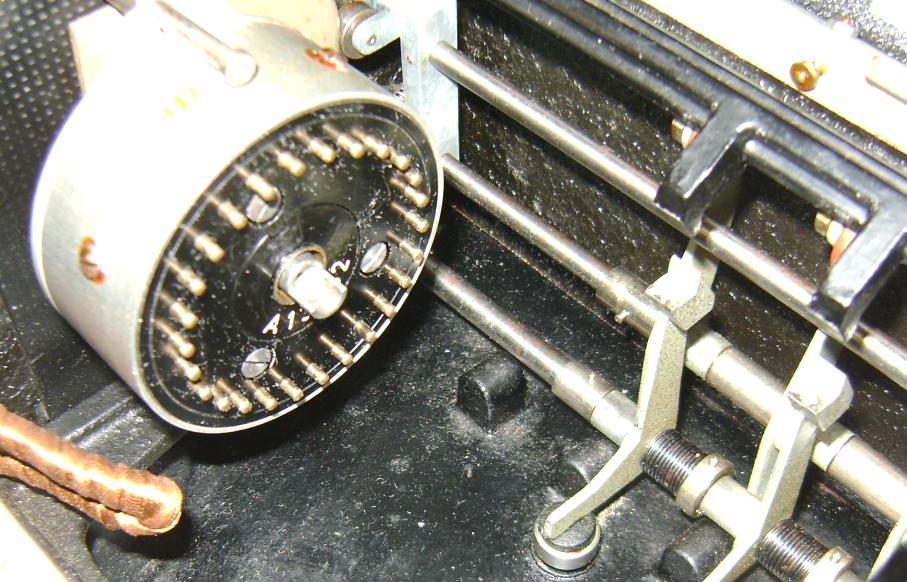
It takes argument wiring and assin it to self.right and self.left gets assin by "ABCDEFGHIJKLMNOPQRSTUVWXYZ". Then we call this function reflector(self, signal) takes the signal and finds it in letter in self.right and then it find the index of the letter in self.left and returns the signal.
class Reflect:
    def __init__(self, wiring):
        self.left = "ABCDEFGHIJKLMNOPQRSTUVWXYZ"
        self.right = wiring

    def reflector(self, signal):
        letter = self.right[signal]
        signal = self.left.find(letter)
        return signal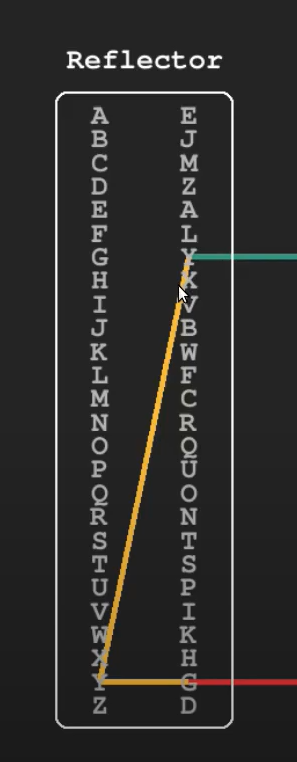
This program is the heart of the machine. Which takes Keyboard, Plugboard, Rotar, Reflector
class Enigma:
    def __init__(self,kb,pb,r1,r2,r3,re):
        self.kb = kb
        self.pb = pb
        self.r1 = r1
        self.r2 = r2
        self.r3 = r3
        self.re = re
set_key(self, key) This function set the Key which will rotate the rotars.
def set_key(self, key):
        self.r1.rotate_to_letter(key[0])
        self.r2.rotate_to_letter(key[1])
        self.r3.rotate_to_letter(key[2])
The Rotars had gears. The right most rotar have 24 teeth which is equal to 24 letter which rotate the rotar at every key stroke and other rotars have one teeth which rotates the when the right most rotar complete 24 strokes.
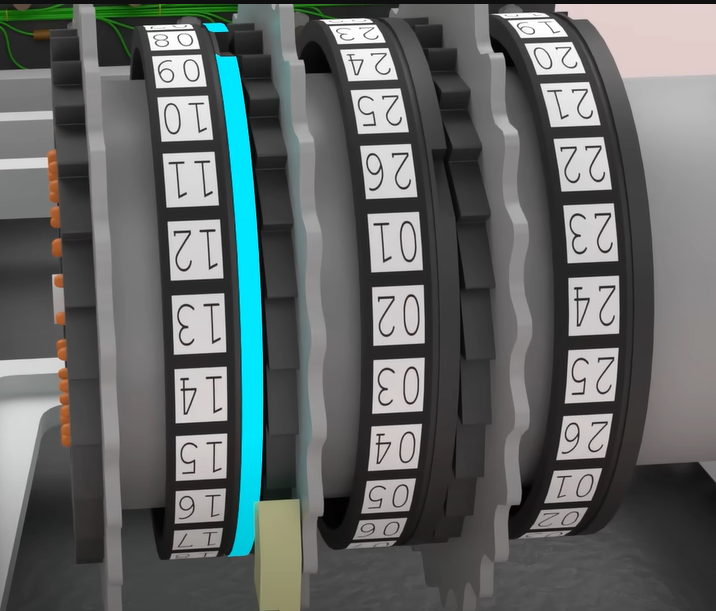
Same like this I have this program which just mimic this process. Here self.r3.rotate() right most rotar which rotates at every key stroke and self.r2.rotate() rotates when self.r3.rotate() complete 24 strokes and same as self.r1.rotate().
def encript(self, letter):
        if self.r2.left[0] == self.r2.notch and self.r3.left[0] == self.r3.notch:
            self.r1.rotate()
            self.r2.rotate()
            self.r3.rotate()

        elif self.r3.left[0] == self.r3.notch:
            self.r2.rotate()
            self.r3.rotate()
        else:
            self.r3.rotate()
Then we take the letter argument then pass to forward functions of the objects and then to reflector and the back to backward function of the objects. and then to keyboard which then returns the letter.
        signal = self.kb.forward(letter)
        signal = self.pb.forward(signal)
        signal = self.r3.forward(signal)
        signal = self.r2.forward(signal)
        signal = self.r1.forward(signal)
        signal = self.re.reflector(signal)
        signal = self.r1.backward(signal)
        signal = self.r2.backward(signal)
        signal = self.r3.backward(signal)
        signal = self.pb.backward(signal)
        letter = self.kb.backward(signal)

        return letter
Below is working visualization of this Enigma program.
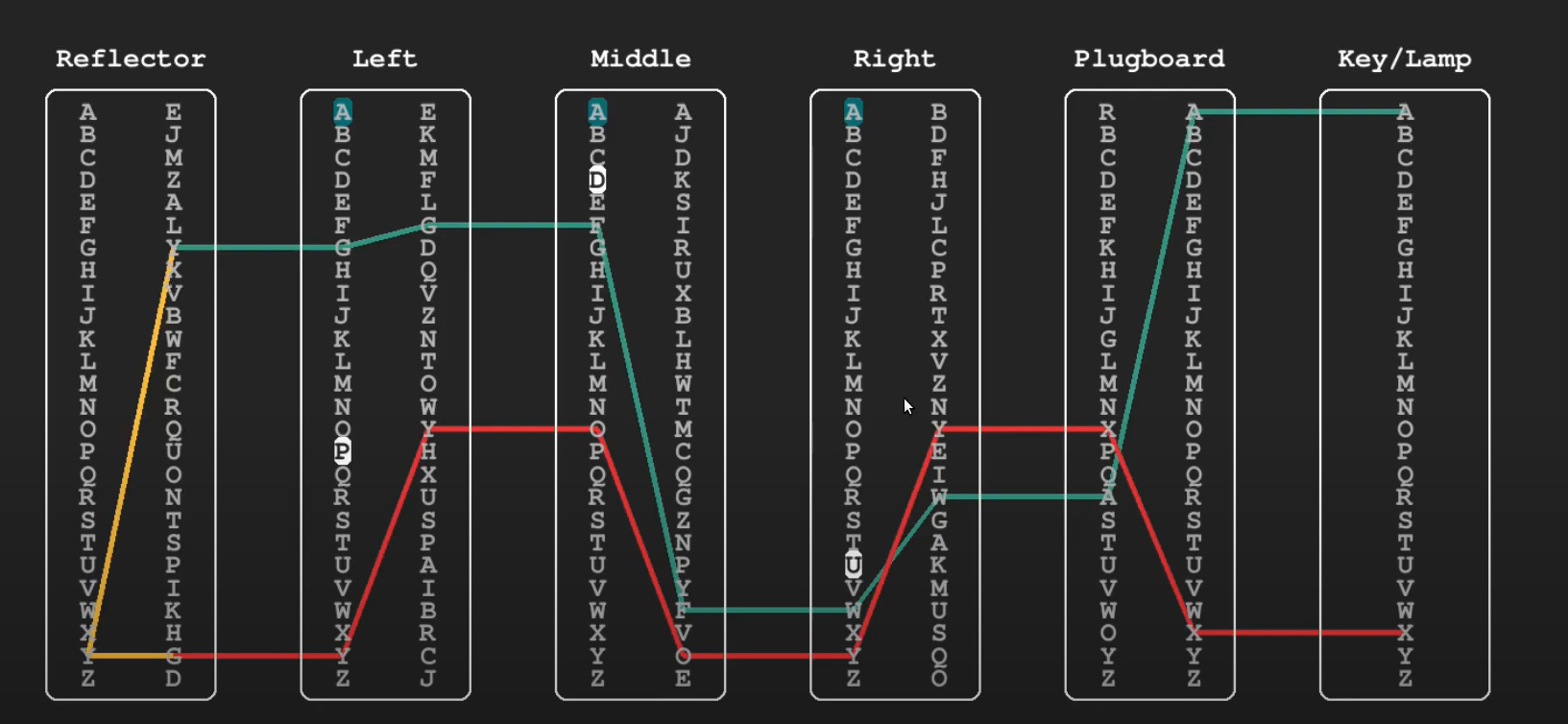
Here we imported all the parts of machine like Keyboard, Plugboard, Rotar, Reflector and the machine Enigma.
from key_board import Keyboard
from plugboard import Plugboard
from rotor import Rotor
from reflect import Reflect
from enigma import Enigma
We spacified the object for Rotars, Reflectors, Keyboard, Plugboard, Enigma
I = Rotor("EKMFLGDQVZNTOWYHXUSPAIBRCJ", "Q")
II = Rotor("AJDKSIRUXBLHWTMCQGZNPYFVOE", "E")
III = Rotor("BDFHJLCPRTXVZNYEIWGAKMUSQO", "V")
IV = Rotor("ESOVPZJAYQUIRHXLNFTGKDCMWB", "J")
V = Rotor("VZBRGITYUPSDNHLXAWMJQOFECK", "Z")

A = Reflect("EJMZALYXVBWFCRQUONTSPIKHGD")
B = Reflect("YRUHQSLDPXNGOKMIEBFZCWVJAT")
C = Reflect("FVPJIAOYEDRZXWGCTKUQSBNMHL")

KB = Keyboard()
PB = Plugboard(["AR", "GK", "OX"])

ENIGMA = Enigma(KB,PB,I,II,III,A)
Then we pass the key e.g "DOG" and then we pass the msg from the string: "NGMC" and then append the output in the string op
op = ""
ENIGMA.set_key("DOG")
for msg in "NGMC":
    op = op + ENIGMA.encript(msg)
print(op)To make our django aplication easy for deployment we made ALLOWED_HOSTS = ["*"] so, that we can access it from any url provied by cloud platform.
ALLOWED_HOSTS = ["*"]We then mention our ap machine in the list of installed apps.
# Application definition

INSTALLED_APPS = [
    'django.contrib.admin',
    'django.contrib.auth',
    'django.contrib.contenttypes',
    'django.contrib.sessions',
    'django.contrib.messages',
    'django.contrib.staticfiles',
    'machine',
]
and database we are using railway cloud.
DATABASES = {
    'default': {
        'ENGINE': 'django.db.backends.postgresql',
        'NAME': 'railway',
        'USER': 'postgres',
        'PASSWORD': '',
        'HOST': 'monorail.proxy.rlwy.net',
        'PORT': '',
    }
}
This project uses Django's static files system for serving CSS, JavaScript, images, and other assets. The STATIC_URL setting defines the base URL for static files, while STATICFILES_DIRS specifies the directory where Django looks for additional static files during development. For production, the STATIC_ROOT setting determines the directory where all static files are collected when running the collectstatic command. Additionally, the DEFAULT_AUTO_FIELD setting is used to define the default primary key field type for models.
It defines two URL routes using Django's path function. The first route maps the URL path "enigma" to the enigma view, which likely handles the Enigma Machine simulation. The second route maps the root URL ("") to the doc view, which is probably used to display documentation or additional information about the project.
from django.urls import path
from . import views

urlpatterns = [
    path("enigma", views.enigma),
    path("", views.doc),
]- Plugboard (
plugbd): A string representing pairs of connected letters, which is used for initial letter substitution. - Reflector (
reflector): The type of reflector used in the Enigma machine (A,B, orC). - Rotor Settings (
rotor1,rotor2,rotor3): Integer values representing the rotor configuration (1 to 5), which determine the wiring and notch positions. - Notches (
notch1,notch2,notch3): The positions of the notches on each rotor, affecting when the rotors will rotate. - Message (
textmsg): The plaintext message to be encrypted.
- Data Collection: The view gathers the user inputs via a
POSTrequest. - Rotor Setup: Based on the rotor choices (
rotor1,rotor2,rotor3), the corresponding rotors and notches are selected from theInventory. - Plugboard Setup: The plugboard configuration is created and used to swap letters.
- Reflector Setup: The selected reflector (A, B, or C) is chosen from the
Inventory. - Rotor Rotation: Each rotor is rotated according to its corresponding notch positions, and the machine's wiring configuration is applied.
- Encryption: The input message (
textmsg) is processed letter by letter:- The letter goes through the keyboard, plugboard, and rotors.
- The signal is reflected by the reflector and then goes back through the rotors, plugboard, and keyboard.
- The resulting letter is added to the output string.
- Display: The encrypted message is displayed using Django's messages framework.
- The created components (keyboard, plugboard, rotors, and reflector) are deleted after processing the message to avoid unnecessary memory usage.
- The encrypted message is displayed to the user as an informational message.
- The user inputs the plugboard configuration, rotor settings, notch positions, reflector type, and plaintext message via the form.
- The Enigma machine processes the message and displays the encrypted result on the same page.
The view renders the enigma2.html template, where the encrypted message and configurations are displayed. Additionally, a doc.html template is rendered for documentation purposes.
This view provides a functional simulation of the Enigma machine, implementing key encryption concepts of substitution and rotor shifting.
from django.shortcuts import render
from machine.models import *
from django.contrib import messages

def enigma(request):
    keyboard = ""
    plugboard = []
    rotar_1 = []
    rotar_2 = []
    rotar_3 = []
    reflector_ = []
    if request.method == "POST":
        plgbd = str(request.POST.get("plugbd"))
        plugbd =  plgbd.upper().split()
        reflector = str(request.POST.get("reflector"))
        reflector = reflector.upper()
        keys = str(request.POST.get("notch3")) + str(request.POST.get("notch2")) + str(request.POST.get("notch1"))
        print(keys)
        keys = keys.upper()
        rotor1 = int(request.POST.get("rotor1"))
        rotor2 = int(request.POST.get("rotor2"))
        rotor3 = int(request.POST.get("rotor3"))

        textmsg = str(request.POST.get("textmsg"))
        textmsg = textmsg.upper()

        keybrd = Keyboard.objects.create()

        plgbrd = Plugboard.objects.create(pairs = plugbd)

        if rotor1 == 1:
            RotI = Inventory.RotorI[0]
        elif rotor1 == 2:
            RotI = Inventory.RotorII[0]
        elif rotor1 == 3:
            RotI = Inventory.RotorIII[0]
        elif rotor1 == 4:
            RotI = Inventory.RotorIV[0]
        elif rotor1 == 5:
            RotI = Inventory.RotorV[0]

        if rotor2 == 1:
            RotII = Inventory.RotorI[0]
            NotchII = Inventory.RotorI[1]
        elif rotor2 == 2:
            RotII = Inventory.RotorII[0]
            NotchII = Inventory.RotorII[1]
        elif rotor2 == 3:
            RotII = Inventory.RotorIII[0]
            NotchII = Inventory.RotorIII[1]
        elif rotor2 == 4:
            RotII = Inventory.RotorIV[0]
            NotchII = Inventory.RotorIV[1]
        elif rotor2 == 5:
            RotII = Inventory.RotorV[0]
            NotchII = Inventory.RotorV[1]

        if rotor3 == 1:
            RotIII = Inventory.RotorI[0]
            NotchIII = Inventory.RotorI[1]
        elif rotor3 == 2:
            RotIII = Inventory.RotorII[0]
            NotchIII = Inventory.RotorII[1]
        elif rotor3 == 3:
            RotIII = Inventory.RotorIII[0]
            NotchIII = Inventory.RotorIII[1]
        elif rotor3 == 4:
            RotIII = Inventory.RotorIV[0]
            NotchIII = Inventory.RotorIV[1]
        elif rotor3 == 5:
            RotIII = Inventory.RotorV[0]
            NotchIII = Inventory.RotorV[1]

        if reflector == "A":
            reflt = Inventory.ReflectorA
        elif reflector == "B":
            reflt = Inventory.ReflectorB
        elif reflector == "C":
            reflt = Inventory.ReflectorC

        Keys = Inventory.objects.create(Keys = keys)

        plgbrd.swap()

        RI = Rotor_I.objects.create(right = RotI)
        RII = Rotor_II.objects.create(right = RotII)
        RIII = Rotor_III.objects.create(right = RotIII)

        REFLT = Reflector.objects.create(right = reflt)

        RI.rotate_to_char(Keys.Keys[0])
        RII.rotate_to_char(Keys.Keys[1])
        RIII.rotate_to_char(Keys.Keys[2])

        def encript(letter):

            if RIII.left[0] == NotchIII and RII.left[0] == NotchII:
                RI.rotate()
                RII.rotate()
                RIII.rotate()

            elif RIII.left[0] == NotchIII:
                RII.rotate()
                RIII.rotate()

            else:
                RIII.rotate()

            signal = keybrd.forward(letter)
            signal = plgbrd.forward(signal)
            signal = RIII.forward(signal)
            signal = RII.forward(signal)
            signal = RI.forward(signal)
            signal = REFLT.reflector(signal)
            signal = RI.backward(signal)
            signal = RII.backward(signal)
            signal = RIII.backward(signal)
            signal = plgbrd.backward(signal)
            letter = keybrd.backward(signal)

            return letter

        op = ""
        for msg in textmsg:
            op = op + encript(msg)
        print(op)
        messages.info(request, op)
        plugboard.append(plgbrd.left)
        rotar_1.append(RI.right)
        rotar_2.append(RII.right)
        rotar_3.append(RIII.right)
        reflector_.append(REFLT.right)
        keybrd.delete()
        plgbrd.delete()
        RI.delete()
        RII.delete()
        RIII.delete()
        REFLT.delete()
    keyboard = Keyboard.keys
    plugboard.append(Plugboard.right)
    rotar_1.append(Rotor_I.left)
    rotar_2.append(Rotor_II.left)
    rotar_3.append(Rotor_III.left)
    reflector_.append(Reflector.left)
    print(keyboard, plugboard)
return render(request, "enigma2.html")This document provides an overview of the Django models used to simulate the Enigma Machine.
The Inventory model represents the configurations for the rotors and reflectors, along with the initial key setting.
class Inventory(models.Model):
    RotorI = ["EKMFLGDQVZNTOWYHXUSPAIBRCJ", "Q"]
    RotorII = ["AJDKSIRUXBLHWTMCQGZNPYFVOE", "E"]
    RotorIII = ["BDFHJLCPRTXVZNYEIWGAKMUSQO", "V"]
    RotorIV = ["ESOVPZJAYQUIRHXLNFTGKDCMWB", "J"]
    RotorV = ["VZBRGITYUPSDNHLXAWMJQOFECK", "Z"]

    ReflectorA = "EJMZALYXVBWFCRQUONTSPIKHGD"
    ReflectorB = "YRUHQSLDPXNGOKMIEBFZCWVJAT"
    ReflectorC = "FVPJIAOYEDRZXWGCTKUQSBNMHL"

    Keys = models.CharField(max_length=3, default='DOG')

    def __str__(self):
return self.Keys- RotorI, RotorII, RotorIII, RotorIV, RotorV: Rotor wiring configurations and initial positions.
- ReflectorA, ReflectorB, ReflectorC: Reflector wiring configurations.
- Keys: User-defined key for encryption (default: 'DOG').
The Keyboard model represents the Enigma machine's keyboard with letters A-Z.
class Keyboard(models.Model):
    keys = "ABCDEFGHIJKLMNOPQRSTUVWXYZ"
    letter = models.CharField(max_length=1, default='A')
    signal = models.IntegerField(default=0)

    def forward(self, letter):
        signal = self.keys.find(letter)
        return signal

    def backward(self, signal):
        letter = self.keys[signal]
        return letter

    def __str__(self):
return self.keys- forward(letter): Maps a letter to its corresponding signal (index in the alphabet).
- backward(signal): Maps a signal (index) back to the corresponding letter.
The Plugboard model allows for letter pair swapping, which modifies the signal.
class Plugboard(models.Model):
    right = "ABCDEFGHIJKLMNOPQRSTUVWXYZ"
    left = "ABCDEFGHIJKLMNOPQRSTUVWXYZ"
    pairs = models.JSONField(default=list)
    signal = models.IntegerField(default=0)

    def swap(self):
        for pair in self.pairs:
            a = pair[0]
            b = pair[1]
            pos_a = self.right.find(a)
            pos_b = self.right.find(b)
            self.left = self.left[:pos_a] + b + self.left[pos_a+1:]
            self.left = self.left[:pos_b] + a + self.left[pos_b+1:]

    def forward(self, signal):
        letter = self.right[signal]
        signal = self.left.find(letter)
        return signal

    def backward(self, signal):
        letter = self.left[signal]
        signal = self.right.find(letter)
        return signal

    def __str__(self):
return self.left- swap(): Swaps pairs of letters in the left wiring.
- forward(signal): Maps a signal through the plugboard.
- backward(signal): Maps a signal backward through the plugboard.
Each rotor has a right and left wiring, with methods to map signals forward and backward. The rotors also rotate with each key press.
class Rotor_I(models.Model):
    right = models.CharField(max_length=26, default="ABCDEFGHIJKLMNOPQRSTUVWXYZ")
    left = "ABCDEFGHIJKLMNOPQRSTUVWXYZ"
    n = models.IntegerField(default=1)

    def forward(self, signal):
        letter = self.right[signal]
        signal = self.left.find(letter)
        return signal

    def backward(self, signal):
        letter = self.left[signal]
        signal = self.right.find(letter)
        return signal

    def rotate(self, n=1):
        for _ in range(n):
            self.left = self.left[1:] + self.left[0]
            self.right = self.right[1:] + self.right[0]

    def rotate_to_char(self, letter):
        n = "ABCDEFGHIJKLMNOPQRSTUVWXYZ".find(letter)
        self.rotate(n)

    def __str__(self):
return self.right- forward(signal): Maps a signal through the rotor.
- backward(signal): Maps a signal in reverse through the rotor.
- rotate(n): Rotates the rotor by
npositions. - rotate_to_char(letter): Rotates the rotor to a specific letter.
The Reflector model reflects the signal back after passing through the rotors.
class Reflector(models.Model):
    right = models.CharField(max_length=26, default="ABCDEFGHIJKLMNOPQRSTUVWXYZ")
    left = "ABCDEFGHIJKLMNOPQRSTUVWXYZ"
    signal = models.IntegerField(default=0)

    def reflector(self, signal):
        letter = self.right[signal]
        signal = self.left.find(letter)
        return signal

    def __str__(self):
return self.rightreflector(signal): Reflects the signal through the reflector.
I have developed and deployed an Enigma Machine simulation in Django. You can learn more about the project from the following YouTube videos: