

- The entire Open Source/Weights Community that will continue to democratize Intelligence.
This thesis argues that Bittensor represents an evolution of capitalism — a crypto-incentivized market for intelligence compute, where mechanisms like Yuma Consensus function as an optimization process analogous to natural selection, rewarding the miners and validators that best serve a subnet's objective function.
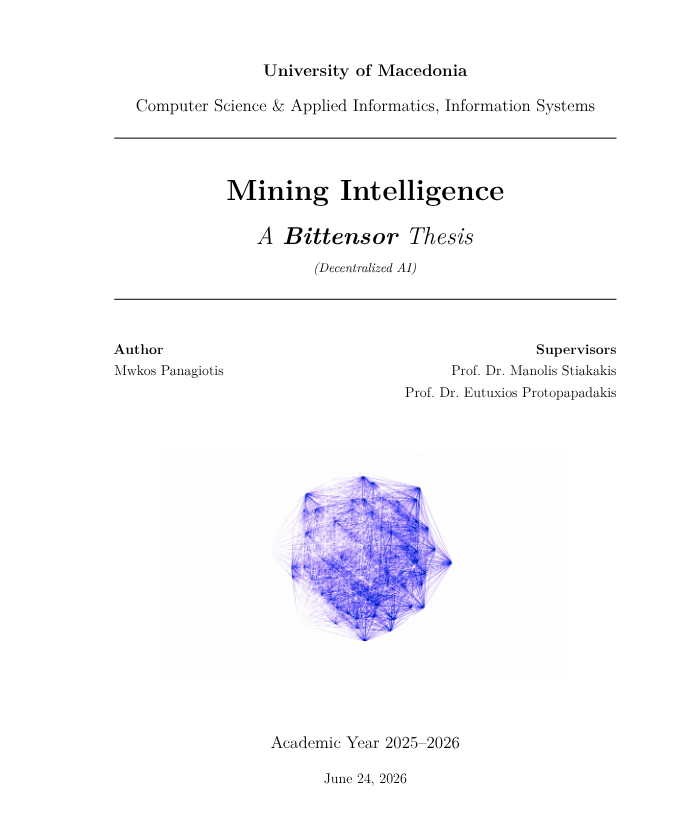
The thesis is split into two parts:
- Theory — Bittensor framed as the latest stage in the evolution of capitalism and cryptocurrency: from the history of capitalism, through the Web3 era (Bitcoin, Ethereum, consensus mechanisms), to Bittensor's own architecture (Yuma Consensus, Dynamic TAO, subnet incentive markets).
- Empirical / hands-on mining — validating the theory in practice by actually mining a subnet, rather than treating the argument as purely conceptual.
The title is intentionally double-meaning: mining as the literal hands-on crypto work this thesis performs, and intelligence as the compute being harnessed and incentivized — the title previews the paper's own two-part structure.
Covers the history of capitalism, the Web3 era (Bitcoin, Ethereum, altcoins, consensus mechanisms), and Bittensor's architecture in depth: Yuma Consensus, tokenomics, Dynamic TAO (dTAO), and the subnet incentive-market model.
Key tokenomics points argued in this section: TAO follows a Bitcoin-style fixed 21 million supply cap with programmed halving events (first halving ~December 2025), not unbounded inflation. Bittensor extends this with a two-layer emission system — root TAO plus per-subnet alpha tokens, each independently capped at 21 million with its own halving schedule — distinguishing it from Bitcoin's single-asset model.
The empirical chapter mines a live subnet hands-on to validate the theoretical framing. Conceptual sections (mining loop/tempo mechanics, Yuma Consensus in practice, subnet selection criteria) are kept separate from setup/walkthrough material to avoid redundancy with the existing Linux environment chapter. Subnets referenced for context and comparison include Chutes (SN64), Ridges, Targon, and Templar.
This part also has hands on Coding as a potential Miner Example for Subnet 32 (SN 32) ItsAI. Dataset Selection/Preprocessing, Feature Engineering, Exploratory Data Analysis, Model Selection/training/evaluation & Ultimately Fine Tuning & Findings Report.
The Coding is mainly done using existing open source libraries like numpy,pandas,pytorch and mainly AbstractML python library made by me to Abstract the ML steps & Proecesses into simple Concise Steps.
- Supervisors: Prof. Dr. Manolis Stiakakis, Prof. Dr. Eutuxios Protopapadakis
- University of Macedonia (ΠΑΜΑΚ) — Applied Informatics
Panagiotis Mokos
- GitHub: MwkosP
- LinkedIn: panagiotis-mokos