




A living ASCII ecosystem that runs in your terminal. Watch plants spread, herbivores graze and predators hunt—all while you leave your terminal open.
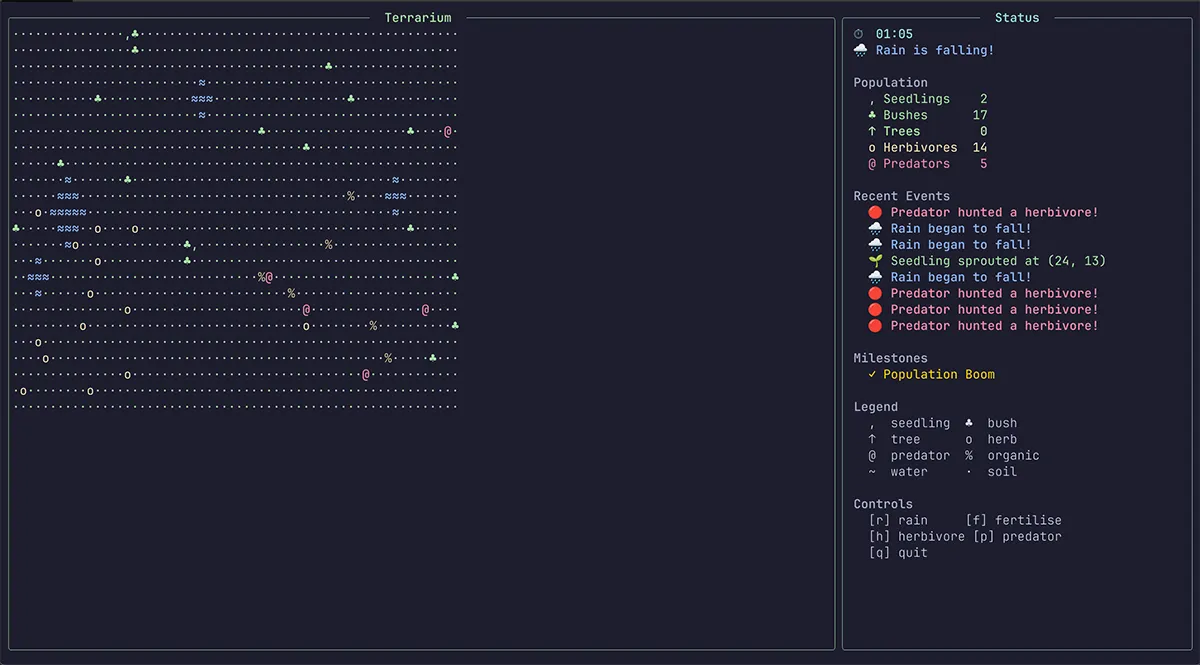
Terrarium is an idle simulation game. The player watches—and occasionally nudges— a self-sustaining world of plants, herbivores and predators. The core fantasy is:
"I grew something beautiful just by leaving my terminal open."
- Python 3.11+
rich- A terminal at least 80 × 24 characters (120 × 30+ recommended)
pip install terrarium-game
terrarium-gamegit clone https://github.com/minoangelo/terrarium
cd terrarium
pip install -r requirements.txt
python main.py| Key | Action |
|---|---|
r |
Drop rain: boosts all moisture for 20 seconds |
f |
Fertilise a random region: boosts nutrients |
h |
Introduce a new herbivore |
p |
Place a new predator (if below the cap) |
q |
Quit and save |
The game is designed to be satisfying to watch without touching the keyboard.
The world is a 2-D tile grid (up to 60 × 24, scaled to your terminal). Each tile tracks moisture and nutrients (0–100) that slowly regenerate over time. Static water tiles (~) boost nearby moisture. Dead organic matter (%) fertilises the soil as it decays.
| Symbol | Name | Behaviour |
|---|---|---|
, |
Seedling | Grows into a bush after ~30 s if soil is fertile |
♣ |
Bush | Grows into a tree after ~120 s; spreads seeds more aggressively |
↑ |
Tree | Fully mature; highest seed-spread rate |
Plants die when soil nutrients reach zero, leaving organic matter behind.
| Symbol | Name | Cap | Behaviour |
|---|---|---|---|
o |
Herbivore | 20 | Wanders and eats adjacent plants; reproduces when well-fed |
@ |
Predator | 5 | Hunts the nearest herbivore within 5 tiles; second one unlocks at 2 min |
Both animals starve if hunger reaches 100—health then decays until death, leaving organic matter.
| Milestone | Trigger |
|---|---|
| First Tree Matured | A tree reaches full growth |
| Old Growth Forest | More than 10 trees exist simultaneously |
| Population Boom | Herbivore count exceeds 12 |
| Ecosystem Balanced | All three species co-exist for 60 consecutive seconds |
| Apex Predator | A predator survives 5+ minutes (it earns a name) |
| The Great Dying | All herbivores go extinct |
The game auto-saves every 30 seconds to ~/.terrarium/save.json. On next launch
you will be asked whether to resume. Quitting with q always saves immediately.
terrarium/
├── main.py          # Entry point, game loop, keyboard input
├── world.py         # Grid, Tile and soil simulation
├── entities.py      # Entity classes and per-tick simulation logic
├── renderer.py      # Rich layout, viewport drawing, sidebar
├── events.py        # Event log and milestone tracking
├── persistence.py   # JSON save/load
├── state.py         # Shared runtime/render state dataclasses
└── requirements.txt
Contributions are welcome. This project currently uses a lightweight workflow.
python3 -m venv .venv
source .venv/bin/activate
python -m pip install --upgrade pip
pip install -r requirements.txt# run the app
python main.py
# basic syntax/import check
python -m compileall .
# lint (primary)
pylint main.py <file>
# lint tests (with project root on PYTHONPATH)
PYTHONPATH=. pylint tests/<file>
# optional fast lint
ruff check .The repository includes tests under tests/. Use pytest to run them, and keep
adding coverage there as features and bug fixes evolve.
# run all tests
pytest

# run a single test file
pytest tests/test_entities.py

# run a single test case
pytest tests/test_entities.py::test_predator_moves_toward_nearest_prey

# run by expression
pytest -k "predator and not slow"- Follow Conventional Commits
(for example:
feat: ...,fix: ...,docs: ...). - Keep changes focused and small when possible.
- In your PR description, include:
- what changed,
- why it changed,
- which validation commands you ran.
- Versioning and release PRs are automated with Release Please.
- Conventional Commit messages are used to determine version bumps and changelog entries.
- Publishing to PyPI runs from GitHub Actions when a GitHub Release is published.
- Configure PyPI trusted publishing for this repository before the first release.
- Keep architecture boundaries intact:
world.pyfor terrain/soil rules,entities.pyfor simulation behavior,renderer.pyfor presentation,persistence.pyfor save/load,main.pyfor orchestration and input loop.
- Avoid blocking I/O in the main loop.
- Preserve save compatibility where practical.
See LICENSE.md.
- Carmine (Mino) Siena, dev@mino-siena.de