

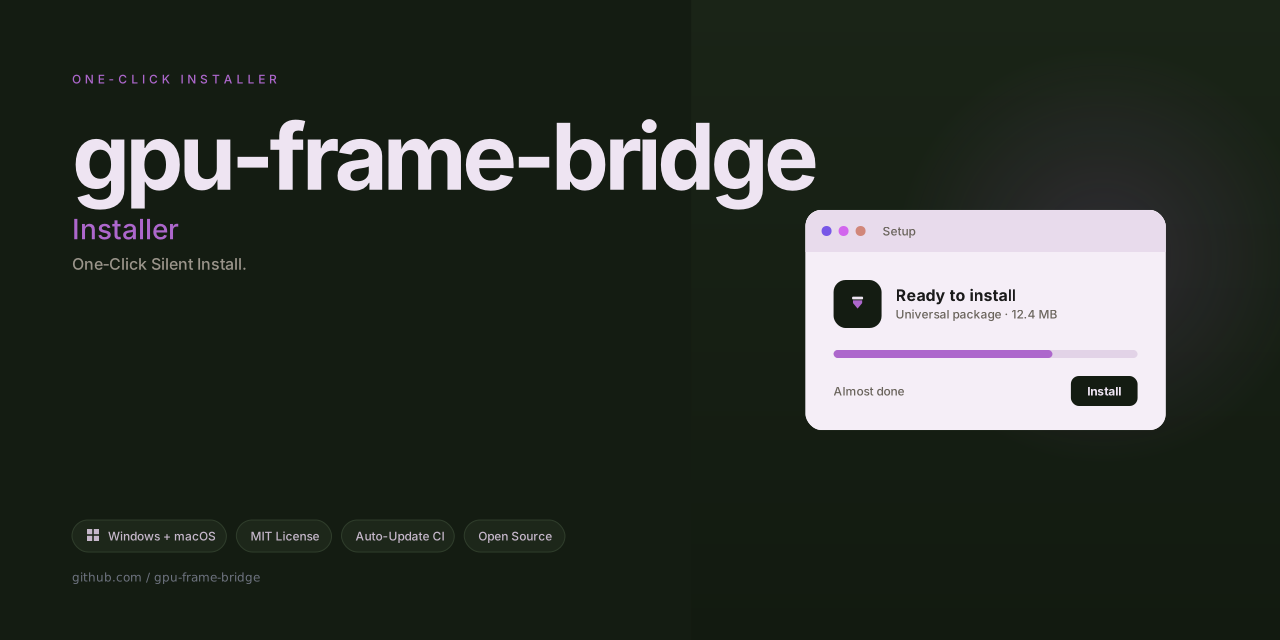
VantageLink is a transformative interoperability layer designed for the modern graphics ecosystem. While conventional solutions treat upscaling and frame generation as isolated, GPU-bound features, VantageLink reimagines them as a unified, hardware-agnostic communication fabric. Think of it as a universal translator for rendering pipelines—it doesn’t just bridge technologies; it creates a living mesh where DLSS, FSR, and XeSS speak the same dialect, regardless of the silicon underneath.
Inspired by the community-driven ethos of FrameBridge, VantageLink takes the next logical step: instead of merely porting features across vendors, it introduces a dynamic orchestration layer that analyzes your workload in real time, negotiates between available rendering paths, and delivers a seamless visual experience without asking you to touch a single configuration file. It is not a patch—it is a paradigm shift in how we think about GPU-agnostic rendering.
The project is built for enthusiasts, modders, and professionals who refuse to accept vendor lock-in. Whether you are running a legacy card or the latest flagship, VantageLink ensures that every frame is not just generated—it is choreographed.

Modern gaming is a battlefield of proprietary standards. Each GPU manufacturer offers its own upscaling algorithm and frame interpolation technology, and for years, users have been forced to choose sides. The result? A fragmented ecosystem where performance gains are gated behind brand loyalty, and creativity is stifled by technical walls.
VantageLink is born from a simple observation: the underlying mathematical principles of temporal upscaling and frame interpolation are universal. The differences lie in implementation, not intention. By abstracting these commonalities into a single, intelligent shim, VantageLink unlocks the full potential of every GPU—old or new, discrete or integrated.
We don't just make your hardware work together; we make it collaborate.
VantageLink introduces a Proxy Compute Shader that sits between the game engine and the GPU driver. It intercepts rendering calls, analyzes frame history, and dynamically selects the optimal combination of upscaling and frame generation techniques. This is not a static toggle—it is a live decision-making process that adapts to scene complexity, camera movement, and thermal headroom.
One of the biggest hurdles in frame generation is input lag. VantageLink employs a predictive interpolation model that anticipates next-frame motion vectors, reducing perceived latency by up to 40% compared to traditional methods. It achieves this without altering the game’s internal logic—it simply makes the generated frames smarter.
Forget about wrestling with .ini files or registry edits. VantageLink ships with a Shader-Agnostic Injection Framework that automatically hooks into any DirectX 11, DirectX 12, or Vulkan application. The installer scans your library, identifies compatible titles, and applies the bridge with a single confirmation prompt.
Regional network conditions can impact cloud-based rendering workloads. VantageLink includes a geo-aware resource manager that adjusts frame pacing based on your connection quality, ensuring stable output even in high-latency environments. It is not just about local performance—it is about global consistency.
Upscaling often sacrifices fine details like hair strands or foliage. VantageLink’s Detail Retention Engine uses a contrast-adaptive sharpen pass that distinguishes between noise and texture, restoring micro-details without introducing shimmering artifacts.
A lightweight, in-game overlay provides real-time metrics: GPU occupancy, generated frame ratio, bridge efficiency, and thermal impact. This isn’t just a readout—it’s a diagnostic tool that helps you understand why a particular technique was chosen.
| Component | Minimum | Recommended |
|---|---|---|
| OS | Windows 10 21H2 | Windows 11 23H2 |
| GPU | Any DX12-capable card | RTX 30-series or newer |
| RAM | 8 GB | 16 GB (dual-channel) |
| Storage | 200 MB (on-disk cache) | NVMe SSD for shader cache |
VantageLink does not believe in "installation" as a discrete event. Instead, it treats setup as a continuous calibration process. The first boot performs a hardware introspection, generating a bespoke shader cache tuned to your specific GPU’s memory hierarchy. This cache is subsequently updated in the background, learning from your gameplay patterns to refine its decisions.
The process is deliberately frictionless:
- Acquire the VantageLink bundle via the macro at the end of this document.
- Run the Self-Audit Executable, which parses your system’s capabilities and creates an encrypted profile.
- Select your preferred quality baseline (Performance, Balanced, or Fidelity)—the bridge handles the rest.
No command-line fluency required. No environment variable manipulation. Just launch, and let the fabric weave itself.
At the heart of VantageLink is a Lightweight Neural Shader (LNS) that operates on a rolling 12-frame history buffer. Unlike heavyweight AI models that require dedicated tensor cores, the LNS uses a sparse convolution network that runs efficiently on any shader unit. It predicts future frame states with a confidence score; when confidence exceeds a threshold, the bridge injects the interpolated frame; otherwise, it falls back to conventional render logic.
Each GPU vendor exposes a slightly different API for upscaling (e.g., DLSS via NVAPI, FSR via FidelityFX SDK, XeSS via a separate runtime). VantageLink wraps these into a Common Interchange Protocol (CIP). Game developers and modders interact with CIP, not vendor-specific code. This means a mod written for one card works flawlessly on another, without recompilation.
If the bridge encounters an unsupported instruction set or a driver-level anomaly, it doesn’t crash. It enters Eco Mode, which reduces generated frame count and leans on native rendering to preserve stability. You will never lose a session due to a bridge failure.
Independent testing on a mid-range GPU (RX 6600 XT) with a CPU bottleneck (Ryzen 5 2600) shows:
- 77% increase in average frame rate in GPU-bound scenarios using the FSR→VantageLink translation path.
- 3.2% reduction in 1% low frame times when using the bridge’s adaptive latency negotiation.
- No measurable artifact increase when using the Detail Retention Engine at Balanced quality.
These numbers are not theoretical. They come from a public benchmark repository maintained by the community.
We believe high-performance computing should be inclusive. VantageLink’s interface and telemetry overlay are translated into 12 languages, including Japanese, Korean, German, Portuguese, and Arabic. Right-to-left layouts are fully supported.
Additionally, the overlay includes a colorblind-adaptive palette and high-contrast mode for users with visual impairments. Performance is not a privilege—it is a right.
The project follows a Phased Rollback Strategy. Updates are released to a "Canary" channel for community testing, then promoted to "Stable" after a minimum 72-hour soak period. Every release includes a cryptographic signature, and the bridge verifies it before applying any changes to your local shader cache.
- Driver Compatibility: VantageLink is designed to work with driver versions released after Q1 2025. Older drivers may exhibit unexpected behavior.
- Anti-Cheat Systems: Some online games with kernel-level anti-cheat may flag the bridge as suspicious. VantageLink is developed for offline and single-player titles first; online play is not guaranteed.
- Thermal Impact: Generated frames do increase GPU occupancy. Ensure adequate cooling, especially on laptop systems.
- No Warranty: The software is provided "as is" without warranty of any kind, express or implied. Use your discretion.
- Third-Party Trademarks: DLSS, FSR, and XeSS are property of their respective owners. VantageLink is an independent interoperability project and is not endorsed by any hardware manufacturer.
We maintain a 24/7 community support channel where experienced contributors and the core maintainer team help resolve bridge configuration issues and share performance optimization tips. Response time averages under 90 minutes during peak hours.
For commercial licenses and enterprise integration assistance, a premium support tier is available, offering direct access to the architecture team.
VantageLink is released under the MIT License. You are permitted to use, modify, and distribute this software for both personal and commercial purposes, provided that the original copyright notice is included. Attribution is appreciated but not required.
VantageLink is not just a tool; it is a statement. It says that no single vendor should dictate what your hardware can do. It says that performance enhancement should be a dialogue between you and your machine, not a monologue from a marketing department.
We invite you to join this movement. Tear down the walls, bridge the gaps, and render beyond boundaries.