

Curtis Compliance is a static regulatory scanner for fintech code — it catches the things auditors care about (plaintext secrets, non-TLS calls, missing audit logs, unencrypted sensitive data, unvalidated user input) at commit time and blocks non-compliant changes with the specific HIPAA / SOC2 / PCI-DSS citation they'd fail an audit on.
Every check produces a timestamped, hash-chained event in a local JSONL log. Tamper with a historical event and the chain breaks. Export it as CSV and hand it to your auditor. That's the whole product.
Curtis Compliance occupies a spot no other tool sits in — a dev-loop regulatory gate that produces cited, tamper-evident evidence. The closest neighbors aren't really competitors, but the contrast is useful:
| Tool | Category | What Curtis does differently |
|---|---|---|
| ESLint, Biome, Nx Conformance | Code-style / best-practice linters | Different category entirely. Those enforce style and engineering conventions. Curtis enforces regulatory requirements and cites the failing clause. |
| Gitleaks, TruffleHog, GitGuardian | Secret scanners | Curtis uses similar detection (21 patterns across 12 providers) but wraps every finding in a compliance workflow — each is a cited audit failure, not just a regex hit. |
| Vanta, Drata, Secureframe | Compliance automation platforms | Those manage org-wide posture and collect evidence for auditors. Curtis sits inside the developer loop, preventing violations at commit time before they ship — the thing that makes the controls those platforms attest to actually true in the code. A hosted Pro tier to feed Curtis's evidence into Vanta/Drata directly is on the roadmap at JordanNewell/curtis-compliance-pro; not shipping yet. |
If you already use Vanta or Drata, Curtis is the engineering-side complement — the thing that makes the controls those platforms attest to actually true in the code.
**Regulatory compliance consumes 15–20% of operating costs for fintech companies.**¹
¹ National Law Review — FinTech Compliance Costs Hit 20% of Budgets.
For the evidence base behind every claim in this README, see
docs/research/positioning-evidence.md.
Curtis automates the part that lives in the code:
- ✅ Pre-commit compliance gate (blocks non-compliant commits locally)
- ✅ One-shot PR review via CLI + GitHub PAT
- ✅ Hash-chained, tamper-evident audit trail on disk
- ✅ CSV / JSON evidence export for SOC2 / PCI-DSS auditors
- ✅ HIPAA, SOC2, and PCI-DSS framework presets with real citations
graph LR
    A[Developer Pushes Code] --> B[Pre-commit Check]
    B --> C{Compliant?}
    C -->|No| D[Block + Cite Why]
    C -->|Yes| E[PR Opens]
    E --> F[review:pr CLI]
    F --> G{Passes Gate?}
    G -->|No| H[Comment Fixes]
    G -->|Yes| I[Merge]
    I --> J[Hash-chained Audit Event Appended]
    J --> K[.curtis/audit/YYYY/MM/DD.jsonl]
Every check produces a tamper-evident event — see Audit Trail below.
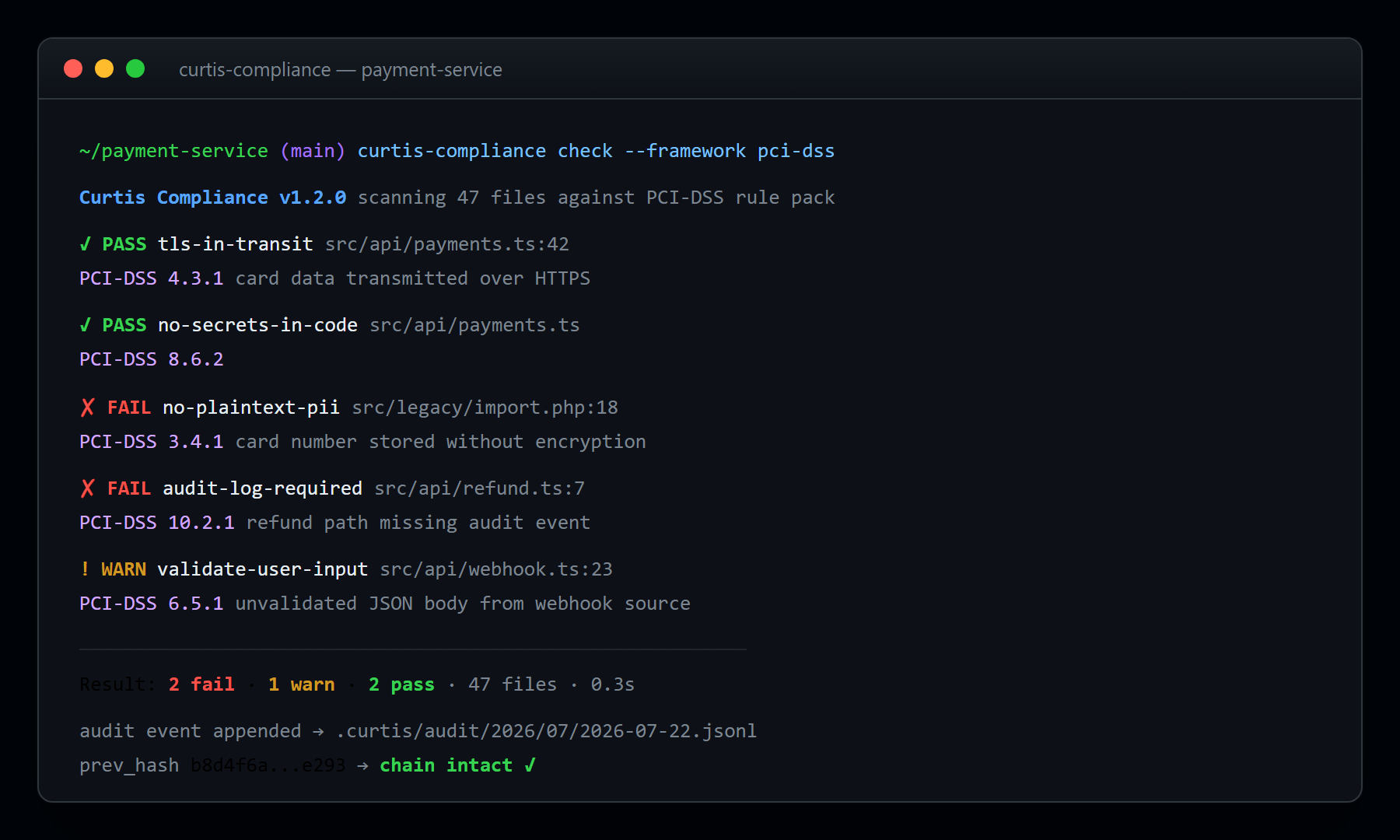
# Install globally (one-time)
npm install -g @jordannewell/curtis-compliance

# In a scratch repo
mkdir curtis-test && cd curtis-test && git init
curtis-compliance init --framework pci-dss

# Stage a deliberately non-compliant commit
echo "stripe_secret = 'sk_live_PLACEHOLDER_EXAMPLE_KEY'" > payments.ts
git add payments.ts
git commit -m "feat: add stripe payment"

# Curtis blocks the commit and cites the failing requirement:
#
#   ❌ no-secrets-in-code
#      🔴 Found 1 potential secret(s) in code. Use environment variables.
#      → payments.ts:1
#      → PCI-DSS 3.4 — Render PAN unreadable wherever it is stored.
Once initialized in a repo, Curtis runs as a pre-commit hook on every commit — no extra commands needed. Non-compliant commits are blocked locally with the specific HIPAA / SOC2 / PCI-DSS citation they'd fail an audit on.
# .curtis/compliance.yaml
framework: pci-dss
blockOnFailure: true
auditTrail: true
skipPatterns:
  - node_modules/**
  - dist/**

rules:
  no-secrets-in-code:   { enabled: true,  blockOnFail: true  }
  tls-only:             { enabled: true,  blockOnFail: false }
  audit-logging:        { enabled: true,  blockOnFail: false }
  encryption-at-rest:   { enabled: true,  blockOnFail: true  }
  input-validation:     { enabled: true,  blockOnFail: false }
Disable any rule by setting enabled: false. The check result will report
skip with a clear "Rule disabled in config" message.
Trigger a one-off review of any PR using a GitHub PAT (requires repo scope):
export GITHUB_TOKEN=ghp_xxx

curtis-compliance review:pr 42 \
  --owner acme \
  --repo payments \
  --framework pci-dss
Curtis fetches the PR diff, runs the same checks, posts a review comment, and sets the commit status:
## 🔍 Curtis Compliance Review

**Framework:** `PCI-DSS` | **Status:** ❌ **NON-COMPLIANT**

| Check | Status | Severity | Details |
|-------|--------|----------|----------|
| no-secrets-in-code | ❌ FAIL | 🔴 CRITICAL | Found 2 potential secret(s). [`src/payments.ts:42`](...) |
| tls-only | ✅ PASS | 🟠 HIGH | All external calls use HTTPS/TLS |
| audit-logging | ❌ FAIL | 🟠 HIGH | Sensitive operations detected but no audit logging found |
| input-validation | ⚠️ WARN | 🟡 MEDIUM | User input detected but validation not confirmed |

### 📋 Action Required

This PR is **not compliant**. Please address the issues above before merging.
For automatic PR reviews on every push, wire handlePRWebhook (exported from
src/github-integration.ts) into your own GitHub App or CI worker. A hosted
Curtis App is on the roadmap — see Roadmap.
Every curtis-compliance check and report writes one event to an append-only,
hash-chained JSONL log. One file per day at
.curtis/audit/YYYY/MM/YYYY-MM-DD.jsonl.
{
  "timestamp": "2026-07-20T17:50:41.259Z",
  "event_id": "db8579a6-971f-4a98-bf1c-32ff7db7a58f",
  "event_type": "compliance_check",
  "framework": "pci-dss",
  "repo": "acme/payments",
  "commit": "abc123",
  "author": "JordanNewell",
  "branch": "main",
  "overall_status": "non-compliant",
  "checks": [
    { "requirement": "no-secrets-in-code", "status": "fail", "severity": "critical", "file": "src/payments.ts", "line": 42 },
    { "requirement": "tls-only", "status": "pass", "severity": "high" }
  ],
  "summary": { "critical": 1, "high": 0, "medium": 0, "low": 0, "total": 5 },
  "curtis_version": "1.3.0",
  "prev_hash": "a7192de26a7e8c1d4f5b..."
}
Each event's prev_hash is the SHA-256 of the prior event's canonical JSON.
Any modification to a historical event breaks the chain and is detected by:
$ curtis-compliance audit verify
✅ Audit chain intact (142 events verified).
If someone tampers with an old event, the next audit verify exits non-zero
with the exact line and the broken hash:
❌ Audit chain broken at line 87:
   prev_hash mismatch: expected a7192de26a7e…, got 924075dbbff0…
   event_id: 83024baa-8382-405b-a30a-f0e9f3a98fa8
   86 events verified before break.
SOC2 / PCI-DSS auditors want CSV. Curtis ships it:
# Export everything as CSV
curtis-compliance audit export --format csv > evidence.csv

# Filter by date range + framework
curtis-compliance audit export \
  --since 2026-01-01 \
  --until 2026-06-30 \
  --framework pci-dss \
  --format csv \
  -o pci-evidence-h1.csv

# JSON for programmatic consumers
curtis-compliance audit export --format json
CSV columns: timestamp, event_id, framework, repo, commit, author, branch, overall_status, critical, high, medium, low, total. RFC-4180 compliant
(quotes/commas/newlines escaped).
$ curtis-compliance audit tail -n 5
2026-07-20T17:50:41Z  pci-dss   non-compliant  acme/payments
2026-07-20T16:12:03Z  pci-dss   compliant      acme/payments
2026-07-20T14:33:09Z  hipaa     partial        acme/health-api
...
Disable the audit trail by setting auditTrail: false in
.curtis/compliance.yaml.
Built-in rules map to real compliance citations — when Curtis blocks a commit, it tells you which specific requirement would fail an audit.
HIPAA:
- §164.312(a)(1) — Access controls
- §164.312(a)(2)(iv) — Encryption and decryption (encryption-at-rest rule)
- §164.312(b) — Audit controls (audit-logging rule)
- §164.312(e)(1) — Transmission security (tls-only rule)
PCI-DSS:
- 3.4 — Render PAN unreadable (encryption-at-rest rule)
- 4.1 — Use strong cryptography (tls-only rule)
- 6.5.1 — Input validation (input-validation rule)
- 10.2 — Implement audit trails (audit-logging rule)
SOC2:
- CC6.1 — Logical and physical access controls
- CC7.2 — System monitoring
The no-secrets-in-code rule recognizes 21 patterns across 12 providers:
- Cloud: AWS access keys (
AKIA…), Google API keys (AIza…) - LLM: OpenAI legacy + project, OpenRouter, Anthropic
- VCS: GitHub PAT/App/OAuth/refresh, GitLab PATs
- Payments: Stripe live secret + restricted live
- Chat: Slack token family (
xox[baprs]-…) - Generic:
password =,api_key =,secret_key =,token =, PEM private key blocks (RSA/EC/DSA/OpenSSH/PGP)
npm install -g @jordannewell/curtis-complianceRequires Node 20+.
If you prefer not to install globally, npx works:
npx @jordannewell/curtis-compliance init --framework pci-dssShipped (MIT core):
- Pre-commit gate with framework-aware citations
- Hash-chained audit trail with tamper evidence
- CSV / JSON evidence export
-
review:prCLI (PAT-based, posts comment + commit status) - Per-rule enable/disable via
.curtis/compliance.yaml - Secret detection across 12 providers
Future: hosted tier (paid, in development — see JordanNewell/curtis-compliance-pro):
- Hosted GitHub App for automatic PR reviews without PAT setup
- Multi-repo audit rollup (org-level evidence view)
- PDF report export (auditor-ready, signed)
- Custom compliance frameworks (beyond the three presets)
Not built yet (no timeline promises):
- VS Code extension
- GitLab / Bitbucket support
- Slack / Teams notifications
- AWS / Azure / GCP policy checks
- Compression of audit files older than 30 days
The MIT core is free forever. The hosted tier is tracked at JordanNewell/curtis-compliance-pro — star that repo if you want a ping when it ships.
A few things to head off confusion, including from older drafts of this README:
- No hosted GitHub App. The
review:prCLI with a PAT is the only PR-review path. A hosted App is on the roadmap at JordanNewell/curtis-compliance-pro; not shipping yet. - No Docker image.
docker run curtis/compliancedoes nothing — there's no image published. - No
curtis.aiwebsite. That domain belongs to an unrelated party. This project lives at github.com/JordanNewell/curtis-compliance. - No paid tier yet. The MIT core is the only thing shipping today. Older READMEs mentioned a Pro tier; the Pro package is in development at JordanNewell/curtis-compliance-pro but nothing is for sale and no npm package exists to install.
git clone https://github.com/JordanNewell/curtis-compliance.git
cd compliance
npm install
npm test         # 43 unit tests, ~5s
npm run build    # tsc → dist/
Test coverage is enforced on the engine modules (80% statements / 70% branches / 85% functions / 80% lines; actuals: 95 / 82 / 98 / 97). The CLI and GitHub-integration modules are covered by manual smoke tests instead.
See CHANGELOG.md for release history.
Curtis Compliance is a static code-pattern scanner. A passing run does not mean your codebase is HIPAA-, SOC2-, or PCI-DSS-compliant — only that it does not trip the specific rules currently shipped.
This tool is not legal advice and does not establish any attorney- client or advisor relationship. It is not a substitute for a formal compliance audit, an attorney review, or your own internal compliance process. The cited frameworks are referenced for engineering convenience and may be incomplete, out of date, or interpreted differently by your auditor.
You are responsible for your own compliance posture. Use at your own risk. See LICENSE for the full warranty disclaimer.
MIT © Jordan Newell
Currently solo-maintained — see CONTRIBUTING.md. Not accepting external pull requests at this time, but bug reports, security reports, and framework requests are welcome via Issues.
Areas on the roadmap (informational, not a request for PRs):
- Additional secret-detection patterns (especially non-AWS cloud providers)
- The audit-logging rule's comment-awareness (it currently false-positives on
the literal
exportkeyword in TypeScript — seetests/compliance.test.tsfor the locked regression test)
Custom frameworks, PDF export, and the hosted App are tracked at JordanNewell/curtis-compliance-pro — not the core, and not shipping yet.
The core is MIT-licensed and free. There is no paid tier to buy yet — the hosted Pro package is in development at JordanNewell/curtis-compliance-pro. Star that repo if you want a ping when it lands.
For the open-source core itself, sponsorship is welcome and voluntary:
Neither unlocks core features — everything in this repo is already available to everyone under MIT.
