


This is the official implementation of WeightCLIP: Aligning Datasets and Models for Weight Space Learning (ICML 2026).
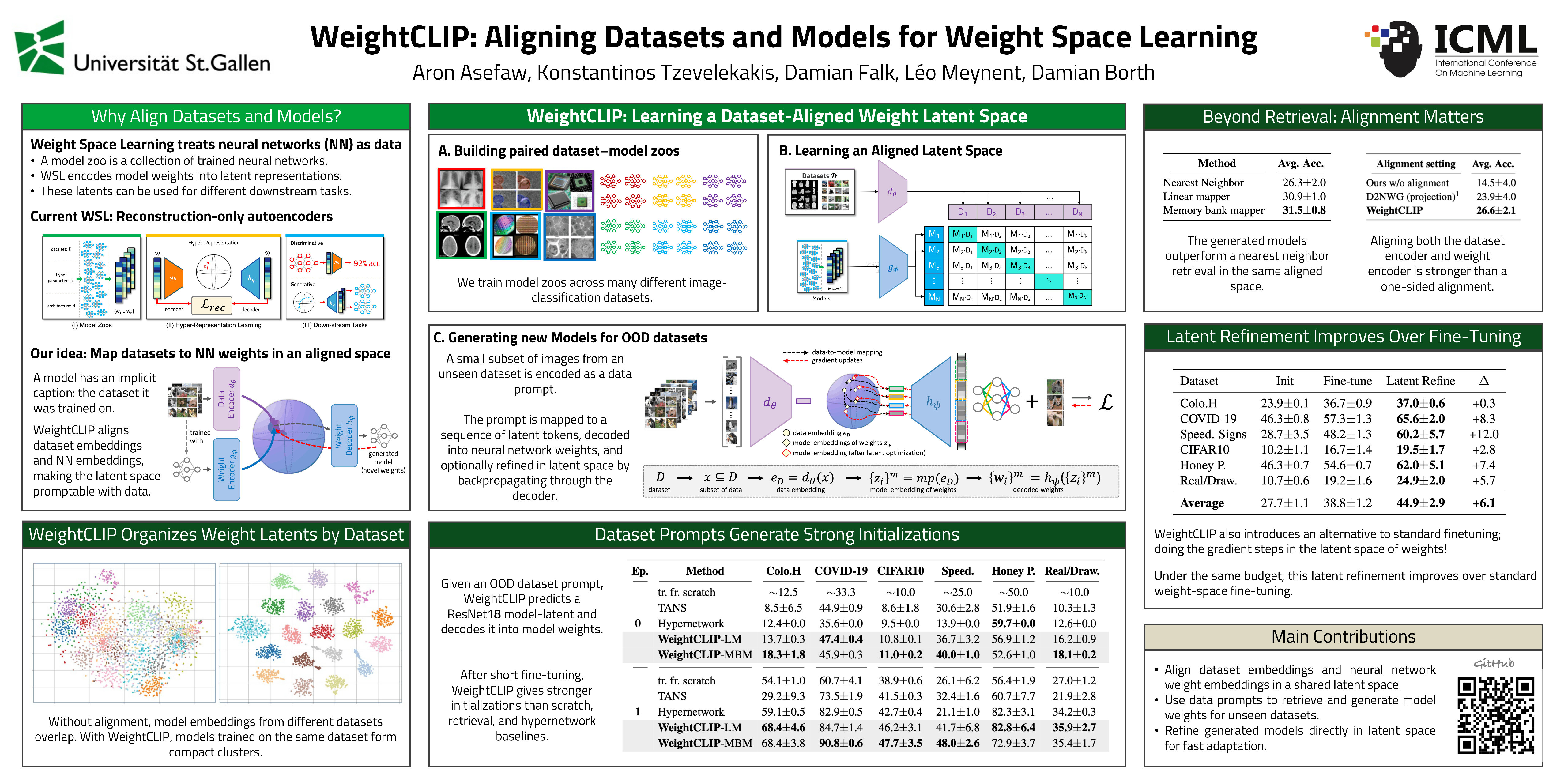
We propose WeightCLIP, a method for learning a dataset-aligned latent space for neural networks. A weight-space autoencoder encodes models into latent representations while a dataset encoder encodes samples of the datasets they were trained on, and the two are aligned with a contrastive objective that reshapes the weight space using the dataset as a semantic reference frame. Once trained, a data prompt from an unseen dataset can be mapped into the aligned space and decoded into model weights tailored to that dataset, and a latent refinement step further improves generated models beyond standard fine-tuning. Explicitly incorporating dataset information strengthens dataset–model retrieval, out-of-distribution model generation, and refinement.

Requires Python >= 3.10 (tested with 3.10.12) and, for training, a CUDA-capable GPU.
conda create -n weightclip python=3.10 -y
conda activate weightclip

pip install -r requirements.txt
pip install -e .
Training proceeds in two steps: build the model zoos, then train the aligned latent space.
Skip this if you already have zoos. Source and output paths are set via environment variables at the
top of each script (e.g. SOURCE_ZOO_ROOT, ZOO_ROOT).
bash scripts/train_resnet18slim_metatrain_zoos.sh   # ResNet18 zoos
bash scripts/train_cnn3_metatrain_zoos.sh # CNN zoosTraining is configured with Hydra; run.py selects an experiment with
--config-name and accepts overrides for any field. The zoos used by each experiment are listed in
config/data/meta_train_resnet.yaml and config/data/meta_train_cnn.yaml. A run writes a
checkpoint.pt and a sibling dataset_encoder.pt under root_dir/experiment_name.
python run.py --config-name contrastive_multi_zoo_resnet_alignment   # ResNet18
python run.py --config-name contrastive_multi_zoo_cnn_alignment      # CNN

# overrides and single-process (debug) execution
python run.py --config-name contrastive_multi_zoo_resnet_alignment \
  root_dir=/path/to/experiments experiment_name=weightclip_resnet \
  alignment.objective=siglip alignment.weight=0.5 dataset_encoder.set_size=10
python run.py --config-name contrastive_multi_zoo_resnet_alignment --debugGiven a trained checkpoint, use a dataset prompt to generate models and optionally refine them.
Map an out-of-distribution dataset prompt to model weights and evaluate after 0, 1, and 10 epochs of
fine-tuning. --mode selects the mapper: direct_decode (linear mapper, LM), memory_bank
(memory-bank mapper, MBM), neighbour (retrieval), or scratch (from-scratch baseline).
python scripts/dataset_to_model.py \
  --sane-ckpt /path/to/experiment/checkpoint_000000 \
  --arch resnet18slim --mode direct_decode
Out-of-distribution dataset-to-model generation on ResNet18 (test accuracy %, after 0/1/10 epochs of fine-tuning):

Refine a generated model's latent with gradients through the decoder, which outperforms standard fine-tuning under the same compute budget:
python scripts/latent_refine_with_translator.py \
  --sane-ckpt /path/to/experiment/checkpoint_000000.pt \
--arch cnn3 --steps 20 --scale-to-shell@inproceedings{asefaw2026weightclip,
title = {WeightCLIP: Aligning Datasets and Models for Weight Space Learning},
author = {Asefaw, Aron and Tzevelekakis, Konstantinos and Falk, Damian and Meynent, L\'eo and Borth, Damian},
booktitle = {Proceedings of the Forty-third International Conference on Machine Learning (ICML)},
year = {2026}
}The weight-space autoencoder builds on the SANE codebase from the HSG AI:ML group.