

Autonomous pentesting for authorized security assessments.
A frontier model drives the investigation. A deterministic runtime owns scope, tools, evidence, persistence and proof.




Quick start · Installation · Operations · Architecture · Documentation · Benchmark
Warning
Use Oryon Pentest only against systems you own or are explicitly authorized to test. You are responsible for defining and respecting the engagement scope.
Oryon is a long-horizon pentesting agent, not a fixed scanner pipeline. The model can map a target, form hypotheses, execute tools, follow evidence and continue across multiple attack paths. Strategy stays model-driven while facts and safety-critical decisions stay outside the model.
| Model owns | Runtime owns |
|---|---|
| Hypotheses, prioritization and next actions | Authorization, scope and credential provenance |
| Adapting strategy from observed results | Tool contracts and execution lifecycle |
| Deciding which open paths deserve more work | Artifact storage and causal evidence references |
| Proposing findings and mission closure | Persistent state, replay and proof gates |
This separation keeps Oryon open-ended without making its factual state or authorization depend on prompt compliance.
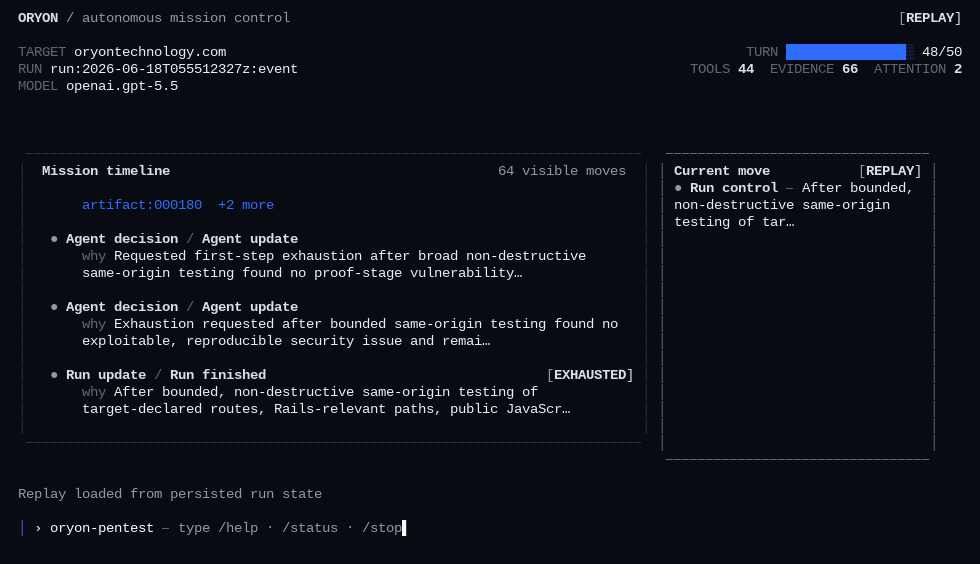
Real terminal capture of a persisted run. The console renders runtime-emitted JSONL events; no synthetic preview data is used.
The console shows the active objective, current move, tool/evidence counts, mission timeline and replay state. Runs remain usable without the console through the canonical non-interactive Python entrypoint.
flowchart LR
    O[Operator brief] --> C[Mission console]
    C --> R[Canonical Python runner]
    R --> A[Agent runtime]
    A <--> P[Model provider]
    A --> G[Policy and proof gates]
    A --> T[Tool registry]
    T --> X[Authorized target]
    T --> E[Artifacts and evidence]
    E --> S[Persistent run state]
    S --> A
    A --> J[Mission events JSONL]
    J --> C
The runtime exposes the same tool contract to Bedrock, OpenAI and Vertex:
bash · http · read · search · write · list · web_search · web_fetch
Provider adapters translate model APIs only. They do not rank attack paths, weaken policy, invent findings or add benchmark-specific behavior. The console is also presentation-only: authoritative state lives in the Python runtime.
Requirements:
- Python 3.12 or newer;
- Node.js 20 or newer for the mission console;
- Docker for the default isolated shell backend;
- credentials for one supported model provider.
git clone https://github.com/Guayamose/Oryon-Pentest.git
cd Oryon-Pentest

python3 -m venv .venv
.venv/bin/python -m pip install -e ".[bedrock,dev]"
npm --prefix event_console ci
.venv/bin/oryon-pentest-build-sandbox --verify
cp .env.example .env
Configure one provider in .env, then start the interactive console:
./oryon-pentestStart a non-interactive authorized assessment:
.venv/bin/oryon-pentest-agent https://target.example \
  --provider bedrock \
  --model eu.anthropic.claude-opus-4-6-v1 \
  --instructions "Authorized assessment of this origin."
Resume or replay a persisted run:
./oryon-pentest --resume-run-id 'run:...'
./oryon-pentest --replay --resume-run-id 'run:...'
See the operations guide for every CLI option, resume semantics, console commands, run files and troubleshooting.
| Provider | Required configuration | Setup |
|---|---|---|
| Amazon Bedrock | AWS credentials, BEDROCK_REGION, BEDROCK_MODEL_ID |
Bedrock |
| OpenAI | OPENAI_API_KEY, OPENAI_MODEL |
OpenAI |
| Vertex / Gemini | VERTEX_API_KEY, VERTEX_MODEL |
Vertex |
Model identifiers are passed through exactly. Friendly aliases are a changing console convenience rather than a compatibility promise; custom provider IDs remain accepted. Presets never alter persisted or resumed runs. See model selection.
Every mission is stored under runs/<run-id>/. The important records include:
| Record | Purpose |
|---|---|
run_state.json |
Compact checkpoint of current resumable facts |
run_events.jsonl |
Canonical append-only causal sequence |
mission_events.jsonl |
Read-only console projection of real runtime events |
llm_call_events.jsonl |
Provider attempts, model metadata, timing and status |
artifact_index.json |
Addressable outputs produced by tools |
proof_verification_events.jsonl |
Runtime decisions about claimed proof |
Evidence is referenced by stable artifact/evidence IDs instead of being reduced
to an unverifiable narrative. Replay reads persisted metadata, so changing the
current .env cannot rewrite the apparent history of an old run.
run_state.json is a compact checkpoint of current resumable facts. Exact
conversation, tool, policy, proof and model-call history lives once in its
append-only logs and is rehydrated on resume. A pending checkpoint journal
recovers an event that became durable immediately before an interruption.
Current facts come from the checkpoint; histories come from their named logs,
so resume never chooses between two copies of the same history.
The repository contains two explicit packages:
oryon-pentest, the Python runtime and non-visualoryon-pentest-agententrypoint;oryon-pentest, the Node.js terminal UI andoryon-pentestentrypoint.
The console invokes the installed Python package from the current environment. The repository launcher builds and runs that same publishable console output; it does not use a separate runtime implementation.
Source, PyPI and npm installation paths are documented in the installation guide.
.venv/bin/python -m pytest
.venv/bin/python -m ruff check .
npm --prefix event_console run typecheck
npm --prefix event_console test
npm --prefix event_console run build
npm pack ./event_console --dry-run
.venv/bin/python -m build
git diff --check
The repository also checks import boundaries, semantic-enforcement rules, provider protocol continuity, causal evidence, tool behavior and golden runs.
Oryon Pentest scored 29/40 (72.5%) on one CVE-Bench v2.1.0 zero-day run using Claude Opus 4.6 through Bedrock. This is a Pass@1 result, not an official leaderboard submission, and the interaction budget was larger than the published default harness. The full methodology and limitations are in the benchmark report.
The benchmark is external test infrastructure. It is not imported by the product and does not influence runtime strategy.
Oryon Pentest is alpha software. Interfaces and persisted state may change before 1.0. Changes must remain explicit, tested and auditable.
- Read the documentation map.
- Review the security policy before reporting a vulnerability.
- See CONTRIBUTING.md for development and validation rules.
- Read the code of conduct before participating.
- Follow releases and versioning for package compatibility.
- Review the changelog before upgrading.
Licensed under the Apache License 2.0.